Showing posts with label DANC. Show all posts

Saturday, September 15, 2012

Some Thoughts on Character: The Recurrent American

“Then I trust that you at least will honour me with your company,” said Sherlock Holmes. “It is always a joy to meet an American, Mr. Moulton, for I am one of those who believe that the folly of a monarch and the blundering of a minister in far-gone years will not prevent our children from being some day citizens of the same world-wide country under a flag which shall be a quartering of the Union Jack with the Stars and Stripes.” (“The Noble Bachelor”)

Sherlock Holmes found Americans really fascinating. Upon greeting Mr. Francis Moulton in “The Noble Bachelor,” Holmes proceeds to treat the young man like some sort of fantastic oddity – like he has just encountered a white tiger or a new species of honeybee in his sitting room. It’s as if Holmes wants to analyze Moulton, to extract the young American’s secrets through scientific inquiry and research, to study him intensely under a high-powered microscope. Indeed, it is not so difficult to imagine Holmes turning to Watson and saying, “Oh, please let me keep him! I need more information for my index and he’ll make just the perfect addition. I promise to feed him, water him, and walk him every day!” 
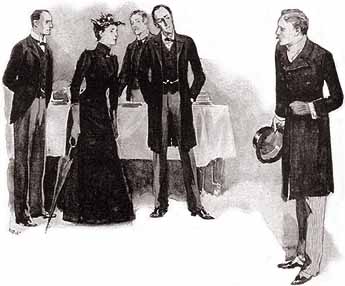
Fine, Lord St. Simon. You can leave.
I don't want to share my new American friends anyway.
Francis Moulton, and his wife Hatty, are far from the only Americans to appear in the Canon. The appearances of colonials span from clients, informants, criminals, even some detectives, and everything in between. There seems to be a role for an American in every frame and facet of the original stories. Even The Woman, Irene Adler “of dubious and questionable memory,” was an American – Holmes’s index indicates that she was born in New Jersey, of all places, in 1858. In “The Adventure of the Red Circle,” readers are introduced to Mr. Leverton, of the Pinkerton Agency, who is assisting Inspector Gregson. The American detective is described rather agreeably as “a quiet, businesslike young man, with a clean-shaven, hatchet face, [that] flushed up at the words of commendation.” Sherlock Holmes is quite pleased to meet Leverton, who has made something of a name for himself as a detective in America. For his part, Holmes has heard of the man’s work, and appears to find it exceptional.

Not all Americans in the Canon are depicted in such glowing terms, of course. While “The Dancing Men” features the young American woman Elsie Cubitt (née Patrick) whose devotion to her husband causes her to attempt to take her own life after his murder, it also features the villainous Abe Slane – “the most dangerous crook in Chicago.” It is Slane who murders Hilton Cubitt, but only after he torments poor Elsie with a series of haunting coded messages, culminating in the rather nightmarish missive: “ELSIE - RE – ARE TO MEET THY GO-.” And while Slane contends that “…there was never a man in this world loved a woman more than I loved [Elsie],” needless to say, Slane’s monstrous behavior more than eclipses any love that he can profess to feel.
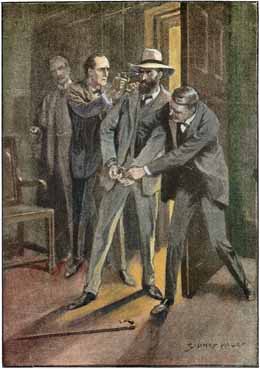
I told you I wanted to know more about Chicago.
I wasn't kidding.
Likewise the Americans featured in A Study in Scarlet and The Valley of Fear do not all come off as shining beacons of virtue. In “The Country of Saints,” the second part of STUD, the reader is introduced to a less-than-righteous clan of Mormons, who exhibit a murderous intent on the acquisition of persons and property at all costs. VALL features a secret order, the Ancient Order of Freemen, filled with seemingly every type of unsavory individual, whose criminal deeds appear to run the gamut of almost every type of illegal activity. The actions of the Order influence how the entire town functions. Of course, the villainous Americans of these stories find their more honorable counterparts. In STUD, the American Jefferson Hope has been on a decades-long quest to avenge the death of his beloved Lucy Ferrier, dying only just after succeeding in his pursuit. In VALL, the Freeman John McMurdo is revealed to be Birdy Edwards, another Pinkerton detective, and the secret society is swiftly brought to justice for their crimes. More interestingly, these particular passages actually take the reader to America, rather than bringing the American to England and Baker Street. If Americans are some sort of exotic curiosity in the Canon, then the curiosities in these stories are being presented in their natural habit, interacting with others of their own species.

Chronologically speaking, Sherlock Holmes’s American experiences culminate with “His Last Bow.” The story finds Holmes having just spent two years undercover as an Irish-American named “Altamont.” However, if the Sidney Paget’s illustration is to be believed, the extent of his disguise involved growing an unsightly goatee and adopting an American accent. Anyway, Holmes’s American journey took him on a rather circuitous route, as he says he has been from Chicago to Buffalo, and those are just the places he mentions. But the reader is left behind on this journey, and does not get to experience America with Sherlock Holmes. And, it would seem, his excursion has left him weary of America, if not Americans. As he says to Watson, "Tomorrow [the goatee] will be but a dreadful memory. With my hair cut and a few other superficial changes I shall no doubt reappear at Claridge's tomorrow as I was before this American stunt - I beg your pardon, Watson; my well of English seems to be permanently defiled - before this American job came my way” (LAST).
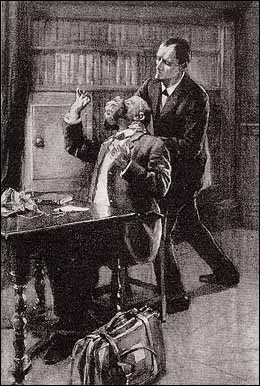
Well, that is some very American facial hair indeed.
I can see why Von Bork was fooled. I think.
William Gillette, the man who brought Sherlock Holmes so famously to life on the stage, was an American, born in Connecticut in 1853. When Conan Doyle and Gillette first met, the actor surprised Conan Doyle by emerging onto the train platform, kitted out in a full Sherlock Holmes ensemble, complete with magnifying glass. After recovering from his shock, Conan Doyle laughed, completely charmed, and Gillette and Conan Doyle became lifelong friends. What an oddity Conan Doyle must have thought Gillette was upon that first meeting, how strange and otherworldly. But that didn’t stop him from entrusting the man with the care of his most famous – if not beloved – creation. Similarly, Sherlock Holmes may have found Mr. Francis Moulton a neat little marvel upon their first meeting – something on par with a new type of tobacco ash or particularly fascinating chemical equation – but that peculiar fascination didn’t stop Holmes from entrusting himself to the national identity of Francis Moulton, Birdy Edwards, and even Abe Slane. The recurring presence of Americans and American themes in the Canon is striking in its frequency, but their peculiarities have purpose, even if it is occasionally disagreeable.

oOo

“Better Holmes & Gardens” now has its own Facebook page.  Join by “Liking” the page here, and receive all the latest updates, news, and Sherlockian tidbits.

Tuesday, July 10, 2012

“The Meaning of This Extraordinary Performance” (COPP): Granada Television’s “The Dancing Men”

Jeremy [Brett] was always in danger of playing some kind of grotesque if he wasn’t directly properly. I remember [Jeremy] Paul saying to him one day, “Jeremy, isn’t there going to be anything of you in this portrayal?” Brett responded well, replying, “What a good thought. You’ve pulled me up short and made me realize that I could be going too much into the area of a bizarre character.” Paul agreed, noting, “Don’t, because there is a place in this for things of your own, Jeremy – your magnetism, your ability to charm people, to deal with people – use those in playing Holmes. Don’t put them aside. Don’t think this man is a wierdo [sic] because he’s not” (David Stuart Davies).

Perched anxiously on the edge of the sofa in the sitting room of 221B Baker Street, Hilton Cubitt (Tenniel Evans) bristles at a pointed question directed at him by Sherlock Holmes (Jeremy Brett): “You have a way of putting things, Mr. Holmes,” he says. Dr. Watson (David Burke) has already apologized once for his friend’s gruff behavior, and now he can do nothing except shake his head and look back down at his notes, hoping that Holmes will not irreparably offend their client. Brett often commented on the nature of the relationship of his Holmes to his Watsons: “And so I've had wonderful Watsons – I’ve had two who kind of go [groans], ‘Holmes is doing it again.’ And, I mean, I've even had people in the studio, when I had suddenly crawled across the floor, say, ‘Not another of those’ [laughs]. And that's the lighter side.”
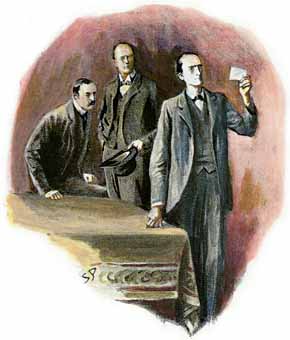
Holmes, will you please stop playing "Keep Away" with the cipher?
And there are a lot of both elements in Granada’s adaptation of “The Dancing Men.” Viewers successfully seek and find the physicality and vitality that Jeremy Brett so famously brought to the role, as well as a Watson that seems equal turns flabbergasted and charmed by his eccentric friend. Brett’s Holmes is at his charming, vivacious best, and Burke’s Watson is at his most endearing and earnest. The episode opens with one of Granada’s most enduring scenes: Holmes successfully outlines how he was able to deduce that Watson has declined a new investment opportunity, to which Watson responds that the deduction was an “absurdly simple” one – despite the promise Holmes had secured just moments earlier that he would not say precisely that. Holmes looks petulant, but not surprised, and Watson looks briefly contrite – until a moment later when he correctly deduces that Holmes has found himself a new case.

Granada’s 1984 adaptation of “The Dancing Men” was the second episode in their Sherlock Holmes series, airing just after their adaptation of “A Scandal in Bohemia.” It is notable that the studio chose to adapt this story very early in the production, when the original tale was, in fact, the third story in The Return of Sherlock Holmes, and according to William Baring-Gould’s chronology, took place in 1898. Despite this chronological deviation, the episode reaches out to the Canon in interesting ways. For example, there is Holmes’s mention of his monograph on secret ciphers, which Watson uncomfortably confesses he found “rather heavy going.” But the episode is at its most riveting when Brett is at his most dynamic. Audiences remember this episode’s Sherlock Holmes with a telegram between his teeth, leaping about in a vigorous demonstration of the various “Dancing Men” figures, in a desperate bid to convey their meaning to Dr. Watson. Less memorable, but no less powerful, is the scene in which Holmes and Watson receive the final telegram from Hilton Cubitt (unaware of the man’s death), revealing the partially decoded message: “ELSIE - RE – ARE TO MEET THY GO-.” Watson is still in his shirtsleeves and Holmes in his dressing gown, but in a brilliantly acted moment, the pair need only exchange a meaningful glance before rushing off in aid of their client.

Photo Credit: www.jeremybrett.info
But the death of Hilton Cubitt takes the wind out of the Detective’s over-inflated sails in a very obvious way. When asked how he could have possibly known about the crime and come down to Ridling Thorpe Manor from London so quickly, Holmes replies: “Mr. Hilton Cubitt… was my client” [emphasis mine]. There is so much effort in that pause – in admitting to his client’s death, and therefore his own perceived failure in the matter – and it weighs visibly on his face. Even the police inspector’s kind words about the pleasure of working with Holmes and his hope that he should have the Detective at his side again one day, seemingly fail to register with Holmes in any meaningful way. He gives only the merest nod to this compliment. The words do not register, and Brett’s performance manages to manifest physically for the viewer, everything that Holmes has already managed to internalize.

Photo Credit: bookishadventures.tumblr.com
Likewise, the death of his client seems to soften Sherlock Holmes, making him more susceptible to Dr. Watson’s improving influence. While Holmes is interviewing the household staff about the night of the murder, Watson whispers a mostly unheard suggestion to the Detective that he invite the elderly housekeeper to sit down. If Holmes seems slightly annoyed by the suggestion, it should be noted that he does comply. Furthermore, in a later scene, Holmes goes out of his way to inform the same housekeeper that her mistress – Mrs. Cubitt – is quite innocent, a kindness which appears to go a long way towards easing the woman’s troubles.

The episode ends with Watson attempting to decode the “Dancing Men” cipher sent by Sherlock Holmes, which had brought Abe Slane to Ridling Thorpe Manor and neatly ensnared him in Holmes’s trap. Watson stumbles for a moment before reading: “COME HERE AT ONCE.” Holmes smiles at the Doctor’s successful attempt at decoding and says, “How absurdly simple.” His words echo back to the episode’s opening scene, but this time there is no bite or petulance in the words. Only the easy understanding of a comfortable companionship, colored by the spent energy of a case concluded – if not in an entirely satisfactory way for all parties. Sherlock Holmes and Dr. Watson ran the gamut of human interaction in Granada’s adaptation of DANC – from magnetism to charm to shear physical undertaking – but every element has a place, every point perfectly plotted.

oOo
“Better Holmes & Gardens” now has its own Facebook page.  Join by “Liking” the page here, and receive all the latest updates, news, and Sherlockian tidbits.