Showing posts with label SIXN. Show all posts

Friday, January 1, 2016

My Favorite Sherlock Holmes Story: "The Adventure of the Six Napoleons" (SIXN)

[As presented at "A Saturday with Sherlock Holmes," in Baltimore, Md., on November 14, 2015.]

When Beth first honored me with the invitation to be here today, and I heard the theme for today’s presentations, I knew immediately and without hesitation that my favorite story in the Canon is “The Adventure of the Six Napoleons.” What I did not know immediately and without hesitation was why. And as I pondered the topic for many weeks (and months, if I’m being truly honest), I began to worry that maybe there wasn’t a why, that like the infamous motiveless crime I simply loved SIXN because. Because of its own merits. Because it was simply a great story. Because I said so. Because, end of sentence. Because, because, because. And then, to my own mind, I started to sound like a petulant child, unable or unwilling to complete the assignment given to her.

And this, for some reason, made me think of my mother. Who knows why?

Those who know me a little better know that my mother is the great reader of my life. She’s the reason that I love books and writing and words. And if there is anything my mother loves more than books and writing and words, it is Law & Order. Not the process, mind you – the television show. The original flavor too, not the Special Victims Unit persuasion or even the Criminal Intent version with its pseudo-Holmesian detective played by Vincent D’Onofrio (but that’s a topic for another day and another presentation). No, she loves the classic with Sam Waterston as Jack McCoy and its ever-cycling cast of district attorneys.

So, what does this have to do with Sherlock Holmes and his six busts of Napoleon, you may be asking (or not)? Because it occurred to me – as I contemplated SIXN and Jeremy Brett’s facial expressions and Basil Rathbone’s creature-features and everything else peripherally related to this tale – that the reason I loved this story is because it is exactly like an episode of Law & Order.


Told you I was going somewhere with this.

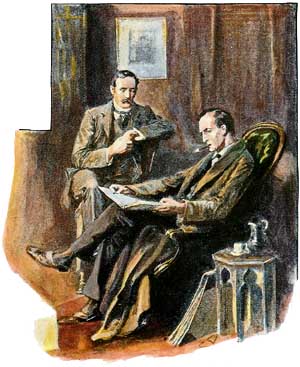
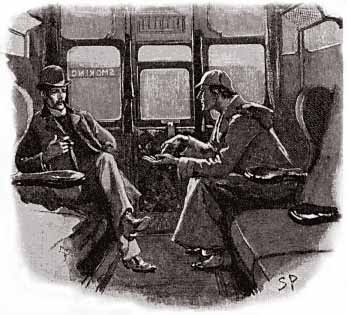
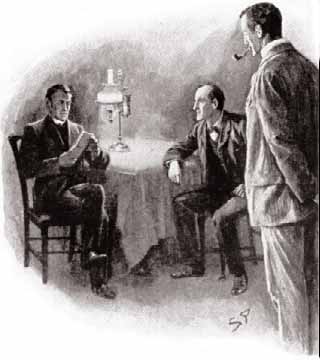
Now if you think about it (and I’m going to make you) – an episode of Law & Order typically opens with banal, unassuming scene meant to distract: some kids playing basketball in a park, two friends shopping for expensive clothing in a high-end boutique, a young couple spending the night in a fancy hotel. Eventually, all these people stumble upon something nefarious and gruesome (and usually dead). And SIXN has a similarly inauspicious beginning: the reader learns that Inspector Lestrade has taken to dropping in at Baker Street. To chat. And this particular evening is no different. They are talking about newspapers and the weather. Maybe even their macramé. There’s probably a fire going and brandy in snifters. It’s as charmingly a domestic scene if there ever was one. But not for long, because crime is about to drop from the sky, like a body falling right into the middle of the Baker Street sitting room (a plot device which may or may not have happened in an episode of Law & Order, I can’t be sure). Lestrade has a case. An interesting case – “This is certainly very novel,” says Sherlock Holmes.

Despite the case’s novelty, however, Holmes and Watson don’t pursue it right away. In fact after getting the initial details from Lestrade, Watson posits a theory which ultimately bears no fruit, and Holmes decides to wait to investigate the case until there are “fresh developments.” This brings us to our second element of a Law & Order episode: the redirection in the form of a second crime. In any given episode, upon being given their task, the detectives will set out on their investigation (this is, of course, the “law” portion of the title). However, invariably they find that this initial thread of investigation is nothing but a red herring, leading to a dead end. Or even worse (and better television), while they have been giving their energies to the first investigation, a second and related crime has been committed. There is another victim. And it’s this crime that will ultimately set the detectives on the right path towards solving the case.

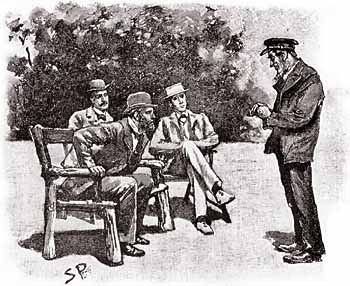
In the case of SIXN, the second crime is the body found on the doorstep of Mr. Horace Harker of the Central Press Syndicate. Aside from the dead body (a minor difference), the crime at the Harker residence seems much like the others before it – shattered busts of Napoleon and all. But now there’s a photograph in the dead man’s pocket and a broken streetlamp, both of which are indicative if not outright conclusive. From there, Holmes and Watson go to Harding Brothers, and then to Mr. Morse Hudson, of the Kennington Road. It’s Morse Hudson who provides a major breakthrough (interspersed with talk of Nihilists and anarchists and red republicans). He knows the man in the photograph: it’s Beppo, “a kind of Italian piece-work man,” he says. From there Holmes and Watson “make for Gelder & Co., of Stepney, the source and origin of the busts.” And then finally, based on the information they receive there, to Chiswick and the home of Mr. Josiah Brown. This is where Beppo is apprehended with the fifth bust of Napoleon and the active investigation draws to a close.
And...commercial break!

Now, a typical episode of Law & Order is usually split equally, with "law" bowing out of the way for "order" at about the 30 minute mark. We'll find that the structure of SIXN is definitely frontloaded with more law at the beginning and a briefer order experience at the end. If SIXN were truly an episode of Law & Order, then the “order” portion of the plot would probably only take up about 10-15 minutes of the episode. However, the reader finds that the impact of Sherlock Holmes's order more than makes up for its brevity. With Dr. Watson and Inspector Lestrade acting as something tantamount to a jury, Holmes’s revelatory theatrics are equal to any courtroom drama. With the reveal of the missing pearl in the sixth bust, one can easily imagine Waterston’s Jack McCoy unleashing the last damning piece of evidence against the accused, and all of the pieces of the case falling neatly into place. I mean, Watson and Lestrade even break out into applause for Sherlock Holmes, like they would for any actor on the stage. Holmes then proceeds to outline the details of the case, which go back over a year, and when he is done, it is obvious to the “jury” that Beppo is guilty. Holmes has proclaimed it so, with every leap and twirl and dramatic gesture. But more than that, Holmes has proven it so. And after all, what is order if not that?

Finally, every episode of Law & Order has a summary scene. More often than not, it’s very brief. Sam Waterston shares heated words with the prosecuting attorney on the steps of the courthouse. Or there’s a poignant conversation amongst all the attorneys over Chinese food in a darkened office. It’s a way to draw the episode to close quickly, and with wit and pathos. And this, let’s be honest, the concluding scene of SIXN has in spades.  
“Well,” said Lestrade, “I’ve seen you handle a good many cases, Mr. Holmes, but I don’t know that I ever knew a more workmanlike one than that. We’re not jealous of you at Scotland Yard. No, sir, we are very proud of you, and if you come down to-morrow, there’s not a man, from the oldest inspector to the youngest constable, who wouldn’t be glad to shake you by the hand.”
End of scene. Fade to black. Dun dun. And the Great Detective goes so far as to say, “Thank you! Thank you!,” as if he were at a curtain call, as if he were taking a bow.


As if you didn't know what I meant by "dun, dun".

Of course, it’s more accurate to say that the structure of SIXN paved the way for the episodic organization of Law & Order than the other way around. And I wish I could say with certainty, as Sherlock Holmes does in “The Empty House,” that “The parallel is exact.” Because it’s not exact, of course, but it is very near. It is very near enough to say that SIXN is my favorite Sherlock Holmes story because it reminds me of another dearly beloved thing. Of another dearly beloved person. Or perhaps just because. Because, because, because. 

Saturday, May 4, 2013

Some Thoughts on Setting: The Tranquil
English Home

“As we drove away I stole a glance back, and I still seem to see that little group on the step – the two graceful, clinging figures, the half-opened door, the hall-light shining through stained glass, the barometer, and the bright stair-rods. It was soothing to catch even that passing glimpse of a tranquil English home in the midst of the wild, dark business which had absorbed us.” (SIGN)

221B Baker Street was not a tranquil English home. Life with Sherlock Holmes was not tranquil. The world with Sherlock Holmes in it was not tranquil. An existence punctuated by indoor pistol practice, unpredictable and uncontrollable chemical experiments, and an assorted cast of unsavory characters arriving at irregular hours was not a tranquil one. But there were moments of tranquility. For instance, the conclusion of “The Adventure of the Blue Carbuncle,” in which the reader finds Sherlock Holmes and Dr. Watson enjoying a peaceful, seasonal meal together. The passage in The Sign of Four in which Holmes lulls a tense and exhausted Watson to sleep with his violin. Or even the opening lines of “The Adventure of the Six Napoleons,” in which the reader finds that Inspector Lestrade has acquired the habit of dropping in at Baker Street of an evening, just to chat. But, by and large, the Baker Street flat was a rambunctious residence.

But that doesn’t mean, necessarily, that all other canonical residences were tranquil ones, either. An address off of Baker Street did not guarantee a peaceful life. The eponymous residence of “The Copper Beeches,” for all its efforts at the appearance of normalcy, turned out to be – for Miss Violet Hunter especially – as dark and dangerous a residence as any alley of ill-repute in London. The Trevor residence in Donnithorpe, seen in “The ‘Gloria Scott’”, is certainly more than peaceful enough in the beginning. As Sherlock Holmes said, “…he would be a fastidious man who could not put in a pleasant month there,” but unfortunately the “old-fashioned, widespread, oak-beamed brick” dwelling quickly becomes the site of high drama, when the elder Trevor’s previous transgressions follow him home. And of course, in “The Adventure of the Abbey Grange,” no number of ivy-covered walls or pillared front facades can conceal the dark business that took place inside – the monstrous cruelty of Sir Eustace Brackenstall and his violent end.


Nevertheless, in “The Crooked Man,” Sherlock Holmes arrives at the home of Dr. and Mrs. Watson, seeking sanctuary. The Watsons have only been married a few months, and the hour is late – Watson informs the reader that his wife had already gone to bed – but there is no question that Sherlock Holmes would be welcome, that his hat can fill the vacant peg on the hatstand. So, if a tranquil English home doesn’t necessarily mean “anywhere outside of Baker Street,” then what was Dr. Watson longing after as he gazes back at the Forrester residence in The Sign of Four? Was it necessarily the tranquility? Was it the sense of stability? Was it the woman standing on the doorstep (you know, the one he would eventually marry)? Or was it something else, some more intangible quality, something that perhaps escaped even Watson’s implicit understanding?


It’s worth noting that, in the passage from SIGN, Watson is neither coming from nor returning to the flat at Baker Street. He is coming from Pondicherry Lodge – returning Miss Mary Morstan to the home where she currently resides as a governess – and their evening has been long and dark, punctuated by theft, murder, and the revelation of secrets horrible and long-harbored. After leaving Miss Morstan with the Forresters, Watson does not immediately return to Pondicherry Lodge, but instead embarks on an errand for Sherlock Holmes, and goes to Pinchin Lane. It is an unlovely place. As Watson says, “Pinchin Lane was a row of shabby, two-storied brick houses in the lower quarter of Lambeth. I had to knock for some time at No. 3 before I could make any impression.” He is then subjected to a variety of abuse at the hands of the resident, Mr. Sherman, before mentioning Sherlock Holmes and thus gaining entrance, and Sherman’s deference. The interior of No. 3 Pinchin Lane is no better than the exterior: “In the uncertain, shadowy light I could see dimly that there were glancing, glimmering eyes peeping down at us from every cranny and corner. Even the rafters above our heads were lined by solemn fowls, who lazily shifted their weight from one leg to the other as our voices disturbed their slumbers.”

So, what was Watson really seeing in that passage from SIGN, what were the particular items that drew his eye? The first thing he mentions is Miss Morstan and Mrs. Forrester on the doorstep – “the two graceful, clinging figures.” Mary Morstan didn’t just arrive at the place where she lived; she was welcomed home by Mrs. Forrester: “…it gave me joy to see how tenderly her arm stole round the other’s waist and how motherly was the voice in which she greeted her. She was clearly no mere paid dependant but an honoured friend.” And hasn’t Watson received similarly warm welcomes from Sherlock Holmes? In “The Naval Treaty,” the Doctor is informed, “You come at a crisis, Watson” and “I will be at your service in an instant... You will find tobacco in the Persian slipper.” In “The Adventure of the Empty House,” Holmes tells his friend: “So it was, my dear Watson, that at two o’clock to-day I found myself in my old armchair in my own old room, and only wishing that I could have seen my old friend Watson in the other chair which he has so often adorned.” It’s really very simple. What more can one want from a home than to just to know that you are welcome, and that all the comforts are at your disposal?  


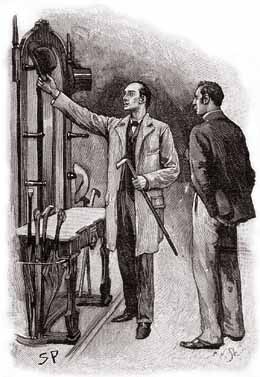
And speaking of those comforts, that is the second thing that draws Watson’s eye in the passage from SIGN: “the half-opened door, the hall-light shining through stained glass, the barometer, and the bright stair-rods.” These items are all meant to be indicators of home – things that are comforting and familiar. So, how are these articles any different that the tobacco in the toe-end of a Persian slipper (or the cigars in the coal-scuttle, for that matter), correspondence eternally fixed under a jack-knife, or the bullet-marks in the wall. In “The Adventure of the Creeping Man,” Watson practically equates himself with these items: “As an institution I was like the violin, the shag tobacco, the old black pipe, the index books, and others perhaps less excusable.” If bullet-marks and jack-knifes are perhaps less graceful than “hall-light shining through stained glass,” does that make them any less effective as objects of comfort? They are still indicators of home, no matter what kind of home that might be.

Perhaps what Dr. Watson was longing for in that passage from SIGN was not necessarily a different type of home. Is it possible that he just wanted to go home – no matter where that home was, or what it might be? It had already been a long night, with the promise of it being even longer, and maybe all he wanted to do was feel welcomed, and surround himself with the items that comforted him (and most likely sleep, of all ridiculous notions). This is, after all, what Watson does for Holmes when the man arrives on his doorstep, on that long dark night in CROO. He welcomes him in, offers him a familiar creature comfort (in the form of his tobacco pouch), and shares his company with a man that knew his habits even better than himself. The tranquil English home might be, after all, not a necessarily a place, but a place of being.  

oOo

“Better Holmes & Gardens” has its own Facebook page.  Join by “Liking” the page here, and receive all the latest updates, news, and Sherlockian tidbits.

Saturday, February 2, 2013

“The Meaning of This Extraordinary Performance” (COPP): Granada Television’s “The Six Napoleons”

“Now let me endeavour to show you the different steps in my reasoning. To begin at the beginning.” (“A Study in Scarlet”)

"It has long been an axiom of mine that the little things are infinitely the most important.” (“A Case of Identity”)

There is no better place to begin a discussion of Granada’s adaptation of “The Six Napoleons” than at the beginning. The episode opens on an odd note: a young woman sensually washes herself at an open window while an old man watches lecherously from across the way. The camera pulls back from the depraved onlooker to reveal a young man (Pietro Venucci, played by Vincenzo Nicoli) and a young woman (his sister, Lucrezia, played by Marina Sirtis of “Star Trek: The Next Generation” fame) arguing heatedly in Italian. The argument takes a sudden, violent turn as the man strikes the woman across the face, but their argument carries on without pause. The elderly voyeur finally intercedes, but the young man eventually devolves into hysterical screaming before he runs from the room – the young woman chasing after him, sobbing, her hair falling out of its neat arrangement and blood running from her lip. The first five minutes of Granada Television’s adaptation of SIXN could be quite accurately described as bizarre, with dialogue almost entirely in un-translated Italian and the opening sequence ending with the episode’s main antagonist laughing maniacally while being taken away in a straitjacket. Topped off with a well-filmed fight scene and a strange ritualistic moment involving a photograph and a jewel-encrusted dagger, these opening scenes are indeed odd, but are also punctuated with perfect, memorable moments.

These perfect moments carry over throughout the episode and the first scenes at Baker Street (nearly six minutes into the production, but chronologically a year later) are no exception. The viewer finds Inspector Lestrade (Colin Jeavons) comfortably ensconced in the sitting room of 221B, drinking brandy and smoking cigars with Dr. Watson (Edward Hardwicke) while Sherlock Holmes (Jeremy Brett) peruses a tattered folio. According to Richard Valley, “A man of considerable reticence where companionship is concerned, Sherlock Holmes has no close friends save Dr. John H. Watson, which perhaps explains why it’s so utterly charming and delightful to find, at the start of this episode of THE RETURN OF SHERLOCK HOLMES, that Inspector Lestrade of Scotland Yard is given to dropping by 221B Baker Street every now and then to pass the time.” The casual intimacy between the three men is only reinforced by perfect, punctuating moments, like those already seen in the episode’s prologue. The knowing way in which Holmes lowers the folio to encourage Lestrade to “tell us about it,” understanding intuitively that the man has something of interest to share, but is restraining himself. Or Lestrade’s pleased expression when Holmes rubs his hands together and admits that the Inspector’s story “is certainly very novel.” Or the way in which the Great Detective laughingly tells Watson that the Doctor’s theories “will not do” – dismissively, but without any real venom.


Granada’s adaptation of SIXN is also a demonstration of how well Dr. Watson and Inspector Lestrade know their dear friend, the lengths to which they will go to in order to accommodate him, and how deeply they admire him. While in the morgue, Sherlock Holmes closely inspects the corpse of Pietro Venucci, paying no mind to his proximity to the dead man or the appropriateness of examining him with a magnifying glass. Once the Detective leaves, Lestrade leans down to inspect the corpse himself, his actions a pale imitation of Holmes’s own, before pulling the sheet back over poor Venucci. Later, when Holmes insists that a visit to Chiswick would be timelier than Lestrade’s plan to visit the Italian Quarter, the Inspector actually protests the change in plan very little, and compliantly takes up space upon 221B’s sofa until Holmes tells him that it is time to go. And while waiting in the dark and cold at two o’clock in the morning (we know, because Watson dutifully checks his pocket watch), his only question is “I don’t suppose we can smoke, can we?” Watson offers Lestrade a hard candy so as to ease some of the Inspector’s suffering, only to be told (in another one of those perfectly memorable moments) by Sherlock Holmes: “This is no time for humbugs!” Lestrade’s apparently blind faith in Holmes is soon validated, however, by the appearance of Beppo (the raving lunatic from the opening sequence).

Holmes’s mutual admiration for Watson and Lestrade is also present. When Holmes reveals to Watson how he has baited the journalist Horace Harker into writing a sensational (though inaccurate) article for his newspaper, Watson is visibly pleased with his friend’s cunning and tells him so. The Detective’s reply of thanks is both sincere and enthusiastic (with a mannered tip of his cane to set off his words). Moments later when Holmes and Watson return to Baker Street and approach their sitting room, they find that Lestrade is already present and unaware of their arrival. The Inspector is trying to surreptitiously view the folio that Holmes left on an end table (presumably the same one Holmes was reading at the beginning of the episode). The Detective is more amused by these actions than anything else, and rather than embarrass the Inspector by catching him in the act of prying, he instructs Watson to quietly walk away from the sitting room door – and return a moment later, much more loudly, giving Lestrade a moment to jump out of his seat and away from suspicion.

Inspector Lestrade in close examination of his shoes.
In his role as Sherlock Holmes, Jeremy Brett never wasted a gesture, a facial expression, or a well-timed inflection on a word of import. And so, whether Holmes chokes on his coffee at Watson’s command to be ready in “two minutes,” lowers his head to stare meaningfully but silently at Mr. Horace Harker, or trills slightly over the letter “R” in the word “morgue,” the viewer knows that these are moments of consequence and therefore they take notice. Although some moments may seem hyperbolic to almost the point of overacting – such as when Holmes greets Mr. Sandeford of Reading (and the sixth Napoleon bust) with an exaggerated turn and flourish from his dramatic posture at the fireplace mantel – the actions are not without purpose. For Sherlock Holmes is a theatrical man, with dramatic sensibilities, and the instance lays the framework for the scene just moments later when Holmes takes a cane to the plaster bust of Napoleon – violently and without warning. And instead of being shocked by the sight of the shattered bust, Watson and Lestrade are merely surprised, greeting with delighted astonishment the priceless pearl the Detective finds within – because they know their friend’s nature. They understand what he is made of.

The episode ends, as so many viewers already know, with one more perfectly punctuated moment, with Colin Jeavons delivering Inspector Lestrade’s memorable monologue from SIXN:

“I’ve seen you handle a good many cases, Mr. Holmes, but I don’t know that I ever knew a more workmanlike one than that. We’re not jealous of you at Scotland Yard. No, sir, we are very proud of you, and if you come down to-morrow, there’s not a man, from the oldest inspector to the youngest constable, who wouldn’t be glad to shake you by the hand.”

 
But even more remarkable than the words, delivered exactly as written in Sir Arthur Conan Doyle’s original story, is the way in which Jeremy Brett’s Sherlock Holmes reacts to the words. Something that a reader of the Canon had only supposed, but had never before seen, is the way in which the Detective is moved by the Inspector’s compliment. As Watson says, “[Holmes] was more nearly moved by the softer human emotions than I had ever seen him,” but Granada’s presentation has the visual appeal that the written word sometimes does not. The camera angle is tight on Holmes’s face, rarely breaking away, and the subtly evolving emotions are viewed in full – a slightly more open and softer expression, a dropped lip, and eyes that seem instantly, impossibly brighter. And when Sherlock Holmes thanks the Inspector twice – once with passion and once more as his rational side asserts itself – the scene is perfectly punctuated, the episode perfectly executed.

oOo

“Better Holmes & Gardens” now has its own Facebook page.  Join by “Liking” the page here, and receive all the latest updates, news, and Sherlockian tidbits.

Sunday, December 4, 2011

Sherlock Holmes on Screen: “The Pearl of Death” (1944)

“Gentlemen,” he cried, “let me introduce you to the famous black pearl of the Borgias…it is the most famous pearl now existing in the world, and it has been my good fortune, by a connected chain of inductive reasoning, to trace it from the Prince of Colonna’s bedroom at the Dacre Hotel, where it was lost, to the interior of this, the last of the six busts of Napoleon which were manufactured by Gelder & Co., of Stepney.  You will remember, Lestrade, the sensation caused by the disappearance of this valuable jewel, and the vain efforts of the London police to recover it.  I was myself consulted upon the case, but I was unable to throw any light upon it.” (“The Six Napoleons”)

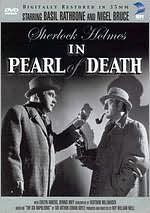
Outside of his 1939 production of “The Hound of the Baskervilles,” the Sherlock Holmes films starring Basil Rathbone were only tangentially linked to the stories of the canon, at best.  In many instances, Sir Arthur Conan Doyle’s original stories could be more accurately viewed as source material, rather than any real type of blueprint.  They provided a framework, not any real form.  But in 1944’s “The Pearl of Death,” when Basil Rathbone’s Sherlock Holmes advises Nigel Bruce’s Dr. Watson against hitting newspaper reporters in the teeth (an affectionate, though misguided, attempt at defending the Detective’s honor), there is more than an echo of Holmes’s original sentiment: “The Press, Watson, is a most valuable institution, if you only know how to use it."

Image via www.sherlockholmesposters.com.
The Pearl of Death” also marked the introduction of a new adversary for the Great Detective, provided by Universal Pictures in the form of Giles Conover, the jewel thief.  Perhaps the studio felt that audiences had seen enough of Professor Moriarty, but unfortunately Conover embodies many of the Professor’s most prominent characteristics anyway.  According to Sherlock Holmes, “This man pervades Europe like a plague, yet no one has ever heard of him.  That’s what puts him on the pinnacle in the records of crime.  In his whole diabolical career the police have never been able to pin anything on him.  Yet give me a crime without motive, robbery without a clue, murder without trace, and I’ll show you Giles Conover.”  This description is, of course, taken almost verbatim from the Great Detective’s description of Moriarty in “The Final Problem.”

That is not to say, however, that Conover—played by Miles Mander—is not a suitably diabolical figure.  Indeed, the audience’s first glimpse of Conover is quite ominous; he looms menacingly in the back of a darkened car, cloaked in shadow, waiting for his associate Naomi Drake (played by Evelyn Ankers).  In many ways, this scene echoes how the audience would first view Professor Moriarty in the 2009 Warner Bros. movie.  In that film, as Moriarty sits with Irene Adler (played by Rachel McAdams), he is seen mostly in darkness, only a cuff and coat sleeve visible, and lurking in the back of a carriage.  Both Adler and Drake appear to school their nerves in the presence of their intimidating companions, but there is an unmistakable undercurrent of terror that they cannot quite conceal, and which feeds the audience’s perception of the villains.
Another interesting addition to this film was the character known only as “The Creeper,” (played by Rondo Hatton).  The Creeper is a silent, lurking, violent killer, whose distorted features only serves to heighten his chilling presence.  Hatton suffered from acromegaly, a pituitary disorder, which caused his disfigurement.  But this fearsome hooligan, who serves Conover and is responsible for almost all of the violence to person and property throughout the film, stands in the place of a character from the source material.  As Dr. Watson describes the photograph of Beppo: “It was evidently taken by a snapshot from a small camera.  It represented an alert, sharp-featured simian man, with thick eyebrows and a very peculiar projection of the lower part of the face, like the muzzle of a baboon.”  And when Beppo is captured:  “As we turned him over I saw a hideous, sallow face, with writhing, furious features, glaring up at us, and I knew that it was indeed the man of the photograph whom we had secured.”  The Creeper is no more peaceful than Beppo in resolving his affairs in “The Pearl of Death,” and the character would later appear in two more films, unrelated to Sherlock Holmes.

According to David Stuart Davies, author of Starring Sherlock Holmes: A Century of the Master Detective on Screen, this particular Sherlock Holmes film by Universal was significant in other respects:

“'The Pearl of Death' is noteworthy in that it really saw the transition of Rathbone and Bruce into the characters they were playing.  Universal practically eliminated the names Holmes and Watson from their advertising from this film onwards.  Typical blurbs now ran: ‘Basil Rathbone and Nigel Bruce Crack the Mystery of The Pearl of Death’ or ‘Rathbone & Bruce – The Masterminds Tackle The Master Crimes’.  The names and identities of the actors had become so synonymous with those of the characters they were playing that as far as Universal was concerned—and the public too—using one name was as good as another” (57).

Of course, “The Pearl of Death” also features the ceramic busts of Napoleon, their methodical destruction, and the valuable pearl hidden inside one of them, in addition to new archenemies and their fearsome companions.  The film also deviates in important ways.  But the manner in which the film hearkens back to its source material is suggestive.  When Watson asks Holmes if he is certain that the missing pearl is inside the final bust, Holmes dismissively says: “If it isn’t, I shall retire to Sussex and keep bees.”  Such is typical of the type of tributes an avid Sherlock Holmes fan would find in “The Pearl of Death.”  While some of Universal’s Sherlock Holmes films seem to hearken back to the original stories in terms of only one plot point, character, or narrative device, this film seems to recognize the spirit of the original SIXN, and seeks to embody it globally.

oOo

“Better Holmes & Gardens” now has its own Facebook page.  Join by “Liking” the page here, and receive all the latest updates, news, and Sherlockian tidbits.

Friday, August 19, 2011

On the Observation of Nothing: “Silver Blaze,” “The Six Napoleons,” and “The Second Stain”

“No, no: I never guess.  It is a shocking habit—destructive to the logical faculty.”  (“The Sign of Four,” Chapter One)
At “A Scintillation of Scions IV” this past Saturday, Vincent Wright, of the Illustrious Clients of Indianapolis, spoke on the subject of the “Initially Seen, But Not Observed.”  Specifically, Wright presented on the subject of Alfred Garth Jones, a man whose name was totally unfamiliar to most people in the audience—but whose work was instantly recognizable.  Jones was the illustrator of the famous cover of the first hardback edition of The Hound of the Baskervilles, in 1902.  It is a book that many Sherlockians own, in some form, or have at least seen many times over.  But of those many times, how many readers had given a single thought to the cover art of HOUN, its origins, or its artist?  But sometimes all it takes is for one person, like Vincent Wright, to really look at something—the commonplace, the unremarkable, and the routine—and to see the unanswered question lying beneath; to make a logical inference based upon the knowledge of some bit of information—no matter how elusive that information may be—without leaping ahead while there are still gaps in information.  Some of Sherlock Holmes’s most striking deductions came by looking at nothing, but observing the absence of something crucial, rather than seeing only a dearth of clues.
The Sherlock Holmes story, “Silver Blaze,” contains one of the Great Detective’s most famous and oft-quoted deductions.  Having learned all he can from the stables at King’s Pyland, Holmes and company are preparing to move on to the next location.  When asked if he has observed anything crucial, Holmes merely remarks cryptically that he would like to draw their attention:
“To the curious incident of the dog in the night-time.”
“The dog did nothing in the night-time.”
“That was the curious incident,” remarked Sherlock Holmes.
What Holmes is referring to, of course, is that fact that the guard dog did not bark when the intruder entered the stable to steal the racehorse, Silver Blaze.  The absence of this activity indicated that whoever had come in must have been familiar to the canine, and did not arouse suspicion.  The villain, John Straker, was the lead trainer and someone who was seen every day around the stables, and the dog would have felt no fear of him, and thus no need to bark.  Rather than looking at a silent guard dog and seeing no clue, Sherlock Holmes observed an absent behavior, which in and of itself turned out to be one of the case’s most crucial clues.  In another instance, Holmes would rely upon the absence of a conclusion in one mystery, in order to find the correct solution to another.
One of the more interesting features of “The Six Napoleons” is the fact that Holmes had already worked the case once before.  As he tells Lestrade and Watson, “You will remember, Lestrade, the sensation caused by the disappearance of this valuable jewel, and the vain efforts of the London police to recover it.  I was myself consulted upon the case, but I was unable to throw any light upon it.”  If Sherlock Holmes seems to be positively blasé about this supposedly less than successful investigation, it is not because he has finally brought the case to an end.  It is not to say that he previously worked the case without success, but instead that he worked the case without conclusion.  However, Sherlock Holmes being Sherlock Holmes, the Detective knew that the absence of a solution in one instance did not preclude the existence of one entirely. 
Not pictured: The "I'm not following this" expression
on Lestrade's and Watson's faces.
Holmes refers to his detective work in SIXN as “a connected chain of inductive reasoning,” and Inspector Lestrade calls the case “workmanlike.”  They are both correct, of course, but the item of note is that observing a missing element was a crucial step in the deductive process.  Marking the missing conclusion from his previous case, Sherlock Holmes knew that a satisfactory solution—and by association, the missing pearl of the Borgias—must exist somewhere.  Simply labeling a case without a solution as unsolvable would not do, and regarding an elusive object as lost forever—simply for the crime of being elusive—would not stand either.
In “The Second Stain,” upon opening his despatch-box to find the missing diplomatic letter safely within its depths, Trelawney Hope exclaims, “Thank you!  Thank you!  What a weight from my heart.  But this is inconceivable–impossible.  Mr. Holmes, you are a wizard, a sorcerer!  How did you know it was there?”  To which Sherlock Holmes replies, “Because I knew it was nowhere else.”
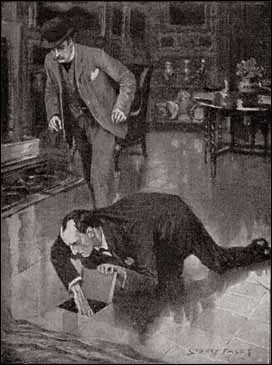
This statement, of course, is not precisely true.  Holmes is, in fact, shielding Hope’s wife, who is the one who had initially stolen, and then secreted away the important document.  Holmes did not know the letter was in the despatch-box—in fact, the Detective placed it there himself to complete his ruse—but he did know that Lady Hope was in possession of the letter, simply because there was nowhere else it could be.  Following his train of deductions, Sherlock Holmes finds himself at the home of the murdered spy, Eduardo Lucas.  Sending Inspector Lestrade out the room, Holmes immediately begins to search for what he knows must be present:
“He tore the drugget from the floor, and in an instant was down on his hands and knees clawing at each of the squares of wood beneath it.  One turned sideways as he dug his nails into the edge of it.  It hinged back like the lid of a box.  A small black cavity opened beneath it.  Holmes plunged his eager hand into it and drew it out with a bitter snarl of anger and disappointment.  It was empty.”
Empty.  But what of the Great Detective’s deductions, his logical inferences?  Although he is for a moment stymied, it does not take Holmes long to realize that the absence of the document from the place he imagined it to be—the place he knew it to be—was the key indicator in another solution entirely.
Remarking on the absence of activity or behavior is not the same as a guess.  A guess indicates a lack of knowledge and the need to move ahead without some crucial piece of information.  With a lucky jump, a guess can sometimes get one over the gaps in the deductive bridge, but can just as easily leave you plunging into the abyss of blunder and falsehoods.  In SILV, SIXN, and SECO, what Sherlock Holmes is doing is observing nothing, and discovering the various ways in which the nothing is itself, a clue.  As Holmes says in SILV: “See the value of imagination…It is the one quality which Gregory lacks.  We imagined what might have happened, acted upon the supposition, and find ourselves justified.  Let us proceed.”
oOo
A Scintillation of Scions” is an annual Sherlockian event in Columbia, Md., hosted by “Watson’s Tin Box.”  Learn more about the group here.
“Better Holmes & Gardens” now has its own Facebook page.  Join by “Liking” the page here, and receive all the latest updates, news, and Sherlockian tidbits.

Friday, June 10, 2011

“It was an admirable hiding-place”: The Adventure of the Six Napoleons

I gave serious thought to subtitling this post: “The Six Lives of Sherlock Holmes,” but it sounded a bit too much like a bad cable television drama for my liking, even if Sherlock Holmes himself had a well-documented appreciation of sensational literature.  Throughout the canon, Sherlock Holmes serves in many capacities, and is many things to many people.  Sometimes the list of descriptors is not so flattering, as in “The Speckled Band,” when the villainous Dr. Grimesby Roylott says to Holmes: “You are Holmes, the meddler…Holmes, the busybody…Holmes, the Scotland Yard Jack-in-office!”  On the other hand, some are flattering to the point of sounding obsequious, such as when Inspector Stanley Hopkins, in “Black Peter,” tells Holmes: “…I should never have forgotten that I am the pupil and you are the master.”
There are a multitude of planes and facets to Sherlock Holmes and his personality.  Some traits are quite clear and distinct, while some are as subtle and elusive as “trying to catch an arrow in mid-flight.”  And more often than not, many of Holmes’s characteristics are difficult to reconcile with each other, such as how a “perfect reasoning and observing machine” (SCAN) can also play his violin with the sensitivity and grace to lull his friend to sleep (SIGN).  Sherlock Holmes describes the case detailed in “The Six Napoleons” as “absolutely original in the history of crime,” but even more interesting is the variety of personality traits he presents to the reader within the tale.  Each trait is distinct and unique, but ultimately, dependent upon each other to create the complete picture of Sherlock Holmes that Dr. Watson presents in this instance.
~~~
1. The Homebody:  SIXN opens on what is actually a very charming, domestic scene: Holmes, Watson, and Inspector Lestrade seated around the fire at 221B Baker Street, smoking cigars and discussing the news and weather.  Moreover, Watson informs the reader that this is not the first such visit that the inspector has made and “It was no very unusual thing for Mr. Lestrade, of Scotland Yard, to look in upon us of an evening, and his visits were welcome to Sherlock Holmes…”  Later, before the trio ventures out on a late-night visit to Chiswick, Holmes invites Lestrade to rest on the sofa until the proper time, and it is all very friendly and comfortable, with Holmes giving off the impression of a king governing from his favorite armchair, secure in his domain.
Furthermore, Inspector Lestrade’s visits serve another purpose, in that Lestrade keeps Holmes up-to-date on the latest news from Scotland Yard and specifically, any details of the cases on which the inspector is currently engaged.  The Detective, in turn, “…was able occasionally, without any active interference, to give some hint or suggestion drawn from his own vast knowledge and experience.”  While it goes without saying that Sherlock Holmes was an incredibly active man, who would occasionally go to any extreme to solve a case, SIXN also shows the side of Holmes that was sometimes content to solve crimes from his armchair, in front of his fire.
2. The Relentless Pursuer:  One of the victims of SIXN is Mr. Horace Harker, who works for the Central Press Syndicate.  After Harker’s Napoleon bust is stolen, and a man is murdered on his front step, Holmes has Inspector Lestrade tell Harker that clearly “…a dangerous homicidal lunatic, with Napoleonic delusions, was in his house last night.”  Holmes conveys this opinion even though he personally believes no such thing.  More importantly, Holmes knows that Harker intends to write-up the story for the evening press, and now this piece of fraudulent and ill-thought-out information will likely appear in print.  When the item does indeed appear in the newspaper, Holmes famously says, “The Press, Watson, is a most valuable institution, if you only know how to use it.”  According to Leslie Klinger’s New Annotated Sherlock Holmes, this is “…perhaps the first recorded instance of deliberate manipulation of the news…” (1033).
But this is not the first example of Holmes in relentless pursuit of his own ends.  Periodically throughout the canon, Holmes has been known to impersonate a member of the clergy (SCAN), break into homes (CHAS, BRUC), and even allow a criminal to go free, if he felt the crime did not warrant whatever consequences loomed (BLUE).  He even once required Watson to serve as a makeshift jury, while he served as judge in a mock trial (ABBE).  Sherlock Holmes typically operates with his own goals and ends in mind.  Sometimes those ends work fortuitously with the goals of others, but that is merely an added bonus, rather than an intended purpose.
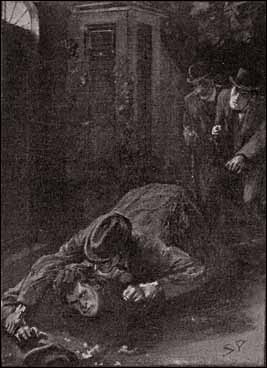
3. The Attack Dog: When he finally has the notorious Beppo cornered, Sherlock Holmes is not satisfied with any subtle or modest method of capture.  Watson claims that Beppo was perfectly intent upon and consumed with smashing his stolen statue and combing through the debris, so it is possible that the criminal could have been cornered and captured quietly, as he was outnumbered and outmaneuvered.  But instead, “With the bound of a tiger Holmes was on his back, and an instant later Lestrade and I had him by either wrist, and the handcuffs had been fastened.”  Illustrations of the scene sometimes show Holmes pinning Beppo firmly to the ground, his body sprawled entirely over him, giving no quarter.  It is no wonder that Watson describes the man as having, “...a hideous, sallow face, with writhing, furious features, glaring up at us…”  If in that position, most people would probably look similarly furious—criminal or no.
The canon is full of examples of Sherlock Holmes’s physical prowess.  He is an accomplished boxer, singlestick fighter, and fencer.  Perhaps most famous is his knowledge of the Japanese art of baritsu [sic], a skill he uses to fend off Professor Moriarty at Reichenbach Falls.  But these skills are all just part and parcel of Holmes’s personality: if something is worth doing, it is worth doing well, but also worth doing spectacularly.  Holmes could have easily taken out Moriarty with a pistol or a knife on that mountain in Switzerland, but why would he do that when he could physically clash with his archenemy, twisting him under his own hands, before throwing him, screaming, over the falls?  Holmes isn’t just a physical man—as his capture of Beppo shows—he is a dramatic one, a characteristic that is also demonstrated elsewhere in the story.
4. The Dramatist: The Great Detective has a sense of humor that could occasionally be described as “ill-timed,” or even cruel.  For example, rather than simply producing the sensitive government treaty that he had been hired to retrieve (the loss of which had driven one man to illness), Holmes requests that Mrs. Hudson hide it under a breakfast dish for their client to find (NAVA).  And while it’s been discussed elsewhere that Holmes’s “old bookseller” costume from EMPT was necessary for a number of safety and logistical reasons, the dramatic method in which he revealed himself to Watson probably was not.  Such is the case in SIXN after Holmes acquires the final Napoleon bust from Mr. Sandeford:
“When our visitor had disappeared, Sherlock Holmes’s movements were such as to rivet our attention.  He began by taking a clean white cloth from a drawer and laying it over the table.  Then he placed his newly acquired bust in the centre of the cloth.  Finally, he picked up his hunting-crop and struck Napoleon a sharp blow on the top of the head.  The figure broke into fragments, and Holmes bent eagerly over the shattered remains.  Next instant, with a loud shout of triumph he held up one splinter, in which a round, dark object was fixed like a plum in a pudding.”
I suppose a simple, “Don’t mind me, but I think a rare, stolen pearl is embedded in this plaster bust so I’m going to smash it apart with a hunting crop,” would have been out of the question here?  As Holmes once said, “I begin to think, Watson…that I make a mistake in explaining.  'Omne ignotum pro magnifico,' you know, and my poor little reputation, such as it is, will suffer shipwreck if I am so candid” (REDH).  Holmes made that statement in 1890, and by 1900 when SIXN takes place, his reputation as a dramatist is firmly established.  This goes a long way towards explaining why Watson and Lestrade are pleasantly surprised, but not shocked, by Holmes’s dramatic revelation.
5. The Peer:  And on the subject of surprises, Inspector Lestrade has one up his own sleeve before the case is over.  After enthusiastically applauding Holmes’s grand reveal and intricate explanation, Lestrade says:
“I’ve seen you handle a good many cases, Mr. Holmes, but I don’t know that I ever knew a more workmanlike one than that.   We’re not jealous of you at Scotland Yard.  No, sir, we are very proud of you, and if you come down to-morrow, there’s not a man, from the oldest inspector to the youngest constable, who wouldn’t be glad to shake you by the hand.”
What a dramatic change from some of Holmes’s earlier interactions with Scotland Yard—considering that the Detective was even once accused of stealing all the credit for solved cases from the official police (NAVA).  Furthermore, Lestrade is saying quite a bit about the Yard’s relationship with the world’s only consulting detective.  He shows that he appreciates the considerable effort that goes into Holmes’s methods—unorthodox as they may be—and he’s saying that everyone else at the Yard sees it too.  He’s recognizing the many years that he and Holmes have worked together, and that while they will never work together in an official way, that he considers Holmes an equal, if not a colleague, and that the feeling is shared by the collective force.  SIXN marks Inspector Lestrade’s last appearance in the canon (after this story, he is only mentioned in passing), making his remarks a fitting closure to his relationship with Sherlock Holmes.
6. The Heart: In her book, The Fictional 100: Ranking the Most Influential Characters in World Literature and Legend, Lucy Pollard-Gott says, “Sherlock Holmes continues to attract us, assuredly for the quality of his mind, but also for the quality of his enigmatic heart” (51).  Throughout the canon, the reader gets brief glimpses of that heart: when he is apologetic for nearly sentencing Watson and himself to a life of nightmarish madness (DEVI), and perhaps most famously when he thinks Watson’s life is compromised (3GAR).  But Holmes’s reaction to Lestrade’s compliment is equally memorable: “’Thank you!’ said Holmes. ‘Thank you!’ and as he turned away, it seemed to me that he was more nearly moved by the softer human emotions than I had ever seen him.”  The scene is made even more haunting by Jeremy Brett’s 1986 interpretation.
Sherlock Holmes may have worked more for “the love of his art than for the acquirement of wealth” (SPEC), but that does not mean he was above praise, or was not susceptible to a well-put or genuine compliment.  Lestrade’s proclamation moves him, even if it just for a moment.  Suddenly the Great Detective becomes accessible, and human.  It is extremely improbable (though I suppose, not impossible) that Holmes would ever have crossed the threshold of Scotland Yard, seeking those handshakes that Lestrade guaranteed.  But for just a moment, he seems to consider it.  For just an instant, he seems almost open to the possibility—like a regular man, who might enjoy something like that.
~~~
In SIXN, the reader experiences the many facets of Sherlock Holmes’s personality, presented on a broad continuum.  But not one of the characteristics encompasses him entirely.  It would be doing the Detective a disservice in pretending that he could be defined completely by one aspect of his character, no matter how important that characteristic may seem.  Dr. Watson presents a wide array of ways to approach Sherlock Holmes and his methods, and while that might never make him ordinary, it goes a long way towards making him accessible.
oOo
June 27 marks the beginning of the next blog contest, and this one will call on your creativity and ingenuity to win.  The prizes have arrived and I can’t wait to get started!  Watch this space for details.
If you have the means to do so, please consider purchasing a DVD copy of The Lady Shallot.  Proceeds over the next five weeks will help support a lovely family through a difficult time.  Details here

Sunday, January 16, 2011

Currently on Twitter...

Currently on my Twitter feed, I am recounting Dr. Watson's excellent tale of "The Adventure of the Six Napoleons."


You can read "The Adventure of the Six Napoleons" in its entirety online, or stop by my Twitter every weekday for an update.