Friday, November 25, 2011

“…a group of people who seemed to be intensely amused by the situation” (BLAN): The Nature of the Sherlockian Gathering

“We’re more than reality, you and I…you, my friend, have made us immortal.” (Clive Merrison, as Sherlock Holmes)
I have my nose nearly pressed up against a display case at the Lilly Library, trying not to breathe clouds of condensation onto the glass.  “That…that…that is just…” I stutter, struggling for words.  “That is just spectacular,” I finally announce to the room at-large, and the few people around me murmur in agreement.  We are all exhibiting a similar posture—trying to get as close to the case as possible, without smearing the glass with fingerprints.
“I know, isn’t it?”  Ginger sidles up beside me, and peers down appreciatively into the case.  “It’s just magnificent.  I wish I could put my hands on it.”
“Far be it from me to interrupt you two,” Darlene mutters from behind us.  “But you do know that there is a copy of the Gutenberg Bible sitting just to your right?  Just turn your head slightly, and you’ll see it.  Right there.  Gutenberg Bible.”
I glance back at her, and then back down again at the original “Elementary, My Dear Data,” script sitting in the case before me.  “My priorities are where I want them to be, thank you.”
“Well, as long as we’re all in agreement,” Darlene says with a smile.  “Now, shove over.  I want to see too.”

"Gillette to Brett" attendees viewing rare items in the Lilly Library collection.
(Photo via Wessexpress.com)
The weekend of November 11-13 marked the third incarnation of Wessex Press’s seminal “Gillette to Brett” conference, which highlights the various incarnations of the Great Detective on stage and screen.  Distinguished presenters included: actor Curtis Armstrong, editor and scholar Leslie Klinger, BBC radio producer Bert Coules, and authors Tony Earnshaw, Henry Zecher, and Michael Hoey (son of character actor, Dennis Hoey, who appeared as Inspector Lestrade in the Universal Sherlock Holmes films).  The event was capped off with the 35th anniversary screening of “The Seven-Per-Cent Solution,” with introductory remarks by author and screenwriter Nicholas Meyer.  Presentations were punctuated by film screenings and networking opportunities.  Throughout the conference, at meals and huddled in the Dealer’s Room, conversations centered on the various persons who have had the opportunity to portray Sherlock Holmes and Dr. Watson, and the various types of media in which they been portrayed. 

However, the conference’s theme seemed to center around one of Curtis Armstrong’s early remarks: “Anyone can play Hamlet…Keanu Reeves played Hamlet…but Sherlock Holmes requires a gift which is not given to many.”  Because more than anything I learned that weekend in Bloomington, Ind., I learned that studying Sherlock Holmes requires a keenness that is not given to many.  For instance, Henry Zecher’s impressive and monumental biography, William Gillette, America’s Sherlock Holmes, which is nearly 750 pages of exhaustive research and was therefore too large to fit into my carry-on bag, demonstrates a depth and an enthusiasm of subject, which was mirrored in his presentation.  Another point of fervent conversation regarded the various adaptations’ attentiveness and adherence to the minute details of the canon: where Peter Cushing was forced to deviate from his original vision for Hammer Films’ version of “The Hound of the Baskervilles;” and conversely, how Bert Coules worked tirelessly to create the first complete rendering of the canon using the same two actors (Clive Merrison as Sherlock Holmes, and Michael Williams as Dr. Watson).  Furthermore, Michael Hoey’s stories of his time on the Universal Sherlock Holmes set with Basil Rathbone, Nigel Bruce, and his father, have lost none of the childlike wonder and appreciation which he must certainly felt as a young boy, surrounded by such giants of the industry.
But that, I think, is part of the nature of being a Sherlockian, too.  We do not, and cannot afford to, lose our childlike wonder at the subject that so gripped our hearts as children, as young people, or even as grown adults.  As I sat in the Lilly Library, viewing a presentation of some the collection’s rarer pieces, the gasps and murmurs of appreciation grew louder and more pronounced with each new treasure—a copy of Edgar Allan Poe’sTamerlane,” a rare printing of Chaucer’sCanterbury Tales,” pages from that Gutenberg Bible that had failed to catch my eye earlier, but which were now given to the audience to touch.  But when the librarian presented one of the Lilly Library’s two copies of the 1887 “Beeton’s Christmas Annual,” the intakes of breath took on such a sharp edge that I began to worry that the audience as a whole was going to gasp itself into suffocation.  I wondered briefly if the librarian knew CPR, but lost the thought when he revealed an original print of the Declaration of Independence.

Author and screenwriter Nicholas Meyer (left) with
"Gillette to Brett" co-creator Steven Doyle.
(Photo via Wessexpress.com)

“Education never ends, Watson,” Sherlock Holmes says in “The Red Circle.”  “It is a series of lessons with the greatest for the last.”  And after meeting some of the presenters and authors in attendance at “Gillette to Brett,” I realized just how many Sherlockians hold this axiom close to heart.  I had the opportunity to meet and speak with Dan Andriacco, and Kieran McMullen, two MX Publishing’s authors.  Andriacco is the author of Baker Street Beat, and No Police Like Holmes; McMullen is the author of Watson’s Afghan Adventure and Sherlock Holmes and the Irish Rebels.  And they are both enthusiastic devotees of Sherlock Holmes, as enamored of their chosen subject today, as they were when they first began.  They are always learning, constantly thinking, and most importantly, they want to be a part of the conversation—not just start it.  Sherlockians want to discuss everything from bourbon, to period weaponry, to the finer points of rare pastiches—as long as it all relates back to the root discussion.  The desire to talk about the thing we love, with others who love it, should not fade, but only grow stronger with time.  This is, after all, why conferences such as “Gillette to Brett” exist, and why they continue to exist.  It is also why Sherlockians continue to seek each other out, and hopefully will always do so.
oOo
“Better Holmes & Gardens” now has its own Facebook page.  Join by “Liking” the page here, and receive all the latest updates, news, and Sherlockian tidbits.

Tuesday, November 15, 2011

“The Meaning of This Extraordinary Performance” (COPP): Granada Television’s “The Musgrave Ritual”

“One morning, as I approached the entrance to the Granada studios, Jeremy arrived in a cab.  As he leant forward on the pavement to pay the driver, the waistband of his well-worn, much-laundered white trousers parted company with the legs which fell in a heap on the kerb.  Giggling, Jeremy pulled them back up and struggled to the safety of the wardrobe, where his laughter could be heard as far away as Liverpool.  His laugh was always infectious.  When I think of Jeremy, I think of his laughing... that will always be my lasting memory of him.  I cannot pay him a greater compliment” (Edward Hardwicke).

November 3 recently marked what would have been the 78th birthday of Jeremy Brett, who was born Peter Jeremy William Huggins in 1933. He starred as Sherlock Holmes in the Granada Television series, appearing in 41 episodes as the Great Detective.  Brett looms large over the role of Sherlock Holmes, and casts a very long shadow over all the actors who have played the part.  Even Benedict Cumberbatch, star of the new BBC series “Sherlock,” said in an October 2010 interview: “[Brett] casts a towering shadow.  He was a friend of my mom's, and he was around our family a lot.  He and the part collided, and he let it take him over.  He was a manic depressive, but that was a side issue, but he then played one.”

The immense range of performance that Jeremy Brett brought to the role of Sherlock Holmes is thrown in to sharp relief in Granada Television’s adaptation of “The Musgrave Ritual.”  This particular episode manages to contain some marked deviations from the original source material, but also somehow, remain remarkably faithful and familiar.  As has been discussed elsewhere, the primary mystery of “The Musgrave Ritual” originally takes place before Sherlock Holmes and Dr. Watson first meet.  The actual narrative of story is told by Sherlock Holmes to Dr. Watson, with Watson relaying the telling of that tale to his readers.  MUSG has been dated by both William Baring-Gould and Leslie Klinger as taking place in 1879, which would have made the Great Detective around 25-years-old.  In other words, the Sherlock Holmes of the original MUSG was quite a young man.

Unfortunately, when Jeremy Brett and Edward Hardwicke filmed Granada’s version of MUSG in 1986, neither man could be quite honestly classified as “young.”  At the time of filming, both Brett and Hardwicke were approximately 53-years-old, and so therefore, the production team’s first obstacle was how to compensate for their stars’ somewhat advanced age.  Furthermore, it simply would not do to film an entire episode with Watson appearing only briefly at the beginning, and perhaps at the end.  That is, it would not do to exclude Watson intentionally, as some casting and plot allowances were made in later Granada episodes for Brett’s health troubles, and Hardwicke’s scheduling conflicts.

So Granada’s 1986 episode of MUSG opens with both Sherlock Holmes and Dr. Watson perched on the back of a cart, on their way to a brief holiday at Musgrave Manor.  Holmes is wrapped in several layers of clothing, including a ratty crocheted blanket, and is coughing pitifully (and melodramatically) every time Watson tries to cheer him with the thought of the entertainments that await them.  On the cart with them is a heavy, locked trunk, which Holmes reveals to contain notes on some of his earliest cases:  “…the record of the Tarleton murders, the case of Vamberry, the wine merchant, and the adventure of the old Russian woman, a full account of Ricoletti of the club-foot, and his abominable wife, and the singular affair of the aluminum crutch…that was something a little recherché.”  Unfortunately, the moment Dr. Watson expresses interest in reading these notes, Holmes slams his foot down upon the lid and begins to use it as a footstool.


And so, from the very beginning, Granada’s adaptation of MUSG both deviates from the original story, and at the same time reaches out to its source.  Many plot details remain the same: Reginald Musgrave, whom Sherlock Holmes always associated “…with gray archways and mullioned windows and all the venerable wreckage of a feudal keep”; Musgrave’s brilliant butler, Brunton; his tumultuous relationship with the housemaid, Rachel; and of course, the ancient Musgrave family ritual.  According to Richard Valley:

“When it came time to remake the story for Granada’s THE RETURN OF SHERLOCK HOLMES, dramatist Jeremy Paul found that it was again necessary to make some minor changes, this time because no suitable location could be found containing the trees essential to the untangling of the puzzle.  The solution: a tree-shaped weathervane atop Hurlestone Manor.”


But the most significant divergence comes relatively early on in the episode, after Watson arrives at Holmes’s room to collect him for dinner.  Holmes is nowhere to be found, but the tempting trunk of early case notes is prominently displayed.  But just as Watson is about sneak a quick peek, the Doctor also spies Holmes’s open morocco case, the needle and cocaine solution prepped for dosage.  The scene ends with Watson looking pensive, but ultimately saying nothing.  Holmes spends the following scenes, and the rest of the evening, being easily coaxed into maniacal, uncontrollable laughter.  Sometimes giggling privately under his breath as he warms himself in front of the fireplace, sometimes flinging himself bodily around the room—laughing in a powerful way that seems to make both Musgrave and Brunton uncomfortable, while Watson tries desperately to simultaneously ignore Holmes and distract the other men.


Finally, at the end of the episode, as Holmes and Watson drive away, it is the Doctor who posits the theory that perhaps Rachel Howells may have intentionally sent the stone crashing, and also the alternate hypothesis that she had “only been guilty of silence as to [Brunton’s] fate.”  Holmes seems uncharacteristically indifferent about this loose thread and says, “Very probably she's far away from Hurlstone now and carries her secret with her.”

Surprisingly and unfortunately, Holmes is wrong.  In the final scene, the pale, waterlogged face of Rachel Howells’s corpse rises up from the mere.  Her romantic rival, Janet Tregellis, recoils in horror at the sight, and runs away screaming in terror.  This final scene brings closure to a plot point that Sir Arthur Conan Doyle had originally left open—whatever happened to Rachel Howells?  But this addition on Granada’s part in no way seems like a correction, or an admonition directed at Doyle for leaving a question unanswered.  Instead, it seems like one last accommodation, a last tribute to the original story that was flexible enough to meet the needs of an evolving cast and crew, which was able to stretch enough to meet in the middle between canon and canonization.

oOo

“Better Holmes & Gardens” now has its own Facebook page.  Join by “Liking” the page here, and receive all the latest updates, news, and Sherlockian tidbits.

Sunday, November 13, 2011

Currently on Twitter...


As part of an ongoing project on my Twitter feed, I'm delivering stories from the Sherlock Holmes canon in tiny installments of 140 characters or less.  Last week, I finished up "The Devil's Foot," and I wonder if you agree with the Great Detective's own personal assessment of the case: "...strangest case I have handled."

The current story is "The Adventure of the Blue Carbuncle." I hope you will join in on this seasonal tale, which Christopher Morely once described as: "Surely one of the most unusual things in the world: a Christmas Story without slush." 

Check out my Twitter feed for a daily installment, although I am usually inspired to post more than once a day. And don't forget you can read through the original canon online

Saturday, October 29, 2011

“Give me problems, give me work” (SIGN): The Nature of Work in the Sherlock Holmes Canon


“Your work is going to fill a large part of your life, and the only way to be truly satisfied is to do what you believe is great work.  And the only way to do great work is to love what you do. If you haven’t found it yet, keep looking. Don’t settle. As with all matters of the heart, you’ll know when you find it. And, like any great relationship, it just gets better and better as the years roll on. So keep looking until you find it. Don’t settle.” (Steve Jobs)

Sherlock Holmes’s universe—the mental spaces that he occupied—was famously narrow.  If a piece of information wasn't in some way relevant to whatever case or mystery he was pursuing at the moment, then it wasn’t relevant at all.  In A Study in Scarlet, when Dr. Watson takes the Detective to task for not knowing that the Earth revolves around the sun, the Detective snaps: “What the deuce is it to me?  …you say that we go round the sun.  If we went round the moon it would not make a pennyworth of difference to me or to my work.”  The 2010 BBC series, “Sherlock,” featured a variation on the line, with the title character saying: “Oh hell, what does [the solar system] matter?  So we go round the sun.  If we went round the moon or round and round the garden like a teddy bear it wouldn't make any difference.  All that matters to me is the work.  Without it my brain rots.”


Sherlock Holmes had clearly defined, carefully cultivated priorities.  In “The Bruce-Partington Plans,” he says: “I play the game for the game’s own sake.”  He worked neither for money nor for public acclaim, and was openly antagonistic towards Watson’s literary efforts on his behalf, even though the Doctor’s stories must have certainly brought a tremendous number of clients to the door of 221B Baker Street.  Holmes also does not care if the police or other parties receive the credit for solving the case, as the long as the case is solved.  In “The Naval Treaty,” Holmes says to an unreasonably vexed police inspector: “On the contrary…out of my last fifty-three cases my name has only appeared in four, and the police have had all the credit in forty-nine.  I don’t blame you for not knowing this, for you are young and inexperienced, but if you wish to get on in your new duties you will work with me and not against me.”  Sherlock Holmes understood his priorities, and likewise, he knew how to cultivate them in others.

On the other hand, John Watson is a medical man, a surgeon, by trade.  Though that character detail is often easy to forget given the amount of time that he spends running beside, and chasing after, Sherlock Holmes.  He abandons his medical practice frequently—sometimes with his wife’s encouragement—and with little notice, foisting his patients onto an unsuspecting colleague—whom must certainly have benefited from the constant influx of business.  Truly, it appears that Watson spent most of his time as the Great Detective’s biographer and partner, but he must have found some spare moments to be the doctor that he trained to be.  In “The Creeping Man,” the reader finds that Watson cannot get away and follow Holmes as easily as he used to do: “Monday morning found us on our way to the famous university town–an easy effort on the part of Holmes, who had no roots to pull up, but one which involved frantic planning and hurrying on my part, as my practice was by this time not inconsiderable."

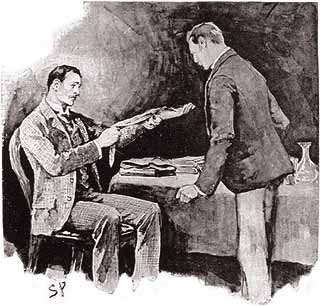
Dr. John Watson seen here in "The Adventure of the Engineer's Thumb,"
offering some practical advice to a patient
whose thumb is missing...brandy, naturally. 

How and when Watson found the time to build up a medical practice is beside the point, because he did find it.  Additionally, no matter how difficult it eventually became for Watson to get away and follow Holmes, he does manage to get away.  Even after the Great Hiatus, during which time Watson would have had three years to cultivate his own practice, and again establish himself as the doctor he was trained to be, he is quick to sell his business, move back to Baker Street, and throw his lot back in with Sherlock Holmes once again:

“At the time of which I speak, Holmes had been back for some months, and I at his request had sold my practice and returned to share the old quarters in Baker Street.  A young doctor, named Verner, had purchased my small Kensington practice, and given with astonishingly little demur the highest price that I ventured to ask–an incident which only explained itself some years later, when I found that Verner was a distant relation of Holmes, and that it was my friend who had really found the money” (NORW).

So, for all that Dr. Watson judged his friend for not knowing that the Earth revolved around the sun (“But the Solar System!” [STUD]) simply because it was irrelevant to his work, Sherlock Holmes does not judge his friend for abandoning his prosperous practice to pursue a man who has inexplicably begun imitating a monkey.  Possibly because he was encouraging the behavior, as he does by having a relative purchase Watson’s practice, but also he knows that Watson’s priorities are the same as his own, and he has no issues with making sure that they remain so.

At the recent annual formal dinner hosted by Watson’s Tin Box, author Lyndsay Faye quoted John le Carré and said: “No one writes of Sherlock Holmes without love.”  I’ve been thinking a lot about the nature of work lately, Sherlockian work in particular—the why and how of why Sherlockians do what they do.  And I wonder if the Great Detective and Doctor Watson provided their readers with an example of how to pattern and organize their priorities, to remind the reader of why they read.
  
Sherlock Holmes “[worked] as he did rather for the love of his art than for the acquirement of wealth, he refused to associate himself with any investigation which did not tend towards the unusual, and even the fantastic” (SPEC).  And Dr. Watson had a vocation that he occasionally fell back upon, but had no issues with abandoning it when it was no longer what he wanted.  When Sherlock Holmes reappeared in Dr. Watson’s life—whole and alive—the Doctor knew without question where he wanted to be.  The canon is filled with examples of working for the love of the work, of people who loved what they did.  And I think they would be disappointed if their devotees behaved any differently, if we found ourselves writing of Sherlock Holmes without joy, enthusiasm, or love.

oOo

“Better Holmes & Gardens” now has its own Facebook page.  Join by “Liking” the page here, and receive all the latest updates, news, and Sherlockian tidbits.

Wednesday, October 19, 2011

BOOK REVIEW: “Shadowfall: A Novel of Sherlock Holmes”

Tracy Revels; Publisher:  MX Publishing (March 2011)
He reached inside his coat and removed his cigarette case.  He spoke a word in an unknown language as he waved his hand over the silver box.  The container suddenly shone like a beacon, brighter than any lantern, and I turned aside, eyes burning.  There was a click as he opened it, and a tiny point of golden light shot from the container.  I heard a sound like a great buzzing.
“Holmes, is that an insect?”
“It is the humble apis mellifera, or western honeybee.  He is noted for his industry and strength and unfailing ability to find that for which he seeks.”  Holmes held out his palm, and the creature descended onto his flesh, wings drawn back against its striped body, still glowing with an unnatural light (70).
Of the recent book reviews on this blog, they all seem to present a common theme: Dr. Watson as an absent character, or at the very least, as an absent narrator.  We’ve looked at books that feature characters acting in Watson’s place, narrating the story from their own perspective, or that have been written from an omniscient point-of-view that precludes having the direct access to Watson’s thoughts that so many readers enjoy.  Of the fifty-six short stories and four novels in the canon, only four of them are not written from the Doctor’s perspective.  “The Mazarin Stone” and “His Last Bow” are written from a third person perspective.  In “The Gloria Scott,” and “The Musgrave Ritual,” Sherlock Holmes relates the primary mystery to Watson from his own memories, but the Doctor still frames and narrates the initial story.  And “The Blanched Solider” and “The Lion’s Mane,” from The Casebook of Sherlock Holmes, are written from Holmes’s perspective.  In LAST, Sherlock Holmes famously names Watson as “the one fixed point in changing age,” and the Doctor’s narration is often a guiding influence, piloting the reader through a murky sea of mystery.  Furthermore, as has been discussed elsewhere, the reader must often completely trust Dr. Watson, in order for the plot device to work.
And so, Tracy Revels’s Shadowfall is a perfect example of trusting Dr. Watson as a narrator—trusting that the story he ultimately delivers is complete and entire, that he is telling the truth, and that he writes with the understanding that reader will believe him.  From the start, Revels’s novel finds Watson’s skepticism stretched to its absolute limits, as he finds himself plunged into a world filled with fairies and shadows.  It is a world in which his own immortal soul is stolen by Titania, the fairy high queen, in a desperate bid for Sherlock Holmes’s assistance.  A world in which the sacred and mystical objects of London are disappearing, prophesying doom and destruction.  A world in which the Great Detective is not what he appears to be:
What are you, Holmes?”
“There is no true word for it, but the closest term would be a Merlin, a wizard.  I inherited the powers of magic from my mother’s immortal house, even as I gained my height and my hair from my mortal father’s” (45).
Now, it goes without saying that placing Sherlock Holmes in a supernatural setting—not to mention making him a supernatural being—is not going to be to everyone’s taste.  After all, Holmes himself said, “This agency stands flat-footed upon the ground, and there it must remain.  The world is big enough for us.  No ghosts need apply” (SUSS).  But Revels approaches the subject intelligently, and the methods of her version of the Great Detective are still recognizable.  His deductive abilities are paired equally with his magical talents, and Holmes does not begin suddenly casting spells with impunity once he has revealed his true nature to Dr. Watson.  For example, after extracting some needed information from a group of laborers, using nothing but a bit of clever repartee, Holmes turns to Watson with a smile: “No magic was necessary, as you witnessed” (80).
Likewise, Revels’s Dr. Watson approaches his friend’s revelation with a sensible amount of incredulity.  When Holmes produces a flame from the tip of his finger, and lights the Doctor’s cigarette, Watson says: “Any Covent Garden conjurer could do the same” (46).  Watson as the narrator of this story is incisive and perceptive—both the companion that Holmes does not deserve, but also the one that he needs.  It is Watson who knows Holmes better than he knows himself, and who knows why the Great Detective could never subsist entirely on a deductive diet of magical abilities (even if he occupies a world where such things exist): “At that moment, I began to understand why he had returned to the world of the Sun.  Magic and enchantments were less satisfying to him than the superb command of his own intelligence.  There was a greater thrill in being a reasoning machine than in wielding supernatural forces” (80).
Tracy Revels has a clever and delicious way with words, and the world of Shadowfall is fully formed and beautifully imagined—from the dazzling and terrifying Queen Titania who steals Watson’s soul, to Holmes’s tiny and ethereal honeybee familiar.  Revels’s story is carefully and artfully constructed.  It would be easy for an author to merely transpose the Detective’s deductive methods for supernatural ones, thereby explaining away Holmes’s sometimes inhuman ability to know “by a man’s finger-nails, by his coat-sleeve, by his boots, by his trouser-knees, by the callosities of his forefinger and thumb, by his expression, by his shirt-cuffs—by each of these things a man’s calling is plainly revealed” (STUD).  But by incorporating and combining both the canonical aspects of Sherlock Holmes’s character, and her fresh perspective, Tracy Revels has written a cerebral pastiche, one that speaks to both focus and fantasy.
Tracy Revels’s sequel, Shadowblood, will be available from MX Publishing in November 2011.  Order the book here.
oOo
Shadowfall: A Novel of Sherlock Holmes, by Tracy Revels is available in paperback from MX Publishing, and Amazon.  It is also available for the Kindle.  You can also follow the author on Twitter and on Facebook.
Speaking of Facebook, “Better Holmes & Gardens” now has its own Facebook page.  Join by “Liking” the page here, and receive all the latest updates, news, and Sherlockian tidbits.
Friday, October 7, 2011

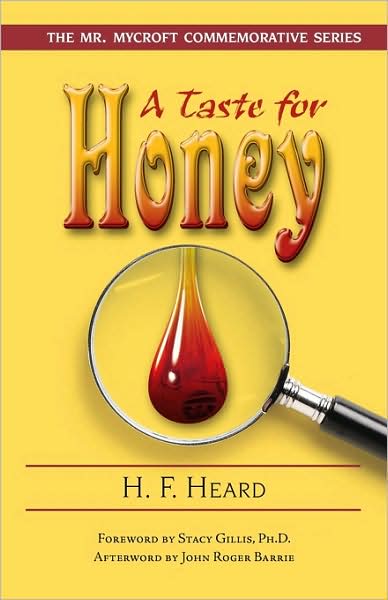
BOOK REVIEW: “A Taste for Honey”

H.F. Heard; Publisher: Blue Dolphin Publishing (September 2009, Originally Published in 1941 by The Vanguard Press, Inc.)
“I turned to see beside me a serene face, a sort of political Dante, if I may so put it and not seem high-brow.  It was cold, perhaps; or maybe it would be juster to say it was super-cooled, cooled by thought until the moods and passions which in most of us are liquid or even gaseous had become set and solid—a face which might care little for public opinion but much for its opinion of itself” (14-5).
Nowadays, it seems as if new Sherlock Holmes pastiches are coming out consistently, if not constantly.  The advent of e-books, and self-publishing, has certainly increased the amount of reading material on the market in general, not just in the mystery and Sherlock Holmes genres.  With that said, however, it is sometimes easy to forget just how very far back the tradition reaches.  According to Richard Lancelyn Green, in The Sherlock Holmes Letters, “The earliest pastiche is thought to be ‘My Evening with Sherlock Holmes,’ which appeared in the Speaker on 28 November 1891 and described a visit to Baker Street” (7).  Issues with copyright and the appropriation of the character of Sherlock Holmes have further complicated matters over the years, forcing some authors into new and innovative methods of representing the Great Detective.  H.F. Heard’s novel is a prime example of both an early Sherlock Holmes pastiche, and an inventive method of skirting around the character of Sherlock Holmes, without ever really addressing him directly.
H.F. Heard’s novel, A Taste for Honey, is the first in a trilogy of novels featuring a retired detective turned beekeeper, who goes by the name, “Mr. Mycroft.”  Other novels in the trilogy include: Reply Paid, and The Notched Hairpin.  In 1955, A Taste for Honey was adapted into a made-for-television movie called, “The Sting of Death,” which featured the iconic Boris Karloff in the role Mr. Mycroft.  Heard’s novel runs in the same vein as Michael Chabon’s The Final Solution: A Story of Detection, in that the story never explicitly states or outright names the main detective character as Sherlock Holmes.  In Chabon’s novel, he is referred to only as “the old man,” and in Heard’s book, he is “Mr. Mycroft” (a name, which he eventually reveals to the narrator, is only one of his many “family names”).  But there are certainly enough clues in both stories for the reader to draw the intended conclusion, to find them at turns clever, touching, or even humorous.
A Taste for Honey is narrated by the exceedingly neurotic and mostly unlikeable Sydney Silchester, resident of the quiet village of Ashton Clearwater.  He is remarkably particular in his ways, ill-tempered, and anti-social in a way that makes Sherlock Holmes look positively chummy in his interactions in the canon.  As Silchester himself puts it, the whole mystery of the novel began: “…through my breaking my rule—the rule, as it happens, of all village life of the better-off, of ‘keeping myself to myself’” (6).  But the narrator is also an incurable honey-addict, and his quest for his preferred sweet leads him directly into the path of the villainous Heregroves, then to Mr. Mycroft, and then, finally, into a swarm of feral honeybees.  Silchester has no desire to ally himself with Mr. Mycroft (or with anyone, for that matter), but his survival depends upon finding a solution to the mystery of the murderous swarm, and the eccentric beekeeper is clearly his best chance at finding that answer.  It is not possible, even for the briefest of moments, to confuse Sydney Silchester with Dr. Watson.  The Doctor was constantly in awe of his friend; Silchester is, at best, confused and at worst, horrified by Mr. Mycroft.  Mr. Mycroft, in turn, seems to spend a copious (and occasionally tedious) amount of time simply assuring his new companion of his competency.
On that front, the beekeeper’s efforts seem to be mostly in vain.  At the end of the novel, when Mr. Mycroft reveals his “real” name (to which the reader is never privy) to Silchester, the man’s reaction is frankly underwhelming.  He says:
“’You see,’ I said, ‘now that I do know your real name, I have to own I have never heard of you before.’
“Then, I must own, he looked amazed—perhaps the only time I had seen him profoundly surprised, and he turned away without a word” (141).
Mr. Mycroft is, naturally, the great mystery of Heard’s novel.  While he is clearly intended to stand in the stead of Sherlock Holmes, and the similarities are obvious and numerous, the characters are not perfect parallels.  Occasionally, there are aberrations in Mr. Mycroft’s character that seem possibly jarring and discordant to those who know the Great Detective well.  For example, Mr. Mycroft demonstrates an appreciation for fine cuisine that seems better suited as a characteristic of another Holmes relation (comparisons further strengthened by the conspicuousness of the character name).  According to Silchester, “The [food] was as good to my eye as to my ear and even better on the tongue.  My host knew about food and wine.  He talked both, well and fully, as if he wouldn’t touch on shop at mealtimes” (25).  But Mr. Mycroft has endless wells of energy, a brain that turns endlessly, and a manner of interacting with people that seems equal turns calculating and charming.  And—as the reader learns—Mr. Mycroft has absolutely no problem with being both judge and jury when the situation sees fit, and the novel's climax rings familiar in a way that will probably bring to mind the concluding scene of "The Abbey Grange."
In his essay, “Who Is Mr. Mycroft?” John Roger Barrie discusses the various theories and possible identities of Mr. Mycroft, their pertinence to Heard’s novel, and applicability to Sherlock Holmes pastiches, in general:
“…by utilizing powers of deductive reasoning that would put Sherlock Holmes to shame, we are now able conclusively to state with absolute and unequivocal certainty the answer to our question, who is Mr. Mycroft.  Add 1 ¾ cups Sherlock, a dash of Mycroft Holmes, 5 ounces of Heard, ½ cup archetypal investigator, 3 tablespoons quintessential justice seeker, and voila.  The true identity of Mr. Mycroft is, and will forever remain…Mr. Mycroft.”
And that’s the crux of it, I think—can the reader find Sherlock Holmes in the weeds?  Is he identifiable in the morass of original characters?  Can he be found among features that seem incongruous or incompatible?  H.F. Heard’s “Mr. Mycroft” is not a perfect parallel to the Sherlock Holmes of Sir Arthur Conan Doyle’s source material, but he is recognizable in A Taste for Honey nonetheless; Sherlock Holmes is indeed detectable in his original shape.  And when Mr. Mycroft speaks, the reader knows his voice, even if his profile no longer stands in sharp relief.
oOo
“Better Holmes & Gardens” now has its own Facebook page.  Join by “Liking” the page here, and receive all the latest updates, news, and Sherlockian tidbits.
Monday, October 3, 2011

Currently on Twitter...

As part of an ongoing project on my Twitter feed, I'm delivering stories from the Sherlock Holmes canon in tiny installments of 140 characters or less.  Last week,  I finished up "The Problem of Thor Bridge," and I hope everyone enjoyed taking a closer look inside the "tin dispatch-box," which Dr. Watson keeps at Cox & Co., at Charing Cross.

The current story is "The Adventure of the Devil's Foot."  I hope you will join in, and see if you agree with the Great Detective's own personal assessment of the case: "...strangest case I have handled."

Check out my Twitter feed for a daily installment, although I am usually inspired to post more than once a day.  And don't forget you can read through the original canon stories online.