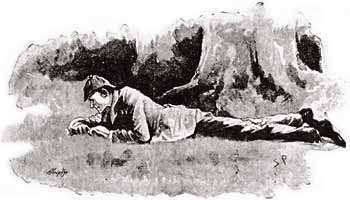
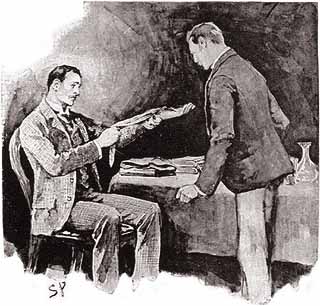
221B Baker Street was not a tranquil English home. Life with Sherlock Holmes was not tranquil. The world with Sherlock Holmes in it was not tranquil. An existence punctuated by indoor pistol practice, unpredictable and uncontrollable chemical experiments, and an assorted cast of unsavory characters arriving at irregular hours was not a tranquil one. But there were moments of tranquility. For instance, the conclusion of “The Adventure of the Blue Carbuncle,” in which the reader finds Sherlock Holmes and Dr. Watson enjoying a peaceful, seasonal meal together. The passage in The Sign of Four in which Holmes lulls a tense and exhausted Watson to sleep with his violin. Or even the opening lines of “The Adventure of the Six Napoleons,” in which the reader finds that Inspector Lestrade has acquired the habit of dropping in at Baker Street of an evening, just to chat. But, by and large, the Baker Street flat was a rambunctious residence.
But that doesn’t mean, necessarily, that all other canonical residences were tranquil ones, either. An address off of Baker Street did not guarantee a peaceful life. The eponymous residence of “The Copper Beeches,” for all its efforts at the appearance of normalcy, turned out to be – for Miss Violet Hunter especially – as dark and dangerous a residence as any alley of ill-repute in London. The Trevor residence in Donnithorpe, seen in “The ‘Gloria Scott’”, is certainly more than peaceful enough in the beginning. As Sherlock Holmes said, “…he would be a fastidious man who could not put in a pleasant month there,” but unfortunately the “old-fashioned, widespread, oak-beamed brick” dwelling quickly becomes the site of high drama, when the elder Trevor’s previous transgressions follow him home. And of course, in “The Adventure of the Abbey Grange,” no number of ivy-covered walls or pillared front facades can conceal the dark business that took place inside – the monstrous cruelty of Sir Eustace Brackenstall and his violent end.
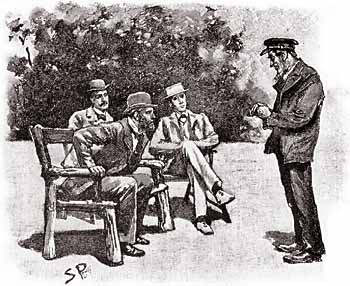
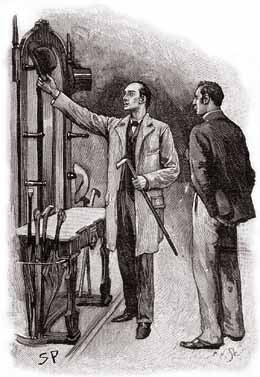
Nevertheless, in “The Crooked Man,” Sherlock Holmes arrives at the home of Dr. and Mrs. Watson, seeking sanctuary. The Watsons have only been married a few months, and the hour is late – Watson informs the reader that his wife had already gone to bed – but there is no question that Sherlock Holmes would be welcome, that his hat can fill the vacant peg on the hatstand. So, if a tranquil English home doesn’t necessarily mean “anywhere outside of Baker Street,” then what was Dr. Watson longing after as he gazes back at the Forrester residence in The Sign of Four? Was it necessarily the tranquility? Was it the sense of stability? Was it the woman standing on the doorstep (you know, the one he would eventually marry)? Or was it something else, some more intangible quality, something that perhaps escaped even Watson’s implicit understanding?
It’s worth noting that, in the passage from SIGN, Watson is neither coming from nor returning to the flat at Baker Street. He is coming from Pondicherry Lodge – returning Miss Mary Morstan to the home where she currently resides as a governess – and their evening has been long and dark, punctuated by theft, murder, and the revelation of secrets horrible and long-harbored. After leaving Miss Morstan with the Forresters, Watson does not immediately return to Pondicherry Lodge, but instead embarks on an errand for Sherlock Holmes, and goes to Pinchin Lane. It is an unlovely place. As Watson says, “Pinchin Lane was a row of shabby, two-storied brick houses in the lower quarter of Lambeth. I had to knock for some time at No. 3 before I could make any impression.” He is then subjected to a variety of abuse at the hands of the resident, Mr. Sherman, before mentioning Sherlock Holmes and thus gaining entrance, and Sherman’s deference. The interior of No. 3 Pinchin Lane is no better than the exterior: “In the uncertain, shadowy light I could see dimly that there were glancing, glimmering eyes peeping down at us from every cranny and corner. Even the rafters above our heads were lined by solemn fowls, who lazily shifted their weight from one leg to the other as our voices disturbed their slumbers.”
So, what was Watson really seeing in that passage from SIGN, what were the particular items that drew his eye? The first thing he mentions is Miss Morstan and Mrs. Forrester on the doorstep – “the two graceful, clinging figures.” Mary Morstan didn’t just arrive at the place where she lived; she was welcomed home by Mrs. Forrester: “…it gave me joy to see how tenderly her arm stole round the other’s waist and how motherly was the voice in which she greeted her. She was clearly no mere paid dependant but an honoured friend.” And hasn’t Watson received similarly warm welcomes from Sherlock Holmes? In “The Naval Treaty,” the Doctor is informed, “You come at a crisis, Watson” and “I will be at your service in an instant... You will find tobacco in the Persian slipper.” In “The Adventure of the Empty House,” Holmes tells his friend: “So it was, my dear Watson, that at two o’clock to-day I found myself in my old armchair in my own old room, and only wishing that I could have seen my old friend Watson in the other chair which he has so often adorned.” It’s really very simple. What more can one want from a home than to just to know that you are welcome, and that all the comforts are at your disposal?
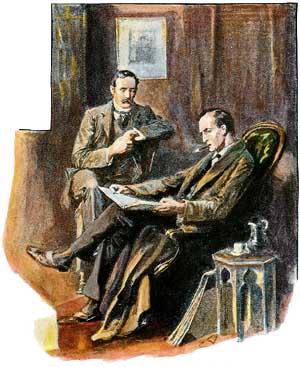
And speaking of those comforts, that is the second thing that draws Watson’s eye in the passage from SIGN: “the half-opened door, the hall-light shining through stained glass, the barometer, and the bright stair-rods.” These items are all meant to be indicators of home – things that are comforting and familiar. So, how are these articles any different that the tobacco in the toe-end of a Persian slipper (or the cigars in the coal-scuttle, for that matter), correspondence eternally fixed under a jack-knife, or the bullet-marks in the wall. In “The Adventure of the Creeping Man,” Watson practically equates himself with these items: “As an institution I was like the violin, the shag tobacco, the old black pipe, the index books, and others perhaps less excusable.” If bullet-marks and jack-knifes are perhaps less graceful than “hall-light shining through stained glass,” does that make them any less effective as objects of comfort? They are still indicators of home, no matter what kind of home that might be.
Perhaps what Dr. Watson was longing for in that passage from SIGN was not necessarily a different type of home. Is it possible that he just wanted to go home – no matter where that home was, or what it might be? It had already been a long night, with the promise of it being even longer, and maybe all he wanted to do was feel welcomed, and surround himself with the items that comforted him (and most likely sleep, of all ridiculous notions). This is, after all, what Watson does for Holmes when the man arrives on his doorstep, on that long dark night in CROO. He welcomes him in, offers him a familiar creature comfort (in the form of his tobacco pouch), and shares his company with a man that knew his habits even better than himself. The tranquil English home might be, after all, not a necessarily a place, but a place of being.
oOo
“Better Holmes & Gardens” has its own Facebook page. Join by “Liking” the page here, and receive all the latest updates, news, and Sherlockian tidbits.