Showing posts with label RESI. Show all posts

Sunday, January 19, 2014

An Open Letter to Mrs. Godfrey Norton (Née Adler)

Dear Mrs. Norton,

I'm the first person to admit that I don't always understand the appeal of some things. I've never been particularly fashionable or cutting-edge, and so I often find myself on the outskirts of what is popular. Parkour, for example, is something I don't particularly understand. Wearing tights as pants is another. Pretty much anything involving John Mayer. And you, Mrs. Norton. I just have never been able to bend my brain around your incomprehensible, interminable appeal. Perhaps I'm uncharitable – there are certainly enough people who have called me such for this opinion – but I tremendously dislike you. In fact, despite the numerous warnings I have received over the course of my life about the strength of this word, I would go so far as to say that I hate you.


Ick.

I hate you whether you exist in black and white, in the printed word, or as a disembodied voice on the radio. And I certainly hate you when you are live and in full color on my television or cinema screen. I hate you whether you are played by Charlotte Rampling or Rachel McAdams. I even hate you when you are played by Gayle Hunnicutt opposite the incomparable Jeremy Brett (which is really saying something, because even though I consider all of Mr. Brett's performances sacrosanct, your episode remains the least viewed one from my copy of the Granada Television collection). I hate you whether you are an opera singer, an adventuress, a single mother to a young boy who loves music and puzzles, or even just an unapologetic thief. And I especially hate you in one of your most recent incarnations as a dominatrix (your hairstyle, to be frank, was utterly confounding). I hate you whether you are a redhead, a brunette, or a blonde. In fact, one of the things that I liked best about the recent television series, Elementary, is that I was promised that you were dead. Even better, I was promised you had been brutally murdered off-screen, before the series even began. The mere idea of it was delicious. I was thrilled. I was ecstatic. I promise you that I was beside myself with joy. And while it appears that the rumors of your death have been greatly (and cruelly) exaggerated, I assure you that CBS Television still owes me a rotting corpse. Yours, preferably, but I’m not picky. I will wait. 


Natalie Dormer as Irene Adler in CBS Television's Elementary.
They promised me that you were dead.

But mostly I hate you because you simply will not go away. Must you stick your perfectly powdered nose into every plot that calls for a XX chromosome? The mere mention of your name is often enough to make me put down whatever pastiche I may be reading – no matter how much I paid for it or how difficult it was to obtain – and use the pages of the book as a liner for my cat’s litter-pan. And my goodness, you do turn up so very often, don't you? A popular website, which catalogues historical and fictional characters appearing in Sherlockian pastiches, lists dozens, if not hundreds, of references to your person in non-canonical fiction. It’s really too many. Having only appeared in one original story, you are just as prolific – but not nearly as interesting as – the late, lamented Professor Moriarty. Does the plot call for a uniquely feminine touch? There you are. Has a member of royalty found himself in some sort of moral morass? Up pops your name. Has Sherlock Holmes, heaven forbid, found himself in some sort of romantic imbroglio? You’re involved, Mrs. Norton. And, even more offensive, does the Great Detective need to be brought down a peg? Of course you show up. 


And your hat is stupid.

But to be honest, you get more credit than you really deserve, don’t you think? While Sherlock Holmes once claimed, “I have been beaten four times – three times by men, and once by a woman,” (FIVE) I think he was being a little generous. Let’s assume, first of all, that Holmes is referring to you in that passage, even though he doesn’t mention you by name, does he? A well-timed escape is not the same as beating someone. That would be like saying that the Worthingdon bank gang (RESI) beat Sherlock Holmes because they managed to drown before their capture. Or the murderers of John Openshaw (FIVE) beat Sherlock Holmes for the same reason, ironically. It would be like saying that Sherlock Holmes was bested in “The Lion’s Mane,” because the murderer turned out to be a jellyfish and not a human being as originally assumed. Could you imagine the Great Detective saying, “I have been beaten five times – three times by men, and once by a woman… and once by an invertebrate creature”? 


Yup, I don't know what to say either, madam.

Sherlock Holmes caught you out, madam. He devised a trap, and you fell into it precisely as he imagined: 
"The smoke and shouting were enough to shake nerves of steel. She responded beautifully. The photograph is in a recess behind a sliding panel just above the right bell-pull. She was there in an instant, and I caught a glimpse of it as she half-drew it out. When I cried out that it was a false alarm, she replaced it, glanced at the rocket, rushed from the room, and I have not seen her since." (SCAN)
You did exactly what he thought you were going to do. Far from being clever, you were predictable, madam. When Sherlock Holmes tells the iniquitous King of Bohemia, “From what I have seen of the lady she seems indeed to be on a very different level to your Majesty,” I feel it was intended more as a slight at the king, than any compliment of you. And while I’m at it, donning a disguise for an evening stroll and a verbal jab doesn’t confirm any supposed cleverness either. If anything, it makes you appear childish, unable to admit you had been run to ground. “Good-night, Mister Sherlock Holmes,” indeed. It was almost like a rude gesture, don’t you think? And I should mention that even then you didn’t even have the man completely baffled. “I’ve heard that voice before,” Holmes said.  
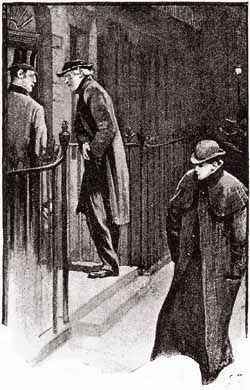

Don't look so smug. You haven't earned it.

I have also heard your voice before, Mrs. Norton, and it seems I am condemned to hear it over and over again. I find myself lamenting, as Dr. Watson did in “The Adventure of the Copper Beeches,” that Sherlock Holmes expressed no interest in Miss Violet Hunter and her luxuriant, chestnut hair once she ceased to be the focus of a case. Not because I feel that the Great Detective is in any particular need of a female companion, but because it means I would be rid of you. I find myself constantly on the alert for your presence, looking for mentions of your name, just as one would scan a dark alleyway for danger. I fear you will always be there, on the outskirts, claiming a cleverness that isn’t deserved and isn’t yours, but believe me, madam, you don’t have me fooled. I’m on to you.

Yours very truly (and honestly),
Jaime Mahoney


oOo

The above tongue-in-cheek piece first appeared – ironically – the 11th (2013) edition of Irene's Cabinet, a Sherlockian publication by Watson's Tin Box.

“Better Holmes & Gardens” has its own Facebook page. Join by “Liking” the page here, and receive all the latest updates, news, and Sherlockian tidbits.

Sunday, May 6, 2012

“My advice to you, sir, is to speak the truth”: In Defense of “The Resident Patient”

“For in those cases in which Holmes has performed some tour de force of analytical reasoning, and has demonstrated the value of his peculiar methods of investigation, the facts themselves have often been so slight or so commonplace that I could not feel justified in laying them before the public. On the other hand, it has frequently happened that he has been concerned in some research where the facts have been of the most remarkable and dramatic character, but where the share which he has himself taken in determining their causes has been less pronounced than I, as his biographer, could wish.”

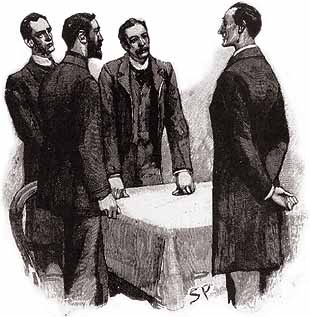
If you have ever been to a meeting of any of the many Sherlock Holmes scion societies, you know that these meetings tend to be rather boisterous. Rambunctious, even. Loud, to put it in even more simple terms. Members laugh and shout and argue, but it’s all in good fun, even if it is rather spirited. So, you can imagine my surprise, when attending the most recent meeting of Watson’s Tin Box, when the Gasogene opened up the discussion of “The Resident Patient” only to be met with silence. It was an awkward silence, complete with cricket sounds and forced coughing. After waiting a moment for someone, anyone, to speak, the Gasogene finally prompted: “So, I take it that none of you liked this story?”
“No,” someone finally spoke up. “No, I wouldn’t say that.”

“You liked it, then?”
“Well, I wouldn’t say that either,” said another Tin Box member.  “I wouldn’t say I feel much about the story either way.”

And that was the problem then. How does one verbalize: meh (complete with indifferent should shrug)? Is there even a way to discuss a story that appears to inspire such little feeling? Stories that are either greatly loved or greatly hated can inspire magnificent discussion, but a narrative that inspires no feeling likewise inspires no conversation. And relatively speaking, Sherlock Holmes doesn’t really do very much in RESI to inspire any kind of traditional response. The story begins with Holmes and Watson discussing the latest news, followed by a typical Holmesian deduction of Watson’s thought -process, and then the two men take a walk around London. They return to Baker Street, and spend the majority of the story listening to Dr. Percy Trevelyan relaying his very strange story. Holmes doesn’t even meet the man at the heart of the strange tale – Mr. Blessington – until more than halfway through the narrative, and even then he refuses to help him. Blessington is then killed in the middle of the night, and the murderers are eventually lost on the steamship Norah Creina, and thus come to no justice, except perhaps that of a karmic variety. 
So where do readers find the value in a story like RESI? If the mystery itself invokes only a feeling of lukewarm indifference, then what is there to which the reader can respond? And readers do respond to RESI – the story tied for 42nd place (along with “The Engineer’s Thumb,” “The Retired Colourman,” “Shoscombe Old Place,” and “The Yellow Face”) in the 1999 poll of invested members of the Baker Street Irregulars.  If the case itself teaches the reader nothing, then the reader is learning something from somewhere else in the tale, otherwise RESI would have been relegated to the very bottom of the list with the three stories tied for 54th place: “The Three Gables,” “The Mazarin Stone,” and “The Veiled Lodger.”

There’s actually quite a bit of information to gather about Sherlock Holmes from RESI – about his talents and methods – even if they are not on display to their fullest possible extent in this story. Watson begins by sharing with the reader:
“[Sherlock Holmes] loved to lie in the very centre of five millions of people, with his filaments stretching out and running through them, responsive to every little rumour or suspicion of unsolved crime. Appreciation of nature found no place among his many gifts, and his only change was when he turned his mind from the evil-doer of the town to track down his brother of the country.”

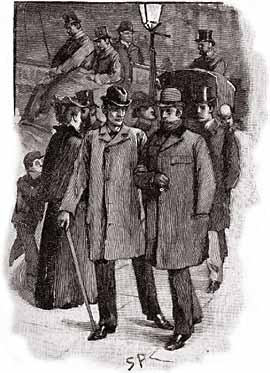
This insight into Holmes’s character is followed by a magnificent string of deduction on the Detective’s part. The deductions are of little import to the overall scope of the narrative, but he is able to catalog Watson’s entire train of thought and is even able to accurately remind Watson of how this train of thought began when the Doctor himself was unable to remember. This exercise into fundamental Sherlockian method is followed by the two men taking a stroll around London: “For three hours we strolled about together, watching the ever-changing kaleidoscope of life as it ebbs and flows through Fleet Street and the Strand. His characteristic talk, with its keen observance of detail and subtle power of inference, held me amused and enthralled.”
And so the reader finds this particularly charming sketch of Sherlock Holmes and John Watson as friends – a sliver of insight into the relationship that fuels the narratives of the Canon for so many readers. We see Holmes and Watson in a companionable, easy intimacy that comes with a long acquaintance. We see Dr. Watson charmed by his friend on the mere merit of Holmes being himself, nothing more. We see Sherlock Holmes at ease, and at his best.

I once got into a discussion with another Sherlockian about just how many of the stories in the Canon are owed to characters making extremely poor life choices, or being otherwise unable to spot glaring red flags. Obviously, RESI is one of these stories. Where would the reader be if Dr. Trevelyan had reflected for only a moment on the peculiarities of this stranger’s generous offer, and had decided to try his hand at researching nervous disorders for a bit longer? Likewise, what if Mr. Melas had said, “No, I don’t think I shall accompany you to an undisclosed location to translate for you at this late hour” (GREE)? Or if young Englishwomen had paid more cautious attention to those rumors circulating around that Baron Gruner fellow (ILLU)? Or even if Dr. Watson has said to young Stamford, “Beating the subjects in the dissecting room, you say? Oh, never mind. I’ve always imagined that I would be better off living on my own anyway” (STUD). So every story in the Canon has something to recommend to it, even if it is only a reminder of what might have been, or what never was.
oOo
“Better Holmes & Gardens” now has its own Facebook page.  Join by “Liking” the page here, and receive all the latest updates, news, and Sherlockian tidbits.
Monday, March 12, 2012

Currently on Twitter...

As part of an ongoing project on my Twitter feed, I'm delivering stories from the Sherlock Holmes canon in tiny installments of 140 characters or less. I recently finished up "The Reigate Puzzle" (or "The Reigate Squires," as you may be accustomed to calling it). The story opens with Dr. Watson arriving at Sherlock Holmes's side "...at a time when Europe was ringing with his name and when his room was literally ankle-deep with congratulatory telegrams I found him a prey to the blackest depression." It also contains a rather memorable scene involving a dish of oranges, a carafe of water, and Watson's understanding disposition.

The current story is "The Resident Patient," a story which begins with a quiet walk through London and ends with yet another case in which the Great Detective misses out on bringing his quarry to justice because of a shipwreck.

Check out my Twitter feed for a daily installment, although I am usually inspired to post more than once a day. And don't forget you can read through the original canon online.