Showing posts with label LAST. Show all posts

Thursday, January 8, 2015

“My power to surprise you” (EMPT): On Hiatuses

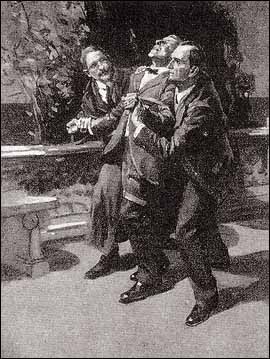
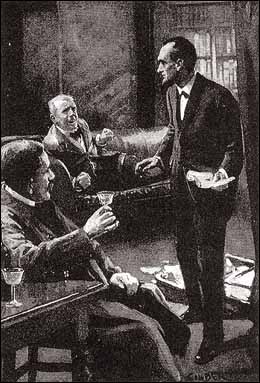
“I moved my head to look at the cabinet behind me. When I turned again, Sherlock Holmes was standing smiling at me across my study table. I rose to my feet, stared at him for some seconds in utter amazement, and then it appears that I must have fainted for the first and the last time in my life. Certainly a gray mist swirled before my eyes, and when it cleared I found my collar-ends undone and the tingling after-taste of brandy upon my lips. Holmes was bending over my chair, his flask in his hand.” (EMPT)
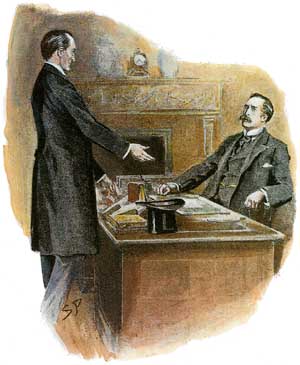

It is sometimes more difficult to return, than to leave.

On May 4, 1891, Sherlock Holmes allowed the world to believe him dead. He abandoned everything and everyone, only permitting his brother to know the truth. Holmes didn’t leave a single clue that he still lived, not even the flimsiest scrap of hope for those who cared most about him – unless one made a habit of looking for subtext in newspaper articles about Norwegian explorers. (Don’t we all?) The Great Detective was silent for nearly three years.
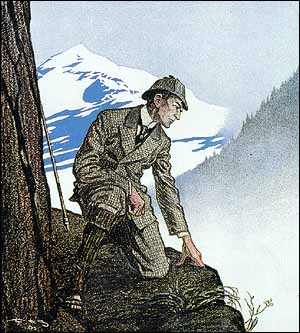

It was a time during which the criminal population of London grew more confident: “It is best that I should not leave the country. Scotland Yard feels lonely without me, and it causes an unhealthy excitement among the criminal classes.” (LADY)

In which Inspector Lestrade managed somewhat passable achievements in police work: “Three undetected murders in one year won’t do, Lestrade. But you handled the Molesey Mystery with less than your usual – that’s to say, you handled it fairly well.” (EMPT)

In which Mrs. Hudson kept a strangely untouched room at 221 Baker Street: “…Mycroft had preserved my rooms and my papers exactly as they had always been. So it was, my dear Watson, that at two o’clock to-day I found myself in my old armchair in my own old room, and only wishing that I could have seen my old friend Watson in the other chair which he has so often adorned.” (EMPT)

And in which Dr. Watson returned to his medical practice, his personal bereavements, and a quiet, uneventful life: “As we drove away I stole a glance back, and I still seem to see that little group on the step – the two graceful, clinging figures, the half-opened door, the hall-light shining through stained glass, the barometer, and the bright stair-rods. It was soothing to catch even that passing glimpse of a tranquil English home in the midst of the wild, dark business which had absorbed us.” (SIGN)

It can be argued that Sherlock Holmes left under duress, certainly. He left in pursuit of what remained of Professor Moriarty’s criminal empire, dodging boulders heaved at his person by Colonel Sebastian Moran, and the safety of the public at the forefront of his mind. Neither was it three years of rest and relaxation. He may have found ways to occasionally amuse himself, but Sherlock Holmes was rarely at ease during this time, telling Watson:

The course of events in London did not run so well as I had hoped, for the trial of the Moriarty gang left two of its most dangerous members, my own most vindictive enemies, at liberty. I travelled for two years in Tibet, therefore, and amused myself by visiting Lhassa, and spending some days with the head lama. You may have read of the remarkable explorations of a Norwegian named Sigerson, but I am sure that it never occurred to you that you were receiving news of your friend. I then passed through Persia, looked in at Mecca, and paid a short but interesting visit to the Khalifa at Khartoum the results of which I have communicated to the Foreign Office. Returning to France, I spent some months in a research into the coal-tar derivatives, which I conducted in a laboratory at Montpellier, in the south of France. Having concluded this to my satisfaction and learning that only one of my enemies was now left in London, I was about to return when my movements were hastened by the news of this very remarkable Park Lane Mystery, which not only appealed to me by its own merits, but which seemed to offer some most peculiar personal opportunities. (EMPT)

So, while it may not have been a consensual parting, the Great Detective left, nonetheless. And without a doubt there is a certain, sharped-edged cruelty to his departure, both for the people he left behind and for Sherlock Holmes himself. Leaving is difficult enough when you want to be found and contacted during your time away, but to disappear completely, without a trace? Well, that’s an extraordinary undertaking.

What’s even more extraordinary, however, is that Sherlock Holmes came back.

You may wonder, what’s so difficult about returning? Wouldn't that be the easiest part? Sherlock Holmes could just slip back into his old life, his old ways, his old work. Even his flat was kept just as he left it. And his friends and associates, once they got over the initial shock and sting of his deception, wouldn't they be grateful to have the Detective back? Wouldn't returning to his old life in London feel positively relaxing compared to the trials of the past three years?

But three years is a very long time, and things change. Mycroft Holmes may have done his best to keep his brother informed, but there was truly no way for the Detective to be certain of what awaited him in London. Perhaps Mrs. Hudson had grown tired of the perpetual silence in her home and the morbid memorial to a man she believed long dead – no matter what princely payments she was receiving for its upkeep? Perhaps Inspectors Lestrade and Gregson had learned to cooperate, and their combined forces meant the dawn of a new age of criminal investigation in London? Perhaps the criminal masses of London had grown tired of a city without Sherlock Holmes and had moved on to greener, more interesting pastures? Worst of all, perhaps Dr. Watson had grown accustomed to his new quiet life – with regular sleep, predictable meals, and no errant bullet holes piercing the walls of his sitting room?

None of these things, of course, proved to be true, but there was always the risk that his life was not as he left it. That there would be no well-worn rut to slip unobtrusively into. That returning to his life would be just as much of a fight as leaving it had been. Returning was just a risky as leaving, and Sherlock Holmes knew it, as he knew most things. But he also knew it was worth it. He knew – or perhaps only hoped – that there was still a place for him in London, and that the world still needed its only consulting detective.

My own hiatus has a name. Her name is Morrigan Maeve, and when she was born this past April, she weighed 7lbs, 5.5oz and was 20 inches long. She is an absolute joy and is completely worth everything. Unequivocally, everything. Like the Great Detective in Tibet, however, I have observed my Sherlockian life from a distance and hoped that there would still be a place for me when I returned. So now I’m back and “I trust that age doth not wither nor custom stale my infinite variety,” and that you all still have faith in “my power to surprise you.”

Now, there is work to do. Let’s get to it.


oOo

“Stand with me here upon the terrace…” (LAST)

For Trevor: You played the game for the game’s own sake. May it be 1895 wherever you are, my friend. 

Monday, January 21, 2013

Some Thoughts on Character: Colonel Sebastian Moran

Moran, Sebastian, Colonel. Unemployed. Formerly 1st Bangalore Pioneers. Born London, 1840. Son of Sir Augustus Moran, C. B., once British Minister to Persia. Educated Eton and Oxford. Served in Jowaki Campaign, Afghan Campaign, Charasiab (despatches), Sherpur, and Cabul. Author of Heavy Game of the Western Himalayas (1881); Three Months in the Jungle (1884). Address: Conduit Street. Clubs: The Anglo-Indian, the Tankerville, the Bagatelle Card Club… The second most dangerous man in London. ("The Adventure of the Empty House")

In the 2011 film, Sherlock Holmes: A Game of Shadows, Professor James Moriarty signs copies of The Dynamics of an Asteroid in Paris. His signature is an elegant scrawl from a fountain pen as he speaks in effortless French to those who have come to praise him. A man in an inconspicuous tweed suit slides into the empty seat next the Professor, a pair of opera tickets in his hands. There is a long pause as he waits for Moriarty to address him. Finally, the Professor turns, only slightly, to look at the man at his side: “My ticket?” The man nods, gesturing with the object in question.  “Unfortunately,” the Professor says, “you won’t be needing yours.” The man’s expression is largely unreadable as he looks back down at the tickets in his hands, but his sardonic tone is telling: “It’s a shame, Professor. I was looking forward to Don Giovanni.” The identity of the man in the unprepossessing suit isn’t officially revealed as Colonel Sebastian Moran until a bit later in the film, but there are enough clues in even that brief scene for the viewer to make the logical deduction on his or her own. For is that not how we always picture Colonel Moran – the slightly uncouth man on Moriarty’s right hand?


Paul Anderson as Colonel Sebastian Moran and
Jared Harris as Professor James Moriarty 
Colonel Sebastian Moran was first introduced to readers in “The Adventure of the Empty House,” but like many of the minor characters in the Canon, he has taken on a life of his own, appearing in numerous pastiches and television and film adaptations. In A Game of Shadows, mentioned above, he was played by Paul Anderson, and in the Granada television adaptation of EMPT, Patrick Allen. In the 1946 Basil Rathbone film, Terror by Night, Alan Mowbray took on the role of the Colonel (inexplicably masquerading as Major Duncan Bleek). In a recent episode of the new television series, Elementary (simply entitled, “M.”), actor Vinnie Jones takes a turn as Moran – a slightly more bloodthirsty, more unhinged version. And while the Colonel has not yet appeared in the BBC series, “Sherlock” (although who can say who was on the other end of those sinister red laser sights at the end of “The Great Game”?), don’t tell that to the legions of fans who have already imagined Mark Gatiss and Steven Moffat’s 21st century version of Professor Moriarty’s trusted assassin in full. Several pastiche writers have also imagined their own versions of Colonel Moran. Kim Newman’s Moran of The Hound of the D'Urbervilles is every bit as vulgar, crass, ruthless and merciless as so many have imagined (I fully recommend The Well-Read Sherlockian’s excellent review of the novel available here). In John Gardner’s novel, The Return of Moriarty, Moran’s appearance is pitifully, though logically and necessarily, brief – and raises a host of questions.


Jeremy Brett as Sherlock Holmes and Patrick Allen as Colonel Moran
But what do readers really know about Colonel Sebastian Moran? The above description – found in EMPT and taken from Sherlock Holmes’s own “index of biographies” – is concise and informative enough, providing details of birth and ancestry, education and military career, even his current address and preferred recreational spots, but the apparent glut of explicit knowledge ends there. Prior to EMPT (chronologically speaking), Moran is mentioned alongside Professor Moriarty in their brief cameo in The Valley of Fear: “[Moriarty’s] chief of the staff is Colonel Sebastian Moran, as aloof and guarded and inaccessible to the law as himself.” So readers can add those three remarkable descriptors (aloof, guarded, inaccessible) to what they already know about the man. To put Moran on the same level as Moriarty in terms of demeanor and position is quite a lofty compliment indeed. But it is also contrary to the man that readers know from EMPT. The Colonel found there is a man of barely contained rage, snarling, savage and “wonderfully like a tiger himself.” As Watson recounts, “The fury upon [Moran’s] face was terrible to look at.” This is a man impulsive and hotheaded enough to murder a man because he could expose the Colonel’s unethical card practices, but patient and methodical enough to be really clever about how he did it. There is the “man of iron nerve,” that Sherlock Holmes describes, a man ruthless enough to relentlessly pursue a man-eating tiger, but possessing of the necessary quietness of disposition to be successful.


At the end of EMPT, the Great Detective seems more than confident that the Colonel will no longer be a concern, but Moran doesn’t disappear from the Canon entirely. In “The Illustrious Client,” which according to William Baring-Gould’s chronology takes place in 1902, Holmes comments: “If your man is more dangerous than the late Professor Moriarty, or than the living Colonel Sebastian Moran, then he is indeed worth meeting.” And in “His Last Bow,” which according to the same chronology takes place in 1914: “The old sweet song… How often have I heard it in days gone by! It was a favourite ditty of the late lamented Professor Moriarty. Colonel Sebastian Moran has also been known to warble it.” This means that Moran was most definitely alive as of 1902, and most probably alive as of 1914 (Holmes refers to the Colonel in the present tense, but a life of international espionage is a busy one, so it might be worth arguing that Holmes’s information could be outdated). Surviving an incarceration of twenty years or more certainly shows a certain resilience of character, or perhaps just a mulish intractability.

At the end of A Game of Shadows, Moran covertly executes Professor Moriarty’s undercover assassin (discreetly, with a blowgun) and then walks out of the Swiss chateau, into the shadows, and away from Professor Moriarty, who is currently engaged in a cerebral battle out on the balcony with Sherlock Holmes. Dr. Watson runs towards his friend, while the Colonel just simply walks away, his intended direction unknown. It is a curious divergence, but not entirely unexpected. As Holmes himself points out in EMPT:

"There are some trees, Watson, which grow to a certain height, and then suddenly develop some unsightly eccentricity. You will see it often in humans. I have a theory that the individual represents in his development the whole procession of his ancestors, and that such a sudden turn to good or evil stands for some strong influence which came into the line of his pedigree. The person becomes, as it were, the epitome of the history of his own family... Whatever the cause, Colonel Moran began to go wrong."

The Great Detective refers to Colonel Moran as a shikari, which is a Persian word in two parts: the main “Shikar,” meaning “of hunting” and the suffix “i” denoting possession. And it would seem that Moran too was a character in two parts. He comprises a certain cold reservation that made him equal to sit beside Professor Moriarty, but also a contrary savagery that made him effective in his role. Like so many remarkable characters, it is the dichotomy that makes Moran interesting, makes him memorable. Sherlockians return to Colonel Sebastian Moran not simply because he sits beside Professor Moriarty, but because he stands on his own, and cuts his own path.

oOo

“Better Holmes & Gardens” now has its own Facebook page.  Join by “Liking” the page here, and receive all the latest updates, news, and Sherlockian tidbits.

Saturday, September 15, 2012

Some Thoughts on Character: The Recurrent American

“Then I trust that you at least will honour me with your company,” said Sherlock Holmes. “It is always a joy to meet an American, Mr. Moulton, for I am one of those who believe that the folly of a monarch and the blundering of a minister in far-gone years will not prevent our children from being some day citizens of the same world-wide country under a flag which shall be a quartering of the Union Jack with the Stars and Stripes.” (“The Noble Bachelor”)

Sherlock Holmes found Americans really fascinating. Upon greeting Mr. Francis Moulton in “The Noble Bachelor,” Holmes proceeds to treat the young man like some sort of fantastic oddity – like he has just encountered a white tiger or a new species of honeybee in his sitting room. It’s as if Holmes wants to analyze Moulton, to extract the young American’s secrets through scientific inquiry and research, to study him intensely under a high-powered microscope. Indeed, it is not so difficult to imagine Holmes turning to Watson and saying, “Oh, please let me keep him! I need more information for my index and he’ll make just the perfect addition. I promise to feed him, water him, and walk him every day!” 

Fine, Lord St. Simon. You can leave.
I don't want to share my new American friends anyway.
Francis Moulton, and his wife Hatty, are far from the only Americans to appear in the Canon. The appearances of colonials span from clients, informants, criminals, even some detectives, and everything in between. There seems to be a role for an American in every frame and facet of the original stories. Even The Woman, Irene Adler “of dubious and questionable memory,” was an American – Holmes’s index indicates that she was born in New Jersey, of all places, in 1858. In “The Adventure of the Red Circle,” readers are introduced to Mr. Leverton, of the Pinkerton Agency, who is assisting Inspector Gregson. The American detective is described rather agreeably as “a quiet, businesslike young man, with a clean-shaven, hatchet face, [that] flushed up at the words of commendation.” Sherlock Holmes is quite pleased to meet Leverton, who has made something of a name for himself as a detective in America. For his part, Holmes has heard of the man’s work, and appears to find it exceptional.

Not all Americans in the Canon are depicted in such glowing terms, of course. While “The Dancing Men” features the young American woman Elsie Cubitt (née Patrick) whose devotion to her husband causes her to attempt to take her own life after his murder, it also features the villainous Abe Slane – “the most dangerous crook in Chicago.” It is Slane who murders Hilton Cubitt, but only after he torments poor Elsie with a series of haunting coded messages, culminating in the rather nightmarish missive: “ELSIE - RE – ARE TO MEET THY GO-.” And while Slane contends that “…there was never a man in this world loved a woman more than I loved [Elsie],” needless to say, Slane’s monstrous behavior more than eclipses any love that he can profess to feel.

I told you I wanted to know more about Chicago.
I wasn't kidding.
Likewise the Americans featured in A Study in Scarlet and The Valley of Fear do not all come off as shining beacons of virtue. In “The Country of Saints,” the second part of STUD, the reader is introduced to a less-than-righteous clan of Mormons, who exhibit a murderous intent on the acquisition of persons and property at all costs. VALL features a secret order, the Ancient Order of Freemen, filled with seemingly every type of unsavory individual, whose criminal deeds appear to run the gamut of almost every type of illegal activity. The actions of the Order influence how the entire town functions. Of course, the villainous Americans of these stories find their more honorable counterparts. In STUD, the American Jefferson Hope has been on a decades-long quest to avenge the death of his beloved Lucy Ferrier, dying only just after succeeding in his pursuit. In VALL, the Freeman John McMurdo is revealed to be Birdy Edwards, another Pinkerton detective, and the secret society is swiftly brought to justice for their crimes. More interestingly, these particular passages actually take the reader to America, rather than bringing the American to England and Baker Street. If Americans are some sort of exotic curiosity in the Canon, then the curiosities in these stories are being presented in their natural habit, interacting with others of their own species.

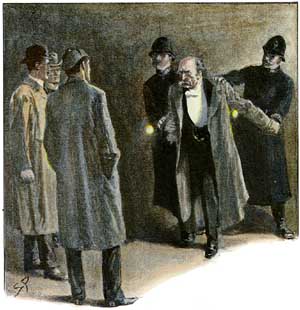
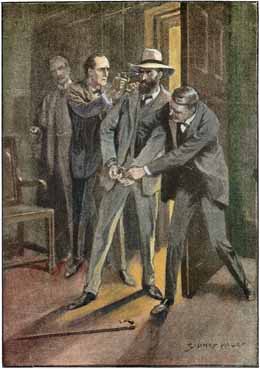
Chronologically speaking, Sherlock Holmes’s American experiences culminate with “His Last Bow.” The story finds Holmes having just spent two years undercover as an Irish-American named “Altamont.” However, if the Sidney Paget’s illustration is to be believed, the extent of his disguise involved growing an unsightly goatee and adopting an American accent. Anyway, Holmes’s American journey took him on a rather circuitous route, as he says he has been from Chicago to Buffalo, and those are just the places he mentions. But the reader is left behind on this journey, and does not get to experience America with Sherlock Holmes. And, it would seem, his excursion has left him weary of America, if not Americans. As he says to Watson, "Tomorrow [the goatee] will be but a dreadful memory. With my hair cut and a few other superficial changes I shall no doubt reappear at Claridge's tomorrow as I was before this American stunt - I beg your pardon, Watson; my well of English seems to be permanently defiled - before this American job came my way” (LAST).

Well, that is some very American facial hair indeed.
I can see why Von Bork was fooled. I think.
William Gillette, the man who brought Sherlock Holmes so famously to life on the stage, was an American, born in Connecticut in 1853. When Conan Doyle and Gillette first met, the actor surprised Conan Doyle by emerging onto the train platform, kitted out in a full Sherlock Holmes ensemble, complete with magnifying glass. After recovering from his shock, Conan Doyle laughed, completely charmed, and Gillette and Conan Doyle became lifelong friends. What an oddity Conan Doyle must have thought Gillette was upon that first meeting, how strange and otherworldly. But that didn’t stop him from entrusting the man with the care of his most famous – if not beloved – creation. Similarly, Sherlock Holmes may have found Mr. Francis Moulton a neat little marvel upon their first meeting – something on par with a new type of tobacco ash or particularly fascinating chemical equation – but that peculiar fascination didn’t stop Holmes from entrusting himself to the national identity of Francis Moulton, Birdy Edwards, and even Abe Slane. The recurring presence of Americans and American themes in the Canon is striking in its frequency, but their peculiarities have purpose, even if it is occasionally disagreeable.

oOo

“Better Holmes & Gardens” now has its own Facebook page.  Join by “Liking” the page here, and receive all the latest updates, news, and Sherlockian tidbits.

Monday, April 16, 2012

Currently on Twitter...

As part of an ongoing project on my Twitter feed, I'm delivering stories from the Sherlock Holmes canon in tiny installments of 140 characters or less. I recently finished up "The Resident Patient," a story which begins with a quiet walk through London and ends with yet another case in which the Great Detective misses out on bringing his quarry to justice because of a shipwreck.

The current story is "His Last Bow: An Epilogue of Sherlock Holmes," which opens "upon the second of August – the most terrible August in the history of the world," and closes with "the last quiet talk" Sherlock Holmes and Dr. Watson may have ever had.

Check out my Twitter feed for a daily installment, although I am usually inspired to post more than once a day. And don't forget you can read through the original canon online.

Friday, April 22, 2011

“I never can resist a touch of the dramatic” (NAVA): Sherlock Holmes and the Art of Disguise

“Ah, you rogue!” cried Jones, highly delighted. “You would have made an actor and a rare one. You had the proper workhouse cough, and those weak legs of yours are worth ten pound a week.  I thought I knew the glint of your eye, though. You didn’t get away from us so easily, you see” (The Sign of Four).
I have a confession to make.  You see, I was once completely taken in by one of Sherlock Holmes’s disguises.  There, I said it.  I don’t feel any less embarrassed for having admitted it, but still, it’s the truth.  It was my first viewing of The Adventures of Sherlock Holmes (1939), starring Basil Rathbone, and oh, how I laughed when that silly vaudeville singer came out, in his ridiculous striped jacket.  And oh, how I chuckled to myself, thinking how Sherlock Holmes would never do anything as undignified as sing, “I Do Like to Be Beside the Seaside,” while dancing merrily.  And oh, how stupid I felt when that music hall performer revealed himself as the Great Detective.  I had read the stories after all, how did I not I see this coming?  It felt a bit like being caught off-guard at Holmes making a complex deduction or lighting his pipe; at times, the disguises seem as much a part of his character as anything else.
www.basilrathbone.net
Sherlock Holmes uses the art of disguise throughout the canon, quite often and typically to great success.  On average, he appears as some form of laborer (CHAS) or as a sailor (SIGN), and even once appearing as an opium addict (TWIS); on film or television, his costumes tend to be a bit more elaborate [Note: Rupert Everett’s impressive “French ambassador” disguise in Sherlock Holmes and the Case of the Silk Stocking].   But there are three particular disguises from the canon that stand out as being unique: the old priest whom Holmes becomes to gain access to Briony Lodge and Irene Adler; the old bookseller he is dressed as when he presents himself to Watson after the Great Hiatus; and Holmes’s spy persona, the Irish-American “Altamont.”  These three instances highlight both the faults, and the intricacies of purpose, when considering this particular method in Holmes’s art of detection.
·         The Old Priest from “A Scandal in Bohemia”
A unique disguise for Holmes if only in that it failed.  He appears in costume twice in SCAN, first as “a drunken-looking groom,” before becoming the “simple-minded Nonconformist clergyman.”  Granted it was the entire package of circumstances (the rowdy crowd, the fire scare, the smoke bomb, and the old priest) that allowed Irene Adler to realize that she had been duped.  But Holmes’s disguise didn’t serve to protect him.  He is wearing it at that famous canonical moment, when bent over to unlock the door to Baker Street, Adler saunters past (in her much more effective costume) and says, “Good-night, Mister Sherlock Holmes.”  Holmes is caught off-guard and very unsettled.  The Great Detective has been defeated, and he doesn’t even fully realize it until the next day, when he returns to Briony Lodge with Watson and the King of Bohemia to attempt to retrieve the prize.
Holmes has a laundry list of skills at his disposal, without even considering his ability to camouflage himself: analytical and deductive reasoning, physical dexterity, safe cracking and lock picking, the ability to identify 140 different types of tobacco ash (BOSC) and 42 different bicycle tire treads (PRIO).  But Holmes’s ability to disguise himself is a bit like putting on armor; it’s a skill, to be sure, but it also acts as an extra layer of protection.  Holmes appears as other people when it would be unwise to appear as himself, or when he would learn more masquerading as someone else.  The costumes shelter him from physical threat, and protect him from the possibility of failure.   
Irene Adler saw through his disguise, and she knew who he was.  She knew that she had become “an object of interest to the celebrated Mr. Sherlock Holmes.”  Sherlock Holmes wasn’t just wrong in the case of “A Scandal in Bohemia”; and he wasn’t just proven wrong by a woman.  He was proven vulnerable.
·         The Old Bookseller from “The Empty House”
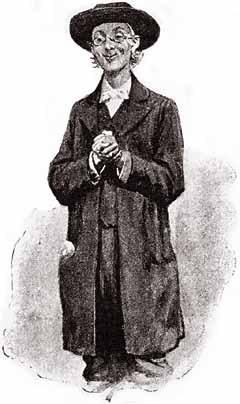
A unique costume for the reasons that Holmes employed it.  Ransom Riggs says, in The Sherlock Holmes Handbook: The Mysteries and Methods of the World’s Greatest Detective, “Few things are more shocking than watching one person become another” (143).  Nowhere in the canon is this more accurate than in “The Empty House.”  One moment, Watson is talking to an old bookseller who is eagerly trying to sell him copies of British Birds, Catullus, and The Holy War; he turns to examine his bookcase and when he looks back, Sherlock Holmes is smiling at him—a man who by all accounts has been dead for three years.  It’s hard to blame the Doctor for careening into a flat faint. 
Holmes gets quite a bit of grief for being needlessly cruel to his old friend in this instance, and even he terms his use of the disguise as “unnecessarily dramatic,” but there are few factors to consider before passing judgment.  While the rest of the world thinks Sherlock Holmes is dead—and that meant he could have walked down a Kensington street and not attracted any notice from random passersby—there certainly were people that were looking for the face of a dead man in the crowd.  Holmes knew that one of Professor Moriarty’s confederates, Colonel Moran, had escaped capture; and most importantly, Holmes knew that he was being watched.  In short, he is in danger, but most especially, he is a danger to others.  If he had simply strolled casually into Watson’s practice dressed as no one but himself, the apple-seller across the street may have thought little of it, but more likely, one of Moran’s associates would have attempted to cut down Holmes before he ever crossed the threshold.  And if not, Watson would have been in danger just by being in Holmes’s presence. 
So in this instance, Holmes disguises himself, not just to glean information, not just for his own protection, but for the protection of others.
·         “Altamont,” Irish-American Spy, from “His Last Bow”
A unique masquerade if only in terms of sheer longevity.  In this story, which is chronologically the last of their adventures (taking place in 1914), Holmes tells Watson how he came to be a spy, under the behest of the prime minister himself: “It has cost me two years, Watson, but they have not been devoid of excitement. When I say that I started my pilgrimage at Chicago, graduated in an Irish secret society at Buffalo, gave serious trouble to the constabulary at Skibbareen…”  Michael Walsh’s short story, “The Song at Twilight,” available in the collection, Sherlock Holmes in America, provides an interesting timeline of specifics regarding Holmes’s American excursion, including the details of his induction into the Irish secret society he spoke of, how “James McKenna” became “Altamont,” and how the ghost of a past adventure influenced that change.
Altamont is also peculiar in that he is not one of Holmes’s more complicated disguises in terms of make-up and costuming.  He grows a goatee, and adopts an Irish-American accent and appropriate slang.  Both of which he apparently despises and plans to do away with as soon as possible, but a disguise for Sherlock Holmes was more than just grease-paint and fake hair.  As Watson tells us, “It was not merely that Holmes changed his costume.  His expression, his manner, his very soul seemed to vary with every fresh part that he assumed” (SCAN).  Considering this, assuming a persona for two entire years, becomes a very interesting thing indeed for Sherlock Holmes. 
In “The Song at Twilight,” Holmes outlines the assumption of his new personality: “Still, no role I had played, neither stable boy, nor wizen bookseller, nor even Sigerson—when the world, including Watson, thought me dead after Professor Moriarty’s unfortunate accident at the Reichenbach Falls—could rival my new persona…With every passing day, he was becoming more and more real to me, and there were days when I hardly thought of Mr. Sherlock Holmes of Baker Street” (336).  “Altamont” is interesting, therefore, in that he could perhaps be termed a person and not a persona; and serves to further accentuate the very dangerous games Holmes sometimes played with others, but also with himself.  
~~~
Like Inspector Jones tells him in The Sign of Four, Holmes “would have made an actor and a rare one,” and the Detective’s ability to masquerade as almost anyone provides some of the canon’s more lighthearted moments.  But as with almost everything he does, there are layers of purpose here.  He uses disguise for a myriad number of reasons—to get information, to protect himself, to protect others, and perhaps even for reasons that are beyond his own understanding.  Whatever the case, Holmes was a master at it, and even Watson never seemed to develop the ability to see through his friend’s subterfuges, no matter how many years they knew each other.  Perhaps then I’ll stop being embarrassed about my oversight in The Adventures of Sherlock Holmes.  Probably not.
oOo
A new blog contest launches this Monday, April 25!  Brush up on your Sherlock Holmes trivia, and check back here for details on how to enter and win.