Showing posts with label colin jeavons. Show all posts

Saturday, February 2, 2013

“The Meaning of This Extraordinary Performance” (COPP): Granada Television’s “The Six Napoleons”

“Now let me endeavour to show you the different steps in my reasoning. To begin at the beginning.” (“A Study in Scarlet”)

"It has long been an axiom of mine that the little things are infinitely the most important.” (“A Case of Identity”)

There is no better place to begin a discussion of Granada’s adaptation of “The Six Napoleons” than at the beginning. The episode opens on an odd note: a young woman sensually washes herself at an open window while an old man watches lecherously from across the way. The camera pulls back from the depraved onlooker to reveal a young man (Pietro Venucci, played by Vincenzo Nicoli) and a young woman (his sister, Lucrezia, played by Marina Sirtis of “Star Trek: The Next Generation” fame) arguing heatedly in Italian. The argument takes a sudden, violent turn as the man strikes the woman across the face, but their argument carries on without pause. The elderly voyeur finally intercedes, but the young man eventually devolves into hysterical screaming before he runs from the room – the young woman chasing after him, sobbing, her hair falling out of its neat arrangement and blood running from her lip. The first five minutes of Granada Television’s adaptation of SIXN could be quite accurately described as bizarre, with dialogue almost entirely in un-translated Italian and the opening sequence ending with the episode’s main antagonist laughing maniacally while being taken away in a straitjacket. Topped off with a well-filmed fight scene and a strange ritualistic moment involving a photograph and a jewel-encrusted dagger, these opening scenes are indeed odd, but are also punctuated with perfect, memorable moments.

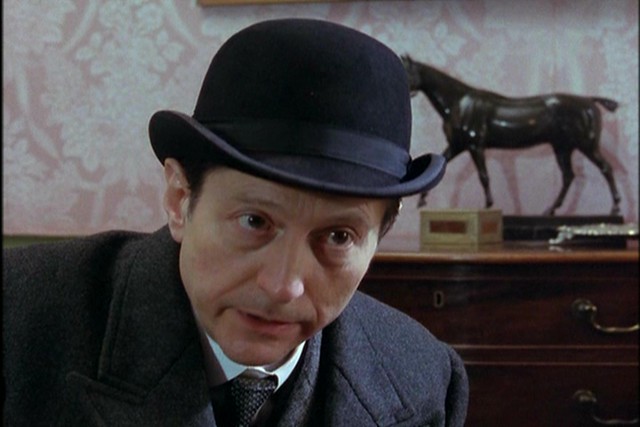
These perfect moments carry over throughout the episode and the first scenes at Baker Street (nearly six minutes into the production, but chronologically a year later) are no exception. The viewer finds Inspector Lestrade (Colin Jeavons) comfortably ensconced in the sitting room of 221B, drinking brandy and smoking cigars with Dr. Watson (Edward Hardwicke) while Sherlock Holmes (Jeremy Brett) peruses a tattered folio. According to Richard Valley, “A man of considerable reticence where companionship is concerned, Sherlock Holmes has no close friends save Dr. John H. Watson, which perhaps explains why it’s so utterly charming and delightful to find, at the start of this episode of THE RETURN OF SHERLOCK HOLMES, that Inspector Lestrade of Scotland Yard is given to dropping by 221B Baker Street every now and then to pass the time.” The casual intimacy between the three men is only reinforced by perfect, punctuating moments, like those already seen in the episode’s prologue. The knowing way in which Holmes lowers the folio to encourage Lestrade to “tell us about it,” understanding intuitively that the man has something of interest to share, but is restraining himself. Or Lestrade’s pleased expression when Holmes rubs his hands together and admits that the Inspector’s story “is certainly very novel.” Or the way in which the Great Detective laughingly tells Watson that the Doctor’s theories “will not do” – dismissively, but without any real venom.


Granada’s adaptation of SIXN is also a demonstration of how well Dr. Watson and Inspector Lestrade know their dear friend, the lengths to which they will go to in order to accommodate him, and how deeply they admire him. While in the morgue, Sherlock Holmes closely inspects the corpse of Pietro Venucci, paying no mind to his proximity to the dead man or the appropriateness of examining him with a magnifying glass. Once the Detective leaves, Lestrade leans down to inspect the corpse himself, his actions a pale imitation of Holmes’s own, before pulling the sheet back over poor Venucci. Later, when Holmes insists that a visit to Chiswick would be timelier than Lestrade’s plan to visit the Italian Quarter, the Inspector actually protests the change in plan very little, and compliantly takes up space upon 221B’s sofa until Holmes tells him that it is time to go. And while waiting in the dark and cold at two o’clock in the morning (we know, because Watson dutifully checks his pocket watch), his only question is “I don’t suppose we can smoke, can we?” Watson offers Lestrade a hard candy so as to ease some of the Inspector’s suffering, only to be told (in another one of those perfectly memorable moments) by Sherlock Holmes: “This is no time for humbugs!” Lestrade’s apparently blind faith in Holmes is soon validated, however, by the appearance of Beppo (the raving lunatic from the opening sequence).

Holmes’s mutual admiration for Watson and Lestrade is also present. When Holmes reveals to Watson how he has baited the journalist Horace Harker into writing a sensational (though inaccurate) article for his newspaper, Watson is visibly pleased with his friend’s cunning and tells him so. The Detective’s reply of thanks is both sincere and enthusiastic (with a mannered tip of his cane to set off his words). Moments later when Holmes and Watson return to Baker Street and approach their sitting room, they find that Lestrade is already present and unaware of their arrival. The Inspector is trying to surreptitiously view the folio that Holmes left on an end table (presumably the same one Holmes was reading at the beginning of the episode). The Detective is more amused by these actions than anything else, and rather than embarrass the Inspector by catching him in the act of prying, he instructs Watson to quietly walk away from the sitting room door – and return a moment later, much more loudly, giving Lestrade a moment to jump out of his seat and away from suspicion.

Inspector Lestrade in close examination of his shoes.
In his role as Sherlock Holmes, Jeremy Brett never wasted a gesture, a facial expression, or a well-timed inflection on a word of import. And so, whether Holmes chokes on his coffee at Watson’s command to be ready in “two minutes,” lowers his head to stare meaningfully but silently at Mr. Horace Harker, or trills slightly over the letter “R” in the word “morgue,” the viewer knows that these are moments of consequence and therefore they take notice. Although some moments may seem hyperbolic to almost the point of overacting – such as when Holmes greets Mr. Sandeford of Reading (and the sixth Napoleon bust) with an exaggerated turn and flourish from his dramatic posture at the fireplace mantel – the actions are not without purpose. For Sherlock Holmes is a theatrical man, with dramatic sensibilities, and the instance lays the framework for the scene just moments later when Holmes takes a cane to the plaster bust of Napoleon – violently and without warning. And instead of being shocked by the sight of the shattered bust, Watson and Lestrade are merely surprised, greeting with delighted astonishment the priceless pearl the Detective finds within – because they know their friend’s nature. They understand what he is made of.

The episode ends, as so many viewers already know, with one more perfectly punctuated moment, with Colin Jeavons delivering Inspector Lestrade’s memorable monologue from SIXN:

“I’ve seen you handle a good many cases, Mr. Holmes, but I don’t know that I ever knew a more workmanlike one than that. We’re not jealous of you at Scotland Yard. No, sir, we are very proud of you, and if you come down to-morrow, there’s not a man, from the oldest inspector to the youngest constable, who wouldn’t be glad to shake you by the hand.”

 
But even more remarkable than the words, delivered exactly as written in Sir Arthur Conan Doyle’s original story, is the way in which Jeremy Brett’s Sherlock Holmes reacts to the words. Something that a reader of the Canon had only supposed, but had never before seen, is the way in which the Detective is moved by the Inspector’s compliment. As Watson says, “[Holmes] was more nearly moved by the softer human emotions than I had ever seen him,” but Granada’s presentation has the visual appeal that the written word sometimes does not. The camera angle is tight on Holmes’s face, rarely breaking away, and the subtly evolving emotions are viewed in full – a slightly more open and softer expression, a dropped lip, and eyes that seem instantly, impossibly brighter. And when Sherlock Holmes thanks the Inspector twice – once with passion and once more as his rational side asserts itself – the scene is perfectly punctuated, the episode perfectly executed.

oOo

“Better Holmes & Gardens” now has its own Facebook page.  Join by “Liking” the page here, and receive all the latest updates, news, and Sherlockian tidbits.

Sunday, February 12, 2012

“The Meaning of This Extraordinary Performance” (COPP): Granada Television’s “The Second Stain”

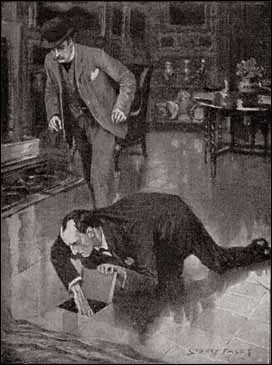
"’Now, Watson, now!’ cried Holmes with frenzied eagerness. All the demoniacal force of the man masked behind that listless manner burst out in a paroxysm of energy. He tore the drugget from the floor, and in an instant was down on his hands and knees clawing at each of the squares of wood beneath it. One turned sideways as he dug his nails into the edge of it. It hinged back like the lid of a box. A small black cavity opened beneath it. Holmes plunged his eager hand into it and drew it out with a bitter snarl of anger and disappointment. It was empty.”

Readers of Sherlock Holmes want nothing more than to see our favorite scenes come to life – vibrantly, often in full color, and on the biggest television or cinema screen we can find. It's not that our own imaginations are somehow lacking – I imagine most folks of any literary bent are all possessed of extremely vivid and lively imaginations – but there is something intrinsically satisfying in being able to say (usually to yourself, a confused pet, or perhaps some longsuffering family member who is idly perusing pamphlets for mental wellness centers), "Yes. Yes, that is precisely how I imagined it." And the Granada television series starring Jeremy Brett as Sherlock Holmes was remarkably adept at capturing that feeling of preciseness, of the satisfaction of exactness. The Baker Street sitting room comes to life with impeccable detail, and the Great Detective’s “certain quiet primness of dress” becomes available for minute examination (MUSG).

But all of these elements are lost without a performance, which the Granada series always delivers in spades. Each episode tried to capture of some each canon story’s particularly unique moments, the ones both implicitly and explicitly stated. For example, the demonstration of Mr. Henry Baker’s cranial capacity via his lost hat from “The Blue Carbuncle,” is charmingly rendered, and scenes from “The Red-Headed League” often seem like a Sidney Paget illustration come to life. Granada’s 1986 adaptation of “The Second Stain” is filled with such instances; ones which readers of Sherlock Holmes stories are drawn to from the original source material, and ones that they might not have even known that they wanted to see rendered.

Dr. Watson informs his readers that Sherlock Holmes was capable of no small amount of physical energy or exertion, when the occasion served his purposes. In those instances, the Doctor describes his friend as “absolutely untiring and indefatigable” (YELL), and it often seemed as if Jeremy Brett was bound and determined to capture that indefatigable energy in every episode, until his own illness and physical limitations prevented him from doing so. This energy is captured best in Granada’s version of SECO as Brett’s Great Detective carelessly tosses Eduardo Lucas’s eponymous stained carpet aside, and throws himself hard upon the ground. He then begins to crawl relentlessly across the floor, clawing viciously at each wooden tile – his determination so visible and obviously single-minded that the viewer almost fears for Dr. Watson’s well-being if he weren’t tucked away by a window keeping watch. But the capstone of the scene comes as Holmes finds the hidden compartment beneath floor, and opens it – only to find it empty. Brett’s “bitter snarl of anger and disappointment” is a total, full-bodied effort, sounding so much like an enraged bull that the viewer half-expects steam to rise from his nostrils. But Sir Arthur Conan Doyle’s original scene (as referenced at the beginning of this post) is captured entirely, down to the last detail.
(Photo via bookishadventures.tumblr.com)
The episode also features a variety of more subtle efforts, which are no less important to achieving the overall effect of exactness. For example, the understated play of expression on Brett’s face as Inspector Lestrade (Colin Jeavons) relays the mystery of the stained carpet are more telling than any overt display of realization. The audience does not have to be told that the small quirk of his mouth means that Holmes has deduced the presence of a hidden compartment – they simply know. Furthermore, the audience likewise knows that, as Holmes lights his pipe and carelessly tosses his match, the Detective’s monologue about the possible locations of the missing paper will lead to more than just a rather smug statement about the Detective’s own abilities: “Should I bring this to a successful conclusion, it will certainly represent the crowning glory of my career!” It also almost leads to a small fire in the Baker Street sitting room, as Holmes’s narrow focus and disregard to common concerns means that his neglected match has again caught light and a pile of discarded newspapers is aflame.

Dr. Watson also has a role in envisioning some of the canon’s iconic moments. As the Doctor comments on Lady Trelawney Hope’s beauty and bearing, Holmes famously responds, “The fair sex is your department, Watson.” But he accompanies this statement with an oddly-pitched, contemplative noise and a dismissive hand gesture that fully enforces how trivial the Detective finds his friend’s “department.” Holmes is not concerned with the outward trifles of Lady Trelawney Hope’s appearance – he is more concerned with what she really wants. Of course, the Detective’s seeming flippancy towards his friend is later offset as the two men stand together companionably, reading the newspaper article about the murder of Eduardo Lucas and bantering about the valet who was out for the evening (“They always are!”) and the elderly housekeeper who heard nothing (“They never do!”). This particular scene is not present in the canon as Granada presents it, but is instead an implicit moment, which the production brought to the surface.

It’s no great revelation to say that the Granada adaptations of the Sherlock Holmes stories were extraordinary, or even to say that they were extraordinary for their minute and exacting attention to detail. But those details are worth mentioning, because there is something uncommon in seeing a favorite scene come to life exactly as it was imagined, or in the inclusion of a moment previously given only a passing reference, but which breathes new life into that which is already offered. The Granada production and its cast and crew often managed to achieve an authenticity which often seemed unachievable, and their 1986 adaptation of “The Second Stain,” remains a hallmark of those efforts.

oOo

“Better Holmes & Gardens” now has its own Facebook page.  Join by “Liking” the page here, and receive all the latest updates, news, and Sherlockian tidbits.

Friday, March 4, 2011

Some Thoughts on Character: “The Best of the Professionals” (HOUN)

Detective Inspector Lestrade stands in the doorway of 221B Baker Street, shrugging on his jacket as John Watson watches.  Doctor Watson asks the DI for any insight into the behavior of his new, eccentric flatmate, Sherlock Holmes.  He’s hoping that Lestrade will advise him on how to handle the man’s many apparent foibles; perhaps he’s hoping that Lestrade will tell him that, despite all appearances to the contrary, John Watson has not decided to share a flat with a man who runs after serial killers, like a child runs after an ice cream truck. 
Unfortunately, Lestrade does not give the Doctor any hope, but he does pause, on his way out the door, to explain why he puts up with Holmes’s manic behavior:  “Because I’m desperate, that’s why.  Because Sherlock Holmes is a great man, and I think one day—if we're very, very lucky—he might even be a good one.”  The scene is from the 2010 BBC adaptation, “Sherlock,” but it’s not so difficult to imagine any of the incarnations of Inspector G. Lestrade muttering this sentiment.
With little time and little effort, any reader could summarize Lestrade’s characteristics, as should probably be the case with any supporting character in an extended series.  According to H. Paul Jeffers in his book, Bloody Business: An Anecdotal History of Scotland Yard:
“He is the most famous detective ever to walk the corridors of Scotland Yard, yet he existed only in the fertile imagination of a writer.  He was Inspector Lestrade.  We do not know his first name, only his initial: G.  Although he appears thirteen times in the immortal adventures of Sherlock Holmes, nothing is known of the life outside the Yard of the detective whom Dr. Watson described unflatteringly as sallow, rat-faced, and dark-eyed and whom Holmes saw as quick and energetic but wholly conventional, lacking in imagination, and normally out of his depth—the best of a bad lot who had reached the top in the CID by bulldog tenacity (95).”
Sidney Paget
Lestrade has the honor of appearing in the first Sherlock Holmes story, A Study in Scarlet, along with Inspector Tobias Gregson, but beyond that it’s easy to think of his character as merely a method of conveyance—someone has to get the details of the case into Holmes’s hands, why not a member of the police force?  In fact, Lestrade—as with any member of Scotland Yard that appear in the canon—seems almost painfully one-dimensional.  We don’t even know his first name (Gregory? Geoffrey? George? Gerald? Gabriel?), and sometimes it seems that most of the debate over Lestrade centers on the pronunciation of his last name (Long ‘A” sound? Short ‘A’ sound?). 
In Dictionary of the Theatre: Terms, Concepts, and Analysis, Patrice Pavis says that the role of a character is to give off “the illusion of being a human person.”  This is particularly applicable in the case of Inspector Lestrade, because he gives off the illusion of being Sherlock Holmes, and therefore makes the Great Detective himself seem even more real.  Just as Mycroft Holmes makes his younger sibling seem more god-like, Inspector Lestrade makes Sherlock Holmes seem a little more human, his skills and abilities a little more attainable.  Lestrade makes clear the cracks in Holmes’s deductive armor, the places where he is most vulnerable.   
Sherlock Holmes describes Lestrade in “The Cardboard Box” as being, “…absolutely devoid of reason, he is as tenacious as a bulldog when he once understands what he has to do.”  Holmes says this as if it were a characteristic unique to Lestrade, as if it were something charming about the man that made him a little more palatable than the rest of Scotland Yard.  Well, to be totally frank, Mr. Holmes?  You can be “as tenacious as a bulldog” yourself, when you want to be.  When Holmes gets his claws into a case, he has been known to, amongst other things: masquerade as a priest (SCAN), pretend he was dying (DYIN), camp out on a moor for several days without anyone's knowledge (HOUN), and poison himself (DEVI).  Lestrade’s tenacity is, in fact, rather subdued when compared to Holmes’s exploits; making everything the Detective does seem more extreme and wonderful in contrast.
In addition, using a secondary character in this manner makes the on-screen portrayals all the more important, and all the more valid as interpretations.  By using him so sparingly, Sir Arthur Conan Doyle left holes in Lestrade’s character.  Actors can fill in the gaps and smooth out the edges, and the manner in which they interpret the Inspector is ultimately reflected back on Holmes in some way.
Colin Jeavons
Eddie Marsan
http://www.allmoviephoto.com/
Rupert Graves

Colin Jeavons plays a slightly bumbling (though in no way stupid) and awkward Lestrade to Jeremy Brett’s elegant and masterful Sherlock Holmes…who becomes patient and affectionately amused as he watches Lestrade peek inside his case files when he thinks no one is looking.  Eddie Marsan plays a biting and irritated Lestrade to Robert Downey Jr.’s frenetic and feverish Great Detective…whose genius appears even more inspired and enlightened when the police inspector agrees to go along with his insane plan.  And Rupert Graves, who started this entry, plays a Lestrade who seems equal parts weary and put-upon, like the proud parent of a difficult prodigy...and Benedict Cumberbatch’s Holmes suddenly seems younger and more inexperienced, but with a new well of vast, untapped potential.  
Over the past couple of weeks, I've realized a few things as I've been writing; one of which is that it is easy to believe that Sherlock Holmes stands on his own two feet as a character—based on his own merits and abilities—but he really does not.  Sherlock Holmes is influenced and formed by those who surround him in the stories, as much as he influences them.  His character is determined by those in his circle, and that makes him extremely variable.  In "The Secret of Sherlock Holmes," by Jeremy Paul, Holmes says:
“If it wasn’t for Watson, I would have been dead within two years.  A man needs a companion, he cannot sit alone… With his silent reproaches, his hurt looks, Watson controlled my [cocaine] addition.  And our walks, our conversations… the sheer breadth and enthusiasm of his mind on any manner of subjects kept me sane when the black fits were upon me.  There was never a better friend.  And I treated him abominably.”
Dr. Watson makes Holmes accessible, capable of friendship and empathy when we had previously thought him incapable of either.  His brother makes him simultaneously human and god-like.  And, perhaps, if Sherlock Holmes is ever considered a "good" man, and not just a "great" one, it will be because of Inspector Lestrade.  Because he rounds off the edges of Holmes when necessary, he fills in his gaps, and introduces the Great Detective to himself.
oOo
I’m giving stuff away!  So make sure you take a minute to enter my contest.  It’s open to all and entries are accepted until 11:59p.m. EST on March 26.