Showing posts with label Sir Henry Baskerville. Show all posts

Sunday, June 21, 2015

“A Man of an Honourable Stock” (SHOS): Sir Christopher Lee

For those of you who have been following this blog for a long time (And have I thanked you for sticking with me? Thank you for sticking with me.), you know that I am not usually given to memorial tributes. This is primarily because I have always found it beyond my meager skills to encapsulate the whole of one person’s life – all its wonders and accomplishments – with just a few words. I have always worried that whatever I wrote would come across as, at best, inadequate, and, at worst, completely disingenuous.

However, on the morning of June 11 when I learned of Sir Christopher Lee’s death (Lee actually passed away earlier on June 7, with the knowledge only becoming public on June 11), I immediately went to share the news with my fellow “geek” colleague – a co-worker with whom I share some mutual interests and with whom I had commiserated over Leonard Nimoy’s death earlier this year. After a few moments of some subdued sadness, my co-worker admitted that, beyond the Lord of the Rings series, she knew little of Lee’s career. “Is that terrible?” she asked.

I didn’t answer at first. Of course, it wasn’t terrible. There’s nothing terrible about not having an investment in a particular actor’s filmography. However, I wanted to tell her about my Christopher Lee.

Christopher Lee with his friends Vincent Price and Peter Cushing

“A Man of Some Substance” (LION)

My Christopher Lee was Dracula. And in his embodiment of the iconic vampire, he was perhaps only second to one other actor. He was as synonymous with the role as Basil Rathbone with Sherlock Holmes, or Nigel Bruce with Dr. Watson. Although his Dracula films would sometimes take ridiculous turns (Dracula A.D. 1972, anyone?), the role would still cast a villainous pall over his career and indeed, my Christopher Lee was also the Mummy, Frankenstein’s monster, and Fu Manchu.

“A Man of Remarkable Appearance” (BLAC)

My Christopher Lee was even Count Dooku (or Darth Tyranus, if you are so inclined), unfortunately, in Star Wars: Attack of the Clones and Star Wars: The Revenge of the Sith. Typically an anathema to true Star Wars fans, the films are worth remembering, if only as a testament to Lee’s villainous character acting.

“A Man of Iron Nerve” (EMPT)

My Christopher Lee was also Francisco Scaramanga in the 1974 film, The Man with the Golden Gun, opposite Roger Moore’s sometimes ludicrous turn as James Bond. Lee was a relative of Bond creator Ian Fleming, and rather perfectly cast as the erudite assassin. Despite the fact that Fleming had originally wanted Lee for Dr. No, he was nonetheless able to channel all his leanness, elegance and his unique razor-sharp keenness to embody Scaramanga.

“A Grave and Taciturn Gentleman of Iron-gray Aspect” (BLAN)

My Christopher Lee was DEATH, voicing the late Sir Terry Pratchett’s (who also passed away earlier this year) characterization in several dramatizations, including The Color of Magic (2008). Tapping into the famous depth and timbre of his voice, his performance was equal turns unlimited cosmic power and affable approachability, just as Pratchett wrote him.

“A Man of Dreams” (GOLD)

And of course my Christopher Lee was Saruman the White in Peter Jackson’s Lord of the Rings series, a masterpiece of film. How could he not be? In addition to providing a vehicle for Lee’s unsurpassed ability to portray malevolence and subtle deviousness, it also gave rise to what might be one of my favorite Christopher Lee anecdotes. Peter Jackson was preparing to shoot a scene in which Saruman is stabbed in the back. Jackson provided Lee with a long, detailed explanation of how he wanted the scene to go. To which Lee replied, “Have you any idea what kind of noise happens when somebody’s stabbed in the back? Because I do.”

“A Man of Energy and Character” (MISS)

But perhaps, more than anything, my Christopher Lee was Sir Henry Baskerville in the 1959 Hammer Film adaptation of The Hound of the Baskervilles, starring opposite Lee's dear friend Peter Cushing as Sherlock Holmes. As the terrorized Sir Henry, Lee had to call upon no acting skills at all to show real fear:

Now there is one thing I’m really scared of…spiders. In particular these ghastly bird-eating spiders from South America, with big, huge hairy legs as thick as my fingers. I hate these things, and there was a sequence in the film in which one of spiders comes out of a boot. I refused to let them place it on my neck, but I did have it on one of my shoulders and I was in such a state that I virtually went green, and sweat poured off my face. Everybody said what a brilliant performance I gave. All I can say was that it wasn’t acting at all. I was nearly sick with nausea and fear.

And my Christopher Lee was Mycroft Holmes in the 1970 film The Private Life of Sherlock Holmes, starring opposite Robert Stephens as Sherlock Holmes and Colin Blakely as Dr. John Watson. Lee was perhaps one of the more sinister and uncanonically lean Mycrofts on record. Until Mark Gatiss’s Mycroft in the BBC’s Sherlock, that is. Gatiss has admitted to using Lee’s interpretation of the elder Holmes brother as the template for his own, calling him “cold” and “disdainful.”

And my Christopher Lee was Sherlock Holmes. First in the 1962 German film, Sherlock Holmes and the Deadly Necklace, in which Lee’s performance was inexplicably dubbed over. And then later in Sherlock Holmes and the Leading Lady (1991) and Sherlock Holmes and the Incident at Victoria Falls (1992), in which Lee plays a somewhat older, retired Great Detective. Of his performance as Sherlock Holmes, Lee said:

My portrayal of Holmes is, I think, one of the best things I’ve ever done because I tried to play him really as he was written – as a very intolerant, argumentative, difficult man – and I looked extraordinarily like him with the make-up on…Everyone who’s seen it said I was as like Holmes as any actor they’ve ever seen – both in appearance and interpretation.


“A Man of Deep Character, a Man with an Alert Mind, Grim, Ascetic, Self-Contained, Formidable” (MISS)

I wanted to say all these things. I wanted to share my experience of Christopher Lee and who my Christopher Lee was. But he also wasn’t my Christopher Lee, no matter how many times I say it. He wasn’t mine, because he belonged to everyone. He was everyone’s Christopher Lee. And he was also no one’s. For how can a person such as Christopher Lee belong to anyone but himself?

But I didn’t tell say any of those things, of course. Who could? Instead, I simply said, “I know Christopher Lee from a lot of things.”

Friday, June 24, 2011

Some Thoughts on Character: Sir Henry Baskerville

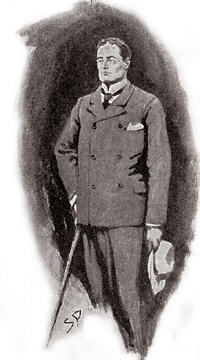
“…the clock had just struck ten when Dr. Mortimer was shown up, followed by the young baronet.  The latter was a small, alert, dark-eyed man about thirty years of age, very sturdily built, with thick black eyebrows and a strong, pugnacious face.  He wore a ruddy-tinted tweed suit and had the weather-beaten appearance of one who has spent most of his time in the open air, and yet there was something in his steady eye and the quiet assurance of his bearing which indicated the gentleman” (HOUN).
Sir Arthur Conan Doyle resurrected Sherlock Holmes with The Hound of the Baskervilles, which is reason enough to make it a favorite canon story with many people.  Even if a person has read no other Sherlock Holmes story, he or she most likely read HOUN (or a selection from it) in a high school English class, during a book club, or at the behest of a particularly insistent relative.  Doyle himself termed the story “a real Creeper,” and as Christopher Redmond points out in the Sherlock Holmes Handbook (Second Edition), “…the dominant colors in this story are the black and white of night, the grey of uncertainty, and the green of the moor’s vegetation.  Somehow this grim environment has appealed to Sherlockians…” (24).  The spectral hound and his gruesome errand hold a universal appeal, which keeps readers returning to Dartmoor over and over, on the page and screen.
The plot of HOUN revolves around the young Sir Henry Baskerville, who has inherited his family’s estate and immense fortune, after the suspicious death of his uncle, Sir Charles.  Sir Henry returns to England from Canada, where he has been farming, and immediately finds himself embroiled in a complex and dangerous plot against his family legacy, and his own life.  The baronet has been played by a wide range of actors over the years, including Richard Greene, Christopher Lee, Nikita Mikhalkov, Kristoffer Tabori, and Jason London.  The production team behind “Sherlock” has announced a modern reinterpretation of HOUN in the second season of the show, and fans are eager to see how the role of Sir Henry will be filled in a 21st century capacity.  The character of Sir Henry Baskerville embodies all the characteristics necessary to propel the plot of the novel forward, and therefore stands on equal footing with Sherlock Holmes or Doctor Watson.  Sir Henry is not solving mysteries, but he is the foundation of one.  He moves the story even more so than the legendary hound that stalks him from across the moor.
To begin with, Sir Henry appears to be almost utterly fearless.  When he is finally completely informed of the situation that awaits him at Baskerville Hall, and the dangers that have been dogging him since he set foot in London, Sir Henry’s response is only to say: “There is no devil in hell, Mr. Holmes, and there is no man upon earth who can prevent me from going to the home of my own people, and you may take that to be my final answer.”  If Sir Henry had chosen that moment to refuse to return to Baskerville Hall—a not unreasonable notion in light of everything he has learned—then there simply would have been no mystery, and no story.  He could have liquidated the Baskerville real estate and claimed the financial assets while in London, or from other safer country.  Indeed, if Jack Stapleton had succeeded in his plot, the villain could have attempted to lay claim to the Baskerville fortune from the safety of Costa Rica—which begs the question of why Sir Henry could not have done the same, and why he returned to England at all.
Early on, the reader learns from Dr. Mortimer that Sir Henry had been farming in Canada, prior to his uncle’s death.  And while farming is not necessarily an occupation conducted in total isolation, it is rather strenuous and difficult; furthermore, he is separated from what little remains of his family, and from familiar country, by a vast ocean.  According to Redmond, “In Holmes’s time Canada was still, in British eyes at least, a colony; young Henry Baskerville went there to farm, but had no hesitation about returning to the motherland when his time came” (173).  Basil Rathbone’s 1939 version of HOUN starring Richard Greene as Sir Henry, makes a point of showing a newspaper clipping bearing news of the baronet’s return to England from Canada (the latter country’s name emphasized in a large, bold typeface) as if Sir Henry were a foreigner, returning from some exotic distant locale.  But in truth, he is merely a loyal soldier, returning to his home port for a new assignment.      
In a similar vein, the young Baskerville is also a herald of progress and change.  Upon surveying his new home, and lonely isolation of Dartmoor, he proclaims: "It's no wonder my uncle felt as if trouble were coming on him in such a place as this…It's enough to scare any man.  I'll have a row of electric lamps up here inside of six months, and you won't know it again, with a thousand-candlepower Swan and Edison right here in front of the hall door.”  Such an addition would offset the gloom of Dartmoor in both a literal and a more metaphorical sense.  Watson describes the moors and the country of Baskerville Hall as gloomy and barren, an isolated country:
We had left the fertile country behind and beneath us.  We looked back on it now, the slanting rays of a low sun turning the streams to threads of gold and glowing on the red earth new turned by the plough and the broad tangle of the woodlands.  The road in front of us grew bleaker and wilder over huge russet and olive slopes, sprinkled with giant boulders.  Now and then we passed a moorland cottage, walled and roofed with stone, with no creeper to break its harsh outline.  Suddenly we looked down into a cuplike depression, patched with stunted oaks and firs which had been twisted and bent by the fury of years of storm. Two high, narrow towers rose over the trees. The driver pointed with his whip.
’Baskerville Hall,’ said he.”
The arrival of Sir Henry and his electric lights demonstrates a rush towards modernity.  Baskerville Hall will no longer exist in a darkness and gloom; Dartmoor will abandon its technological isolation.  And Sir Henry will no longer feel as if he has “walked right into the thick of a dime novel.”
Finally, the mystery of HOUN hinges upon Sir Henry’s utter wholesomeness, and sense of traditional propriety.  As Redmond states, “In The Hound of the Baskervilles, much of the dramatic complexity comes from the relations between the sexes: the apparently wholesome attraction between Sir Henry Baskerville and Beryl Stapleton, the sadomasochistic relationship between Beryl and Jack Stapleton…” (64).  Sir Henry’s pursuit of Beryl Stapleton is remarkably proper and respectable, especially given the sinister motivations that dwell just below of the surface of their courtship. 
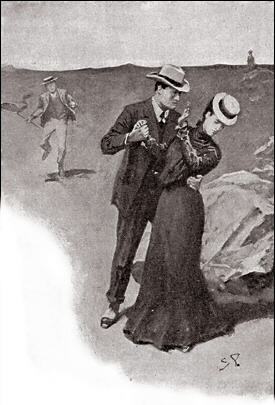
Surely if the baronet had known that Miss Stapleton was, in fact, Mrs. Stapleton, and that Jack Stapleton was not the young woman’s brother, but her husband, he would have been a bit less affectionate in his description of her: “I tell you, Watson, I’ve only known her these few weeks, but from the first I just felt that she was made for me, and she, too–she was happy when she was with me, and that I’ll swear.  There’s a light in a woman’s eyes that speaks louder than words.”  Indeed, if Sir Henry had been a bit less proper, had pressed his hand or taken advantage of his position a bit more forcefully, Beryl Stapleton may had felt inclined to reveal all (or at least crucial elements) of the machinations of her brother/husband that much sooner.  Sir Henry’s respectability and traditional values are ultimately what keeps the plot of HOUN moving.
I’ve spoken elsewhere about whether or not Sherlock Holmes exists in a vacuum, and whether or not his character creates enough momentum to propel a narrative forward on his own.  Sometimes the Great Detective creates enough force to drive other characters—Dr. Watson, Inspector Lestrade, the Irregulars—into action, which may or may not create the desired consequences.  Sir Henry Baskerville is different, however.  He is already a force in his own right when he enters the narrative of HOUN; he is already acting and being acted upon.  In many ways, Sherlock Holmes is caught up in the momentum of the youngest Baskerville, moved along by the violent current.
oOo
The new blog contest launches on Monday, June 27, so make sure to check back here for details on prizes, and how to win!
Sources:
• Redmond, Christopher.  Sherlock Holmes Handbook (Second Edition), Dundurn Press, September 2009.