Showing posts with label Mycroft Holmes. Show all posts

Sunday, June 21, 2015

“A Man of an Honourable Stock” (SHOS): Sir Christopher Lee

For those of you who have been following this blog for a long time (And have I thanked you for sticking with me? Thank you for sticking with me.), you know that I am not usually given to memorial tributes. This is primarily because I have always found it beyond my meager skills to encapsulate the whole of one person’s life – all its wonders and accomplishments – with just a few words. I have always worried that whatever I wrote would come across as, at best, inadequate, and, at worst, completely disingenuous.

However, on the morning of June 11 when I learned of Sir Christopher Lee’s death (Lee actually passed away earlier on June 7, with the knowledge only becoming public on June 11), I immediately went to share the news with my fellow “geek” colleague – a co-worker with whom I share some mutual interests and with whom I had commiserated over Leonard Nimoy’s death earlier this year. After a few moments of some subdued sadness, my co-worker admitted that, beyond the Lord of the Rings series, she knew little of Lee’s career. “Is that terrible?” she asked.

I didn’t answer at first. Of course, it wasn’t terrible. There’s nothing terrible about not having an investment in a particular actor’s filmography. However, I wanted to tell her about my Christopher Lee.

Christopher Lee with his friends Vincent Price and Peter Cushing

“A Man of Some Substance” (LION)

My Christopher Lee was Dracula. And in his embodiment of the iconic vampire, he was perhaps only second to one other actor. He was as synonymous with the role as Basil Rathbone with Sherlock Holmes, or Nigel Bruce with Dr. Watson. Although his Dracula films would sometimes take ridiculous turns (Dracula A.D. 1972, anyone?), the role would still cast a villainous pall over his career and indeed, my Christopher Lee was also the Mummy, Frankenstein’s monster, and Fu Manchu.

“A Man of Remarkable Appearance” (BLAC)

My Christopher Lee was even Count Dooku (or Darth Tyranus, if you are so inclined), unfortunately, in Star Wars: Attack of the Clones and Star Wars: The Revenge of the Sith. Typically an anathema to true Star Wars fans, the films are worth remembering, if only as a testament to Lee’s villainous character acting.

“A Man of Iron Nerve” (EMPT)

My Christopher Lee was also Francisco Scaramanga in the 1974 film, The Man with the Golden Gun, opposite Roger Moore’s sometimes ludicrous turn as James Bond. Lee was a relative of Bond creator Ian Fleming, and rather perfectly cast as the erudite assassin. Despite the fact that Fleming had originally wanted Lee for Dr. No, he was nonetheless able to channel all his leanness, elegance and his unique razor-sharp keenness to embody Scaramanga.

“A Grave and Taciturn Gentleman of Iron-gray Aspect” (BLAN)

My Christopher Lee was DEATH, voicing the late Sir Terry Pratchett’s (who also passed away earlier this year) characterization in several dramatizations, including The Color of Magic (2008). Tapping into the famous depth and timbre of his voice, his performance was equal turns unlimited cosmic power and affable approachability, just as Pratchett wrote him.

“A Man of Dreams” (GOLD)

And of course my Christopher Lee was Saruman the White in Peter Jackson’s Lord of the Rings series, a masterpiece of film. How could he not be? In addition to providing a vehicle for Lee’s unsurpassed ability to portray malevolence and subtle deviousness, it also gave rise to what might be one of my favorite Christopher Lee anecdotes. Peter Jackson was preparing to shoot a scene in which Saruman is stabbed in the back. Jackson provided Lee with a long, detailed explanation of how he wanted the scene to go. To which Lee replied, “Have you any idea what kind of noise happens when somebody’s stabbed in the back? Because I do.”

“A Man of Energy and Character” (MISS)

But perhaps, more than anything, my Christopher Lee was Sir Henry Baskerville in the 1959 Hammer Film adaptation of The Hound of the Baskervilles, starring opposite Lee's dear friend Peter Cushing as Sherlock Holmes. As the terrorized Sir Henry, Lee had to call upon no acting skills at all to show real fear:

Now there is one thing I’m really scared of…spiders. In particular these ghastly bird-eating spiders from South America, with big, huge hairy legs as thick as my fingers. I hate these things, and there was a sequence in the film in which one of spiders comes out of a boot. I refused to let them place it on my neck, but I did have it on one of my shoulders and I was in such a state that I virtually went green, and sweat poured off my face. Everybody said what a brilliant performance I gave. All I can say was that it wasn’t acting at all. I was nearly sick with nausea and fear.

And my Christopher Lee was Mycroft Holmes in the 1970 film The Private Life of Sherlock Holmes, starring opposite Robert Stephens as Sherlock Holmes and Colin Blakely as Dr. John Watson. Lee was perhaps one of the more sinister and uncanonically lean Mycrofts on record. Until Mark Gatiss’s Mycroft in the BBC’s Sherlock, that is. Gatiss has admitted to using Lee’s interpretation of the elder Holmes brother as the template for his own, calling him “cold” and “disdainful.”

And my Christopher Lee was Sherlock Holmes. First in the 1962 German film, Sherlock Holmes and the Deadly Necklace, in which Lee’s performance was inexplicably dubbed over. And then later in Sherlock Holmes and the Leading Lady (1991) and Sherlock Holmes and the Incident at Victoria Falls (1992), in which Lee plays a somewhat older, retired Great Detective. Of his performance as Sherlock Holmes, Lee said:

My portrayal of Holmes is, I think, one of the best things I’ve ever done because I tried to play him really as he was written – as a very intolerant, argumentative, difficult man – and I looked extraordinarily like him with the make-up on…Everyone who’s seen it said I was as like Holmes as any actor they’ve ever seen – both in appearance and interpretation.


“A Man of Deep Character, a Man with an Alert Mind, Grim, Ascetic, Self-Contained, Formidable” (MISS)

I wanted to say all these things. I wanted to share my experience of Christopher Lee and who my Christopher Lee was. But he also wasn’t my Christopher Lee, no matter how many times I say it. He wasn’t mine, because he belonged to everyone. He was everyone’s Christopher Lee. And he was also no one’s. For how can a person such as Christopher Lee belong to anyone but himself?

But I didn’t tell say any of those things, of course. Who could? Instead, I simply said, “I know Christopher Lee from a lot of things.”

Friday, June 3, 2011

Some Thoughts on Setting: The Diogenes Club

“There are many men in London, you know, who, some from shyness, some from misanthropy, have no wish for the company of their fellows.  Yet they are not averse to comfortable chairs and the latest periodicals.  It is for the convenience of these that the Diogenes Club was started, and it now contains the most unsociable and unclubable men in town.  No member is permitted to take the least notice of any other one.  Save in the Stranger’s Room, no talking is, under any circumstances, allowed, and three offences, if brought to the notice of the committee, render the talker liable to expulsion” (“The Greek Interpreter”).
Of all the characters in the Sherlock Holmes canon, I’m probably the most partial to Mycroft Holmes.   I think it has something to do with being an older sibling myself; often corralling a younger sister who seems to loathe all civilized society with her “whole bohemian soul,” and occasionally seems intent upon upsetting our mother whenever possible.  Whatever the reason, I find myself drawn to the stories prominently featuring Sherlock Holmes’s older brother, and to the bizarre gentlemen’s club with which he is so inexorably connected.  The club’s strangeness, in both rule and atmosphere, only serves to augment Mycroft Holmes’s own personal eccentricities, and therefore the oddities of his famous brother (if only by association), by keeping all elements contained within a hermetic atmosphere.
It’s difficult, if not impossible, to separate Mycroft Holmes from the Diogenes Club, which he co-founded.  It is a club for men who enjoy peace and quiet, and who eschew social interactions.  It is a society for men who find the company of other men superfluous, and would rather live their lives without distraction and with little human contact.  Members can even be expelled from the club for speaking, which sounds quite marvelous to those of us eternally in search of silence, never seeming to find it.  Even the local library always seems to have one occupant who believes that his earphones are enough to block out the noise of his iPod, when they most certainly are not. 
But according to Leslie Klinger’s The New Annotated Sherlock Holmes, the Diogenes Club and its litany of peculiar demands was not, in reality, all that strange, given time and place:
“As bizarre as the Diogenes’s practices might seem, such an attitude was de rigueur at most London clubs, where bachelors and married men alike could both relax and cultivate an air of exclusivity and high social rank…That the Diogenes had a designated Stranger’s Room seems similar to the Athenaeum’s policy of relegating its members’ friends to a small room near the club entrance” (641-2).
 So, if the Diogenes Club is not that far removed from the norm as far as Victorian gentlemen’s clubs are concerned, than what is it about the place that is so compelling?  The Diogenes Club is only mentioned directly in two Sherlock Holmes stories—“The Greek Interpreter” and “The Bruce-Partington Plans”—but as with so many Sherlockian things (like Irene Adler, the iconic Deerstalker and pipe, and the Giant Rat from last week’s post), it has taken on a life on its own, beyond the confines of the text.  The answers seem to lie within, not only the boundaries of the club itself, but within what the Holmes brothers make of it.
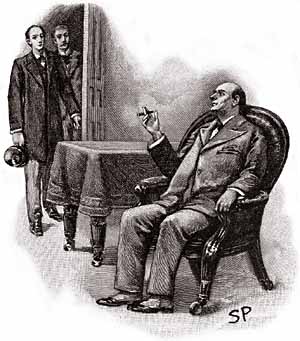
In “The Greek Interpreter,” Mycroft convinces his brother to sit with him in the bow-window of the Stranger’s Room, within moments of Sherlock and Dr. Watson’s arrival at the club.  “To anyone who wishes to study mankind this is the spot,” [says] Mycroft. “Look at the magnificent types!  Look at these two men who are coming towards us, for example.”  What follows is a brilliant example of Holmesian deduction, as Sherlock and Mycroft bat back and forth a series of logical inferences, regarding a non-commissioned officer who had just happened to wander into their viewing.
bookishadventures.tumblr.com
Their combined inferences are undoubtedly correct, and Mycroft famously notices a few details that his younger brother does not (“Children, my dear boy, children…The fact that he has a picture-book under his arm shows that there is another child to be thought of.”).  However, throughout their observations, the Holmes brothers are kept separate from the rest of the world by the walls and glass of the Diogenes Club.  The Granada Television adaptation of GREE even goes so far as to perch Mycroft and Sherlock on tall stools as they look out of the window, down upon the man who is unaware of their peculiar scrutiny.  There is a distinction and a physical separation between the Holmes brothers and the rest of the world—almost as if the Diogenes Club were preserving them, keeping them under glass.
But even when Mycroft Holmes is on his own, the Diogenes Club still works to create a sense of separateness and otherness.  In “The Bruce-Partington Plans,” Sherlock marvels at the telegram announcing his brother’s imminent arrival at 221B Baker Street.  He explains to Watson: “It is as if you met a tram-car coming down a country lane.  Mycroft has his rails and he runs on them.  His Pall Mall lodgings, the Diogenes Club, Whitehall—that is his cycle.  Once, and only once, he has been here.  What upheaval can possibly have derailed him?”  And he says later, “A planet might as well leave its orbit.”
In short, Mycroft Holmes does not go places, as other people do.  He does not run errands, or take walks in the park, or even jump into a hansom cab to visit his only (for the purposes of the canon, Mr. Baring-Gould) brother.  He is not like Sherlock; he is not known anywhere and everywhere.  Therefore, the places that Mycroft chooses to honor with his presence are significant.  When a man divides his time equally amongst work, lodgings, and club—and nowhere else if he can manage it—the mere act of having a club at all says a great deal about the space.  Mycroft gives the Diogenes Club a sense of exclusivity merely by occupying it.  And if Mycroft also chooses to keep himself separate from the rest of humanity, then the Diogenes Club is the place to do so—a place where no one will question Mycroft Holmes, his actions, or his work because they are not allowed, or even maybe because they simply do not care.  At the Diogenes Club, he is free to be Mycroft Holmes, with all the weight of what that statement implies, more than in any other location in London.
I’ve spoken elsewhere on the relationship between Mycroft Holmes and his younger brother, about their inherent god-like qualities and how Mycroft serves to highlight Sherlock’s service to the rest of us lesser mortals, how Mycroft makes the reader grateful that Sherlock chose our human problems and everything that might entail.  The Diogenes Club merely serves to highlight Mycroft in a similar fashion, emphasizing his own particular abilities and attitudes.  The idea of the Diogenes Club will probably always appeal to the socially awkward and misanthropic among us, those who would rather observe the world behind a glass partition than interact with it.  And also to those who are just looking for five minutes of quiet to finish a blog post, away from the sounds of Call of Duty: Modern Warfare II.  But I wouldn’t know anything about that.
oOo
Now you can join the Diogenes Club!  Join a body of fans from across the globe in providing live commentary on the immense catalog of Sherlock Holmes films and television series.  The club is available online and on Twitter.  Join the discussion on Twitter using the hashtag: #221B.  
And just a reminder that a new blog contest will begin on June 27, so check back here for more details!

Friday, May 20, 2011

“The Meaning of This Extraordinary Performance” (COPP): Granada Television’s “The Greek Interpreter”

Sherlock Holmes describes his older brother, Mycroft, as a “curiosity.”  I’ve always liked that term; it implies something that’s meant to be studied.  A “curiosity” should be put up on a shelf, examined thoroughly under glass, picked over with tweezers, and dusted compulsively.  A curiosity bestows knowledge begrudgingly, only after much effort on behalf of the investigator.  Its secrets are kept close to its chest, impermeable and unreadable to all but a select few.  Such is the case with Mycroft Holmes, whose very existence Sherlock neglected to mention to Dr. Watson for the first seven years of their friendship.  But in Granada Television’s adaptation of “The Greek Interpreter,” the relationship and interactions between Sherlock Holmes and his older brother reveal layers of personality and depth of character that a simple reading of the original text leave open to interpretation.
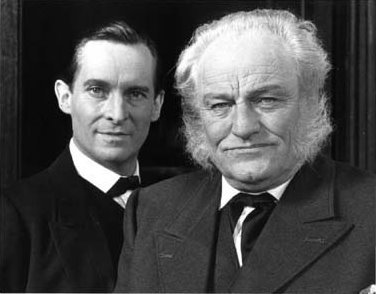
As I’ve mentioned elsewhere, Mycroft Holmes makes two appearances in the canon stories—“The Greek Interpreter,” and “The Bruce-Partington Plans”—and is mentioned in two others—“The Final Problem” and “The Empty House.”  In the Granada Television series, Mycroft Holmes was played by Charles Gray, famous for his roles as the James Bond villain “Ernst Stavro Blofeld,” in Diamonds Are Forever, and as “The Criminologist” (the narrator), in the film version of The Rocky Horror Picture ShowGray was cast in the Granada series due, in part, to his role as Mycroft in the 1976 film adaptation of The Seven-Per-Cent Solution (based on the novel by Nicholas Meyer), starring opposite Nicol Williamson as Sherlock Holmes, and Robert Duvall as Dr. Watson.  
Charles Gray as Mycroft Holmes
in 1976's "The Seven-Per-Cent
Solution." (GoneMovie.Com)
Gray’s Mycroft Holmes made four appearances throughout the series—first in the canonical episodes, “The Greek Interpreter,” and “The Bruce-Partington Plans,” but then later making special appearances in “The Mazarin Stone” (when Mycroft filled in for Sherlock’s role, due to Jeremy Brett’s illness), and then in “The Golden Pince-Nez” (filling in for Edward Hardwicke, who was filming a movie).  Gray’s interpretation of the elder Holmes brother is at turns jovial and pensive, but in his first appearance in “The Greek Interpreter” seemed far older than the mere seven years that are supposed to separate him from his younger sibling—an effect that was lessened as the series went on.  He seems eternally amused and flabbergasted by Sherlock—much in the way of most older siblings—but also pleased with his abilities, saying with an affectionate turn of his lip and shake of his head—“Sherlock has all the energy in the family”—in response to a list of suggested tactics from his brother.
Jeremy Brett’s Sherlock seems likewise amused and flabbergasted by Mycroft, but his reactions are more subtle, often flitting across the screen like an errant firefly.  According to Richard Valley, the late proprietor of ScarletStreet.com, “The underlying affection between the Holmes boys, rarely displayed in earlier interpretations, is largely revealed through Jeremy Brett’s subtle facial expressions as young Sherlock.  As always with Brett, the personality of his Great Detective holds at least as much interest as the mystery itself.”  Indeed, Brett’s facial expressions are as much a clue as any physical evidence.  Upon first seeing his brother perched on a stool in front of the window in the Stranger’s Room of the Diogenes Club, Sherlock looks, at first, awestruck, then suddenly embarrassed, when he realizes that Dr. Watson will have to bear witness to the brothers’ game of deduction.  Later, he looks as shocked and disbelieving to find Mycroft lounging in the Baker Street sitting room as if he had encountered Father Christmas there instead.   
And then finally, when Sherlock makes an unkind (if not inaccurate) assessment of Sophy Kratides, and Mycroft says, “You still retain your low opinion of women,” Sherlock’s head snaps back.  His eyes are narrowed and brows are raised.  His lips are pursed.  Mycroft has apparently strayed too closely into a realm of information best kept between brothers.
Gray’s Mycroft Holmes is also a bit more involved in this televised adaptation than in the original text—thanks to an added subplot where Sherlock, Watson, and Mycroft chase down the villains while aboard a train.  The trio arrives at the rail platform, just as the train is beginning to pull away.  Sherlock and the Doctor race deftly after it, but the larger Mycroft slips behinds and yells, “I’m not built for running, Sherlock!”  This leaves Sherlock in the position of physically pushing his brother onto the moving train, while Watson pulls him from his position onboard, and Mycroft gives a cartoonish cry. 
The decision to bring Mycroft along is an interesting one, for a number of reasons.  First of all, Mycroft, a man who “has no ambition and no energy,” seems a rather unlikely candidate for voluntary participation in an active criminal pursuit such as the one that develops at the end of Granada’s version of GREE.  His presence suggests that Sherlock believes his older brother would be needed or even necessary (perhaps for his diplomatic or government connections) at the close of the case.  Sherlock even goes to great lengths to make sure that his brother has boarded the train, when he probably would have left anyone else behind on the platform.  Certainly, it’s not too much of a stretch to imagine Sherlock Holmes leaving a dawdling and wheezing member of Scotland Yard behind, while waving patronizingly as the train pulls away. 
But then, after going to such trouble make sure his brother was on-hand, Sherlock leaves his “sleeping” brother behind as he goes to locate his quarry’s compartment.  “No,” he says to Watson.  “Don’t wake him.  There’s danger enough for the two of us.”  Of course, Mycroft is not sleeping, and his eyes slowly open as his companions leave the compartment.  As Sherlock and Watson corner Harold Latimer and Sophy Kratides in their quarters, the audience watches as Mycroft dines companionably with the third villain, Wilson Kemp, the dining car.  There’s a moment of confusion, where the audience might wonder what Mycroft is up to or if he even knows who he is sharing wine with, but all is revealed when Mycroft arrives at the perfect moment to save his brother and the Doctor, pulling out the weapon that he had deftly lifted from Kemp’s pocket without his knowledge.  Sherlock, for his part, looks pleased, proud, and not at all surprised to see his older brother save the day.     
As the episode closes, Sherlock Holmes watches with distaste as Sophy Kratides is lead away.  “It is not a crime to have a cold heart and not a single shred of compassion,” he says, before turning sharply, and walking away—alone—into the fog.  If the intention was to create a silence of isolation, reinforce the idea of Sherlock Holmes as a unique and unmatched phenomenon, then this adaptation of “The Greek Interpreter” was probably the wrong place to do so.  What this episode effectively demonstrates is that, far from being a remote, untethered being, Sherlock Holmes has several moorings that keep him in place.  His brother is one of them, though Sherlock may have kept Mycroft’s existence close to his chest.  But like any remarkable curiosity, Mycroft Holmes has a lot to tell the persistent Sherlockian devotee, and Granada’s interpretation of GREE is just one example of how much he might have to say.
oOo
One day left to enter the Sherlock Holmes trivia contest!  You have until 11:59p.m. EST, on Saturday, May 21, to submit your answers and qualify to win a prize package of Sherlock Holmes reference works.  The winner will be announced on Monday, May 23. 

Friday, February 11, 2011

The Unstoppable Force and the Immovable Object: Sherlock & Mycroft Holmes

Sherlock: “…I mean, what is there for me to do?”
Mycroft: “To act, Sherlock.  To act.  All my instincts are against this explanation, and your’s too, I think.  We are not brothers for nothing.  Use your powers, go to the scene, question the people concerned, leave no stone unturned.  In all your career, you’ll never have a greater chance of serving your country.”
(“The Bruce-Partington Plans,” 1988)
Quite a bit of Sherlockian scholarship is devoted to the question of whether or not Sherlock Holmes could have existed in a vacuum.  Could he have deduced as easily from Montague Street as from Baker Street?  Would he have been able to solve crime as a chemist working in the laboratories of St. Bart’s?  And, perhaps most pressing, does Sherlock Holmes even exist without Dr. Watson by his side?
For my part, I’ve always been more than a little bit fascinated by the relationship between Sherlock Holmes and his older brother, Mycroft.  My perception of their relationship has been colored by some of the remarkable on-screen portrayals over the years.  Not the least of which is that of Charles Gray’s Mycroft to Jeremy Brett’s Sherlock; but more recently we’ve seen Mark Gatiss as older brother to Benedict Cumberbatch; and much buzz is already brewing about Stephen Fry’s portrayal of the older Holmes sibling, opposite Robert Downey, Jr., in Guy Ritchie’s sequel to his 2009 blockbuster, which is due out later this year.
Mycroft Holmes, for all that he is apparently Sherlock’s only living relative, appears in just two of the original stories: “The Greek Interpreter,” and “The Bruce-Partington Plans.”  He is also briefly mentioned in “The Final Problem,” and “The Empty House.”  He is one of the founding members of the Diogenes Club (a club for misanthropic men), superior to his brother in both intelligence and deductive skill, and, as Dr. Watson puts it, rather…rotund:
“Heavily built and massive, there was a suggestion of uncouth physical inertia in the figure, but above this unwieldy frame there was perched a head so masterful in its brow, so alert in its steel-gray, deep-set eyes, so firm in its lips, and so subtle in its play of expression, that after the first glance one forgot the gross body and remembered only the dominant mind (BRUC).”
Sherlock Holmes and Dr. Watson are flatmates for more than seven years before Sherlock reveals his brother’s existence and introduces him to Dr. Watson in “The Greek Interpreter.”  And frankly, you have to wonder why Mycroft needed to enter the picture at all.  Everyone seemed to be getting on just fine without him.  Sherlock was deducing, making daring leaps of intellect, and even battling poisonous snakes, while the world thought, as Watson did, that “…he was an orphan with no relatives living” (GREE).
There was seemingly nothing wrong with thinking that the world only had space for one terrifyingly intelligent man, who could know the shape of you by the pattern of your footfalls.  What are the readers supposed to do with two men of startling genius, even if one of them is (gently put) less inclined to physical efforts?  Why wasn’t one Holmes enough?
Therefore, I think you have to consider the Holmes brothers as a set in order to go about answering that question.  In her 2010 novel, The God of the Hive, Laurie R. King makes an interesting observation:
“The Holmes brothers were a bit god-like: generous and well meaning towards lesser mankind, but capricious and sometimes frightening in their omniscience (47).”
The reader should consider Sherlock and Mycroft as an entity, consider them as a pair, consider what is accomplished when the two of them work together (or do not, as the case may be).  Sherlock is the unstoppable force to Mycroft’s immovable object.  Sherlock makes mistakes, and he also been outwitted.  But Mycroft often needs help because of his own physical limitations.  Together, they are a veritable fortress of intellect.  Who wouldn’t be a little frightened?  They are unemotional, unmovable… and really very uninteresting.
And so it’s easy to see why Mycroft wasn’t around at the beginning, why Sherlock didn’t make a point of introducing his new flatmate to his only family in A Study in Scarlet, and why Mycroft only made sporadic appearances throughout the canon.  Because when the Holmes brothers are together—the conclusion is nearly forgone.  How can the mystery not be solved?  It would get a bit boring after awhile, I think. 
But when they are together, the reader can’t help but remember that we are “lesser mankind,” as King puts it.  When Sherlock is solving crime with Dr. Watson as his partner, the reader can look to the good doctor as a reminder of all that is normal, and attainable, and accessible, and the Great Detective suddenly doesn’t seem so out of reach.  We feel as if it might even be possible to imagine ourselves in the doctor’s position, using our own normal brains to assist, as Watson does on occasion.
But paired up with, and standing alongside his equally astonishing brother, the reader can’t help but be reminded of why Sherlock Holmes is so truly extraordinary, and beyond our ability to fully comprehend.  Mycroft accentuates and reinforces all that so otherworldly about his brother, and throws it all into stark relief.  We can’t help but see it all, because we are seeing it in double.   
We remember that Sherlock is unique, that he is exceptional, and he is, most certainly, not like the rest of us.  Mycroft Holmes serves as a reminder of the company that Sherlock should be keeping, of what he could potentially achieve, if he weren’t so caught up in our lesser problems.  The reader feels more grateful, after seeing Sherlock with Mycroft.  They are, indeed, “a bit god-like,” when they are together, and the reader feels grateful that Sherlock Holmes would choose lesser mankind at all. 
They are not brothers for nothing, it would seem, after all.