Showing posts with label edward hardwicke. Show all posts

Saturday, June 29, 2013

“The Meaning of This Extraordinary Performance” (COPP): Granada Television’s “The Man with the Twisted Lip”

Jeremy Brett particularly enjoyed the next stage of the story, the construction of the divan and Holmes’ enormous consumption of tobacco as he thinks the problem through while Watson snatches an hour or two of sleep. We decided that Holmes had brought his mouse-colored dressing gown with him rather than borowing [sic] a blue one, thus adding our contribution to one of the minor mysteries of the Canon. Jeremy also enjoyed finding new aspects of Holmes and he relished the meditative stillness of this sequence, although inspiration does not strike until he washes his face at dawn.” (From A Study in Celluloid: A Producer’s Account of Jeremy Brett as Sherlock Holmes, by Michael Cox)

In Sir Arthur Conan Doyle’s original short story, “The Man with the Twisted Lip,” Mrs. Kate Whitney actually arrives at Dr. Watson’s home looking for, not the doctor himself, but his wife. “Folk who were in grief came to my wife like birds to a light-house,” he says. But in the 1986 Granada Television adaptation of the story, Dr. Watson is the lighthouse. This is, of course, because the marriage between Mary Morstan and Dr. Watson was written out of the Granada series. According to Jeremy Brett, “[Mary Morstan] would have got in the way. Watson was more in love with Holmes – in a pure sense – than he could have been with a woman. He wouldn’t want to give up the excitement, the danger. As for Holmes, if Watson had gone off and left him for a woman he wouldn’t know what to do. He’d be stoned out of his mind every night.” And so, in Granada’s version, Mrs. Kate Whitney arrives at Baker Street, hoping that Dr. Watson (played by Edward Hardwicke) might help her find her missing husband, Isa Whitney. But the hour is late, and Mrs. Whitney tells Mrs. Hudson that she is concerned that she will only be in the Doctor’s way. “He won’t mind, I’m sure,” says Mrs. Hudson. “He’s the kindest of men.”

The audience has already seen Mr. Isa Whitney in the opening sequence of the episode, walking distractedly past the beggar, Hugh Boone. Whitney attracts Boone’s attention momentarily, if only because he fails to give him any change before disappearing down a shadowy alleyway. “Yours is the Kingdom of Heaven, sir,” Boone mumbles after Whitney’s retreating figure. Whitney walks past a group of workmen, who lift a burlap sheet in the course of their labors, but when the sheet falls again, Whitney is gone – vanished completely. It is an effortless bit of cinematic magic, but nevertheless effective. Whitney has evaporated as completely as the smoke from an opium pipe, gone the audience knows not where, but the tone of the episode has been set. Existence and identity are insubstantial notions, and both ideas are at odds in this episode. A person can dissipate into nothing, with an ill-timed word or a thoughtless action. A person can vanish completely, but they can also vanish deliberately. “Mr. Holmes disappears without a trace at regular intervals,” Watson tells Kate Whitney, and such is the episode’s common thread. The audience finds characters that are tasked with the effort of identity and the burden of existence.

Dr. Watson eventually leaves Baker Street to retrieve our vanished man, leaving Mrs. Whitney to take tea with Mrs. Hudson. The two women muse philosophically as to whether “men ever really truly grow up, or if they remain little boys forever,” over a shot of Dr. Watson running to catch a cab and arriving in Upper Swandam Lane – a vile alley of disrepute if there ever was one, and brought to vivid life out of Sir Arthur Conan Doyle’s story. As the Doctor arrives, a well-dressed man is discussing trade with two women of ill-repute (who then turn their attentions to Watson), then a scream as a fight breaks out, and Watson narrowly avoids being struck down by a shattering bottle. Watson locates the vanished Whitney inside The Bar of Gold, the opium den, but he also finds Sherlock Holmes, “merge[ed] with the surroundings,” and artfully disguised as an opium addict – complete with grizzled wig and beard, false eyebrows, a prosthetic nose, and tattered clothing. It’s a masterful camouflage, and so the effect is rather singular, therefore, when Holmes removes the disguise once in a cab with Watson. Each piece of his false face is removed to reveal the refined, patrician features of Jeremy Brett underneath. He has already exchanged his ratty addict’s costume for his traditional black suit, all crisp lines and sharp angles, and the transformation is complete. Sherlock Holmes himself has shown the audience how simple it is to assume the persona of another person – and also how effortless it is to dispose of one.


Sherlock Holmes and Dr. Watson arrive at the Cedars, near Lee, in Kent, where Mrs. Neville St. Clair is waiting and eager to attest to her husband’s character. Of interest, in this adaptation Mrs. St. Clair is played by Eleanor David, who would take another Sherlockian turn in the 2004 film Sherlock Holmes and the Case of the Silk Stocking as Mary Pentney (with Jonathan Hyde, as George Pentney, who appears in Granada’s 1994 adaptation of “The Dying Detective”). She describes her dramatic ordeal in detail, including how she found her (also vanished) husband’s garments behind a curtain in the opium den. Neville St. Clair’s clothing has been discarded like a snakeskin, disposed of like so much trash, but Mrs. St. Clair fervently announces the name of her husband’s tailor – as if that were somehow an integral part of his identity and the mention of it will somehow summon him into being. Later on the episode, as Holmes recounts a discussion with Inspector Bradstreet, the audience sees those same clothes in Bradstreet’s office. In this instance, however, the clothes are laid out neatly, as if trying to replicate the man who should be occupying them. And at the end of the episode, when St. Clair emerges from his Bow Street cell in his gentleman’s persona, he arranges the remaining scraps of Hugh Boone in a similar, tidy fashion, perhaps in the hopes of bidding the beggar into his own separate, independent existence – so that he won’t have to destroy him completely by casting him into the fire.  

In the original short story, after a few hours of sleep at the St. Clair residence, Watson (and therefore, the reader) is awoken by Holmes’s shout of revelation, to find the Detective still smoking and in much the same contemplative position as he was before the Doctor drifted off. Holmes has solved the case, but the readers do not get to witness the actual epiphany. Granada’s adaptation remedies this omission by having the audience witness Sherlock Holmes while in the midst of his method. Immersed in the golden light of a slowly rising sun and subtle clouds of tobacco smoke, the Detective sits in a meditative state. The camera angle moves in gradually and narrows into a tight shot of Jeremy Brett’s face, his eyes opening slowly and his brow subtly arched. With his pipe in hand, perhaps we see a slight echo of Holmes as he appeared earlier – as the ragged opium addict in the Bar of Gold. And in this version, Watson sleeps through the moment of grand understanding, because it takes place elsewhere. In front of a mirror, Holmes washes his face only in waistcoat and shirtsleeves, and understanding slowly dawns, resulting in a boisterous clap instead of a verbal cue. As he wakes Watson in the next scene, Holmes is suddenly fully dressed – including overcoat and hat – his detective identity fully assumed and ready for battle.


At the end of the episode, Inspector Bradstreet makes Neville St. Clair promise that they will see no more of Hugh Boone. “I swear it by the most solemn oath that a man could take,” St. Clair replies. But the understated smirk and downturned expression on Holmes’s face suggest that the Detective doesn’t think much of St. Clair’s promises. Perhaps it is simply because the end of Hugh Boone doesn’t necessarily preclude St. Clair from taking up some other beggar persona, in another part of London. The man had a gift for disguise, after all. Or perhaps he understands that St. Clair and Boone are inexorably intertwined, and that untangling the two will be no mean feat. Because as the audience has already seen, Sherlock Holmes knows better than anyone how simple it is to assume an identity, dispose of one, and begin the whole process anew.

oOo
Sources:
"Better Holmes & Gardens” has its own Facebook page.  Join by “Liking” the page here, and receive all the latest updates, news, and Sherlockian tidbits.

Saturday, February 2, 2013

“The Meaning of This Extraordinary Performance” (COPP): Granada Television’s “The Six Napoleons”

“Now let me endeavour to show you the different steps in my reasoning. To begin at the beginning.” (“A Study in Scarlet”)

"It has long been an axiom of mine that the little things are infinitely the most important.” (“A Case of Identity”)

There is no better place to begin a discussion of Granada’s adaptation of “The Six Napoleons” than at the beginning. The episode opens on an odd note: a young woman sensually washes herself at an open window while an old man watches lecherously from across the way. The camera pulls back from the depraved onlooker to reveal a young man (Pietro Venucci, played by Vincenzo Nicoli) and a young woman (his sister, Lucrezia, played by Marina Sirtis of “Star Trek: The Next Generation” fame) arguing heatedly in Italian. The argument takes a sudden, violent turn as the man strikes the woman across the face, but their argument carries on without pause. The elderly voyeur finally intercedes, but the young man eventually devolves into hysterical screaming before he runs from the room – the young woman chasing after him, sobbing, her hair falling out of its neat arrangement and blood running from her lip. The first five minutes of Granada Television’s adaptation of SIXN could be quite accurately described as bizarre, with dialogue almost entirely in un-translated Italian and the opening sequence ending with the episode’s main antagonist laughing maniacally while being taken away in a straitjacket. Topped off with a well-filmed fight scene and a strange ritualistic moment involving a photograph and a jewel-encrusted dagger, these opening scenes are indeed odd, but are also punctuated with perfect, memorable moments.

These perfect moments carry over throughout the episode and the first scenes at Baker Street (nearly six minutes into the production, but chronologically a year later) are no exception. The viewer finds Inspector Lestrade (Colin Jeavons) comfortably ensconced in the sitting room of 221B, drinking brandy and smoking cigars with Dr. Watson (Edward Hardwicke) while Sherlock Holmes (Jeremy Brett) peruses a tattered folio. According to Richard Valley, “A man of considerable reticence where companionship is concerned, Sherlock Holmes has no close friends save Dr. John H. Watson, which perhaps explains why it’s so utterly charming and delightful to find, at the start of this episode of THE RETURN OF SHERLOCK HOLMES, that Inspector Lestrade of Scotland Yard is given to dropping by 221B Baker Street every now and then to pass the time.” The casual intimacy between the three men is only reinforced by perfect, punctuating moments, like those already seen in the episode’s prologue. The knowing way in which Holmes lowers the folio to encourage Lestrade to “tell us about it,” understanding intuitively that the man has something of interest to share, but is restraining himself. Or Lestrade’s pleased expression when Holmes rubs his hands together and admits that the Inspector’s story “is certainly very novel.” Or the way in which the Great Detective laughingly tells Watson that the Doctor’s theories “will not do” – dismissively, but without any real venom.


Granada’s adaptation of SIXN is also a demonstration of how well Dr. Watson and Inspector Lestrade know their dear friend, the lengths to which they will go to in order to accommodate him, and how deeply they admire him. While in the morgue, Sherlock Holmes closely inspects the corpse of Pietro Venucci, paying no mind to his proximity to the dead man or the appropriateness of examining him with a magnifying glass. Once the Detective leaves, Lestrade leans down to inspect the corpse himself, his actions a pale imitation of Holmes’s own, before pulling the sheet back over poor Venucci. Later, when Holmes insists that a visit to Chiswick would be timelier than Lestrade’s plan to visit the Italian Quarter, the Inspector actually protests the change in plan very little, and compliantly takes up space upon 221B’s sofa until Holmes tells him that it is time to go. And while waiting in the dark and cold at two o’clock in the morning (we know, because Watson dutifully checks his pocket watch), his only question is “I don’t suppose we can smoke, can we?” Watson offers Lestrade a hard candy so as to ease some of the Inspector’s suffering, only to be told (in another one of those perfectly memorable moments) by Sherlock Holmes: “This is no time for humbugs!” Lestrade’s apparently blind faith in Holmes is soon validated, however, by the appearance of Beppo (the raving lunatic from the opening sequence).

Holmes’s mutual admiration for Watson and Lestrade is also present. When Holmes reveals to Watson how he has baited the journalist Horace Harker into writing a sensational (though inaccurate) article for his newspaper, Watson is visibly pleased with his friend’s cunning and tells him so. The Detective’s reply of thanks is both sincere and enthusiastic (with a mannered tip of his cane to set off his words). Moments later when Holmes and Watson return to Baker Street and approach their sitting room, they find that Lestrade is already present and unaware of their arrival. The Inspector is trying to surreptitiously view the folio that Holmes left on an end table (presumably the same one Holmes was reading at the beginning of the episode). The Detective is more amused by these actions than anything else, and rather than embarrass the Inspector by catching him in the act of prying, he instructs Watson to quietly walk away from the sitting room door – and return a moment later, much more loudly, giving Lestrade a moment to jump out of his seat and away from suspicion.

Inspector Lestrade in close examination of his shoes.
In his role as Sherlock Holmes, Jeremy Brett never wasted a gesture, a facial expression, or a well-timed inflection on a word of import. And so, whether Holmes chokes on his coffee at Watson’s command to be ready in “two minutes,” lowers his head to stare meaningfully but silently at Mr. Horace Harker, or trills slightly over the letter “R” in the word “morgue,” the viewer knows that these are moments of consequence and therefore they take notice. Although some moments may seem hyperbolic to almost the point of overacting – such as when Holmes greets Mr. Sandeford of Reading (and the sixth Napoleon bust) with an exaggerated turn and flourish from his dramatic posture at the fireplace mantel – the actions are not without purpose. For Sherlock Holmes is a theatrical man, with dramatic sensibilities, and the instance lays the framework for the scene just moments later when Holmes takes a cane to the plaster bust of Napoleon – violently and without warning. And instead of being shocked by the sight of the shattered bust, Watson and Lestrade are merely surprised, greeting with delighted astonishment the priceless pearl the Detective finds within – because they know their friend’s nature. They understand what he is made of.

The episode ends, as so many viewers already know, with one more perfectly punctuated moment, with Colin Jeavons delivering Inspector Lestrade’s memorable monologue from SIXN:

“I’ve seen you handle a good many cases, Mr. Holmes, but I don’t know that I ever knew a more workmanlike one than that. We’re not jealous of you at Scotland Yard. No, sir, we are very proud of you, and if you come down to-morrow, there’s not a man, from the oldest inspector to the youngest constable, who wouldn’t be glad to shake you by the hand.”

 
But even more remarkable than the words, delivered exactly as written in Sir Arthur Conan Doyle’s original story, is the way in which Jeremy Brett’s Sherlock Holmes reacts to the words. Something that a reader of the Canon had only supposed, but had never before seen, is the way in which the Detective is moved by the Inspector’s compliment. As Watson says, “[Holmes] was more nearly moved by the softer human emotions than I had ever seen him,” but Granada’s presentation has the visual appeal that the written word sometimes does not. The camera angle is tight on Holmes’s face, rarely breaking away, and the subtly evolving emotions are viewed in full – a slightly more open and softer expression, a dropped lip, and eyes that seem instantly, impossibly brighter. And when Sherlock Holmes thanks the Inspector twice – once with passion and once more as his rational side asserts itself – the scene is perfectly punctuated, the episode perfectly executed.

oOo

“Better Holmes & Gardens” now has its own Facebook page.  Join by “Liking” the page here, and receive all the latest updates, news, and Sherlockian tidbits.

Sunday, November 11, 2012

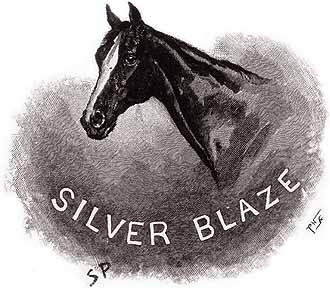
“The Meaning of This Extraordinary Performance” (COPP): Granada Television’s “Silver Blaze”


“Another of Colonel Huggins' interests was riding, an enthusiasm also embraced by Jeremy. As a child, Jeremy had a pony named ‘Babs’ whom he trained to climb stairs. Jeremy actually rode Babs into the Grange, which didn't sit well with Nanny Clifford, especially when it came to the inevitable by-products of Jeremy's four-legged, unhousebroken guest. (Nanny wasn't too pleased when Jeremy rode a donkey up into his room, either – the donkey had no trouble going upstairs, but balked on the way down.) Jeremy took riding lessons and competed in gymkhanas (equestrian field days consisting of exhibitions of horsemanship and pageantry). Although Jeremy decided at an early age that he wanted to become an actor, he once said that he wished he could have been a jockey, too. (He probably enjoyed filming the Holmes story ‘Silver Blaze’.)” (Lisa Oldham, The Brettish Empire)


“My ignorance cries aloud to heaven,” wrote Sir Arthur Conan Doyle about “Silver Blaze,” a short story appearing in The Memoirs of Sherlock Holmes. “I read an excellent and very damaging criticism of the story in some sporting paper, written clearly by a man who did know, in which he explained the exact penalties which would come upon everyone concerned if they had acted as I described. Half would have been in jail, and the other half warned off the turf forever.” And the 1988 adaptation of “Silver Blaze” by Granada Television certainly included its own share of mistakes. The episode famously exceeded its allotted budget due to its need for an on-location shoot, and the large number of horses and human extras needed for the race scenes. The episode was preceded by Granada’s rendering of “The Devil’s Foot,” another episode that had required an expensive on-location shoot. This confluence of factors meant that by the time Granada was ready to produce their adaptation of “The Hound of the Baskervilles,” the series’ budget was already seriously compromised, and the fate of the HOUN adaptation with it (Davies 139). There are many arguable reasons as to why Granada’s HOUN failed when it had every expectation of success – not the least of these being that because of the DEVI and SILV adaptations, producer Michael Cox simply could not afford to construct the HOUN film that he had envisioned.

But its role in the failure of the HOUN adaptation does not necessarily mean that the production of SILV was not a success in its own right. The episode’s location, expensive as it must have been, is atmospheric in a way that a sound stage or even a cleverly set-dressed local field could never be.  The vast and unforgiving loneliness of the fields of Wales, Cheshire and Lancashire in the north of England are desolate and forbidding in the way that the moorlands of Dartmoor must certainly be. The stables of King’s Pyland appear as a mere dot on the landscape as Sherlock Holmes (Jeremy Brett) and Dr. Watson (Edward Hardwicke) travel in with Colonel Ross (Peter Barkworth). The neighboring stable of Backwater is miles away and likewise the odds of finding the missing Silver Blaze seem remote in the extreme. It is the expansiveness of the landscape that impresses upon the viewer the enormity of the Detective’s task. A horse lost on the sprawling moor – even a racehorse as extraordinary as Silver Blaze – will be as difficult to locate as a black cat in a coal cellar. “I expect a miracle from you, Mr. Holmes,” says Colonel Ross. The atmosphere created in the episode (of which the landscape plays no small part) is a testament to the extent of the miracle that was produced.

Photo Credit: bookishadventures.tumblr.com
And in regards to those costly horses and extras that seem to adorn every scene in SILV? The presence of more horses makes the absence of Silver Blaze even more profound and even more significant. King’s Pyland appears to be positively brimming with horses – why is the missing one so important? It is clear that none of the other horses can match Silver Blaze in strength, speed or skill – and the horse in question is not even present for the comparison! Bayard, the only other horse mentioned as being remotely in the same league as Silver Blaze, is admitted by Colonel Ross as just “intended for a pacemaker.” Indeed, Colonel Ross seems to be going to great lengths to reacquire Silver Blaze – even calling on Sherlock Holmes against his better judgment. The identity of the murderer of John Straker, Silver Blaze’s trainer, feels almost secondary to locating the missing horse. Sherlock Holmes even goes so far as to chide Colonel Ross for his neglect. He asks Colonel Ross, “[The location of Silver Blaze] is a minor point, of course, compared with the question of who killed John Straker?”

As for the extra cast members – what is a dramatic reveal without a crowd of people to witness it? When Holmes theatrically reveals the identity of Straker’s killer (who was Silver Blaze, of course, acting in self-defense), it is in the Winner’s Circle of the Wessex Cup, surrounded by a large crowd of well-wishers. As the realization dawns on Colonel Ross that he has been horribly deceived by a man that he trusted implicitly, the slowly encroaching crowd makes his error in judgment seem palpable. For a moment the man seems surrounded by his mistakes – rather than by onlookers – unable to escape them. But perhaps even more simply: what is a story about a racehorse without other horses to race against, and people to watch the race?

Photo Credit: bookishadventures.tumblr.com

The episode also lends the necessary weight and grandeur to one of the most vaunted and recognizable canonical lines. But before Jeremy Brett’s Sherlock Holmes ever speaks a word about the infamous “dog in the nighttime” (the one who did nothing, of course), there is a scene in which he enters the missing racehorse’s stable and is subjected to the snarling and vicious barks of the resident canine. There is a pause, a moment of utter stillness, marked by nothing more than the subtle upward curve of Brett’s mouth. This is not the frenetic silence of a man frozen in terror by the unexpected onslaught of an unruly dog, hoping to avoid injury. This is a moment of intensity and gravitas, as understood by a man for whom the moment of knowing supersedes all other factors and distractions.

There is quite a lot that is tangible about Granada’s adaptation of SILV – moments that are so significant and weighted that the viewer can seemingly reach out and touch them. Holmes reaching out to gently touch the hand of a distraught maid as she recounts finding John Staker’s corpse. Holmes reaching barehanded into the muddy landscape to retrieve a hidden nail. Sherlock Holmes, Dr. Watson, and Inspector Gregory (Malcom Storry) passing around a cataract knife as if it were some precious artifact. The Great Detective hanging his cane on the door of the stable with a significant look and gesture, just before he washes the black paint from a horse, only to reveal the animal beneath as the missing Silver Blaze. Holmes grinning and snickering as he collects his winnings after the Wessex Cup race (one of those moments of Sir Arthur Conan Doyle’s “ignorance” that mentioned earlier). Finally, Holmes reaching out to stop an annoying ringing dinner bell with his hand, as he recounts the solution of the case to Colonel Ross and Dr. Watson.

Photo Credit: bookishadventures.tumblr.com

The viewers of Granada’s Sherlock Holmes series can wistfully speculate what would have become of their adaptation of HOUN had budgetary mistakes not been made in the production of DEVIL and SILV. Even Jeremy Brett was known of having wished that they could go back and re-film that episode (Davies 144). But speculation is a fruitless endeavor, changing nothing. And it distracts from the fact the Granada’s SILV episode is outstanding and artfully constructed in its own right, with unforgettable moments that linger after the episode ends – which leave an indelible impression on the screen.

oOo

Sources:


“Better Holmes & Gardens” now has its own Facebook page.  Join by “Liking” the page here, and receive all the latest updates, news, and Sherlockian tidbits.

Sunday, February 12, 2012

“The Meaning of This Extraordinary Performance” (COPP): Granada Television’s “The Second Stain”

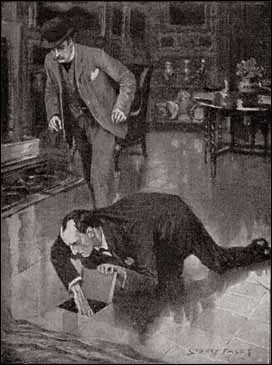
"’Now, Watson, now!’ cried Holmes with frenzied eagerness. All the demoniacal force of the man masked behind that listless manner burst out in a paroxysm of energy. He tore the drugget from the floor, and in an instant was down on his hands and knees clawing at each of the squares of wood beneath it. One turned sideways as he dug his nails into the edge of it. It hinged back like the lid of a box. A small black cavity opened beneath it. Holmes plunged his eager hand into it and drew it out with a bitter snarl of anger and disappointment. It was empty.”

Readers of Sherlock Holmes want nothing more than to see our favorite scenes come to life – vibrantly, often in full color, and on the biggest television or cinema screen we can find. It's not that our own imaginations are somehow lacking – I imagine most folks of any literary bent are all possessed of extremely vivid and lively imaginations – but there is something intrinsically satisfying in being able to say (usually to yourself, a confused pet, or perhaps some longsuffering family member who is idly perusing pamphlets for mental wellness centers), "Yes. Yes, that is precisely how I imagined it." And the Granada television series starring Jeremy Brett as Sherlock Holmes was remarkably adept at capturing that feeling of preciseness, of the satisfaction of exactness. The Baker Street sitting room comes to life with impeccable detail, and the Great Detective’s “certain quiet primness of dress” becomes available for minute examination (MUSG).

But all of these elements are lost without a performance, which the Granada series always delivers in spades. Each episode tried to capture of some each canon story’s particularly unique moments, the ones both implicitly and explicitly stated. For example, the demonstration of Mr. Henry Baker’s cranial capacity via his lost hat from “The Blue Carbuncle,” is charmingly rendered, and scenes from “The Red-Headed League” often seem like a Sidney Paget illustration come to life. Granada’s 1986 adaptation of “The Second Stain” is filled with such instances; ones which readers of Sherlock Holmes stories are drawn to from the original source material, and ones that they might not have even known that they wanted to see rendered.

Dr. Watson informs his readers that Sherlock Holmes was capable of no small amount of physical energy or exertion, when the occasion served his purposes. In those instances, the Doctor describes his friend as “absolutely untiring and indefatigable” (YELL), and it often seemed as if Jeremy Brett was bound and determined to capture that indefatigable energy in every episode, until his own illness and physical limitations prevented him from doing so. This energy is captured best in Granada’s version of SECO as Brett’s Great Detective carelessly tosses Eduardo Lucas’s eponymous stained carpet aside, and throws himself hard upon the ground. He then begins to crawl relentlessly across the floor, clawing viciously at each wooden tile – his determination so visible and obviously single-minded that the viewer almost fears for Dr. Watson’s well-being if he weren’t tucked away by a window keeping watch. But the capstone of the scene comes as Holmes finds the hidden compartment beneath floor, and opens it – only to find it empty. Brett’s “bitter snarl of anger and disappointment” is a total, full-bodied effort, sounding so much like an enraged bull that the viewer half-expects steam to rise from his nostrils. But Sir Arthur Conan Doyle’s original scene (as referenced at the beginning of this post) is captured entirely, down to the last detail.
(Photo via bookishadventures.tumblr.com)
The episode also features a variety of more subtle efforts, which are no less important to achieving the overall effect of exactness. For example, the understated play of expression on Brett’s face as Inspector Lestrade (Colin Jeavons) relays the mystery of the stained carpet are more telling than any overt display of realization. The audience does not have to be told that the small quirk of his mouth means that Holmes has deduced the presence of a hidden compartment – they simply know. Furthermore, the audience likewise knows that, as Holmes lights his pipe and carelessly tosses his match, the Detective’s monologue about the possible locations of the missing paper will lead to more than just a rather smug statement about the Detective’s own abilities: “Should I bring this to a successful conclusion, it will certainly represent the crowning glory of my career!” It also almost leads to a small fire in the Baker Street sitting room, as Holmes’s narrow focus and disregard to common concerns means that his neglected match has again caught light and a pile of discarded newspapers is aflame.

Dr. Watson also has a role in envisioning some of the canon’s iconic moments. As the Doctor comments on Lady Trelawney Hope’s beauty and bearing, Holmes famously responds, “The fair sex is your department, Watson.” But he accompanies this statement with an oddly-pitched, contemplative noise and a dismissive hand gesture that fully enforces how trivial the Detective finds his friend’s “department.” Holmes is not concerned with the outward trifles of Lady Trelawney Hope’s appearance – he is more concerned with what she really wants. Of course, the Detective’s seeming flippancy towards his friend is later offset as the two men stand together companionably, reading the newspaper article about the murder of Eduardo Lucas and bantering about the valet who was out for the evening (“They always are!”) and the elderly housekeeper who heard nothing (“They never do!”). This particular scene is not present in the canon as Granada presents it, but is instead an implicit moment, which the production brought to the surface.

It’s no great revelation to say that the Granada adaptations of the Sherlock Holmes stories were extraordinary, or even to say that they were extraordinary for their minute and exacting attention to detail. But those details are worth mentioning, because there is something uncommon in seeing a favorite scene come to life exactly as it was imagined, or in the inclusion of a moment previously given only a passing reference, but which breathes new life into that which is already offered. The Granada production and its cast and crew often managed to achieve an authenticity which often seemed unachievable, and their 1986 adaptation of “The Second Stain,” remains a hallmark of those efforts.

oOo

“Better Holmes & Gardens” now has its own Facebook page.  Join by “Liking” the page here, and receive all the latest updates, news, and Sherlockian tidbits.

Tuesday, November 15, 2011

“The Meaning of This Extraordinary Performance” (COPP): Granada Television’s “The Musgrave Ritual”

“One morning, as I approached the entrance to the Granada studios, Jeremy arrived in a cab.  As he leant forward on the pavement to pay the driver, the waistband of his well-worn, much-laundered white trousers parted company with the legs which fell in a heap on the kerb.  Giggling, Jeremy pulled them back up and struggled to the safety of the wardrobe, where his laughter could be heard as far away as Liverpool.  His laugh was always infectious.  When I think of Jeremy, I think of his laughing... that will always be my lasting memory of him.  I cannot pay him a greater compliment” (Edward Hardwicke).

November 3 recently marked what would have been the 78th birthday of Jeremy Brett, who was born Peter Jeremy William Huggins in 1933. He starred as Sherlock Holmes in the Granada Television series, appearing in 41 episodes as the Great Detective.  Brett looms large over the role of Sherlock Holmes, and casts a very long shadow over all the actors who have played the part.  Even Benedict Cumberbatch, star of the new BBC series “Sherlock,” said in an October 2010 interview: “[Brett] casts a towering shadow.  He was a friend of my mom's, and he was around our family a lot.  He and the part collided, and he let it take him over.  He was a manic depressive, but that was a side issue, but he then played one.”

The immense range of performance that Jeremy Brett brought to the role of Sherlock Holmes is thrown in to sharp relief in Granada Television’s adaptation of “The Musgrave Ritual.”  This particular episode manages to contain some marked deviations from the original source material, but also somehow, remain remarkably faithful and familiar.  As has been discussed elsewhere, the primary mystery of “The Musgrave Ritual” originally takes place before Sherlock Holmes and Dr. Watson first meet.  The actual narrative of story is told by Sherlock Holmes to Dr. Watson, with Watson relaying the telling of that tale to his readers.  MUSG has been dated by both William Baring-Gould and Leslie Klinger as taking place in 1879, which would have made the Great Detective around 25-years-old.  In other words, the Sherlock Holmes of the original MUSG was quite a young man.

Unfortunately, when Jeremy Brett and Edward Hardwicke filmed Granada’s version of MUSG in 1986, neither man could be quite honestly classified as “young.”  At the time of filming, both Brett and Hardwicke were approximately 53-years-old, and so therefore, the production team’s first obstacle was how to compensate for their stars’ somewhat advanced age.  Furthermore, it simply would not do to film an entire episode with Watson appearing only briefly at the beginning, and perhaps at the end.  That is, it would not do to exclude Watson intentionally, as some casting and plot allowances were made in later Granada episodes for Brett’s health troubles, and Hardwicke’s scheduling conflicts.

So Granada’s 1986 episode of MUSG opens with both Sherlock Holmes and Dr. Watson perched on the back of a cart, on their way to a brief holiday at Musgrave Manor.  Holmes is wrapped in several layers of clothing, including a ratty crocheted blanket, and is coughing pitifully (and melodramatically) every time Watson tries to cheer him with the thought of the entertainments that await them.  On the cart with them is a heavy, locked trunk, which Holmes reveals to contain notes on some of his earliest cases:  “…the record of the Tarleton murders, the case of Vamberry, the wine merchant, and the adventure of the old Russian woman, a full account of Ricoletti of the club-foot, and his abominable wife, and the singular affair of the aluminum crutch…that was something a little recherché.”  Unfortunately, the moment Dr. Watson expresses interest in reading these notes, Holmes slams his foot down upon the lid and begins to use it as a footstool.


And so, from the very beginning, Granada’s adaptation of MUSG both deviates from the original story, and at the same time reaches out to its source.  Many plot details remain the same: Reginald Musgrave, whom Sherlock Holmes always associated “…with gray archways and mullioned windows and all the venerable wreckage of a feudal keep”; Musgrave’s brilliant butler, Brunton; his tumultuous relationship with the housemaid, Rachel; and of course, the ancient Musgrave family ritual.  According to Richard Valley:

“When it came time to remake the story for Granada’s THE RETURN OF SHERLOCK HOLMES, dramatist Jeremy Paul found that it was again necessary to make some minor changes, this time because no suitable location could be found containing the trees essential to the untangling of the puzzle.  The solution: a tree-shaped weathervane atop Hurlestone Manor.”


But the most significant divergence comes relatively early on in the episode, after Watson arrives at Holmes’s room to collect him for dinner.  Holmes is nowhere to be found, but the tempting trunk of early case notes is prominently displayed.  But just as Watson is about sneak a quick peek, the Doctor also spies Holmes’s open morocco case, the needle and cocaine solution prepped for dosage.  The scene ends with Watson looking pensive, but ultimately saying nothing.  Holmes spends the following scenes, and the rest of the evening, being easily coaxed into maniacal, uncontrollable laughter.  Sometimes giggling privately under his breath as he warms himself in front of the fireplace, sometimes flinging himself bodily around the room—laughing in a powerful way that seems to make both Musgrave and Brunton uncomfortable, while Watson tries desperately to simultaneously ignore Holmes and distract the other men.


Finally, at the end of the episode, as Holmes and Watson drive away, it is the Doctor who posits the theory that perhaps Rachel Howells may have intentionally sent the stone crashing, and also the alternate hypothesis that she had “only been guilty of silence as to [Brunton’s] fate.”  Holmes seems uncharacteristically indifferent about this loose thread and says, “Very probably she's far away from Hurlstone now and carries her secret with her.”

Surprisingly and unfortunately, Holmes is wrong.  In the final scene, the pale, waterlogged face of Rachel Howells’s corpse rises up from the mere.  Her romantic rival, Janet Tregellis, recoils in horror at the sight, and runs away screaming in terror.  This final scene brings closure to a plot point that Sir Arthur Conan Doyle had originally left open—whatever happened to Rachel Howells?  But this addition on Granada’s part in no way seems like a correction, or an admonition directed at Doyle for leaving a question unanswered.  Instead, it seems like one last accommodation, a last tribute to the original story that was flexible enough to meet the needs of an evolving cast and crew, which was able to stretch enough to meet in the middle between canon and canonization.

oOo

“Better Holmes & Gardens” now has its own Facebook page.  Join by “Liking” the page here, and receive all the latest updates, news, and Sherlockian tidbits.
Friday, July 22, 2011

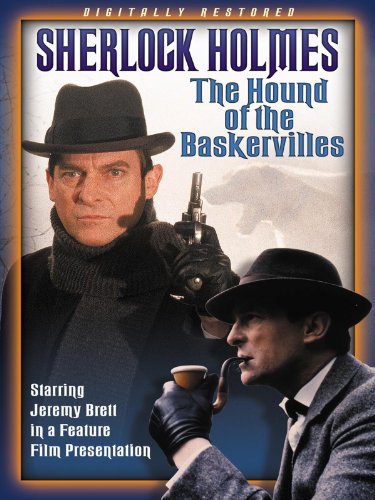
“The Meaning of This Extraordinary Performance” (COPP): Granada Television’s “The Hound of the Baskervilles”

Ick.
Having discovered that the mysterious man on the Tor—whom he had glimpsed briefly one dark evening with Sir Henry Baskerville—is none other than his good friend Sherlock Holmes, Dr. Watson follows the Detective into the rough stone hut that has served as Holmes’s dwelling for the past few days.  Holmes serves Watson some of his “meager refreshment”—a repulsive, lumpy, brown soup—that Holmes pours proudly and sloppily onto a plate, before encouraging Watson to eat.  The Doctor looks revolted, and tries to distract Holmes with a few moments of conversation about the case before them.  Eventually Holmes tries again: “Watson, please, do try my stew.”
Cornered, Watson sighs: “It’s quite disgusting, Holmes.”
“Yes,” Holmes sighs in return.  “Yes, it is.  Well, it’s better when it’s hot.”
That statement can be used to neatly sum-up Granada Television’s version of The Hound of the Baskervilles.  In other words, it’s not so much about what is inside the package, as it is about the presentation.  With HOUN, it’s not about the story itself—there are few people who do not know at least something about the horrible hound, the menacing moors, and the terrible family curse.  As The Stage said, “Like a child who likes to read the same Pooh story time and time again, it’s not so much the narrative that you love as the manner of its telling” (Davies 145).  With the 1988 adaptation of HOUN, what is central is the issue of conveyance, not concept.
Granada’s HOUN actually has quite a bit to recommend itself, beginning with the fact that this version of HOUN actually features a young man (Alastair Duncan) in the role of Dr. James Mortimer, as opposed to the elderly medical man as which he is so often portrayed.  Duncan is certainly more in keeping with the Detective’s famous description of the doctor: “…a young fellow under thirty, amiable, unambitious, absent-minded, and the possessor of a favourite dog, which I should describe roughly as being larger than a terrier and smaller than a mastiff.”  Although Duncan’s Mortimer cannot be described as completely “unambitious,” as perhaps he is “selectively ambitious.”  Dr. Mortimer seems more than willing—even pleased—to accompany Holmes and Watson as they capture Jack Stapleton at the film’s climax.  He even hunts the rabbits that have been destroying his excavation site with lively—if somewhat gruesome—energy.
Kristoffer Tabori fills the role of Sir Henry Baskerville—a character that the late Richard Valley described as somewhat thankless: “Sir Henry’s primary plot functions are to fall in love with the wrong woman and act as bait for a hungry dog…”  It certainly cannot be argued that the baronet does—and more importantly, must do—both of these things; but he is, as I have discussed at-length elsewhere, more than just fodder for the hound.  Tabori’s performance is subtle, almost to the point of being dramatically understated, and nowhere is that more evident than in Sir Henry’s interactions with Beryl Stapleton (Fiona Gillies).  Tabori’s Sir Henry is neither infatuated nor foolishly love-struck; he does not fawn over “Miss” Stapleton.  Instead, he rather seems quietly in awe of her, as if moved to softness and gentility when in her presence.  As Valley describes Sir Henry and Beryl’s final moment on-screen together: “…[Tabori] contributes a fine, ambiguous moment when, surviving the hound’s dinner arrangements, he comes face to face with the one who has simultaneously betrayed and tried to save him.”
Kristoffer Tabori as Sir Henry Baskerville (left),
and Jeremy Brett as Sherlock Holmes (right)
But Granada’s adaptation is not just about the supporting characters, of course.  I don’t typically recommend The Hound of the Baskervilles to friends who have never read a Sherlock Holmes story before; this is mostly because they are always surprised to find how little Sherlock Holmes is actually in this story, for all that it is probably his most famous adventure.  Granada’s version reflects this element of the original text in that Jeremy Brett is only on-screen for a total of about thirty minutes throughout the entire film.  (In fact, some of his scenes are not even new footage, but instead are shots that some viewers may recognize as having been lifted directly from Granada’s version of “The Greek Interpreter.”)  HOUN is really Dr. Watson’s tale. 
Edward Hardwicke plays a Watson that the viewer can easily commit to following around Dartmoor, but more importantly, a Watson that we want to follow as he investigates.  According to Valley:
“Hardwicke embodies the two most important qualities of Watson in ‘The Hound of the Baskervilles’: he’s a man with whom we’re willing to linger while the more dynamic Holmes is not on and; second, he’s of sufficient grit and intelligence not to make us think Holmes has lost his mind by sending Watson to Dartmoor in his stead.”
Hardwicke’s Watson seems a bit flabbergasted, but not truly put-out, when Holmes volunteers the Doctor’s services to Sir Henry at Baskerville Hall.  It’s as if he knows his friend well enough that he was expecting something like this.  And when the two men are reunited outside out the stone hut, and Watson learns that Holmes has been following him all the while, the Doctor’s reprimand is gently chiding, not irate: “I deserve better at your hands, Holmes.  You use me and do not trust me.”  It’s easy to imagine Sherlock Holmes as genuinely remorseful in the face of such a gentle reproof.  Their interactions do not degenerate into childish, angry bickering.  And Hardwicke’s Watson certainly does not bumble around foolishly and make silly proclamations to old beggars who are clearly the Detective in disguise (“I am Sherlock Holmes!”).  Holmes and Watson’s relationship is not at question in this version of HOUN; their friendship is solid and stable.  Hardwicke’s Watson trusts Brett’s Holmes implicitly, and Brett’s Holmes is justifiably reliant on Hardwicke’s Watson.
Basil Rathbone (left) and Nigel Bruce (right) in
The Hound of the Baskervilles (1939):
Oh, do shut your mouth, Watson. 
You're letting in the flies.
In an interview the year of his death, Jeremy Brett was asked if he wanted to redo any of the Sherlock Holmes stories that he had already had a chance to film.  Without hesitation, Brett stated that he would love to have another shot at The Hound of the Baskervilles.  The script drifted, he felt, and Holmes was away for much too long (Davies 144).  While not an unfair assessment, it also undermines Brett’s own contributions to the production.  Brett plays the Sherlock Holmes of this film a bit ambiguously, as if the Detective is himself unsure of the hound’s true nature.  At one point, Watson asks Holmes, “Then you yourself are inclined towards a supernatural explanation?”  Holmes does not answer the question, and instead sighs heavily and suggests that they send word to Dr. Mortimer.  As Brett himself said: “Now as a man of logic, that’s an enormous jump, but he is so disturbed by how disturbed Mortimer is—a doctor and a man of science—that he considers there may be something…” (144).
According to The Ritual, a theatrical magazine, “The definitive version of The Hound is sort of a Sherlockian Holy Grail.  Granada’s production is one of the best—but it is far from definitive.”  There’s quite a bit in this adaptation that the viewer does not typically see in other versions of HOUN:  a young Dr. Mortimer, a Sir Henry with substance, a compelling Watson, and a superstitious Holmes.  But as the star himself admitted, the film is often laborious and slow, and much of the dramatic tension seems to escape with every overly-long shot of landscape.  The Ritual is probably correct in that Granada’s adaptation is not the “Holy Grail” of The Hound of the Baskervilles films.  But it has many of the essential elements, which other versions usually lack, and perhaps it can still be used as a beacon, to prevent other versions of HOUN from being lost on the moors.
oOo
Only one day left to enter the blog contest!  Share your ideal Sherlock Holmes story, and win a prize package of pastiches.  The contest is open until 11:59p.m. EDT on July 23. 
Sources:
• Stuart Davies, David. Starring Sherlock Holmes: A Century of the Master Detective on Screen (January 2006). 

Friday, March 18, 2011

“The Meaning of This Extraordinary Performance” (COPP): Granada Television’s “The Devil’s Foot”

“To me, the Sherlock Holmes stories are about a great friendship.  Without Watson, Holmes might well have burnt out on cocaine long ago.  I hope the series shows how important friendship is” (Jeremy Brett).
Have you been paying attention?  I mean, specifically, to this blog?  I hope so, for a lot of reasons, but more relevantly, if you have been paying attention, you’ve probably figured out who my favorite Sherlock Holmes is.  A lot of talented, brilliant actors have taken on the mantle of the Great Detective over the years, so I try to remain unbiased when it comes to this blog.  Having a favorite does not make me blind to all others, of course.  However, as I looked back over my last few posts, I saw that my preference had managed to worm its way in anyway, subtly and stealthily, much to my chagrin.  Whoops.
Anyway, since my secret is out, “The Adventure of the Devil’s Foot” is a wonderfully atmospheric story in its original form, and Granada Television is, of course, famous for their nearly compulsively faithful adaptations of the Sherlock Holmes canon.  Cornwall is deliciously gothic and sinister as a setting, but it is one thing to read: “The glamour and mystery of the place, with its sinister atmosphere of forgotten nations, appealed to the imagination of my friend, and he spent much of his time in long walks and solitary meditations upon the moor,” and quite another to see Sherlock Holmes walking pensively and alone amongst the dismal landscape, sitting perched high atop ancient ruins, as his thoughts turn inward—looking pale, diminished, and one stiff breeze away from total collapse.
But if I wanted to speak solely on the subject of atmosphere and setting, I would be writing on DEVI, the original text, and not the television adaptation.  I think that the 1988 version of DEVI is worth discussing on its own merits, based upon the inclusion of three new plot points into the story: Sherlock Holmes’s (literal) abandonment of his cocaine habit on the beaches of Cornwall, the inclusion of Holmes’s nightmarish vision under the influence of Radix pedis diaboli, and, finally, the subsequent aftermath of the vision in which Holmes calls out to Dr. Watson by his first name.  These three additions change the whole tenor of the episode, and can be influential in interpreting the original tale, if you like.
Beginning, of course, at the beginning: after what only seems like a few minutes after their arrival in Cornwall (but who can say, really, in television time), Watson enters the cottage to find Holmes at a table injecting himself with cocaine.  The Doctor says nothing, but his expression speaks volumes, and an exceedingly tense moment passes between the two men, before Watson leaves to tend to their luggage.  Not long after, during a scene in which Watson narrates his companion’s activities during the early days of their holiday, we see Holmes standing alone the beach, taking a deep breath before removing a vial of cocaine for his coat pocket.  He empties the vial onto the sand, and then buries the syringe (and modern medical professionals everywhere cringe…someone could step on that). 
Interestingly, Holmes doesn’t appear to inform Watson of his decisions or his actions, as later in the episode, as Holmes sits recoiling from the pain of withdrawal, Watson seems concerned for his friend, but mostly confused—as if he does not know what to make of this new, odd behavior.  Furthermore, after the spasm passes, Holmes smiles benignly: “Cheer up, Watson.  Sea air, sunshine, patience!” and then, “All will be revealed!”  On the surface, he’s speaking of the case, of course, but his attitude is reminiscent of one presenting a well-thought-out gift to a loved one, and Holmes will absolutely not let the surprise be spoiled until it’s ready.  It’s typical of Sherlock Holmes to attempt something potentially life-threatening or dangerous on his own because he wants to, or because he can, but in this instance he seems to act because he must.
Moving on (and more on the subject of Holmes and his danger-for-danger’s-sake habit): in the original text of DEVI, because of the limited perspective of the narrator, the reader is only given access to Watson’s thoughts as the poison smoke of the devil’s foot root overtakes them.  It is an ugly picture:
“A thick, black cloud swirled before my eyes, and my mind told me that in this cloud, unseen as yet, but about to spring out upon my appalled senses, lurked all that was vaguely horrible, all that was monstrous and inconceivably wicked in the universe. Vague shapes swirled and swam amid the dark cloud-bank, each a menace and a warning of something coming, the advent of some unspeakable dweller upon the threshold, whose very shadow would blast my soul.”
But in this televised version, we see Holmes’s vision, and it is nightmarish, gruesome.  There is endless running, across endless fields, and the ghost of a child in a mirror.  There is blood, and churning water, and ghastly, religious-themed images.  And behind it all, is the specter of Professor Moriarty saying, “You must stand clear, Mr. Holmes, or be trodden under foot” (FINA).  So, we walk away from this scene knowing that Holmes is a haunted man, not immune to fear, as we may have thought (or want to believe, your choice).  The original text leaves the reader blind to what happens to Holmes during the ordeal (though Watson describes his friend as looking “drawn with horror”), and even though Holmes says, “It was an unjustifiable experiment even for one’s self, and doubly so for a friend,” there is no way to know for certain what he went through.  Fear being a relative thing, of course.  A televised version, and this particular one, lends depth to the ordeal, and the viewer sees another instance where, perhaps, Holmes acted because he must, and not because he wanted to—because Holmes’s personal sense of amusement might be twisted, but there are limits.
Finally, Holmes awakes from his vision, screaming, insensible, on the ground outside the cottage, with Watson shaking him and calling his name.  After what seems like a full minute of hysterics, Holmes finally comes to his senses enough to call out to his friend…by his first name.  “John!” he screams.  It is a startling moment, one that Jeremy Brett commented on:
“Well, Holmes is semiconscious at the time, right?  It really was the one time that he could call him John.  I think in extremis he might have said ‘John.’ It gives another slant to it.  I slipped in ‘John’ just to show that, underneath it all, there was just something more than what they say, that Holmes is all mind and no heart.”
It goes back, I think, to who Sherlock Holmes becomes when his layers are stripped away.  There are many interpretations, and they’re all subjective, of course—since this is something we never really see in the canon (just as he never refers to Watson by his first name).  But in a moment of semi-conscious horror, there are going to be very few layers, very little armor.  And there again, we see the things that Holmes must do, and not what he can, or wants to do.
Sometimes readers get caught up in seeing Sherlock Holmes as a man that is driven by proving himself, and demonstrating what he can do to everyone around him; that his every action had a pointed, defensive edge to it, an almost passive-aggressive streak, in which he is determined to show himself capable, and worthy.  Televised adaptations, and particularly clever ones like the 1988 version of “The Devil’s Foot,” serve as excellent reminders that despite what Holmes may have believed or thought of himself, he was still human, with compulsions that prevented him from being entirely separated from the human experience.  He was still one of us, if he only walked amongst us briefly.
oOo
One more week to enter my blog contest!  It’s so easy to enter, and the prizes are very cool—a little light reading, a little music.  Sounds like my perfect Sunday afternoon.