Showing posts with label BRUC. Show all posts

Wednesday, August 15, 2012

Currently on Twitter...

As part of an ongoing project on my Twitter feed, I'm delivering stories from the Sherlock Holmes canon in tiny installments of 140 characters or less. I recently finished up "The Engineer's Thumb," which is one of only two cases that Dr. Watson's was able to bring to Sherlock Holmes's attention (the other being the unpublished case of Colonel Warburton's madness).

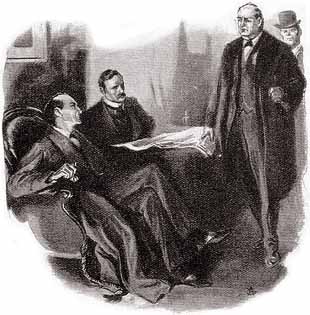
The current story is "The Bruce-Partington Plans," which features an appearance by Mycroft Holmes and is one of only two stories from the Canon to feature the elder Holmes brother (he is also mentioned indirectly in two others). In this story, Sherlock Holmes somewhat reveals the true nature of his brother's work for and as the British Government.

Check out my Twitter feed for a daily installment, although I am usually inspired to post more than once a day. And don't forget you can read through the original canon online.

Sunday, January 8, 2012

“But no heroes, returning from a forlorn hope…” (VALL): The Nature of Heroism in the Sherlock Holmes Canon

“It is simple enough as you explain it,” I said, smiling. “You remind me of Edgar Allan Poe's Dupin.  I had no idea that such individuals did exist outside of stories” (A Study in Scarlet, Chapter Two).

Sherlock Holmes: “Don't make people into heroes, John.  Heroes don't exist and if they did I wouldn't be one of them.” (SHERLOCK, “The Great Game,” 2010)


In his recent graphic novel, Moriarty: The Dark Chamber, writer Daniel Corey re-envisions the world of Sherlock Holmes – a world in which, for all outward appearances, Professor Moriarty had defeated the Great Detective at Reichenbach Falls.  The world of The Dark Chamber is one in which Sherlock Holmes has been dead for over two decades, and Moriarty is living in relative seclusion, seemingly unable to match the excitement of the days when he clashed with his greatest adversary.  However, this Moriarty is no gloating victor – looming malevolently from the center of his criminal spider’s web, and mocking those who remain of Holmes’s confederates.  And so, I was rather surprised to find there were some who took issue with the graphic novel, and with the idea of Professor Moriarty as a “heroic figure.”  You see, I didn’t find Corey’s Moriarty heroic at all, instead I found him rather sad and tired, even if the artwork rendered him less reptilian than I had come to expect from the Napoleon of Crime.


But it got me thinking about the heroes of the Sherlock Holmes canon, and who they really are.  Beginning at the beginning, there’s the Great Detective himself, of course, and as the original definition of “hero” typically only applied to the demigods of Greek myth, than this use of the term might be more appropriate than it even initially appears to be.  After all, Steven Moffat, creator of the television show, SHERLOCK, said: “…Sherlock Holmes is a man who aspires to be a god.”  Certainly, throughout the course of the stories, Sherlock Holmes sometimes acts in ways that could be classified as less-than-heroic, if not flat-out illegal.  He disguised himself as a member of the clergy, participated in numerous instances of breaking and entering, and even contrived an engagement to a housemaid in order to obtain information – just to name a few.  Taken out of context, any one of those acts would be enough to make a lesser fictional character seem less than honorable, less than likeable.  But readers continue to stand behind Sherlock Holmes because he always obeys the spirit of the law, if not the letter of it.  As the Detective says in “The Adventure of the Three Gables,” “I am not the law, but I represent justice so far as my feeble powers go.”

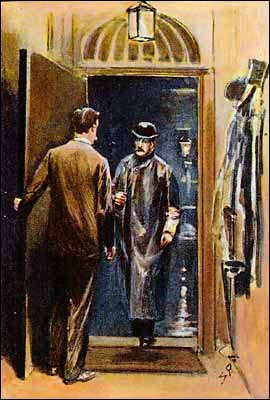
And of course, we can’t forget Dr. Watson, who more than aptly fulfills the later “heroic” definitions of self-sacrifice, martial courage, and moral excellence.  Watson is a soldier, injured in the service of his country, and so it’s more than fair to say that his sense of self-sacrifice is beyond reproach.  Moreover, throughout the canon, Watson repeatedly demonstrates a uniquely honed sense of morality and honor.  Occasionally, he requires a little convincing, and even prodding to get onboard with some of the Detective’s schemes.  In “The Bruce-Partington Plans,” Watson meets Holmes at Goldini’s Restaurant, having brought along the parcel of housebreaking tools that Holmes requested.  After being informed of the plan, and a few moments of trying to convince Holmes to use somewhat more legal channels, Watson still expresses his misgivings: “I don’t like it, Holmes.”

Holmes almost seems taken aback by his friend’s reticence and he lobbies hard for Watson’s presence: “My dear fellow, you shall keep watch in the street.  I’ll do the criminal part.  It’s not a time to stick at trifles.  Think of Mycroft’s note, of the Admiralty, the Cabinet, the exalted person who waits for news.  We are bound to go.”  Of course, the Doctor would never willingly leave his friend to walk into danger alone, and it is this courage that prevents Watson’s heroic characteristics from crossing the line into boring and two-dimensional.  He is a man that is familiar with danger and ambiguous legalities, even wielding a chair as a weapon in “Charles Augustus Milverton.”  But his heroism is rooted in his ability to see where the boundaries are, and decide for himself when he can and should cross them. 

“I knew you would not shrink at the last,” said he, and for a moment I saw something
in his eyes which was nearer to tenderness than I had ever seen.
(via bookishadventures.tumblr.com)
And finally, what of Professor Moriarty?  Could it really be said that there is even anything, remotely heroic about the Napoleon of Crime?  I certainly would not go so far as to say that Sherlock Holmes should have looked to Moriarty in a pinch, but the argument could made that there is something rather protective about the man, which is certainly part and parcel with being a heroic figure.  In “The Norwood Builder,” the Detective says, “From the point of view of the criminal expert, London has become a singularly uninteresting city since the death of the late lamented Professor Moriarty.”  The Professor’s mere existence certainly protected Sherlock Holmes from his own sense of boredom, and his relentless and sometimes dangerous pursuit of more and more interesting work.  Furthermore, Moriarty had a very clear sense of his own boundaries, of what was his, and how to protect it.  As the Professor tells Sherlock Holmes in “The Final Problem”:

“You crossed my path on the fourth of January.  On the twenty-third you incommoded me; by the middle of February I was seriously inconvenienced by you; at the end of March I was absolutely hampered in my plans; and now, at the close of April, I find myself placed in such a position through your continual persecution that I am in positive danger of losing my liberty.  The situation is becoming an impossible one.”

Like Dr. Watson, Professor Moriarty has a clearly defined set of boundaries and limitations that he works very hard to protect.  They might not be respectable boundaries, or even legal ones, but they are set nonetheless and all his efforts are directed towards them.  Such a single-minded focus could possibly be viewed as heroic.  Most readers view Sherlock Holmes’s single-mindedness in much that fashion.

In the short story, “Be Good or Begone,” by Stan Trybulski, Sherlock Holmes has an innocent man savagely beaten by a corrupt police inspector simply because, “…I didn’t like his face.”  Now, Trybulski’s Sherlock Holmes contains more than a few elements of a golden age detective, and often seems less like the Victorian gentleman with which most readers are familiar.  Indeed, in the story, Holmes engages in a litany of strange behavior, from heroin use to vegetarianism, but none of it strikes a discordant note quite like the unprovoked beating of the innocent man.  If perfectly spotless behavior and a constant respect for the confines of the law are what truly define a hero, then Sherlock Holmes wasn’t one.  But instead, readers know what they can expect from Sherlock Holmes – and Dr. Watson and Professor Moriarty, for that matter.  We know what lines they will and will not cross.  We know where they stand, and that’s why we feel that we can stand beside them.


oOo

“Better Holmes & Gardens” now has its own Facebook page.  Join by “Liking” the page here, and receive all the latest updates, news, and Sherlockian tidbits.

Friday, July 15, 2011

“You like this weather?” (CHAS): Using the Weather as an Indicator in the Stories of Sherlock Holmes

“It was a wild, tempestuous night, towards the close of November…Outside the wind howled down Baker Street, while the rain beat fiercely against the windows.  It was strange there, in the very depths of the town, with ten miles of man’s handiwork on every side of us, to feel the iron grip of Nature, and to be conscious that to the huge elemental forces all London was no more than the molehills that dot the fields.  I walked to the window, and looked out on the deserted street.  The occasional lamps gleamed on the expanse of muddy road and shining pavement.  A single cab was splashing its way from the Oxford Street end” (GOLD).
When it comes to setting a scene in a Sherlock Holmes story, needless to say, there are a lot of elements at work.  First, there is the tenor of the case itself: is it murder, blackmail, or robbery? Or is Sherlock Holmes tirelessly tracking down the origins of a mysterious Christmas goose with a valuable gemstone in its crop?  Also, consideration must be given to the physical location of the story: are Holmes and the Doctor at Baker Street?  Or Cornwall?  Or is it the middle of the night on the moors?  And what about the Great Detective’s mood: is he ill, and on holiday?  Lounging about his sitting room like a giant cat?  Or is he already in disguise and crouched in the corner of an opium den
When beginning a story from the Sherlock Holmes canon, there are many ways to tell just what kind of story the reader is going to get, but by simply by looking out of Baker Street’s bow window, or stepping out onto the street, another clear indicator can be gauged.  Will the story be violent and gruesome?  Focus on the cold and dark places of the human heart?  Or will it be about political conspiracy, with complexities so intricate that they are often confused and muddled?  Oftentimes, the weather sets the scene as much as the locale or Holmes’s disposition, and it provides clear clues to the reader, allowing them to prepare for Sherlock Holmes’s next client, perhaps before he or she even arrives at his door.
“It was in the latter days of September, and the equinoctial gales had set in with exceptional violence.  All day the wind had screamed and the rain had beaten against the windows, so that even here in the heart of great, hand-made London we were forced to raise our minds for the instant from the routine of life, and to recognize the presence of those great elemental forces which shriek at mankind through the bars of his civilization, like untamed beasts in a cage.  As evening drew in, the storm grew higher and louder, and the wind cried and sobbed like a child in the chimney.”
Along with Hilton Cubitt from the “The Dancing Men,” John Openshaw, the client from “The Five Orange Pips,” holds the unfortunate distinction of being one of only two clients to be murdered after consulting Sherlock Holmes about his problem.  Openshaw’s arrival in the midst of such a violent storm certainly seems to foreshadow his brutal and futile end.  Openshaw’s family history is also fairly wicked, with its origins in the American Civil War and the Klu Klux Klan.  Openshaw’s uncle, Elias, and father, Joseph, likewise meet violent ends.  Joseph, for example, had been found at the bottom of a chalk pit with his skull shattered, while his son was tossed into the water to drown near Waterloo Bridge.  Perhaps most unjustly, Joseph and John Openshaw’s deaths were entirely dependent upon the actions of Elias—actions that they were neither aware of, or in a position to prevent.
When Openshaw first arrives at Baker Street, he says, “I fear that I have brought some traces of the storm and rain into your snug chamber,” and it is appears that he was correct, if only posthumously.  Openshaw’s death rattles Sherlock Holmes more than Dr. Watson has ever seen.  He takes the young man’s murder personally—a blow to his not inconsiderable pride—and the Detective’s quest for vengeance is as relentless as any “equinoctial gale.”
“It was on a bitterly cold night and frosty morning, towards the end of the winter of ’97, that I was awakened by a tugging at my shoulder…Ten minutes later we were both in a cab, and rattling through the silent streets on our way to Charing Cross Station.  The first faint winter’s dawn was beginning to appear…Holmes nestled in silence into his heavy coat, and I was glad to do the same, for the air was most bitter…”
The frosty morning that begins Holmes and Watson’s adventure to the Abbey Grange complements vividly the icy relationship that they encounter there.  To say that the marriage between Sir Eustace Brackenstall and his wife, Lady Mary Brackenstall, was unhappy would be a dramatic understatement.  Lady Brackenstall spares nothing in describing her late husband: “…Sir Eustace was a confirmed drunkard.  To be with such a man for an hour is unpleasant.  Can you imagine what it means for a sensitive and high-spirited woman to be tied to him for day and night?  It is a sacrilege, a crime, a villainy to hold that such a marriage is binding.”  It is immediately clear that Lady Brackenstall feels no warm sentiment for her late husband; indeed, her opinion of him is as cold as his corpse.
What’s more, the bitterly cold atmosphere of ABBE provides excellent contrast to the fiery and passionate relationship between Mary and Captain Jack Crocker.  There is nothing that Crocker will not do for Mary, even face trial himself as long as she is allowed to go free. “When I think of getting her into trouble,” says Crocker, “I who would give my life just to bring one smile to her dear face, it’s that that turns my soul into water.”  Perhaps Mary Brackenstall’s hot Australian blood and the Captain’s ardent temperament are better suited outside of England’s terribly cold environment.
“In the third week of November, in the year 1895, a dense yellow fog settled down upon London.  From the Monday to the Thursday I doubt whether it was ever possible from our windows in Baker Street to see the loom of the opposite houses…after pushing back our chairs from breakfast we saw the greasy, heavy brown swirl still drifting past us and condensing in oily drops upon the window-panes…”
In My Dear Holmes: Studies in Sherlock, Gavin Brend inevitably brings his discussion of BRUC around to the greasy, yellow fog that encroaches on 221B’s windows: “…the survivor is the greasy, brown, swirling fog of The Bruce-Partington Plans.  This is partly due to Watson’s masterful description, but even more it is due to the fact that we, the English, love and cherish our fogs beyond all things on earth” (136).  And what a fog this is, in BRUC.  This is no wispy fog, no tenuous thing of ethereal gray.  This is a serious fog, and Mycroft Holmes has brought his brother a serious problem—one of national import, with international consequences.
But at first, the Great Detective seems mystified: “But if this is true, then the case is at an end.  On the one hand, the traitor is dead.  On the other, the plans of the Bruce-Partington submarine are presumably already on the Continent.  What is there for us to do?”  Of course Sherlock Holmes is never content to rest upon his laurels, and in reality he is eager to set off on the hunt—but neither is his pathway clear.  When the most likely suspect, Cadogan West, is ruled out, Holmes must set off in fresh pursuit of a criminal that he cannot quite see through the miasma of circumstances, evidence, and deductions.
~~~
There are a variety of ways in which stories in the Sherlock Holmes canon are marked, indicators that allow the reader to know what sort of story to expect before the case even properly begins.  The reader can look for Sherlock Holmes crouched over a tin box of his former cases, or gregariously offering to introduce Watson to his brother, or even stabbing at a dead pig with a harpoon.  But if the client arrives at Baker Street with snow dusting his coat, or the wind chasing him up the seventeen steps—he may not have to speak a single word, for the reader to anticipate what mysteries might come next.

oOo
Only a little more than a week left to enter the new blog contest!  Share the details of your ideal Sherlock Holmes story, and you can win a prize package of pastiches.  Contest is open until July 23.

Friday, June 10, 2011

“It was an admirable hiding-place”: The Adventure of the Six Napoleons

I gave serious thought to subtitling this post: “The Six Lives of Sherlock Holmes,” but it sounded a bit too much like a bad cable television drama for my liking, even if Sherlock Holmes himself had a well-documented appreciation of sensational literature.  Throughout the canon, Sherlock Holmes serves in many capacities, and is many things to many people.  Sometimes the list of descriptors is not so flattering, as in “The Speckled Band,” when the villainous Dr. Grimesby Roylott says to Holmes: “You are Holmes, the meddler…Holmes, the busybody…Holmes, the Scotland Yard Jack-in-office!”  On the other hand, some are flattering to the point of sounding obsequious, such as when Inspector Stanley Hopkins, in “Black Peter,” tells Holmes: “…I should never have forgotten that I am the pupil and you are the master.”
There are a multitude of planes and facets to Sherlock Holmes and his personality.  Some traits are quite clear and distinct, while some are as subtle and elusive as “trying to catch an arrow in mid-flight.”  And more often than not, many of Holmes’s characteristics are difficult to reconcile with each other, such as how a “perfect reasoning and observing machine” (SCAN) can also play his violin with the sensitivity and grace to lull his friend to sleep (SIGN).  Sherlock Holmes describes the case detailed in “The Six Napoleons” as “absolutely original in the history of crime,” but even more interesting is the variety of personality traits he presents to the reader within the tale.  Each trait is distinct and unique, but ultimately, dependent upon each other to create the complete picture of Sherlock Holmes that Dr. Watson presents in this instance.
~~~
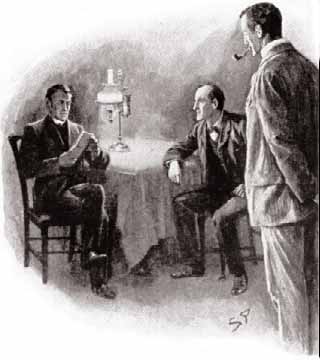
1. The Homebody:  SIXN opens on what is actually a very charming, domestic scene: Holmes, Watson, and Inspector Lestrade seated around the fire at 221B Baker Street, smoking cigars and discussing the news and weather.  Moreover, Watson informs the reader that this is not the first such visit that the inspector has made and “It was no very unusual thing for Mr. Lestrade, of Scotland Yard, to look in upon us of an evening, and his visits were welcome to Sherlock Holmes…”  Later, before the trio ventures out on a late-night visit to Chiswick, Holmes invites Lestrade to rest on the sofa until the proper time, and it is all very friendly and comfortable, with Holmes giving off the impression of a king governing from his favorite armchair, secure in his domain.
Furthermore, Inspector Lestrade’s visits serve another purpose, in that Lestrade keeps Holmes up-to-date on the latest news from Scotland Yard and specifically, any details of the cases on which the inspector is currently engaged.  The Detective, in turn, “…was able occasionally, without any active interference, to give some hint or suggestion drawn from his own vast knowledge and experience.”  While it goes without saying that Sherlock Holmes was an incredibly active man, who would occasionally go to any extreme to solve a case, SIXN also shows the side of Holmes that was sometimes content to solve crimes from his armchair, in front of his fire.
2. The Relentless Pursuer:  One of the victims of SIXN is Mr. Horace Harker, who works for the Central Press Syndicate.  After Harker’s Napoleon bust is stolen, and a man is murdered on his front step, Holmes has Inspector Lestrade tell Harker that clearly “…a dangerous homicidal lunatic, with Napoleonic delusions, was in his house last night.”  Holmes conveys this opinion even though he personally believes no such thing.  More importantly, Holmes knows that Harker intends to write-up the story for the evening press, and now this piece of fraudulent and ill-thought-out information will likely appear in print.  When the item does indeed appear in the newspaper, Holmes famously says, “The Press, Watson, is a most valuable institution, if you only know how to use it.”  According to Leslie Klinger’s New Annotated Sherlock Holmes, this is “…perhaps the first recorded instance of deliberate manipulation of the news…” (1033).
But this is not the first example of Holmes in relentless pursuit of his own ends.  Periodically throughout the canon, Holmes has been known to impersonate a member of the clergy (SCAN), break into homes (CHAS, BRUC), and even allow a criminal to go free, if he felt the crime did not warrant whatever consequences loomed (BLUE).  He even once required Watson to serve as a makeshift jury, while he served as judge in a mock trial (ABBE).  Sherlock Holmes typically operates with his own goals and ends in mind.  Sometimes those ends work fortuitously with the goals of others, but that is merely an added bonus, rather than an intended purpose.
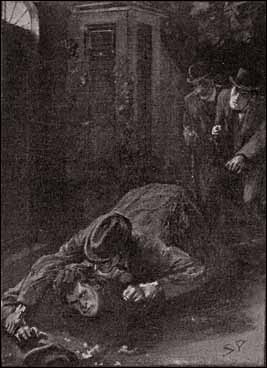
3. The Attack Dog: When he finally has the notorious Beppo cornered, Sherlock Holmes is not satisfied with any subtle or modest method of capture.  Watson claims that Beppo was perfectly intent upon and consumed with smashing his stolen statue and combing through the debris, so it is possible that the criminal could have been cornered and captured quietly, as he was outnumbered and outmaneuvered.  But instead, “With the bound of a tiger Holmes was on his back, and an instant later Lestrade and I had him by either wrist, and the handcuffs had been fastened.”  Illustrations of the scene sometimes show Holmes pinning Beppo firmly to the ground, his body sprawled entirely over him, giving no quarter.  It is no wonder that Watson describes the man as having, “...a hideous, sallow face, with writhing, furious features, glaring up at us…”  If in that position, most people would probably look similarly furious—criminal or no.
The canon is full of examples of Sherlock Holmes’s physical prowess.  He is an accomplished boxer, singlestick fighter, and fencer.  Perhaps most famous is his knowledge of the Japanese art of baritsu [sic], a skill he uses to fend off Professor Moriarty at Reichenbach Falls.  But these skills are all just part and parcel of Holmes’s personality: if something is worth doing, it is worth doing well, but also worth doing spectacularly.  Holmes could have easily taken out Moriarty with a pistol or a knife on that mountain in Switzerland, but why would he do that when he could physically clash with his archenemy, twisting him under his own hands, before throwing him, screaming, over the falls?  Holmes isn’t just a physical man—as his capture of Beppo shows—he is a dramatic one, a characteristic that is also demonstrated elsewhere in the story.
4. The Dramatist: The Great Detective has a sense of humor that could occasionally be described as “ill-timed,” or even cruel.  For example, rather than simply producing the sensitive government treaty that he had been hired to retrieve (the loss of which had driven one man to illness), Holmes requests that Mrs. Hudson hide it under a breakfast dish for their client to find (NAVA).  And while it’s been discussed elsewhere that Holmes’s “old bookseller” costume from EMPT was necessary for a number of safety and logistical reasons, the dramatic method in which he revealed himself to Watson probably was not.  Such is the case in SIXN after Holmes acquires the final Napoleon bust from Mr. Sandeford:
“When our visitor had disappeared, Sherlock Holmes’s movements were such as to rivet our attention.  He began by taking a clean white cloth from a drawer and laying it over the table.  Then he placed his newly acquired bust in the centre of the cloth.  Finally, he picked up his hunting-crop and struck Napoleon a sharp blow on the top of the head.  The figure broke into fragments, and Holmes bent eagerly over the shattered remains.  Next instant, with a loud shout of triumph he held up one splinter, in which a round, dark object was fixed like a plum in a pudding.”
I suppose a simple, “Don’t mind me, but I think a rare, stolen pearl is embedded in this plaster bust so I’m going to smash it apart with a hunting crop,” would have been out of the question here?  As Holmes once said, “I begin to think, Watson…that I make a mistake in explaining.  'Omne ignotum pro magnifico,' you know, and my poor little reputation, such as it is, will suffer shipwreck if I am so candid” (REDH).  Holmes made that statement in 1890, and by 1900 when SIXN takes place, his reputation as a dramatist is firmly established.  This goes a long way towards explaining why Watson and Lestrade are pleasantly surprised, but not shocked, by Holmes’s dramatic revelation.
5. The Peer:  And on the subject of surprises, Inspector Lestrade has one up his own sleeve before the case is over.  After enthusiastically applauding Holmes’s grand reveal and intricate explanation, Lestrade says:
“I’ve seen you handle a good many cases, Mr. Holmes, but I don’t know that I ever knew a more workmanlike one than that.   We’re not jealous of you at Scotland Yard.  No, sir, we are very proud of you, and if you come down to-morrow, there’s not a man, from the oldest inspector to the youngest constable, who wouldn’t be glad to shake you by the hand.”
What a dramatic change from some of Holmes’s earlier interactions with Scotland Yard—considering that the Detective was even once accused of stealing all the credit for solved cases from the official police (NAVA).  Furthermore, Lestrade is saying quite a bit about the Yard’s relationship with the world’s only consulting detective.  He shows that he appreciates the considerable effort that goes into Holmes’s methods—unorthodox as they may be—and he’s saying that everyone else at the Yard sees it too.  He’s recognizing the many years that he and Holmes have worked together, and that while they will never work together in an official way, that he considers Holmes an equal, if not a colleague, and that the feeling is shared by the collective force.  SIXN marks Inspector Lestrade’s last appearance in the canon (after this story, he is only mentioned in passing), making his remarks a fitting closure to his relationship with Sherlock Holmes.
6. The Heart: In her book, The Fictional 100: Ranking the Most Influential Characters in World Literature and Legend, Lucy Pollard-Gott says, “Sherlock Holmes continues to attract us, assuredly for the quality of his mind, but also for the quality of his enigmatic heart” (51).  Throughout the canon, the reader gets brief glimpses of that heart: when he is apologetic for nearly sentencing Watson and himself to a life of nightmarish madness (DEVI), and perhaps most famously when he thinks Watson’s life is compromised (3GAR).  But Holmes’s reaction to Lestrade’s compliment is equally memorable: “’Thank you!’ said Holmes. ‘Thank you!’ and as he turned away, it seemed to me that he was more nearly moved by the softer human emotions than I had ever seen him.”  The scene is made even more haunting by Jeremy Brett’s 1986 interpretation.
Sherlock Holmes may have worked more for “the love of his art than for the acquirement of wealth” (SPEC), but that does not mean he was above praise, or was not susceptible to a well-put or genuine compliment.  Lestrade’s proclamation moves him, even if it just for a moment.  Suddenly the Great Detective becomes accessible, and human.  It is extremely improbable (though I suppose, not impossible) that Holmes would ever have crossed the threshold of Scotland Yard, seeking those handshakes that Lestrade guaranteed.  But for just a moment, he seems to consider it.  For just an instant, he seems almost open to the possibility—like a regular man, who might enjoy something like that.
~~~
In SIXN, the reader experiences the many facets of Sherlock Holmes’s personality, presented on a broad continuum.  But not one of the characteristics encompasses him entirely.  It would be doing the Detective a disservice in pretending that he could be defined completely by one aspect of his character, no matter how important that characteristic may seem.  Dr. Watson presents a wide array of ways to approach Sherlock Holmes and his methods, and while that might never make him ordinary, it goes a long way towards making him accessible.
oOo
June 27 marks the beginning of the next blog contest, and this one will call on your creativity and ingenuity to win.  The prizes have arrived and I can’t wait to get started!  Watch this space for details.
If you have the means to do so, please consider purchasing a DVD copy of The Lady Shallot.  Proceeds over the next five weeks will help support a lovely family through a difficult time.  Details here

Friday, June 3, 2011

Some Thoughts on Setting: The Diogenes Club

“There are many men in London, you know, who, some from shyness, some from misanthropy, have no wish for the company of their fellows.  Yet they are not averse to comfortable chairs and the latest periodicals.  It is for the convenience of these that the Diogenes Club was started, and it now contains the most unsociable and unclubable men in town.  No member is permitted to take the least notice of any other one.  Save in the Stranger’s Room, no talking is, under any circumstances, allowed, and three offences, if brought to the notice of the committee, render the talker liable to expulsion” (“The Greek Interpreter”).
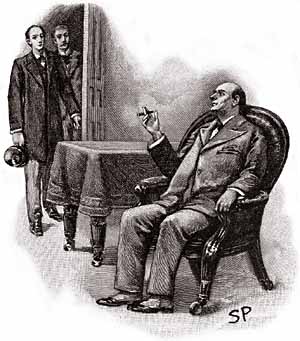
Of all the characters in the Sherlock Holmes canon, I’m probably the most partial to Mycroft Holmes.   I think it has something to do with being an older sibling myself; often corralling a younger sister who seems to loathe all civilized society with her “whole bohemian soul,” and occasionally seems intent upon upsetting our mother whenever possible.  Whatever the reason, I find myself drawn to the stories prominently featuring Sherlock Holmes’s older brother, and to the bizarre gentlemen’s club with which he is so inexorably connected.  The club’s strangeness, in both rule and atmosphere, only serves to augment Mycroft Holmes’s own personal eccentricities, and therefore the oddities of his famous brother (if only by association), by keeping all elements contained within a hermetic atmosphere.
It’s difficult, if not impossible, to separate Mycroft Holmes from the Diogenes Club, which he co-founded.  It is a club for men who enjoy peace and quiet, and who eschew social interactions.  It is a society for men who find the company of other men superfluous, and would rather live their lives without distraction and with little human contact.  Members can even be expelled from the club for speaking, which sounds quite marvelous to those of us eternally in search of silence, never seeming to find it.  Even the local library always seems to have one occupant who believes that his earphones are enough to block out the noise of his iPod, when they most certainly are not. 
But according to Leslie Klinger’s The New Annotated Sherlock Holmes, the Diogenes Club and its litany of peculiar demands was not, in reality, all that strange, given time and place:
“As bizarre as the Diogenes’s practices might seem, such an attitude was de rigueur at most London clubs, where bachelors and married men alike could both relax and cultivate an air of exclusivity and high social rank…That the Diogenes had a designated Stranger’s Room seems similar to the Athenaeum’s policy of relegating its members’ friends to a small room near the club entrance” (641-2).
 So, if the Diogenes Club is not that far removed from the norm as far as Victorian gentlemen’s clubs are concerned, than what is it about the place that is so compelling?  The Diogenes Club is only mentioned directly in two Sherlock Holmes stories—“The Greek Interpreter” and “The Bruce-Partington Plans”—but as with so many Sherlockian things (like Irene Adler, the iconic Deerstalker and pipe, and the Giant Rat from last week’s post), it has taken on a life on its own, beyond the confines of the text.  The answers seem to lie within, not only the boundaries of the club itself, but within what the Holmes brothers make of it.
In “The Greek Interpreter,” Mycroft convinces his brother to sit with him in the bow-window of the Stranger’s Room, within moments of Sherlock and Dr. Watson’s arrival at the club.  “To anyone who wishes to study mankind this is the spot,” [says] Mycroft. “Look at the magnificent types!  Look at these two men who are coming towards us, for example.”  What follows is a brilliant example of Holmesian deduction, as Sherlock and Mycroft bat back and forth a series of logical inferences, regarding a non-commissioned officer who had just happened to wander into their viewing.
bookishadventures.tumblr.com
Their combined inferences are undoubtedly correct, and Mycroft famously notices a few details that his younger brother does not (“Children, my dear boy, children…The fact that he has a picture-book under his arm shows that there is another child to be thought of.”).  However, throughout their observations, the Holmes brothers are kept separate from the rest of the world by the walls and glass of the Diogenes Club.  The Granada Television adaptation of GREE even goes so far as to perch Mycroft and Sherlock on tall stools as they look out of the window, down upon the man who is unaware of their peculiar scrutiny.  There is a distinction and a physical separation between the Holmes brothers and the rest of the world—almost as if the Diogenes Club were preserving them, keeping them under glass.
But even when Mycroft Holmes is on his own, the Diogenes Club still works to create a sense of separateness and otherness.  In “The Bruce-Partington Plans,” Sherlock marvels at the telegram announcing his brother’s imminent arrival at 221B Baker Street.  He explains to Watson: “It is as if you met a tram-car coming down a country lane.  Mycroft has his rails and he runs on them.  His Pall Mall lodgings, the Diogenes Club, Whitehall—that is his cycle.  Once, and only once, he has been here.  What upheaval can possibly have derailed him?”  And he says later, “A planet might as well leave its orbit.”
In short, Mycroft Holmes does not go places, as other people do.  He does not run errands, or take walks in the park, or even jump into a hansom cab to visit his only (for the purposes of the canon, Mr. Baring-Gould) brother.  He is not like Sherlock; he is not known anywhere and everywhere.  Therefore, the places that Mycroft chooses to honor with his presence are significant.  When a man divides his time equally amongst work, lodgings, and club—and nowhere else if he can manage it—the mere act of having a club at all says a great deal about the space.  Mycroft gives the Diogenes Club a sense of exclusivity merely by occupying it.  And if Mycroft also chooses to keep himself separate from the rest of humanity, then the Diogenes Club is the place to do so—a place where no one will question Mycroft Holmes, his actions, or his work because they are not allowed, or even maybe because they simply do not care.  At the Diogenes Club, he is free to be Mycroft Holmes, with all the weight of what that statement implies, more than in any other location in London.
I’ve spoken elsewhere on the relationship between Mycroft Holmes and his younger brother, about their inherent god-like qualities and how Mycroft serves to highlight Sherlock’s service to the rest of us lesser mortals, how Mycroft makes the reader grateful that Sherlock chose our human problems and everything that might entail.  The Diogenes Club merely serves to highlight Mycroft in a similar fashion, emphasizing his own particular abilities and attitudes.  The idea of the Diogenes Club will probably always appeal to the socially awkward and misanthropic among us, those who would rather observe the world behind a glass partition than interact with it.  And also to those who are just looking for five minutes of quiet to finish a blog post, away from the sounds of Call of Duty: Modern Warfare II.  But I wouldn’t know anything about that.
oOo
Now you can join the Diogenes Club!  Join a body of fans from across the globe in providing live commentary on the immense catalog of Sherlock Holmes films and television series.  The club is available online and on Twitter.  Join the discussion on Twitter using the hashtag: #221B.  
And just a reminder that a new blog contest will begin on June 27, so check back here for more details!