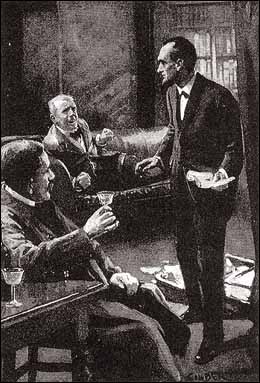
Showing posts with label basil rathbone. Show all posts

Saturday, April 6, 2013

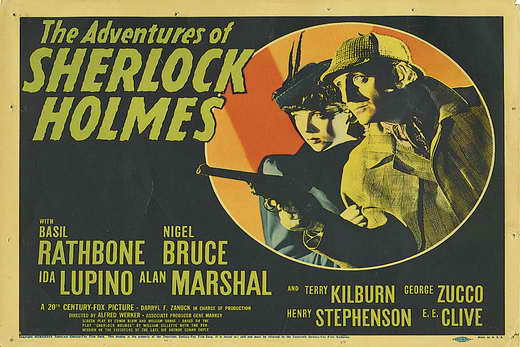
Sherlock Holmes on Screen: “The Adventures of Sherlock Holmes” (1939)

Professor Moriarty: “My whole success depends upon a peculiarity of Holmes’s brain, its perpetual restlessness, its constant struggle to escape boredom.

Bassick: “Holmes again?”

Professor Moriarty: “Always Holmes until the end.”

The man is a music hall singer – a vaudeville performer in a gaudy jacket, adorned with large stripes in an array of undoubtedly ostentatious colors. A straw boater with a large brim, adorned with a ribbon that coordinates with his jacket, is clutched between his gloved hands, and he uses it in a variety of theatrical flourishes during his performance. He sports a handlebar mustache – complete with extravagantly curled, upturned ends – and slickly-styled hair with a pronounced side-part and subtle fingerwave along the brow. He prances energetically about the stage at a garden party, clicking his heels and leaping at appropriate intervals, as he sings a rather nasally-pitched version of the popular British music hall song, “I Do Like to Be Beside the Seaside.” The singer trills and trumpets, and drums upon his boater when the moment calls for it. As a performer, he is utterly outlandish, wildly outrageous, and completely entertaining. He is also Sherlock Holmes – sporting one of his best disguises in his long career on film.

Photo Credit: www.basilrathbone.net
However, the song itself, “I Do Like to Be Beside the Seaside,” is an anachronism. Opening credits date the plot of the film as opening on May 9, 1894, but the song Sherlock Holmes so energetically performs was not written by John A. Glover-Kind until 1907, and was not popularized by the music hall performer Mark Sheridan until 1909. Likewise the 1939 film, The Adventures of Sherlock Holmes, starring Basil Rathbone as Sherlock Holmes and Nigel Bruce as Dr. John Watson, is filled with moments that, while not necessarily anachronistic, certainly seem out of place or inconsistent. The film opens with Professor Moriarty on trial for the murder of a man named “Lorait,” but he is ultimately acquitted, much to the courtroom’s dismay. Moments later, Sherlock Holmes races into the courtroom, proclaiming that he has found incontrovertible evidence of Moriarty’s guilt. He is trailed closely by a man who never speaks a word, and is never introduced. According to Alan Barnes of Sherlock Holmes on Screen, the man was supposedly chief astronomer Dr. Gates (played by Ivan Simpson), who was meant to provide the evidence about which Holmes was so adamant. However it appears that the explanation, along with many other contextual scenes, was cut from the picture (20). According to Barnes:

“The first of three possible endings has Holmes explaining how the vengeful Mateo believed that Ann’s father had been responsible for the death of his own, and had stolen the mine that had made the Brandons rich; meanwhile, Brandon family lawyer Jerrold’s shifty behaviour had been caused by his desire to shield Ann from the truth about her dead father. None of this crucial background information is conveyed in the finished piece” (21).

There are other contextual anomalies in The Adventures of Sherlock Holmes. Dr. Watson is inexplicably antagonistic toward the young page, Billy (Terry Kilburn – who, for some reason, receives top billing over George Zucco, the actor portraying Professor Moriarty), beginning by mocking the frilly, feminine apron that Mrs. Hudson has forced the boy to wear while doing chores. When Holmes good-naturedly points out the deficiencies in the boy’s housework (that Billy has swept the dust under the rug, rather than into the dustbin), the Doctor gives him an intimidating, unforgiving stare, while Billy stares back defensively. Watson is then positively hostile when Billy is able to provide a bit of opportune insight into a piece of evidence: “I’ve listened to seashells that made better sense.” The hostility isn’t solely confined to the Doctor, however. Sherlock Holmes behaves in an equally unfriendly fashion towards Watson, at one point calling him “an incorrigible bungler.” The Detective frequently interrupts his companion’s sentences, often providing his own piercing expression. At one point, Watson says, “You pushed me out of the room as if I were a child. What am I to make of this, Holmes?” And the audience may find themselves wondering the same thing. What are we to make of this?

 
But that doesn’t mean that the film is without its highlights. For every discordant note in the film, there is a harmonious one. The Adventures of Sherlock Holmes was the second of the fourteen Sherlock Holmes films made by the Rathbone-Bruce team. It was also the first film it which Rathbone and Bruce received top billing. For their first film, The Hound of the Baskervilles (also in 1939), Rathbone and Bruce were given second billing to their co-star, Richard Greene, who portrayed Sir Henry Baskerville. The Adventures of Sherlock Holmes was also the last film in the series made by 20th Century Fox, as afterwards the franchise would be acquired and produced by Universal Studios. It was also the last “period” film from the franchise; afterwards, a series of three Sherlock Holmes films set in World War II-era Britain, Europe, and the United States, were made, and followed nine contemporary films in non-wartime settings (sometimes embellished with gothic, not but strictly period, elements).

The Adventures of Sherlock Holmes features George Zucco in the role of Professor James Moriarty (the 1942 film, Sherlock Holmes and the Secret Weapon would feature Lionel Atwill in the role). Zucco’s Moriarty is sedately evil, with undercurrents of roiling menace. He is not a villain that chases after his victims; he waits for them to come to him – as they inevitably do. According to Alan Barnes, “The most measured of crazies, [George] Zucco’s Moriarty makes a significant impression, enjoying another standout scene in which he dares the bullied Dawes to let slip a razor while shaving him: ‘You’re a coward, Dawes. If you weren’t a coward you’d have cut my throat long ago…’” (21).

 
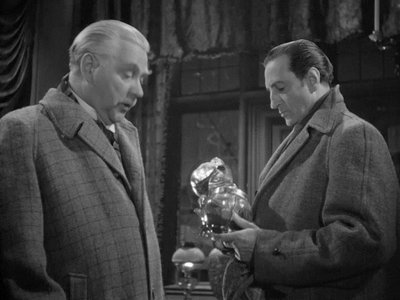
The film also contains an iconic scene. Watson arrives at Baker Street to find Sherlock Holmes in the sitting room, playing scales on his violin to a glass of trapped houseflies. He tells Watson that he is “observing the reaction of the common housefly on the chromatic scale,” and that once he is successful, homeowners will only need to play the correct note to rid the house of flies. The scene is replicated in the 2009 film Sherlock Holmes with Robert Downey, Jr., as Sherlock Holmes and Jude Law as Dr. Watson. Of course, Law’s Watson ultimately releases the carefully trapped flies as recompense for all the trouble his flatmate inflicts upon him. In another interesting contrast, George Zucco’s Moriarty is an avid horticulturist – even making murderous threats at his butler for failing to water one of his plants – while Guy Ritchie’s Professor Moriarty’s (played by Jared Harris in the 2011 film, Sherlock Holmes: A Game of Shadows) inattention to his box of flowers is a critical part of Moriarty’s downfall.

 
The Adventures of Sherlock Holmes was supposedly based on the play by William Gillette, although little – if anything – of the original plot was carried over for the film. Instead the audience is treated to a series of notable scenes, often irreverent, but not without purpose. After all, what could be more memorable than Dr. Watson laying in an empty street – playing at a dead body for Sherlock Holmes’s investigation – and snidely calling a well-meaning, if persistently inquiring stranger a “Stupid fellow”? Anachronisms, contextual problems, and incomplete plotlines aside – much of Sherlock Holmes’s film legacy is owed to the Rathbone-Bruce films, and to The Adventures of Sherlock Holmes in particular. The film’s moments are renowned, and transcend whatever small clumsiness may assert itself, leaping easily into the twenty-first century.  
 
oOo

Sources:


“Better Holmes & Gardens” has its own Facebook page.  Join by “Liking” the page here, and receive all the latest updates, news, and Sherlockian tidbits.

Sunday, July 29, 2012

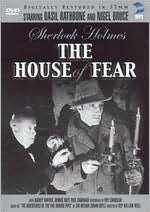
Sherlock Holmes on Screen: “The House of Fear” (1945)

“Viewed today however, one is inescapably reminded of a ‘reality TV’ format: seven diverse housemates are nominated one-by-one for permanent eviction until just one is left to scoop a prize of exactly £100,000. So if The House of Fear fails as both a Sherlock Holmes film and a properly satisfying murder-mystery, its premise is at least enduring.” (Alan Barnes, 92)

Occasionally, I think that Nigel Bruce gets a bad rap. Once in a great while, his performance as Dr. John Watson touches a soft place in my heart. I find myself susceptible to moments like his rendition of “Loch Lomond” in Pursuit to Algiers (and from the same film, his recounting of a recent adventure with Sherlock Holmes using a celery stalk as the Detective and a hunk of cheese as himself); or his utterly crestfallen expression in The Adventures of Sherlock Holmes when the Detective snappishly refers to his companion as “an incorrigible bungler” (though he is soothed by a gentle pat on the shoulder). For all his foolishness and sometimes blatant stupidity, there is warmth and openness in Bruce’s interpretation, with a certain guilelessness that goes a long way towards explaining how he has managed Holmes’s peculiarities for so long – perhaps it is simply because he sees no malice in the Detective’s actions, no animosity, and cannot bring himself to harbor any resentment or bitterness towards his friend.

But in the 1945 film, The House of Fear, such moments of softness and affectation are notably absent. Despite one rather astute and crucial observation, and one poignant moment between the two friends at the conclusion of the film (Holmes does seem rather touchingly grateful for his friend’s survival), Bruce’s Watson is at his vaudevillian worst. It’s hard to find any redemptive qualities in a scene in which Watson – unearthing a grave while Holmes stands about smoking a pipe – finds himself embroiled in an Abbott and Costello-style argument with an owl. Holmes’s comment of “Having a nice little chat, Watson?” is the only one of his many needle-like barbs throughout the film that is utterly deserved. According to Alan Barnes:

“Despite furnishing Holmes with the one last vital piece of evidence, Nigel Bruce’s Watson does not fare well, being a source of irritation to the detective (Holmes loudly informs the entire household that Watson snores ‘like a pig’) and the butt of a semi-jokey five minute sequence in which, guarding downstairs on his own, he flaps hither and thither while attempting to track down the source of a number of strange noises. (He shoots a suit of armour and a cat before asserting, ‘They’ve got me completely surrounded!’)” (94).
To be fair, Rathbone’s Holmes does not come across at his very best in this film either. As Barnes points out, the Detective makes a rather pointed, public and personal joke at the Doctor’s expense: “You snored like a pig!” Later, Watson is attacked in the sitting room while Holmes investigates upstairs. Watson screams rather ardently for his friend, to which Holmes responds by descending the stairs at a pace that could best be described as a “saunter,” or perhaps a leisurely stroll. There is no urgency in his manner, while Watson, for all appearances, has just escaped a brutal death. Holmes’s most animated moment comes only when his own life is in danger – as well as the Doctor’s – at the hands of a falling boulder.

However, Basil Rathbone might have been as much to blame as the film’s screenwriters for the Detective’s apathetic characterization in this film. According to David Stuart Davies: “It was becoming noticeable that Rathbone was beginning to tire of the role of Sherlock Holmes. After nine features and numerous radio broadcasts, the character was so familiar to him that he felt there was nothing fresh he could bring to the part. The reviewer in the New York Times called his performance in this movie ‘as pedestrian as a cop on patrol’” (59). There is a tiredness to Rathbone’s performance in this picture, as if he is trying to summon energy and enthusiasm for the role that he simply does not have. In response, Bruce’s Watson and Dennis Hoey’s Inspector Lestrade (inexplicably present in Scotland in his role as a police inspector, despite being rather clearly out of his jurisdiction) appear to move ever further into the role of caricature, seemingly becoming mere parodies of their roles. Lestrade, for example, loudly and brazenly takes credit for the capture of Professor Moriarty.
To its credit, The House of Fear has much going for it in the way of atmosphere – an eerie, gothic manor seated on top of a high cliff in Scotland, a morose and sinister housekeeper who acts as the harbinger of ill-tidings and death, and a strange men’s club shrouded in secrecy and strange ritual. Even the manners in which the “Good Comrades” are murdered demonstrate a distinct variety and creativity. They are gruesome and evocative, summoning an array of horrifying images with the simple phrase: “No man goes whole to his grave.” The House of Fear’s link to the Canon story “The Five Orange Pips” is tenuous at best – the only reference to the source material being the orange pips each Good Comrade receives prior to his death. But the film does manage to invoke the violence of the original story, the grim and sometimes coldhearted nature of humanity.

There are elements of The House of Fear that are reminiscent of the earlier Rathbone/Bruce picture, Sherlock Holmes Faces Death (1943). As Davies says, “…Sherlock Holmes Faces Death brings Holmes back to the world of creepy old houses, wild windy nights and mysterious unsolved murders. The mood is Victorian Gothic but the presence of the Second World War is still in evidence…” (50). Unfortunately, The House of Fear demonstrates little to none of the strength of its earlier counterpart. Perhaps, this is demonstrative of how much of a Sherlock Holmes film’s success is derived from the strength and vitality of the actor in the title role, and how much the film suffers if he finds himself indifferent.

oOo
“Better Holmes & Gardens” now has its own Facebook page. Join by “Liking” the page here, and receive all the latest updates, news, and Sherlockian tidbits.

Sources:
• Barnes, Alan. Sherlock Holmes on Screen. (September 2011).

Saturday, April 7, 2012

Some Thoughts on Setting: “The strange setting in which their fate was cast” (VALL)

"But there can be no grave for Sherlock Holmes or Doctor Watson... Shall they not always live in Baker Street? Are they not there this moment, as one writes? ...Outside, the hansoms rattle through the rain, and Moriarty plans his latest devilry. Within, the sea coal flames upon the hearth and Holmes and Watson take their well-won ease... So they still live for all that love them well: in a romantic chamber of the heart, in a nostalgic country of the mind, where it is always 1895.” (Vincent Starrett)

So, it is always 1895, as the Sherlockians say – indicating that time is a rather stagnant thing for those who love Sherlock Holmes and Dr. Watson well. That time neither moves forward, nor backward – and Holmes and Watson are perpetually seated in their chairs in front of a fire at 221B Baker Street. But in reality, the canon manages to encompass a rather broad scope of time and space. Even by examining just the original novels, the reader finds “The Country of the Saints” (STUD), “The Strange Story of Jonathan Small” (SIGN), and “Lodge 341, Vermissa” (VALL). These backwards-reaching passages allow the reader to visit Utah, India, and Pennsylvania, respectively – with each separate episode set several years, even decades, in the past from the moment of their telling. Even The Hound of the Baskervilles features a brief foray into the past – the year 1742 specifically – with the reading of the Baskerville legend.

Do you think this is going to have future
consequences? Nah, probably not.
Pastiche and especially film and television adaptations seem to make easy work of time and setting in terms of Sherlock Holmes’s adventures. The Sherlock Holmes films starring Basil Rathbone famously transported the Great Detective and Dr. Watson out of Victorian England, and into a variety of plots centered largely on war propaganda and jingoist sentiment – and based only very tenuously on the original stories by Sir Arthur Conan Doyle. Only two of Rathbone’s Holmes films were set in the nineteenth century: The Hound of the Baskervilles (1939) and The Adventures of Sherlock Holmes (1939). Author Barry Grant, on the other hand, defrosts and revives the Great Detective after nearly a century of being frozen in an Alpine glacier in his two novels, The Strange Return of Sherlock Holmes and Sherlock Holmes and the Shakespeare Letter. And in a similar plot device, Holmes is transported even farther into the future in the animated series, Sherlock Holmes in the 22nd Century, where he is paired with a semi-robotic Watson and a female Lestrade.

So how does Holmes survive all these shifts through time and space (sometimes “space,” in a very literal, astronomical sense)? The Rathbone-Universal Pictures films opened with an explanatory title card: “Sherlock Holmes, the immortal character of fiction created by Sir Arthur Conan Doyle, is ageless, invincible and unchanging. In solving significant problems of the present day he remains as ever the supreme master of deductive reasoning.” Surely the BBC’s series, “Sherlock,” with its modern Sherlock Holmes and Dr. Watson equipped with smartphones and Wifi, has more than proven that a fully contemporary adaptation can be done and done well. However, there is a distinct difference between Benedict Cumberbatch’s Sherlock using video chat with Martin Freeman’s John Watson – or even Basil Rathbone’s Great Detective and Nigel Bruce’s Dr. Watson traveling via airplane – and a Sherlock Holmes who has been forcibly transported to another century, set against of the backdrop of a digital Big Ben and trying to interact with a cyborg. Are we speaking merely to the issue of success or failure in concept and execution?

But Holmes’s body of knowledge and unique strengths were based as much on his knowledge of his time and place as it was upon anything else. So, to forcibly transplant him into another era – via frozen glacier or ill-timed temporal vortex – is to severely weaken him. Cumberbatch and Rathbone’s versions of Sherlock Holmes are certainly not creatures of 1895 in the way of Jeremy Brett’s Great Detective, but they are creatures of their time and place. Because if nothing else, Sherlock Holmes must be comfortable in his own world in the same way that he is comfortable in his own skin. He must know it in the same way that he knows varieties of tobacco ash, or bicycle tires, or the typefaces of various newspapers. To put him in a world in which he fights to understand basic concepts, tools and interactions, is to cripple the Great Detective in a very fundamental way – to see Sherlock Holmes struggle with the world around him would compromise the authenticity of his observations and the authority of his conclusions. A nineteenth century London would be quite alien to both the Rathbone and Cumberbatch versions of Sherlock Holmes, but their own worlds and spheres of existence were not.
All right, someone is going to have to bring me
up to speed here. The "CliffsNotes" version is fine.
There may be no one who has spoken more on the topic of setting – time, place and context – in the canon than the Sherlockian Vincent Starrett. He is, of course, the composer of the iconic poem “221B,” and the gorgeous lines that captured the imagery that so embodied the world of the canonical Sherlock Holmes. But canonical setting is more than just romantic gaslight and cobblestone streets, even for Starrett: "How often have I myself, in other years, climbed those seventeen steps that lead upward to the famous rooms and listened for the voices of their most famous occupants. Sometimes I have been almost certain that I heard them. And the old house in Baker Street still stands for all who remember it. It will stand as long as the cold London fog rolls in with the winter and mischief is planned and thwarted and books are written and read." What he speaks of is being able to recognize Holmes and Watson on sight – of the characteristics of time and setting that make them instantly identifiable – of their being when they should no longer be.

In 2009, the animated series Batman: The Brave and the Bold aired an episode entitled, “The Trials of the Demon,” in which Batman is summoned by Sherlock Holmes into the past to solve a series of inexplicable crimes. Upon first meeting, Holmes is able to accurately deduce Batman’s identity through a series of (humorous) observations. Then with apparently only one observation, Batman is able to likewise deduce Sherlock Holmes’s identity. That observation? “The hat,” Batman says, to which Sherlock Holmes self-consciously adjusts his deerstalker. At the end of the episode, as they say their farewells, Holmes asks Batman to reveal how he really knew his identity. Batman smirks at this question, and finally answers before vanishing:

“Everyone knows who you are. You’re the world’s greatest detective.”
"All right, 'Rock, Paper, Scissors' and then
we'll know who has the silliest outfit."
oOo
“Better Holmes & Gardens” now has its own Facebook page.  Join by “Liking” the page here, and receive all the latest updates, news, and Sherlockian tidbits.

Sunday, December 4, 2011

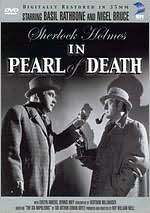
Sherlock Holmes on Screen: “The Pearl of Death” (1944)

“Gentlemen,” he cried, “let me introduce you to the famous black pearl of the Borgias…it is the most famous pearl now existing in the world, and it has been my good fortune, by a connected chain of inductive reasoning, to trace it from the Prince of Colonna’s bedroom at the Dacre Hotel, where it was lost, to the interior of this, the last of the six busts of Napoleon which were manufactured by Gelder & Co., of Stepney.  You will remember, Lestrade, the sensation caused by the disappearance of this valuable jewel, and the vain efforts of the London police to recover it.  I was myself consulted upon the case, but I was unable to throw any light upon it.” (“The Six Napoleons”)

Outside of his 1939 production of “The Hound of the Baskervilles,” the Sherlock Holmes films starring Basil Rathbone were only tangentially linked to the stories of the canon, at best.  In many instances, Sir Arthur Conan Doyle’s original stories could be more accurately viewed as source material, rather than any real type of blueprint.  They provided a framework, not any real form.  But in 1944’s “The Pearl of Death,” when Basil Rathbone’s Sherlock Holmes advises Nigel Bruce’s Dr. Watson against hitting newspaper reporters in the teeth (an affectionate, though misguided, attempt at defending the Detective’s honor), there is more than an echo of Holmes’s original sentiment: “The Press, Watson, is a most valuable institution, if you only know how to use it."

Image via www.sherlockholmesposters.com.
“The Pearl of Death” also marked the introduction of a new adversary for the Great Detective, provided by Universal Pictures in the form of Giles Conover, the jewel thief.  Perhaps the studio felt that audiences had seen enough of Professor Moriarty, but unfortunately Conover embodies many of the Professor’s most prominent characteristics anyway.  According to Sherlock Holmes, “This man pervades Europe like a plague, yet no one has ever heard of him.  That’s what puts him on the pinnacle in the records of crime.  In his whole diabolical career the police have never been able to pin anything on him.  Yet give me a crime without motive, robbery without a clue, murder without trace, and I’ll show you Giles Conover.”  This description is, of course, taken almost verbatim from the Great Detective’s description of Moriarty in “The Final Problem.”

That is not to say, however, that Conover—played by Miles Mander—is not a suitably diabolical figure.  Indeed, the audience’s first glimpse of Conover is quite ominous; he looms menacingly in the back of a darkened car, cloaked in shadow, waiting for his associate Naomi Drake (played by Evelyn Ankers).  In many ways, this scene echoes how the audience would first view Professor Moriarty in the 2009 Warner Bros. movie.  In that film, as Moriarty sits with Irene Adler (played by Rachel McAdams), he is seen mostly in darkness, only a cuff and coat sleeve visible, and lurking in the back of a carriage.  Both Adler and Drake appear to school their nerves in the presence of their intimidating companions, but there is an unmistakable undercurrent of terror that they cannot quite conceal, and which feeds the audience’s perception of the villains.
Another interesting addition to this film was the character known only as “The Creeper,” (played by Rondo Hatton).  The Creeper is a silent, lurking, violent killer, whose distorted features only serves to heighten his chilling presence.  Hatton suffered from acromegaly, a pituitary disorder, which caused his disfigurement.  But this fearsome hooligan, who serves Conover and is responsible for almost all of the violence to person and property throughout the film, stands in the place of a character from the source material.  As Dr. Watson describes the photograph of Beppo: “It was evidently taken by a snapshot from a small camera.  It represented an alert, sharp-featured simian man, with thick eyebrows and a very peculiar projection of the lower part of the face, like the muzzle of a baboon.”  And when Beppo is captured:  “As we turned him over I saw a hideous, sallow face, with writhing, furious features, glaring up at us, and I knew that it was indeed the man of the photograph whom we had secured.”  The Creeper is no more peaceful than Beppo in resolving his affairs in “The Pearl of Death,” and the character would later appear in two more films, unrelated to Sherlock Holmes.

According to David Stuart Davies, author of Starring Sherlock Holmes: A Century of the Master Detective on Screen, this particular Sherlock Holmes film by Universal was significant in other respects:

“'The Pearl of Death' is noteworthy in that it really saw the transition of Rathbone and Bruce into the characters they were playing.  Universal practically eliminated the names Holmes and Watson from their advertising from this film onwards.  Typical blurbs now ran: ‘Basil Rathbone and Nigel Bruce Crack the Mystery of The Pearl of Death’ or ‘Rathbone & Bruce – The Masterminds Tackle The Master Crimes’.  The names and identities of the actors had become so synonymous with those of the characters they were playing that as far as Universal was concerned—and the public too—using one name was as good as another” (57).

Of course, “The Pearl of Death” also features the ceramic busts of Napoleon, their methodical destruction, and the valuable pearl hidden inside one of them, in addition to new archenemies and their fearsome companions.  The film also deviates in important ways.  But the manner in which the film hearkens back to its source material is suggestive.  When Watson asks Holmes if he is certain that the missing pearl is inside the final bust, Holmes dismissively says: “If it isn’t, I shall retire to Sussex and keep bees.”  Such is typical of the type of tributes an avid Sherlock Holmes fan would find in “The Pearl of Death.”  While some of Universal’s Sherlock Holmes films seem to hearken back to the original stories in terms of only one plot point, character, or narrative device, this film seems to recognize the spirit of the original SIXN, and seeks to embody it globally.

oOo

“Better Holmes & Gardens” now has its own Facebook page.  Join by “Liking” the page here, and receive all the latest updates, news, and Sherlockian tidbits.

Friday, August 12, 2011

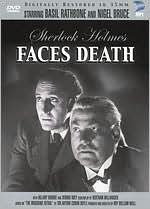
Sherlock Holmes on Screen: “Sherlock Holmes Faces Death” (1943)

While the rest of the film’s cast of characters are solving the infinitely complex and centuries-old family riddle on the great black and white stone floor of Musgrave Manor’s main hall, Inspector Lestrade (played by Dennis Hoey) has managed to get himself lost in the intricate secret passages that are hidden within the sprawling estate.  Hammering desperately on the walls, Lestrade finally attracts the attentions of the crowd, including Sherlock Holmes.  “Get me out,” he shouts.  “I’m lost!  I’m all turned around!”  For his part, Holmes seems entirely indifferent to the police inspector’s plight, responding: “You have been for years!”  And then, turning to the Musgrave’s maid: “Get him out of there, will you, Mrs. Howells?  And give him a saucer of milk.”
As David Stuart Davies points out in Starring Sherlock Holmes: A Century of the Master Detective on Screen, there is no logical reason for Inspector Lestrade to be on hand for the crimes committed at Musgrave Manor, seeing as the location is rather isolated and in Northumberland.  Surely there is a local police inspector who would have better served in this investigative role?  However, he provides (along with Nigel Bruce’s Dr. Watson) some comic relief in what is a really rather gruesome picture.  However, Lestrade’s presence serves another purpose, and his appearance in the 1943 film, Sherlock Holmes Faces Death, marks another way in which the picture returns to the elements with which Sherlockians are most comfortable, the settings in which they most love to see the Great Detective.  Inspector Lestrade may be bumbling and incompetent to the point of hyperbole, but at least he is present, just like Sherlock Holmes’s indoor target practice and Mrs. Hudson’s frustration over the state of her plaster.
“…Sherlock Holmes Faces Death brings Holmes back to the world of creepy old houses, wild windy nights and mysterious unsolved murders.  The mood is Victorian Gothic but the presence of the Second World War is still in evidence…” (50).  Although the plot of the film is only very tenuously linked to the original canon story, “The Musgrave Ritual,” the sprawling Musgrave estate remains, as well as the ancient ceremony that is linked to the layout of the property.  In this film, the puzzle is linked to the layout of the house specifically, rather than the landscape as in the original story; but the ancient crypt remains, with the addition of the black and white stone floor acting as a chessboard and ultimately providing the key to the puzzle’s solution.  As Sherlock Holmes tells Watson, “You were right, Watson, about Musgrave Manor.  Houses, like people, have definite personalities.  And this place is positively ghoulish!”
Interestingly, Musgrave Manor is the film’s link to the present, as well as the past—the shadow of war hangs heavily in the atmosphere, but is not a primary plot point as in some of Basil Rathbone’s previous Sherlock Holmes pictures.  The manor has been converted into a home for convalescent officers, where Watson had been working at the beginning of the picture.  Of particular note, Musgrave Manor has become home to a trio of soldiers that even Sherlock Holmes terms “extraordinary.”  First, there is Captain MacIntosh, who was wounded in a German trench, and now knits compulsively.  There is also Major Langford, a veteran of the Pacific theatre with an escape complex, who now manifests a curious, repetitive speech pattern.  Finally, Lieutenant Clavering is youthful, unexplainably apologetic, and skittish around unidentifiable packages due to his work with explosives.  The three officers act as a type of Greek chorus throughout the film, watching ominously over some of the picture’s more gruesome moments—such as the discovery of Philip Musgrave’s corpse in the trunk of a car.  They also remark surreptitiously on the action—comments that seem to go largely unnoticed by the rest of the ensemble, but nonetheless provide a sense of place and time whenever necessary, sometimes echoing the sentiments of the audience as Sherlock Holmes works through his methods.
And the Great Detective is back in what seems to be his natural element.  There are no spies, NAZIs, nor matters of international intrigue in this picture.  While Holmes’s wardrobe and styling are unmistakably modern, his attitude and his mannerisms are clearly—well, if not Victorian, as such—very uniquely Sherlock Holmes.  From the moment he leaps into action at Watson’s arrival at Baker Street with the case, to the manner in which he keeps everyone in the dark as to his methods at the film’s climax—Basil Rathbone’s Sherlock Holmes stares down his challengers in a way that conveys his intellectual superiority without a word, and he uses that power to its fullest advantage in this movie.  In addition, Holmes is sniping (sometimes nastily, sometimes affectionately) at Nigel Bruce’s famously bumbling Dr. Watson; he brushes off Mrs. Hudson’s concerns over property damage by couching it in terms of the solution to his case; and when Sally Musgrave (played by Hillary Brooke) throws herself into Holmes’s arms while in a state of distress, the Detective’s first reaction is to turn to Dr. Watson for a sedative, all the while looking profoundly uncomfortable.
As Davies says, “[Director Roy William Neill] returned Holmes and Watson to the kind of complex problem and rich atmosphere that make Doyle’s tales so satisfying” (50).  The manner in which Holmes tackles the problem is comfortably familiar—Holmes’s habitual brilliance shining ever so brightly as he solves the riddle that had baffled generations of Musgraves.  The Musgrave Ritual is perhaps one of the most famous treasure hunt puzzles in all of literature (parts of it were appropriated by T.S. Eliot in “Murder in the Cathedral”), and even though the puzzle is changed for the purposes of the film, the spirit of it remains.  And Sherlock Holmes is able to solve it with little more than his own wit, his pipe, and a chessboard (both small and large) on which to act out his deductions.

www.filmjournal.net

According to the New York Times, “…what is admirable about the film is the wonderful sense of atmosphere, of mystery, of sepulchral gloom that oozes like fog throughout the melodrama.  No government spy work for Sherlock this time; despite his being contemporized by the studio right up to the minute, this adventure was, paradoxically, a return to all the shadowy Victorian trappings of the richly old-fashioned mystery” (51).  And perhaps that is what is so lovely and appealing about Sherlock Holmes Faces Death—it appears to have found just the right balance between Rathbone’s earlier “period” Sherlock Holmes films (The Hound of the Baskervilles and The Adventures of Sherlock Holmes) and the later war films (Sherlock Holmes and the Voice of Terror and Sherlock Holmes and the Secret Weapon).  There is a space in which audiences (and readers) know Sherlock Holmes, where they recognize him most easily, where they prefer to find him.  And this film goes a long way towards recreating that place.
oOo
Sources:

Friday, April 22, 2011

“I never can resist a touch of the dramatic” (NAVA): Sherlock Holmes and the Art of Disguise

“Ah, you rogue!” cried Jones, highly delighted. “You would have made an actor and a rare one. You had the proper workhouse cough, and those weak legs of yours are worth ten pound a week.  I thought I knew the glint of your eye, though. You didn’t get away from us so easily, you see” (The Sign of Four).
I have a confession to make.  You see, I was once completely taken in by one of Sherlock Holmes’s disguises.  There, I said it.  I don’t feel any less embarrassed for having admitted it, but still, it’s the truth.  It was my first viewing of The Adventures of Sherlock Holmes (1939), starring Basil Rathbone, and oh, how I laughed when that silly vaudeville singer came out, in his ridiculous striped jacket.  And oh, how I chuckled to myself, thinking how Sherlock Holmes would never do anything as undignified as sing, “I Do Like to Be Beside the Seaside,” while dancing merrily.  And oh, how stupid I felt when that music hall performer revealed himself as the Great Detective.  I had read the stories after all, how did I not I see this coming?  It felt a bit like being caught off-guard at Holmes making a complex deduction or lighting his pipe; at times, the disguises seem as much a part of his character as anything else.
www.basilrathbone.net
Sherlock Holmes uses the art of disguise throughout the canon, quite often and typically to great success.  On average, he appears as some form of laborer (CHAS) or as a sailor (SIGN), and even once appearing as an opium addict (TWIS); on film or television, his costumes tend to be a bit more elaborate [Note: Rupert Everett’s impressive “French ambassador” disguise in Sherlock Holmes and the Case of the Silk Stocking].   But there are three particular disguises from the canon that stand out as being unique: the old priest whom Holmes becomes to gain access to Briony Lodge and Irene Adler; the old bookseller he is dressed as when he presents himself to Watson after the Great Hiatus; and Holmes’s spy persona, the Irish-American “Altamont.”  These three instances highlight both the faults, and the intricacies of purpose, when considering this particular method in Holmes’s art of detection.
·         The Old Priest from “A Scandal in Bohemia”
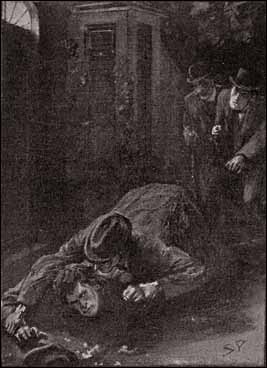
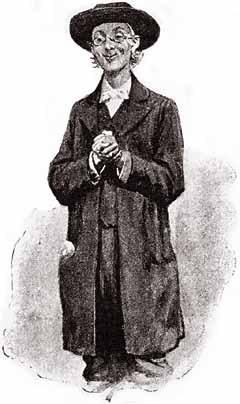
A unique disguise for Holmes if only in that it failed.  He appears in costume twice in SCAN, first as “a drunken-looking groom,” before becoming the “simple-minded Nonconformist clergyman.”  Granted it was the entire package of circumstances (the rowdy crowd, the fire scare, the smoke bomb, and the old priest) that allowed Irene Adler to realize that she had been duped.  But Holmes’s disguise didn’t serve to protect him.  He is wearing it at that famous canonical moment, when bent over to unlock the door to Baker Street, Adler saunters past (in her much more effective costume) and says, “Good-night, Mister Sherlock Holmes.”  Holmes is caught off-guard and very unsettled.  The Great Detective has been defeated, and he doesn’t even fully realize it until the next day, when he returns to Briony Lodge with Watson and the King of Bohemia to attempt to retrieve the prize.
Holmes has a laundry list of skills at his disposal, without even considering his ability to camouflage himself: analytical and deductive reasoning, physical dexterity, safe cracking and lock picking, the ability to identify 140 different types of tobacco ash (BOSC) and 42 different bicycle tire treads (PRIO).  But Holmes’s ability to disguise himself is a bit like putting on armor; it’s a skill, to be sure, but it also acts as an extra layer of protection.  Holmes appears as other people when it would be unwise to appear as himself, or when he would learn more masquerading as someone else.  The costumes shelter him from physical threat, and protect him from the possibility of failure.   
Irene Adler saw through his disguise, and she knew who he was.  She knew that she had become “an object of interest to the celebrated Mr. Sherlock Holmes.”  Sherlock Holmes wasn’t just wrong in the case of “A Scandal in Bohemia”; and he wasn’t just proven wrong by a woman.  He was proven vulnerable.
·         The Old Bookseller from “The Empty House”
A unique costume for the reasons that Holmes employed it.  Ransom Riggs says, in The Sherlock Holmes Handbook: The Mysteries and Methods of the World’s Greatest Detective, “Few things are more shocking than watching one person become another” (143).  Nowhere in the canon is this more accurate than in “The Empty House.”  One moment, Watson is talking to an old bookseller who is eagerly trying to sell him copies of British Birds, Catullus, and The Holy War; he turns to examine his bookcase and when he looks back, Sherlock Holmes is smiling at him—a man who by all accounts has been dead for three years.  It’s hard to blame the Doctor for careening into a flat faint. 
Holmes gets quite a bit of grief for being needlessly cruel to his old friend in this instance, and even he terms his use of the disguise as “unnecessarily dramatic,” but there are few factors to consider before passing judgment.  While the rest of the world thinks Sherlock Holmes is dead—and that meant he could have walked down a Kensington street and not attracted any notice from random passersby—there certainly were people that were looking for the face of a dead man in the crowd.  Holmes knew that one of Professor Moriarty’s confederates, Colonel Moran, had escaped capture; and most importantly, Holmes knew that he was being watched.  In short, he is in danger, but most especially, he is a danger to others.  If he had simply strolled casually into Watson’s practice dressed as no one but himself, the apple-seller across the street may have thought little of it, but more likely, one of Moran’s associates would have attempted to cut down Holmes before he ever crossed the threshold.  And if not, Watson would have been in danger just by being in Holmes’s presence. 
So in this instance, Holmes disguises himself, not just to glean information, not just for his own protection, but for the protection of others.
·         “Altamont,” Irish-American Spy, from “His Last Bow”
A unique masquerade if only in terms of sheer longevity.  In this story, which is chronologically the last of their adventures (taking place in 1914), Holmes tells Watson how he came to be a spy, under the behest of the prime minister himself: “It has cost me two years, Watson, but they have not been devoid of excitement. When I say that I started my pilgrimage at Chicago, graduated in an Irish secret society at Buffalo, gave serious trouble to the constabulary at Skibbareen…”  Michael Walsh’s short story, “The Song at Twilight,” available in the collection, Sherlock Holmes in America, provides an interesting timeline of specifics regarding Holmes’s American excursion, including the details of his induction into the Irish secret society he spoke of, how “James McKenna” became “Altamont,” and how the ghost of a past adventure influenced that change.
Altamont is also peculiar in that he is not one of Holmes’s more complicated disguises in terms of make-up and costuming.  He grows a goatee, and adopts an Irish-American accent and appropriate slang.  Both of which he apparently despises and plans to do away with as soon as possible, but a disguise for Sherlock Holmes was more than just grease-paint and fake hair.  As Watson tells us, “It was not merely that Holmes changed his costume.  His expression, his manner, his very soul seemed to vary with every fresh part that he assumed” (SCAN).  Considering this, assuming a persona for two entire years, becomes a very interesting thing indeed for Sherlock Holmes. 
In “The Song at Twilight,” Holmes outlines the assumption of his new personality: “Still, no role I had played, neither stable boy, nor wizen bookseller, nor even Sigerson—when the world, including Watson, thought me dead after Professor Moriarty’s unfortunate accident at the Reichenbach Falls—could rival my new persona…With every passing day, he was becoming more and more real to me, and there were days when I hardly thought of Mr. Sherlock Holmes of Baker Street” (336).  “Altamont” is interesting, therefore, in that he could perhaps be termed a person and not a persona; and serves to further accentuate the very dangerous games Holmes sometimes played with others, but also with himself.  
~~~
Like Inspector Jones tells him in The Sign of Four, Holmes “would have made an actor and a rare one,” and the Detective’s ability to masquerade as almost anyone provides some of the canon’s more lighthearted moments.  But as with almost everything he does, there are layers of purpose here.  He uses disguise for a myriad number of reasons—to get information, to protect himself, to protect others, and perhaps even for reasons that are beyond his own understanding.  Whatever the case, Holmes was a master at it, and even Watson never seemed to develop the ability to see through his friend’s subterfuges, no matter how many years they knew each other.  Perhaps then I’ll stop being embarrassed about my oversight in The Adventures of Sherlock Holmes.  Probably not.
oOo
A new blog contest launches this Monday, April 25!  Brush up on your Sherlock Holmes trivia, and check back here for details on how to enter and win.