Showing posts with label MUSG. Show all posts

Friday, May 25, 2012

Some Thoughts on Character: Reginald Musgrave

“In appearance [Reginald Musgrave] was a man of an exceedingly aristocratic type, thin, high-nosed, and large-eyed, with languid and yet courtly manners. He was indeed a scion of one of the very oldest families in the kingdom… Something of his birth-place seemed to cling to the man, and I never looked at his pale, keen face or the poise of his head without associating him with gray archways and mullioned windows and all the venerable wreckage of a feudal keep.”

In the 1986 Granada Television adaptation of “The Musgrave Ritual,” Sherlock Holmes and Dr. Watson arrive at Hurlstone Manor for a holiday – much needed (on Holmes’s part) and much encouraged (on Watson’s part). They are greeted by Reginald Musgrave, and the conservation is polite, if a little stilted. Finally, Holmes and Musgrave walk off alone – leaving Watson in friendly conversation with Brunton, the butler. Musgrave compliments Holmes on making a successful living off of his wits, to which Holmes replies, while looking about absently: “And how is the dear wife?” A brief silence follows before Musgrave replies: “I’m not married, Holmes.” There is another, longer, more awkward silence before Holmes claps Musgrave on the shoulder: “How wise!”
Photo Credit: bookishadventures.tumblr.com
And that is the disconnect with Reginald Musgrave; that is what separates Musgrave from other figures from Sherlock Holmes’s past – Victor Trevor, for example. Although the plot of MUSG was slightly altered for the Granada adaptation to compensate for the somewhat advancing ages of the series’ stars – Jeremy Brett, for example, was 53-years-old at the time of filming and was therefore perhaps ill-suited to play the 25-year-old Sherlock Holmes as seen in the original text of MUSG – the dynamic between Holmes and Reginald Musgrave remains true to the source material. Holmes and Musgrave are not friends. That is not to say that they are antagonistic, far from it. They are merely acquainted. Musgrave spins in and out of Sherlock Holmes’s orbit in much the same way as any of his other clients. At times there seems to be no difference between Reginald Musgrave and Violet Hunter, Victor Hatherley, or Grant Munro – that is to say, once they have served their purpose, they are rarely, if ever, heard from again. Musgrave at least has the added benefit of being openly appreciative of Holmes’s talents, where many had seemed initially incredulous: “Once or twice we drifted into talk, and I can remember that more than once he expressed a keen interest in my methods of observation and inference.”
But like Victor Trevor, Reginald Musgrave intrigues because he knew Sherlock Holmes when. He knew him when he was young and was not yet fully formed or fully in possession of his powers. He knew him when his career as the world’s only consulting detective was not yet sculpted out or defined to his satisfaction. More importantly, Reginald Musgrave knew Sherlock Holmes when Dr. Watson did not. Reginald Musgrave was present at the beginning of Sherlock Holmes – which for some Sherlockians is somewhat equivalent to being present for the Big Bang – and so he is in possession of a piece of the puzzle, which we are not. But does that truly lend any extra weight to Musgrave’s presence in the Canon – does that give him more merit as a character, when Holmes appears to give him the same level of consideration as the dottles and plugs of tobacco left on the mantelpiece of Baker Street every morning?
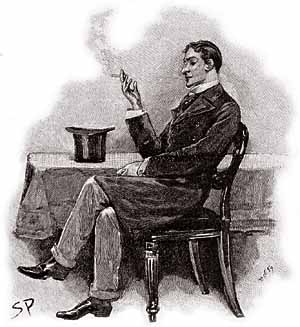
Unlike Victor Trevor, who was present from the very inception of Holmes’s career (“And that recommendation, with the exaggerated estimate of my ability with which he prefaced it, was, if you will believe me, Watson, the very first thing which ever made me feel that a profession might be made out of what had up to that time been the merest hobby.” [GLOR]), Holmes appears to lose track of Reginald Musgrave for a bit of time before their paths cross again: “For four years I had seen nothing of him until one morning he walked into my room in Montague Street. He had changed little, was dressed like a young man of fashion–he was always a bit of a dandy–and preserved the same quiet, suave manner which had formerly distinguished him.” Holmes’s description of this first meeting with a long-lost acquaintance is rather interesting, in that he manages to both insult and compliment Musgrave in the same sentence. It is up to the reader to determine if the balance of the remark is ultimately neutral. But the casual way in which Holmes marks the length of their separation indicates that it was all the same to him if Musgrave had never walked through his door at Montague Street at all, save for the puzzle he brought with him.
According to Leslie Klinger: “Holmes and Musgrave were never more than ‘slight acquaintance(s)’: thus it is possible that the struggling young detective saw not a social visit but a business opportunity when Musgrave walked through his door. June Thomson speculates that Holmes may have charged Musgrave a fee for his services, pointing to his ‘living by my wits’ remark as ‘possibly a hint that he had turned professional and expected to be paid’” (534). And so, the reader sees Reginald Musgrave present at the time when Holmes has begun to realize that his services had value. Musgrave may not be the Detective’s first paying client, but he was probably one of the earliest. Victor Trevor may have been present for the beginning of Sherlock Holmes, but Reginald Musgrave was present for the event horizon – for the point of no return, for the moment when Holmes’s fate was fully determined and guaranteed.
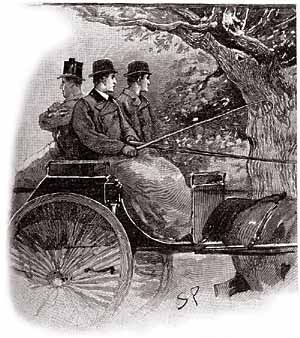
As has been mentioned before, Holmes ultimately lost track of Victor Trevor – just as he lost track of Musgrave – but that was hardly Holmes’s fault entirely – the sordid circumstances surrounding his father’s death were certainly enough to make a reasonable man want to escape any and all places and persons associated with the events. The weight and merit of Trevor’s character rest largely on what he was present for, and Musgrave bears much the same burden. Though of the two men, Victor is the only one who can honestly wear the title of “friend,” Musgrave is the only one who can be honestly called a “client” – in the fully paying sense of the term. And while Victor Trevor sought out Sherlock Holmes in his hour of need, Reginald Musgrave walked through the door of Montague Street looking for a detective.
oOo
“Better Holmes & Gardens” now has its own Facebook page.  Join by “Liking” the page here, and receive all the latest updates, news, and Sherlockian tidbits.

Tuesday, November 15, 2011

“The Meaning of This Extraordinary Performance” (COPP): Granada Television’s “The Musgrave Ritual”

“One morning, as I approached the entrance to the Granada studios, Jeremy arrived in a cab.  As he leant forward on the pavement to pay the driver, the waistband of his well-worn, much-laundered white trousers parted company with the legs which fell in a heap on the kerb.  Giggling, Jeremy pulled them back up and struggled to the safety of the wardrobe, where his laughter could be heard as far away as Liverpool.  His laugh was always infectious.  When I think of Jeremy, I think of his laughing... that will always be my lasting memory of him.  I cannot pay him a greater compliment” (Edward Hardwicke).

November 3 recently marked what would have been the 78th birthday of Jeremy Brett, who was born Peter Jeremy William Huggins in 1933. He starred as Sherlock Holmes in the Granada Television series, appearing in 41 episodes as the Great Detective.  Brett looms large over the role of Sherlock Holmes, and casts a very long shadow over all the actors who have played the part.  Even Benedict Cumberbatch, star of the new BBC series “Sherlock,” said in an October 2010 interview: “[Brett] casts a towering shadow.  He was a friend of my mom's, and he was around our family a lot.  He and the part collided, and he let it take him over.  He was a manic depressive, but that was a side issue, but he then played one.”

The immense range of performance that Jeremy Brett brought to the role of Sherlock Holmes is thrown in to sharp relief in Granada Television’s adaptation of “The Musgrave Ritual.”  This particular episode manages to contain some marked deviations from the original source material, but also somehow, remain remarkably faithful and familiar.  As has been discussed elsewhere, the primary mystery of “The Musgrave Ritual” originally takes place before Sherlock Holmes and Dr. Watson first meet.  The actual narrative of story is told by Sherlock Holmes to Dr. Watson, with Watson relaying the telling of that tale to his readers.  MUSG has been dated by both William Baring-Gould and Leslie Klinger as taking place in 1879, which would have made the Great Detective around 25-years-old.  In other words, the Sherlock Holmes of the original MUSG was quite a young man.

Unfortunately, when Jeremy Brett and Edward Hardwicke filmed Granada’s version of MUSG in 1986, neither man could be quite honestly classified as “young.”  At the time of filming, both Brett and Hardwicke were approximately 53-years-old, and so therefore, the production team’s first obstacle was how to compensate for their stars’ somewhat advanced age.  Furthermore, it simply would not do to film an entire episode with Watson appearing only briefly at the beginning, and perhaps at the end.  That is, it would not do to exclude Watson intentionally, as some casting and plot allowances were made in later Granada episodes for Brett’s health troubles, and Hardwicke’s scheduling conflicts.

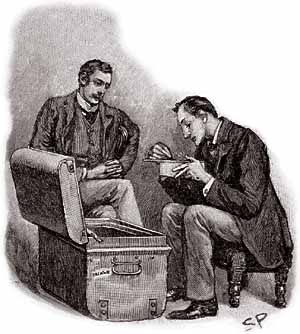
So Granada’s 1986 episode of MUSG opens with both Sherlock Holmes and Dr. Watson perched on the back of a cart, on their way to a brief holiday at Musgrave Manor.  Holmes is wrapped in several layers of clothing, including a ratty crocheted blanket, and is coughing pitifully (and melodramatically) every time Watson tries to cheer him with the thought of the entertainments that await them.  On the cart with them is a heavy, locked trunk, which Holmes reveals to contain notes on some of his earliest cases:  “…the record of the Tarleton murders, the case of Vamberry, the wine merchant, and the adventure of the old Russian woman, a full account of Ricoletti of the club-foot, and his abominable wife, and the singular affair of the aluminum crutch…that was something a little recherché.”  Unfortunately, the moment Dr. Watson expresses interest in reading these notes, Holmes slams his foot down upon the lid and begins to use it as a footstool.


And so, from the very beginning, Granada’s adaptation of MUSG both deviates from the original story, and at the same time reaches out to its source.  Many plot details remain the same: Reginald Musgrave, whom Sherlock Holmes always associated “…with gray archways and mullioned windows and all the venerable wreckage of a feudal keep”; Musgrave’s brilliant butler, Brunton; his tumultuous relationship with the housemaid, Rachel; and of course, the ancient Musgrave family ritual.  According to Richard Valley:

“When it came time to remake the story for Granada’s THE RETURN OF SHERLOCK HOLMES, dramatist Jeremy Paul found that it was again necessary to make some minor changes, this time because no suitable location could be found containing the trees essential to the untangling of the puzzle.  The solution: a tree-shaped weathervane atop Hurlestone Manor.”


But the most significant divergence comes relatively early on in the episode, after Watson arrives at Holmes’s room to collect him for dinner.  Holmes is nowhere to be found, but the tempting trunk of early case notes is prominently displayed.  But just as Watson is about sneak a quick peek, the Doctor also spies Holmes’s open morocco case, the needle and cocaine solution prepped for dosage.  The scene ends with Watson looking pensive, but ultimately saying nothing.  Holmes spends the following scenes, and the rest of the evening, being easily coaxed into maniacal, uncontrollable laughter.  Sometimes giggling privately under his breath as he warms himself in front of the fireplace, sometimes flinging himself bodily around the room—laughing in a powerful way that seems to make both Musgrave and Brunton uncomfortable, while Watson tries desperately to simultaneously ignore Holmes and distract the other men.


Finally, at the end of the episode, as Holmes and Watson drive away, it is the Doctor who posits the theory that perhaps Rachel Howells may have intentionally sent the stone crashing, and also the alternate hypothesis that she had “only been guilty of silence as to [Brunton’s] fate.”  Holmes seems uncharacteristically indifferent about this loose thread and says, “Very probably she's far away from Hurlstone now and carries her secret with her.”

Surprisingly and unfortunately, Holmes is wrong.  In the final scene, the pale, waterlogged face of Rachel Howells’s corpse rises up from the mere.  Her romantic rival, Janet Tregellis, recoils in horror at the sight, and runs away screaming in terror.  This final scene brings closure to a plot point that Sir Arthur Conan Doyle had originally left open—whatever happened to Rachel Howells?  But this addition on Granada’s part in no way seems like a correction, or an admonition directed at Doyle for leaving a question unanswered.  Instead, it seems like one last accommodation, a last tribute to the original story that was flexible enough to meet the needs of an evolving cast and crew, which was able to stretch enough to meet in the middle between canon and canonization.

oOo

“Better Holmes & Gardens” now has its own Facebook page.  Join by “Liking” the page here, and receive all the latest updates, news, and Sherlockian tidbits.

Friday, August 12, 2011

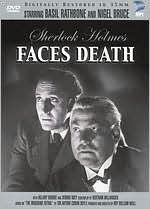
Sherlock Holmes on Screen: “Sherlock Holmes Faces Death” (1943)

While the rest of the film’s cast of characters are solving the infinitely complex and centuries-old family riddle on the great black and white stone floor of Musgrave Manor’s main hall, Inspector Lestrade (played by Dennis Hoey) has managed to get himself lost in the intricate secret passages that are hidden within the sprawling estate.  Hammering desperately on the walls, Lestrade finally attracts the attentions of the crowd, including Sherlock Holmes.  “Get me out,” he shouts.  “I’m lost!  I’m all turned around!”  For his part, Holmes seems entirely indifferent to the police inspector’s plight, responding: “You have been for years!”  And then, turning to the Musgrave’s maid: “Get him out of there, will you, Mrs. Howells?  And give him a saucer of milk.”
As David Stuart Davies points out in Starring Sherlock Holmes: A Century of the Master Detective on Screen, there is no logical reason for Inspector Lestrade to be on hand for the crimes committed at Musgrave Manor, seeing as the location is rather isolated and in Northumberland.  Surely there is a local police inspector who would have better served in this investigative role?  However, he provides (along with Nigel Bruce’s Dr. Watson) some comic relief in what is a really rather gruesome picture.  However, Lestrade’s presence serves another purpose, and his appearance in the 1943 film, Sherlock Holmes Faces Death, marks another way in which the picture returns to the elements with which Sherlockians are most comfortable, the settings in which they most love to see the Great Detective.  Inspector Lestrade may be bumbling and incompetent to the point of hyperbole, but at least he is present, just like Sherlock Holmes’s indoor target practice and Mrs. Hudson’s frustration over the state of her plaster.
“…Sherlock Holmes Faces Death brings Holmes back to the world of creepy old houses, wild windy nights and mysterious unsolved murders.  The mood is Victorian Gothic but the presence of the Second World War is still in evidence…” (50).  Although the plot of the film is only very tenuously linked to the original canon story, “The Musgrave Ritual,” the sprawling Musgrave estate remains, as well as the ancient ceremony that is linked to the layout of the property.  In this film, the puzzle is linked to the layout of the house specifically, rather than the landscape as in the original story; but the ancient crypt remains, with the addition of the black and white stone floor acting as a chessboard and ultimately providing the key to the puzzle’s solution.  As Sherlock Holmes tells Watson, “You were right, Watson, about Musgrave Manor.  Houses, like people, have definite personalities.  And this place is positively ghoulish!”
Interestingly, Musgrave Manor is the film’s link to the present, as well as the past—the shadow of war hangs heavily in the atmosphere, but is not a primary plot point as in some of Basil Rathbone’s previous Sherlock Holmes pictures.  The manor has been converted into a home for convalescent officers, where Watson had been working at the beginning of the picture.  Of particular note, Musgrave Manor has become home to a trio of soldiers that even Sherlock Holmes terms “extraordinary.”  First, there is Captain MacIntosh, who was wounded in a German trench, and now knits compulsively.  There is also Major Langford, a veteran of the Pacific theatre with an escape complex, who now manifests a curious, repetitive speech pattern.  Finally, Lieutenant Clavering is youthful, unexplainably apologetic, and skittish around unidentifiable packages due to his work with explosives.  The three officers act as a type of Greek chorus throughout the film, watching ominously over some of the picture’s more gruesome moments—such as the discovery of Philip Musgrave’s corpse in the trunk of a car.  They also remark surreptitiously on the action—comments that seem to go largely unnoticed by the rest of the ensemble, but nonetheless provide a sense of place and time whenever necessary, sometimes echoing the sentiments of the audience as Sherlock Holmes works through his methods.
And the Great Detective is back in what seems to be his natural element.  There are no spies, NAZIs, nor matters of international intrigue in this picture.  While Holmes’s wardrobe and styling are unmistakably modern, his attitude and his mannerisms are clearly—well, if not Victorian, as such—very uniquely Sherlock Holmes.  From the moment he leaps into action at Watson’s arrival at Baker Street with the case, to the manner in which he keeps everyone in the dark as to his methods at the film’s climax—Basil Rathbone’s Sherlock Holmes stares down his challengers in a way that conveys his intellectual superiority without a word, and he uses that power to its fullest advantage in this movie.  In addition, Holmes is sniping (sometimes nastily, sometimes affectionately) at Nigel Bruce’s famously bumbling Dr. Watson; he brushes off Mrs. Hudson’s concerns over property damage by couching it in terms of the solution to his case; and when Sally Musgrave (played by Hillary Brooke) throws herself into Holmes’s arms while in a state of distress, the Detective’s first reaction is to turn to Dr. Watson for a sedative, all the while looking profoundly uncomfortable.
As Davies says, “[Director Roy William Neill] returned Holmes and Watson to the kind of complex problem and rich atmosphere that make Doyle’s tales so satisfying” (50).  The manner in which Holmes tackles the problem is comfortably familiar—Holmes’s habitual brilliance shining ever so brightly as he solves the riddle that had baffled generations of Musgraves.  The Musgrave Ritual is perhaps one of the most famous treasure hunt puzzles in all of literature (parts of it were appropriated by T.S. Eliot in “Murder in the Cathedral”), and even though the puzzle is changed for the purposes of the film, the spirit of it remains.  And Sherlock Holmes is able to solve it with little more than his own wit, his pipe, and a chessboard (both small and large) on which to act out his deductions.

www.filmjournal.net

According to the New York Times, “…what is admirable about the film is the wonderful sense of atmosphere, of mystery, of sepulchral gloom that oozes like fog throughout the melodrama.  No government spy work for Sherlock this time; despite his being contemporized by the studio right up to the minute, this adventure was, paradoxically, a return to all the shadowy Victorian trappings of the richly old-fashioned mystery” (51).  And perhaps that is what is so lovely and appealing about Sherlock Holmes Faces Death—it appears to have found just the right balance between Rathbone’s earlier “period” Sherlock Holmes films (The Hound of the Baskervilles and The Adventures of Sherlock Holmes) and the later war films (Sherlock Holmes and the Voice of Terror and Sherlock Holmes and the Secret Weapon).  There is a space in which audiences (and readers) know Sherlock Holmes, where they recognize him most easily, where they prefer to find him.  And this film goes a long way towards recreating that place.
oOo
Sources:

Friday, March 11, 2011

“North by Ten and by Ten”: The Musgrave Ritual

I like puzzles.  There’s a shock for you—someone who loves mystery novels is also into puzzles.  Hold on to your hats and clutch your pearls, everyone.  I should probably add that my enjoyment of puzzles does not necessarily mean that I am any good at them.  I have half a brain for cryptograms, but lateral thinking problems, logic-based riddles, Sudoku?  I’m sunk.  Forget it.  But it doesn’t stop me from liking them.  It doesn’t extinguish that small flame of hope that one day I’ll be able to solve the obligatory Rubik’s Cube my mother buys me for Christmas every year, bless her.  It just means I usually keep an answer book or cheat sheet around.  I wonder what that says about me.
Anyway, I like puzzles because I like having answers.  I like having answers wrapped up neatly in a little package and handed to me with a pretty bow.  And one of the best examples in the Sherlock Holmes canon of a “pretty little puzzle” is “The Musgrave Ritual.”  It might even be one of the most famous treasure hunt puzzles in all of literature.  T.S. Eliot borrowed liberally from the story when writing “Murder in the Cathedral (Klinger 528),” and it has been adapted for the screen many times, including Basil Rathbone’s “Sherlock Holmes Faces Death.”
But what I like most about MUSG is that it’s revealing, but not necessarily in the way you might think.  It reveals quite a bit about Sherlock Holmes as a man of logic and deduction, in addition to revealing a lot about his priorities as a detective.  And I don’t think it matters very much that the story took place when he was twenty-five-years old, because he’s telling the story as a thirty-seven-year-old (approximately) man, and his reflections on the case are as revealing as the story he tells.  In the case of “The Musgrave Ritual,” the reader learns more about the character of Sherlock Holmes from the cases that he does not solve, than from the ones he does. 
When Reginald Musgrave approaches his former classmate, Sherlock Holmes, he wants Holmes to deduce what happened to his butler, Brunton, and his second housemaid, Rachel Howells.  He does not ask him to solve the riddle of a centuries-old family tradition, which Musgrave had thought “to be of no practical importance.”  Although Leslie Klinger rightly points out, in The New Annotated Sherlock Holmes, if Musgrave didn’t think the ritual was important, why did he bring it with him to his meeting with Holmes (538)?
And while Holmes does find Brunton (or his earthly remains), he cannot definitively say what happened to him.  He can theorize and rationalize all he wants, but with the two witnesses to the incident dead and missing, respectively, he’ll probably never get anywhere.  And he doesn’t seem to care.  Holmes moves effortlessly from imagining Brunton's and Rachel’s last moments together, to the more concrete business of the ancient crown jewels of England, without missing a beat—jumping to his feet and dashing all thoughts of Brunton's dead body from his mind.  And as for Rachel Howells, she is never heard from again, though various stories have put forth theories, such as Michael Doyle’s “The Legacy of Rachel Howells,” which can be read in The Mammoth Book of New Sherlock Holmes Adventures.
In his 2005 article, “Reflections on ‘The Musgrave Ritual,’” Steven Doyle, author of Sherlock Holmes for Dummies, highlights what might have been Holmes’s intrinsic problem with the other mysteries of MUSG:
“Beneath the surface, beneath the canonical puzzle of what university Holmes attended, the fact of it being an early case, the connection to Charles I, beneath the cryptic Ritual itself, is a story of love, obsession, and betrayal, and of revenge.  Who among us doesn’t recognize themselves in Rachel Howells, or perhaps, God forgive, even Brunton?  Who among us hasn’t at some time wished to dash the support away, and send the slab crashing down on those who have wronged us, perhaps far more than anyone knows?”
Sometimes I wonder if the answer to Doyle’s questions isn’t, perhaps, Sherlock Holmes.  Rachel Howells’s motivations certainly did not matter to him, and he doesn’t spend a great deal of time castigating himself for being unable to figure them out.  He does not care, because he does not understand, and perhaps that does mean he’s never experienced the unpredictable variables of love, obsession, betrayal, and revenge.  He certainly seems unable to process it as a mid-twenty-something, and only seems to grow more understanding of them as he grows older, but only in fits and starts.  But Sherlock Holmes’s apparently stunted emotional life is another blog post entirely.
Indeed, it might be the first time we have documentation of Holmes casting aside that which he cannot concretely prove, but it is certainly not the last.  In “The Six Napoleons,” as Holmes explains the process which led to “the famous black pearl of the Borgias” becoming embedded in a plaster cast of Napoleon Bonaparte, he says: “Beppo had the pearl in his possession. He may have stolen it from Pietro, he may have been Pietro’s confederate, he may have been the go-between of Pietro and his sister. It is of no consequence to us which is the correct solution [Emphasis mine.]”  Holmes doesn’t really care how the pearl ended up in the bust—especially since it probably involved all these sticky relationships—just as long as he found it.
"...there stood a patriarch among oaks,
one of the most magnificent trees that I have ever seen."
In the 1986 television adaptation of MUSG, Holmes’s apathy even causes him to make a significant error in judgment.  The studio altered the original story slightly to bring Watson into the tale, and to accommodate for the fact that Jeremy Brett was no longer able to play a man in his mid-twenties.  Additionally, the ritual itself was changed to due to the fact that producers had been unable to find a filming location that fit all of the ritual’s stringent requirements.  At the end of the episode, as Holmes and Watson drive away, it is the Doctor who posits the theory that perhaps Rachel Howells may have intentionally sent the stone crashing, and also the alternate hypothesis that she had “only been guilty of silence as to [Brunton’s] fate.”  Holmes seems uncharacteristically indifferent about this loose thread and says, “Very probably she's far away from Hurlstone now and carries her secret with her.”
Of course, Holmes is wrong.  In the final scene, the pale, waterlogged face of Rachel Howells’s corpse rises up from the mere.  Her romantic rival, Janet Tregellis, recoils in horror at the sight, and runs away screaming in terror.
It’s fairly obvious that Sherlock Holmes loves pretty little puzzles, and he absolutely wants answers, but that doesn’t mean he wants all of them.  As he once so famously said, "What the deuce is it to me? […] You say that we go round the sun. If we went round the moon it would not make a pennyworth of difference to me or to my work (STUD)."  What difference is the fate of Brunton or Rachel Howells to his work?  Sherlock Holmes solved the real (interesting) mystery, even if that wasn’t what Musgrave had in mind.  It’s not a pretty picture of my favorite detective, but I think it’s enormously in-character to imagine him staring keenly at the lost crown jewels, brushing Reginald Musgrave away, and saying: “What? The butler?  Nevermind that now, I’ve found something worthwhile.”
oOo
Still two weeks left to enter my contest!  Never before have I worked so hard to give someone something for free.