Showing posts with label Paul Gilbert. Show all posts

Saturday, July 27, 2013

BOOK REVIEW: “The Annals of Sherlock Holmes”

Paul D. Gilbert; Publisher: Robert Hale (April 1, 2013)

“[Jeremy Brett’s] exuberance while filming ‘The Devil’s Foot’—an exuberance that to some extent was a result of his illness—led him to make additions to the story, some not always in keeping with either Conan Doyle’s Holmes or his previous performances. It was that great enthusiasm and thrill at developing the character that was responsible for us seeing Holmes wearing a bandana around his head, as Brett had worn one in the swinging ‘sixties. He also draped his scarf around his trilby hat in a strange way. Bohemian, maybe; risible, certainly. A still in ‘The Sunday Times’ which featured Holmes with this scarf/hat concoction was captioned: ‘Sherlock Holmes as a teapot!’” (David Stuart Davies, “Bending the Willow”)

The Sherlock Holmes of Paul Gilbert’s books is immediately recognizable. Beyond the features that automatically mark the character as the Great Detective, there is a more specific quality in every turn of phrase, sharply raised eyebrow and peculiar idiosyncrasy. Gilbert’s Sherlock Holmes is unquestionably and unmistakably Jeremy Brett. The author of four collections of Sherlockian pastiche – The Lost Files of Sherlock Holmes, The Chronicles of Sherlock Holmes, Sherlock Holmes and the Giant Rat of Sumatra, and most recently, The Annals of Sherlock Holmes – Gilbert said in a 2010 interview:

"He was a great actor and when I write, Jeremy Brett is my Sherlock. His family have read my books and I believe they have gone down well with them… I owe a lot to Jeremy Brett. I never met him but my interpretation of Holmes owes a lot to his character."
And that debt to Jeremy Brett is present within even the first few pages of The Annals of Sherlock Holmes, a collection of three stories inspired by canonical references (to both unpublished cases in Dr. Watson’s dispatch box at Cox and Co., at Charing Cross, and fringe characters from published stories). In the very first tale, as Holmes and Watson keep a frigid vigil on Christmas Eve, Watson remarks:

“I could not help but wonder at my friend’s effrontery. After all, he was sitting comfortably in the corner of this tiny stable with his muffler tied down about his hat while a large brown blanket was draped over his shoulders forming the shape of a teepee (13).”
The passage evokes an almost instantaneous recollection of Jeremy Brett’s puzzling wardrobe choices from the Granada Television adaptation of “The Devil’s Foot.” Gilbert’s Sherlock Holmes is a vivid and sharply painted portrait, recognizable in every word and gesture. It is a remarkable tribute. Likewise, his Watson seems to be equal shades of David Burke and Edward Hardwicke – although there appears to be a little bit more of Hardwicke’s interpretation in his Watson’s frustration and exasperation: “Really, Holmes, on this occasion you have surely surpassed yourself. Your shabby treatment of me displays a wanton lack of respect that I surely don’t deserve!” (51) Over the course of three separate stories, Gilbert successfully achieves cohesiveness and consistency, allowing the collection to be appreciated as a whole – as well as for the merits of its parts.
 
vvv

The Dundas Separation Case: In “A Case of Identity,” as he attempts to explain to Dr. Watson just how infinitely strange life can be, Sherlock Holmes makes reference to some papers, saying:

“This is the Dundas separation case, and, as it happens, I was engaged in clearing up some small points in connection with it. The husband was a teetotaller, there was no other woman, and the conduct complained of was that he had drifted into the habit of winding up every meal by taking out his false teeth and hurling them at his wife, which you will allow is not an action likely to occur to the imagination of the average story-teller.”
While the canonical reference makes it sound as if Watson was unaware of this peculiar case, Gilbert’s readers soon learn that this just simply isn’t so. When Holmes and Watson are contacted by Miss Edith Swinton – a friend of Miss Violet Hunter (COPP), she asks their help in deciphering the excessively bizarre behavior of her employer, Sir Balthazar Dundas. Since the arrival of a mysterious visitor, Dundas has begun to treat his wife in an appallingly abusive fashion, and is now cloistering himself in the attic of his home in Dungeness. Readers soon learn that this case is also the explanation behind Watson’s oblique canonical reference to “the whole story concerning the politician, the lighthouse, and the trained cormorant” (VEIL).

The Abernetty Mystery: During “The Adventure of the Six Napoleons,” Sherlock Holmes tells Inspector Lestrade:

“The affair seems absurdly trifling, and yet I dare call nothing trivial when I reflect that some of my most classic cases have had the least promising commencement. You will remember, Watson, how the dreadful business of the Abernetty family was first brought to my notice by the depth which the parsley had sunk into the butter upon a hot day.”
The unpublished case of the Abernetty family has always stimulated curiosity. What could be a better example of Sherlock Holmes’s keen deductive reasoning than his observations on something as seemingly insignificant as a sprig of parsley? When Holmes and Watson are invited to visit the Collier family (a reference to Gilbert’s previous work, Sherlock Holmes and the Giant Rat of Sumatra), Watson suggests that they make a brief visit to his friend, Montague Abernetty, along the way. But where Holmes and Watson go, trouble is sure to follow. When the men arrive, Abernetty is already dead of cyanide poisoning – and every member of his family is a suspect!

The Adventure of the Reluctant Spirit: "I have come to you, Mr. Holmes," Miss Mary Morstan told Sherlock Holmes in The Sign of Four, "because you once enabled my employer, Mrs. Cecil Forrester, to unravel a little domestic complication. She was much impressed by your kindness and skill." While it has been some time since the passing of his wife, Dr. Watson still maintains contact with the woman who once employed her, Mrs. Cecil Forrester. Unfortunately, Mrs. Forrester is recently bereaved and under the influence of a medium who claims he can make contact with her deceased daughter, Evangeline. As such, she turns again to the man who once impressed her with his “kindness and skill”. But with Sherlock Holmes supposedly engaged in the investigation of a sapphire gone missing from a locked room, Watson appears to be on his own in assisting his old acquaintance. However, the two cases begin to intersect, and Langdale Pike (3GAB) arrives, with his own peculiar set of skills, to aid them both.

vvv
 
Gilbert has summoned a Sherlock Holmes who is in full possession of his powers, and does not hesitate to use them completely. His Watson is at equal turns admiring and exasperated, but always at the Detective’s side. Everything about them is authentic and familiar, as comfortable as a visit to Baker Street and an old dressing gown. The Annals of Sherlock Holmes is the latest contribution to Paul Gilbert’s fine collection of Sherlock Holmes pastiche, and he remains exacting in his details and faithful in his execution.
 
oOo
 
The Annals of Sherlock Holmes is available in hardback and for the Kindle from Amazon, and in hardback and for the Nook from Barnes & Noble. Paul D. Gilbert is available on Twitter, and Facebook.
 
“Better Holmes & Gardens” has its own Facebook page.  Join by “Liking” the page here, and receive all the latest updates, news, and Sherlockian tidbits.

Friday, May 27, 2011

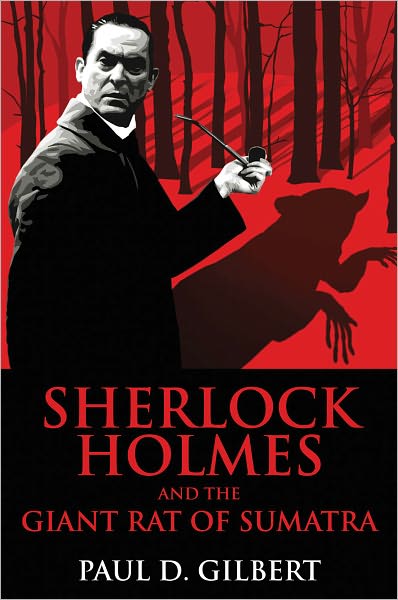
BOOK REVIEW: “Sherlock Holmes and the Giant Rat of Sumatra”

Paul D. Gilbert; Publisher: Robert Hale (April 1, 2011)
“That is as maybe, but as Watson will certainly attest, I have long insisted that most men have only the ability to see, without making a worthwhile observation.  It is the equivalent of reading a great book whilst lacking the power of comprehension.  It is a futile waste of time and energy!” (38)
I wonder if anyone has ever done the math on this.  Of all the stories taking up residence in Dr. John H. Watson’s tin dispatch box at Cox & Co., in Charing Cross; of all the tales of circus belles, Hammersmith wonders, paradol chambers, amateur mendicant societies, and parsley sinking into butter on a hot day—stories that either went unwritten or unread by the general public—which story has inspired the most authors to pick up the pen and try their own hand at it?  When the package from Amazon arrived containing a brand-new copy of Sherlock Holmes and the Giant Rat of Sumatra, by Paul D. Gilbert, I immediately thought of a half dozen other novel-length versions, and at least a dozen short story adaptations, of the “story for which the world is not yet prepared.”  I wondered how Gilbert’s take on the story could possibly distinguish itself.
Paul Gilbert is the author of two other Sherlock Holmes outings: The Lost Files of Sherlock Holmes and The Chronicles of Sherlock Holmes, which are collections of short pastiches from some of Dr. Watson’s “unpublished” accounts.  Sherlock Holmes and the Giant Rat of Sumatra is his first novel-length rendering, and he is currently at work on a fourth volume, which will return to the short story format.  Sherlock Holmes and the Giant Rat of Sumatra picks up in the aftermath of “The Mystery of the Mumbling Duelist,” a story that appears in The Chronicles of Sherlock Holmes.  Holmes is still staggering under the repercussions of the case, although it has been some weeks since its conclusion.  In his familiar, characteristic fashion, the Great Detective finds himself once again in need of mental stimulation, but he is also haunted and uneasy, before he and Watson are even called down to the London docks to investigate the abandoned tea cutter, the Matilda Briggs.  Holmes has developed the mental equivalent of a “thousand-mile-stare,” and Watson is quite worried, despite Holmes’s repeated attempts to reassure his friend.
And so, Gilbert’s story immediately sets itself apart from the very first paragraph.  There are no plague ships here, no genetic mutations or diabolical scientific experiments gone awry that seem so prevalent in other renditions of the tale of the “Giant Rat.”  There is no hideous “Dr. Moreau”-style compound, filled with grotesque transmutations of the animal kingdom.  And there are also no dangerous, desperate treks to Sumatra.  Holmes and Watson stay firmly ensconced in London.  The reader makes the trip to the wild, Indonesian jungle through the story that the client—Daniel Collier—shares, but it is a story told from the safety of an armchair, one neatly secure in front of a fireplace, in the familiar setting of the Baker Street sitting room. 
But, perhaps most importantly, Gilbert’s Sherlock Holmes speaks with an authentic voice.  He is expertly and faithfully rendered.  From the moment Sherlock Holmes sets foot aboard the ghostly Matilda Briggs, there is no mistaking the Master Detective and what he has come to do.  Nearly every one of his famous “methods” is present—from his knowledge of obscure powders and rare cyphers, to his intuitive understanding of the subtleties of handwriting and body language:
“This time he took out his lens and began slithering around on the boards like a viper in pursuit of its prey.  Every so often he would pause for a moment or two and examine something or other with minute diligence.  Occasionally he would emit a loud grunt of disappointment.  Then again he might laugh to himself as he made a more positive discovery although, of course, the nature of each find would remain a mystery to the rest of us for some time” (35).
The famous Baker Street Irregulars are also present, with Wiggins at the helm, and the reader is treated to a brief glimpse of the affection Holmes feels for his collection of “Street Arabs.”  The Detective provides Wiggins with instructions and wages for the group, including extra pay for some additional information.  But Holmes is absolutely adamant that the extra money be spent “…on new mittens, Wiggins, not a noggin of gin” (174).  In the canon, Holmes is quite open about his faith in the abilities of these ragged children, but Gilbert provides some insight into the Irregulars equivalent faith in Holmes. 
Gilbert’s Sherlock Holmes is also unique in that the author has no secrets and makes no apologies about who inspires his vision of the Great Detective.  With a single glance at the cover of the “Giant Rat” (or any of Gilbert’s books), even the most feeble deductive mind sees Jeremy Brett in the starring role of these stories.  In an October 15, 2010, interview with the Harrow Observer, Gilbert says:
"He was a great actor and when I write, Jeremy Brett is my Sherlock.  His family have read my books and I believe they have gone down well with them… I owe a lot to Jeremy Brett.  I never met him but my interpretation of Holmes owes a lot to his character."
And there is so much of Jeremy Brett’s portrayal in the book—from Holmes’s mannerisms, to his speech patterns, to even the descriptions of his wardrobe—but it is the details that are truly charming.  It’s nearly impossible to envision Jeremy Brett as the Sherlock Holmes of this story, and not also see the rest of the Granada cast in their respective roles—Edward Hardwicke as Dr. Watson (the story takes place 1898, after all), Colin Jeavons as Inspector Lestrade, and Rosalie Williams as the much put-upon Mrs. Hudson. 
And there are shadows of the Granada series throughout Gilbert’s writing.  When Watson worries about his friend’s mental state, and surreptitiously checks a private drawer of Holmes’s desk for the infamous “neat morocco case,” there is an echo of a similar scene from the 1993 episode, “The Eligible Bachelor.”  In both instances, Watson finds the needle and cocaine solution present and untouched, much “to [his] intense relief” (13).   And later, when Holmes grapples with the villain at the climax of the novel, Gilbert says, “Holmes’s normally well-groomed hair was constantly falling down over his eyes and as he pushed it back, time and again, I noticed that there was evidence of numerous facial cuts and bruises that were beginning to swell around his eyes” (197).  It’s quite easy to remember Brett and Patrick Allen engaged in a similar brawl, as Sherlock Holmes and Colonel Sebastian Moran, in the 1986 episode of “The Empty House.”  The allusions to the Granada series are more subtle than overt, and are worked expertly into the plot—finely crafted, adding depth and dimension.
The challenge to writing any version of the “Giant Rat of Sumatra” tale is that it has a pretty heavy reputation that precedes it.  To an author, it can be challenging, or even quite daunting, to attempt to write a “story for which the world is not yet prepared.”  It’s a tall order, and one that not every writer is able to fill with success.  Paul Gilbert’s rendering of Sherlock Holmes and the Giant Rat of Sumatra has no such problem.  The plot is original, and inventive, and more than capable of revealing why this was once a story that would have shaken a man to his core.  Gilbert’s Sherlock Holmes is authentic and familiar, like that comfortable chair in front of 221B Baker Street’s fireplace.  That’s where some of the best stories are told, after all.
oOo
Paul D. Gilbert is available on Twitter, and Facebook.
Congratulations to Chelsea Kiser!  She is the winner of the Sherlock Holmes trivia contest and the copies of Sherlock Holmes Handbook, by Christopher Redmond, and Arthur Conan Doyle: A Life in Letters, by Jon Lellenberg, Daniel Stashower, and Charles Foley.  For those interested, the answers to the trivia questions are as follows:
1.   In later years, Sir Arthur Conan Doyle used a Parker Duofold fountain pen—specifically, the “Big Red” model, which was introduced in 1921.  References to this bit of trivia can be found in Graham Moore’s The Sherlockian, and in the 2010 series, Sherlock, in the episode: “The Great Game.”
2.   In The Seven-Per-Cent Solution, Dr. Watson states that “The Lion’s Mane,” “The Mazarin Stone,” “The Creeping Man,” and “The Three Gables,” are “forgeries by other hands than mine.”  Watson also claims to have himself made up “The Final Problem,” and “The Empty House,” to disguise the timeframe in which Sherlock Holmes was seeking treatment for his cocaine addiction.
3.   The answer I was steering readers towards was “Kilravock House,” as stated in Alistair Duncan’s Close to Holmes.  I also accepted "Beaulieu Lodge," or “Hazelwood,” from Leslie Klinger’s annotations.  
There will be a new contest, complete with prizes, on June 27, so please check back for a new chance to win!  Thank you to everyone who participated.  I hope you enjoyed the thrill of the hunt!