Showing posts with label some thoughts on character. Show all posts

Tuesday, March 1, 2016

A Toast to the Woman: If You Can Believe It

[As presented as the February 2016 meeting of Watson's Tin Box in Ellicott City, Maryland.]

I’m probably one of the least likely of people to toast to the Woman. My feelings about Ms. Adler are well known, and well-documented, and there is no love lost between us. Frankly, I think she gets far too much credit.

For starters, she didn’t beat Sherlock Holmes. He knew exactly where that photograph was; she just managed to run away before he could confront her. And if that is the metric by which we are now determining winners – well, I was a much better athlete in high school than I originally believed. If we're being honest, she merely committed the literary equivalent of taking her ball and going home.

As it was, I was both pleased and excited when Elementary premiered on CBS in 2012, primarily because I initially heard that Irene Adler would not be appearing on the show. I was ecstatic to learn that supposedly her character had been brutally, horribly murdered off-screen. I was gleeful. I might not be a nice person.

Anyway, imagine my disappointment at the end of the first season when it was revealed that Irene Adler was alive, and that she would be played by Natalie Dormer. But there was a twist. Elementary’s Irene eventually revealed herself as a female Napoleon of Crime, Jamie Moriarty. For obvious reasons, they had my attention. I guess it doesn’t take much.

Elementary’s Jamie Moriarty was coolly calculating. She inspired both respect and fear. She was both shrewd and fiercely intelligent. She did not suffer fools lightly. 

All right. I'm listening. You have my attention.   

But most importantly, she actually, genuinely deceived Sherlock Holmes. For a time. Which is fine, because no one can get past Sherlock Holmes forever. Nor should they.

Here, finally, was the Irene Adler I had been promised. The one everyone else had seen, but I never had.

Please raise a glass with me and toast to the Woman – may we all find the incarnation of Irene Adler we need, if not the one we deserve.

oOo

"There is no Irene. There is only Moriarty, and Moriarty is never going to change." (Joan Watson)

Sunday, January 19, 2014

An Open Letter to Mrs. Godfrey Norton (Née Adler)

Dear Mrs. Norton,

I'm the first person to admit that I don't always understand the appeal of some things. I've never been particularly fashionable or cutting-edge, and so I often find myself on the outskirts of what is popular. Parkour, for example, is something I don't particularly understand. Wearing tights as pants is another. Pretty much anything involving John Mayer. And you, Mrs. Norton. I just have never been able to bend my brain around your incomprehensible, interminable appeal. Perhaps I'm uncharitable – there are certainly enough people who have called me such for this opinion – but I tremendously dislike you. In fact, despite the numerous warnings I have received over the course of my life about the strength of this word, I would go so far as to say that I hate you.


Ick.

I hate you whether you exist in black and white, in the printed word, or as a disembodied voice on the radio. And I certainly hate you when you are live and in full color on my television or cinema screen. I hate you whether you are played by Charlotte Rampling or Rachel McAdams. I even hate you when you are played by Gayle Hunnicutt opposite the incomparable Jeremy Brett (which is really saying something, because even though I consider all of Mr. Brett's performances sacrosanct, your episode remains the least viewed one from my copy of the Granada Television collection). I hate you whether you are an opera singer, an adventuress, a single mother to a young boy who loves music and puzzles, or even just an unapologetic thief. And I especially hate you in one of your most recent incarnations as a dominatrix (your hairstyle, to be frank, was utterly confounding). I hate you whether you are a redhead, a brunette, or a blonde. In fact, one of the things that I liked best about the recent television series, Elementary, is that I was promised that you were dead. Even better, I was promised you had been brutally murdered off-screen, before the series even began. The mere idea of it was delicious. I was thrilled. I was ecstatic. I promise you that I was beside myself with joy. And while it appears that the rumors of your death have been greatly (and cruelly) exaggerated, I assure you that CBS Television still owes me a rotting corpse. Yours, preferably, but I’m not picky. I will wait. 


Natalie Dormer as Irene Adler in CBS Television's Elementary.
They promised me that you were dead.

But mostly I hate you because you simply will not go away. Must you stick your perfectly powdered nose into every plot that calls for a XX chromosome? The mere mention of your name is often enough to make me put down whatever pastiche I may be reading – no matter how much I paid for it or how difficult it was to obtain – and use the pages of the book as a liner for my cat’s litter-pan. And my goodness, you do turn up so very often, don't you? A popular website, which catalogues historical and fictional characters appearing in Sherlockian pastiches, lists dozens, if not hundreds, of references to your person in non-canonical fiction. It’s really too many. Having only appeared in one original story, you are just as prolific – but not nearly as interesting as – the late, lamented Professor Moriarty. Does the plot call for a uniquely feminine touch? There you are. Has a member of royalty found himself in some sort of moral morass? Up pops your name. Has Sherlock Holmes, heaven forbid, found himself in some sort of romantic imbroglio? You’re involved, Mrs. Norton. And, even more offensive, does the Great Detective need to be brought down a peg? Of course you show up. 


And your hat is stupid.

But to be honest, you get more credit than you really deserve, don’t you think? While Sherlock Holmes once claimed, “I have been beaten four times – three times by men, and once by a woman,” (FIVE) I think he was being a little generous. Let’s assume, first of all, that Holmes is referring to you in that passage, even though he doesn’t mention you by name, does he? A well-timed escape is not the same as beating someone. That would be like saying that the Worthingdon bank gang (RESI) beat Sherlock Holmes because they managed to drown before their capture. Or the murderers of John Openshaw (FIVE) beat Sherlock Holmes for the same reason, ironically. It would be like saying that Sherlock Holmes was bested in “The Lion’s Mane,” because the murderer turned out to be a jellyfish and not a human being as originally assumed. Could you imagine the Great Detective saying, “I have been beaten five times – three times by men, and once by a woman… and once by an invertebrate creature”? 


Yup, I don't know what to say either, madam.

Sherlock Holmes caught you out, madam. He devised a trap, and you fell into it precisely as he imagined: 
"The smoke and shouting were enough to shake nerves of steel. She responded beautifully. The photograph is in a recess behind a sliding panel just above the right bell-pull. She was there in an instant, and I caught a glimpse of it as she half-drew it out. When I cried out that it was a false alarm, she replaced it, glanced at the rocket, rushed from the room, and I have not seen her since." (SCAN)
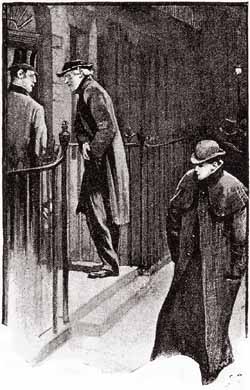
You did exactly what he thought you were going to do. Far from being clever, you were predictable, madam. When Sherlock Holmes tells the iniquitous King of Bohemia, “From what I have seen of the lady she seems indeed to be on a very different level to your Majesty,” I feel it was intended more as a slight at the king, than any compliment of you. And while I’m at it, donning a disguise for an evening stroll and a verbal jab doesn’t confirm any supposed cleverness either. If anything, it makes you appear childish, unable to admit you had been run to ground. “Good-night, Mister Sherlock Holmes,” indeed. It was almost like a rude gesture, don’t you think? And I should mention that even then you didn’t even have the man completely baffled. “I’ve heard that voice before,” Holmes said.  


Don't look so smug. You haven't earned it.

I have also heard your voice before, Mrs. Norton, and it seems I am condemned to hear it over and over again. I find myself lamenting, as Dr. Watson did in “The Adventure of the Copper Beeches,” that Sherlock Holmes expressed no interest in Miss Violet Hunter and her luxuriant, chestnut hair once she ceased to be the focus of a case. Not because I feel that the Great Detective is in any particular need of a female companion, but because it means I would be rid of you. I find myself constantly on the alert for your presence, looking for mentions of your name, just as one would scan a dark alleyway for danger. I fear you will always be there, on the outskirts, claiming a cleverness that isn’t deserved and isn’t yours, but believe me, madam, you don’t have me fooled. I’m on to you.

Yours very truly (and honestly),
Jaime Mahoney


oOo

The above tongue-in-cheek piece first appeared  ironically  the 11th (2013) edition of Irene's Cabinet, a Sherlockian publication by Watson's Tin Box.

“Better Holmes & Gardens” has its own Facebook page. Join by “Liking” the page here, and receive all the latest updates, news, and Sherlockian tidbits.

Monday, January 21, 2013

Some Thoughts on Character: Colonel Sebastian Moran

Moran, Sebastian, Colonel. Unemployed. Formerly 1st Bangalore Pioneers. Born London, 1840. Son of Sir Augustus Moran, C. B., once British Minister to Persia. Educated Eton and Oxford. Served in Jowaki Campaign, Afghan Campaign, Charasiab (despatches), Sherpur, and Cabul. Author of Heavy Game of the Western Himalayas (1881); Three Months in the Jungle (1884). Address: Conduit Street. Clubs: The Anglo-Indian, the Tankerville, the Bagatelle Card Club… The second most dangerous man in London. ("The Adventure of the Empty House")

In the 2011 film, Sherlock Holmes: A Game of Shadows, Professor James Moriarty signs copies of The Dynamics of an Asteroid in Paris. His signature is an elegant scrawl from a fountain pen as he speaks in effortless French to those who have come to praise him. A man in an inconspicuous tweed suit slides into the empty seat next the Professor, a pair of opera tickets in his hands. There is a long pause as he waits for Moriarty to address him. Finally, the Professor turns, only slightly, to look at the man at his side: “My ticket?” The man nods, gesturing with the object in question.  “Unfortunately,” the Professor says, “you won’t be needing yours.” The man’s expression is largely unreadable as he looks back down at the tickets in his hands, but his sardonic tone is telling: “It’s a shame, Professor. I was looking forward to Don Giovanni.” The identity of the man in the unprepossessing suit isn’t officially revealed as Colonel Sebastian Moran until a bit later in the film, but there are enough clues in even that brief scene for the viewer to make the logical deduction on his or her own. For is that not how we always picture Colonel Moran – the slightly uncouth man on Moriarty’s right hand?


Paul Anderson as Colonel Sebastian Moran and
Jared Harris as Professor James Moriarty 
Colonel Sebastian Moran was first introduced to readers in “The Adventure of the Empty House,” but like many of the minor characters in the Canon, he has taken on a life of his own, appearing in numerous pastiches and television and film adaptations. In A Game of Shadows, mentioned above, he was played by Paul Anderson, and in the Granada television adaptation of EMPT, Patrick Allen. In the 1946 Basil Rathbone film, Terror by Night, Alan Mowbray took on the role of the Colonel (inexplicably masquerading as Major Duncan Bleek). In a recent episode of the new television series, Elementary (simply entitled, “M.”), actor Vinnie Jones takes a turn as Moran – a slightly more bloodthirsty, more unhinged version. And while the Colonel has not yet appeared in the BBC series, “Sherlock” (although who can say who was on the other end of those sinister red laser sights at the end of “The Great Game”?), don’t tell that to the legions of fans who have already imagined Mark Gatiss and Steven Moffat’s 21st century version of Professor Moriarty’s trusted assassin in full. Several pastiche writers have also imagined their own versions of Colonel Moran. Kim Newman’s Moran of The Hound of the D'Urbervilles is every bit as vulgar, crass, ruthless and merciless as so many have imagined (I fully recommend The Well-Read Sherlockian’s excellent review of the novel available here). In John Gardner’s novel, The Return of Moriarty, Moran’s appearance is pitifully, though logically and necessarily, brief – and raises a host of questions.


Jeremy Brett as Sherlock Holmes and Patrick Allen as Colonel Moran
But what do readers really know about Colonel Sebastian Moran? The above description – found in EMPT and taken from Sherlock Holmes’s own “index of biographies” – is concise and informative enough, providing details of birth and ancestry, education and military career, even his current address and preferred recreational spots, but the apparent glut of explicit knowledge ends there. Prior to EMPT (chronologically speaking), Moran is mentioned alongside Professor Moriarty in their brief cameo in The Valley of Fear: “[Moriarty’s] chief of the staff is Colonel Sebastian Moran, as aloof and guarded and inaccessible to the law as himself.” So readers can add those three remarkable descriptors (aloof, guarded, inaccessible) to what they already know about the man. To put Moran on the same level as Moriarty in terms of demeanor and position is quite a lofty compliment indeed. But it is also contrary to the man that readers know from EMPT. The Colonel found there is a man of barely contained rage, snarling, savage and “wonderfully like a tiger himself.” As Watson recounts, “The fury upon [Moran’s] face was terrible to look at.” This is a man impulsive and hotheaded enough to murder a man because he could expose the Colonel’s unethical card practices, but patient and methodical enough to be really clever about how he did it. There is the “man of iron nerve,” that Sherlock Holmes describes, a man ruthless enough to relentlessly pursue a man-eating tiger, but possessing of the necessary quietness of disposition to be successful.


At the end of EMPT, the Great Detective seems more than confident that the Colonel will no longer be a concern, but Moran doesn’t disappear from the Canon entirely. In “The Illustrious Client,” which according to William Baring-Gould’s chronology takes place in 1902, Holmes comments: “If your man is more dangerous than the late Professor Moriarty, or than the living Colonel Sebastian Moran, then he is indeed worth meeting.” And in “His Last Bow,” which according to the same chronology takes place in 1914: “The old sweet song… How often have I heard it in days gone by! It was a favourite ditty of the late lamented Professor Moriarty. Colonel Sebastian Moran has also been known to warble it.” This means that Moran was most definitely alive as of 1902, and most probably alive as of 1914 (Holmes refers to the Colonel in the present tense, but a life of international espionage is a busy one, so it might be worth arguing that Holmes’s information could be outdated). Surviving an incarceration of twenty years or more certainly shows a certain resilience of character, or perhaps just a mulish intractability.

At the end of A Game of Shadows, Moran covertly executes Professor Moriarty’s undercover assassin (discreetly, with a blowgun) and then walks out of the Swiss chateau, into the shadows, and away from Professor Moriarty, who is currently engaged in a cerebral battle out on the balcony with Sherlock Holmes. Dr. Watson runs towards his friend, while the Colonel just simply walks away, his intended direction unknown. It is a curious divergence, but not entirely unexpected. As Holmes himself points out in EMPT:

"There are some trees, Watson, which grow to a certain height, and then suddenly develop some unsightly eccentricity. You will see it often in humans. I have a theory that the individual represents in his development the whole procession of his ancestors, and that such a sudden turn to good or evil stands for some strong influence which came into the line of his pedigree. The person becomes, as it were, the epitome of the history of his own family... Whatever the cause, Colonel Moran began to go wrong."

The Great Detective refers to Colonel Moran as a shikari, which is a Persian word in two parts: the main “Shikar,” meaning “of hunting” and the suffix “i” denoting possession. And it would seem that Moran too was a character in two parts. He comprises a certain cold reservation that made him equal to sit beside Professor Moriarty, but also a contrary savagery that made him effective in his role. Like so many remarkable characters, it is the dichotomy that makes Moran interesting, makes him memorable. Sherlockians return to Colonel Sebastian Moran not simply because he sits beside Professor Moriarty, but because he stands on his own, and cuts his own path.

oOo

“Better Holmes & Gardens” now has its own Facebook page.  Join by “Liking” the page here, and receive all the latest updates, news, and Sherlockian tidbits.

Saturday, September 15, 2012

Some Thoughts on Character: The Recurrent American

“Then I trust that you at least will honour me with your company,” said Sherlock Holmes. “It is always a joy to meet an American, Mr. Moulton, for I am one of those who believe that the folly of a monarch and the blundering of a minister in far-gone years will not prevent our children from being some day citizens of the same world-wide country under a flag which shall be a quartering of the Union Jack with the Stars and Stripes.” (“The Noble Bachelor”)

Sherlock Holmes found Americans really fascinating. Upon greeting Mr. Francis Moulton in “The Noble Bachelor,” Holmes proceeds to treat the young man like some sort of fantastic oddity – like he has just encountered a white tiger or a new species of honeybee in his sitting room. It’s as if Holmes wants to analyze Moulton, to extract the young American’s secrets through scientific inquiry and research, to study him intensely under a high-powered microscope. Indeed, it is not so difficult to imagine Holmes turning to Watson and saying, “Oh, please let me keep him! I need more information for my index and he’ll make just the perfect addition. I promise to feed him, water him, and walk him every day!” 

Fine, Lord St. Simon. You can leave.
I don't want to share my new American friends anyway.
Francis Moulton, and his wife Hatty, are far from the only Americans to appear in the Canon. The appearances of colonials span from clients, informants, criminals, even some detectives, and everything in between. There seems to be a role for an American in every frame and facet of the original stories. Even The Woman, Irene Adler “of dubious and questionable memory,” was an American – Holmes’s index indicates that she was born in New Jersey, of all places, in 1858. In “The Adventure of the Red Circle,” readers are introduced to Mr. Leverton, of the Pinkerton Agency, who is assisting Inspector Gregson. The American detective is described rather agreeably as “a quiet, businesslike young man, with a clean-shaven, hatchet face, [that] flushed up at the words of commendation.” Sherlock Holmes is quite pleased to meet Leverton, who has made something of a name for himself as a detective in America. For his part, Holmes has heard of the man’s work, and appears to find it exceptional.

Not all Americans in the Canon are depicted in such glowing terms, of course. While “The Dancing Men” features the young American woman Elsie Cubitt (née Patrick) whose devotion to her husband causes her to attempt to take her own life after his murder, it also features the villainous Abe Slane – “the most dangerous crook in Chicago.” It is Slane who murders Hilton Cubitt, but only after he torments poor Elsie with a series of haunting coded messages, culminating in the rather nightmarish missive: “ELSIE - RE – ARE TO MEET THY GO-.” And while Slane contends that “…there was never a man in this world loved a woman more than I loved [Elsie],” needless to say, Slane’s monstrous behavior more than eclipses any love that he can profess to feel.

I told you I wanted to know more about Chicago.
I wasn't kidding.
Likewise the Americans featured in A Study in Scarlet and The Valley of Fear do not all come off as shining beacons of virtue. In “The Country of Saints,” the second part of STUD, the reader is introduced to a less-than-righteous clan of Mormons, who exhibit a murderous intent on the acquisition of persons and property at all costs. VALL features a secret order, the Ancient Order of Freemen, filled with seemingly every type of unsavory individual, whose criminal deeds appear to run the gamut of almost every type of illegal activity. The actions of the Order influence how the entire town functions. Of course, the villainous Americans of these stories find their more honorable counterparts. In STUD, the American Jefferson Hope has been on a decades-long quest to avenge the death of his beloved Lucy Ferrier, dying only just after succeeding in his pursuit. In VALL, the Freeman John McMurdo is revealed to be Birdy Edwards, another Pinkerton detective, and the secret society is swiftly brought to justice for their crimes. More interestingly, these particular passages actually take the reader to America, rather than bringing the American to England and Baker Street. If Americans are some sort of exotic curiosity in the Canon, then the curiosities in these stories are being presented in their natural habit, interacting with others of their own species.

Chronologically speaking, Sherlock Holmes’s American experiences culminate with “His Last Bow.” The story finds Holmes having just spent two years undercover as an Irish-American named “Altamont.” However, if the Sidney Paget’s illustration is to be believed, the extent of his disguise involved growing an unsightly goatee and adopting an American accent. Anyway, Holmes’s American journey took him on a rather circuitous route, as he says he has been from Chicago to Buffalo, and those are just the places he mentions. But the reader is left behind on this journey, and does not get to experience America with Sherlock Holmes. And, it would seem, his excursion has left him weary of America, if not Americans. As he says to Watson, "Tomorrow [the goatee] will be but a dreadful memory. With my hair cut and a few other superficial changes I shall no doubt reappear at Claridge's tomorrow as I was before this American stunt - I beg your pardon, Watson; my well of English seems to be permanently defiled - before this American job came my way” (LAST).

Well, that is some very American facial hair indeed.
I can see why Von Bork was fooled. I think.
William Gillette, the man who brought Sherlock Holmes so famously to life on the stage, was an American, born in Connecticut in 1853. When Conan Doyle and Gillette first met, the actor surprised Conan Doyle by emerging onto the train platform, kitted out in a full Sherlock Holmes ensemble, complete with magnifying glass. After recovering from his shock, Conan Doyle laughed, completely charmed, and Gillette and Conan Doyle became lifelong friends. What an oddity Conan Doyle must have thought Gillette was upon that first meeting, how strange and otherworldly. But that didn’t stop him from entrusting the man with the care of his most famous – if not beloved – creation. Similarly, Sherlock Holmes may have found Mr. Francis Moulton a neat little marvel upon their first meeting – something on par with a new type of tobacco ash or particularly fascinating chemical equation – but that peculiar fascination didn’t stop Holmes from entrusting himself to the national identity of Francis Moulton, Birdy Edwards, and even Abe Slane. The recurring presence of Americans and American themes in the Canon is striking in its frequency, but their peculiarities have purpose, even if it is occasionally disagreeable.

oOo

“Better Holmes & Gardens” now has its own Facebook page.  Join by “Liking” the page here, and receive all the latest updates, news, and Sherlockian tidbits.

Friday, May 25, 2012

Some Thoughts on Character: Reginald Musgrave

“In appearance [Reginald Musgrave] was a man of an exceedingly aristocratic type, thin, high-nosed, and large-eyed, with languid and yet courtly manners. He was indeed a scion of one of the very oldest families in the kingdom… Something of his birth-place seemed to cling to the man, and I never looked at his pale, keen face or the poise of his head without associating him with gray archways and mullioned windows and all the venerable wreckage of a feudal keep.”

In the 1986 Granada Television adaptation of “The Musgrave Ritual,” Sherlock Holmes and Dr. Watson arrive at Hurlstone Manor for a holiday – much needed (on Holmes’s part) and much encouraged (on Watson’s part). They are greeted by Reginald Musgrave, and the conservation is polite, if a little stilted. Finally, Holmes and Musgrave walk off alone – leaving Watson in friendly conversation with Brunton, the butler. Musgrave compliments Holmes on making a successful living off of his wits, to which Holmes replies, while looking about absently: “And how is the dear wife?” A brief silence follows before Musgrave replies: “I’m not married, Holmes.” There is another, longer, more awkward silence before Holmes claps Musgrave on the shoulder: “How wise!”
Photo Credit: bookishadventures.tumblr.com
And that is the disconnect with Reginald Musgrave; that is what separates Musgrave from other figures from Sherlock Holmes’s past – Victor Trevor, for example. Although the plot of MUSG was slightly altered for the Granada adaptation to compensate for the somewhat advancing ages of the series’ stars – Jeremy Brett, for example, was 53-years-old at the time of filming and was therefore perhaps ill-suited to play the 25-year-old Sherlock Holmes as seen in the original text of MUSG – the dynamic between Holmes and Reginald Musgrave remains true to the source material. Holmes and Musgrave are not friends. That is not to say that they are antagonistic, far from it. They are merely acquainted. Musgrave spins in and out of Sherlock Holmes’s orbit in much the same way as any of his other clients. At times there seems to be no difference between Reginald Musgrave and Violet Hunter, Victor Hatherley, or Grant Munro – that is to say, once they have served their purpose, they are rarely, if ever, heard from again. Musgrave at least has the added benefit of being openly appreciative of Holmes’s talents, where many had seemed initially incredulous: “Once or twice we drifted into talk, and I can remember that more than once he expressed a keen interest in my methods of observation and inference.”
But like Victor Trevor, Reginald Musgrave intrigues because he knew Sherlock Holmes when. He knew him when he was young and was not yet fully formed or fully in possession of his powers. He knew him when his career as the world’s only consulting detective was not yet sculpted out or defined to his satisfaction. More importantly, Reginald Musgrave knew Sherlock Holmes when Dr. Watson did not. Reginald Musgrave was present at the beginning of Sherlock Holmes – which for some Sherlockians is somewhat equivalent to being present for the Big Bang – and so he is in possession of a piece of the puzzle, which we are not. But does that truly lend any extra weight to Musgrave’s presence in the Canon – does that give him more merit as a character, when Holmes appears to give him the same level of consideration as the dottles and plugs of tobacco left on the mantelpiece of Baker Street every morning?
Unlike Victor Trevor, who was present from the very inception of Holmes’s career (“And that recommendation, with the exaggerated estimate of my ability with which he prefaced it, was, if you will believe me, Watson, the very first thing which ever made me feel that a profession might be made out of what had up to that time been the merest hobby.” [GLOR]), Holmes appears to lose track of Reginald Musgrave for a bit of time before their paths cross again: “For four years I had seen nothing of him until one morning he walked into my room in Montague Street. He had changed little, was dressed like a young man of fashion–he was always a bit of a dandy–and preserved the same quiet, suave manner which had formerly distinguished him.” Holmes’s description of this first meeting with a long-lost acquaintance is rather interesting, in that he manages to both insult and compliment Musgrave in the same sentence. It is up to the reader to determine if the balance of the remark is ultimately neutral. But the casual way in which Holmes marks the length of their separation indicates that it was all the same to him if Musgrave had never walked through his door at Montague Street at all, save for the puzzle he brought with him.
According to Leslie Klinger: “Holmes and Musgrave were never more than ‘slight acquaintance(s)’: thus it is possible that the struggling young detective saw not a social visit but a business opportunity when Musgrave walked through his door. June Thomson speculates that Holmes may have charged Musgrave a fee for his services, pointing to his ‘living by my wits’ remark as ‘possibly a hint that he had turned professional and expected to be paid’” (534). And so, the reader sees Reginald Musgrave present at the time when Holmes has begun to realize that his services had value. Musgrave may not be the Detective’s first paying client, but he was probably one of the earliest. Victor Trevor may have been present for the beginning of Sherlock Holmes, but Reginald Musgrave was present for the event horizon – for the point of no return, for the moment when Holmes’s fate was fully determined and guaranteed.
As has been mentioned before, Holmes ultimately lost track of Victor Trevor – just as he lost track of Musgrave – but that was hardly Holmes’s fault entirely – the sordid circumstances surrounding his father’s death were certainly enough to make a reasonable man want to escape any and all places and persons associated with the events. The weight and merit of Trevor’s character rest largely on what he was present for, and Musgrave bears much the same burden. Though of the two men, Victor is the only one who can honestly wear the title of “friend,” Musgrave is the only one who can be honestly called a “client” – in the fully paying sense of the term. And while Victor Trevor sought out Sherlock Holmes in his hour of need, Reginald Musgrave walked through the door of Montague Street looking for a detective.
oOo
“Better Holmes & Gardens” now has its own Facebook page.  Join by “Liking” the page here, and receive all the latest updates, news, and Sherlockian tidbits.

Monday, January 16, 2012

Some Thoughts on Character: Victor Trevor

“You never heard me talk of Victor Trevor?  He was the only friend I made during the two years I was at college.  I was never a very sociable fellow, Watson, always rather fond of moping in my rooms and working out my own little methods of thought, so that I never mixed much with the men of my year.  Bar fencing and boxing I had few athletic tastes, and then my line of study was quite distinct from that of the other fellows, so that we had no points of contact at all.  Trevor was the only man I knew, and that only through the accident of his bull terrier freezing on to my ankle one morning as I went down to chapel.  It was a prosaic way of forming a friendship, but it was effective.” (“The ‘Gloria Scott’”)

In “The Five Orange Pips,” Dr. Watson inquires as to who could be calling at Baker Street on such an inclement evening.  He suggests that their late-night visitor might be a friend of the Great Detective, who dismisses the possibility immediately: “Except yourself I have none… I do not encourage visitors.”  It is not until Sherlock Holmes shares the story of “The ‘Gloria Scott’,” that the reader learns that this declaration is not precisely true.  In GLOR, found in The Memoirs of Sherlock Holmes, Holmes reveals the existence of Victor Trevor, one of only three people in the canon that the Detective explicitly refers to as his friend (Klinger, The New Annotated Sherlock Holmes, 501).  The two others are Dr. Watson, naturally, and perhaps more surprisingly – Inspector Lestrade, whom Holmes amiably refers to periodically throughout the canon as “friend Lestrade” (NOBL, CARD, EMPT, NORW, 3GAR).
The existence of Victor Trevor lends weight to Sherlock Holmes’s existence, gives shape to the person that Holmes was before he ever arrived at Baker Street.  It sometimes seems that Dr. Watson’s stories tell the reader so little about the Great Detective’s early life that it is easy to imagine that the man simply sprang into existence, fully formed like Athena from Zeus’s forehead, and was waiting for Watson to appear in that laboratory in St. Bart’s.  But the presence of a character like Victor Trevor reminds the reader that there was a Sherlock Holmes before there ever was a Dr. Watson, that he had an early life and a history that remain tantalizingly just out of our grasp.  Furthermore, the existence of Victor Trevor demonstrates that there was once a time when the Great Detective was not as the reader knows him, that there was a time when he barely existed at all.
As Sherlock Holmes points out, his first meeting with Victor Trevor was rather inauspicious, and in fact, Holmes’s encounter with Trevor’s dog left him incapacitated for ten days, which indicates a somewhat serious injury.  It’s a wonder that Holmes – a man who loathed extended periods of inactivity – would even tolerate Trevor’s presence afterwards.  However, there is something about Victor Trevor to which Holmes responds: “He was a hearty, full-blooded fellow, full of spirits and energy, the very opposite to me in most respects, but we had some subjects in common, and it was a bond of union when I found that he was as friendless as I.”
It wouldn’t be too much of a stretch to say that there is a bit of Victor Trevor in Dr. Watson.  Upon returning from Afghanistan, Dr. Watson was still ill, and could not honestly be classified as either “hearty” or “full-blooded,” but Holmes immediately identifies him as a soldier and so has the potential to be both those things again.  Furthermore, as a medical man, Watson would have likely shared at least some of Holmes’s love of chemistry (even before the two ever shared a love of adventure), which the Doctor demonstrates in the way he avidly observes his friend’s chemical experiments: “His hands were invariably blotted with ink and stained with chemicals, yet he was possessed of extraordinary delicacy of touch, as I frequently had occasion to observe when I watched him manipulating his fragile philosophical instruments” (STUD).  Finally, Dr. Watson, like Victor Trevor before him, was entirely alone: “I had neither kith nor kin in England, and was therefore as free as air – or as free as an income of eleven shillings and sixpence a day will permit a man to be” (STUD).
In fact, to take the analysis a step farther, the same characteristics could even be said to be true of Inspector Lestrade – Holmes’s other canonical friend.  As a policeman, Lestrade would most likely have been “hearty” and “full-blooded,” and he certainly demonstrates these features as he chases after Holmes on many an occasion.  The Detective and Lestrade certainly do not share many common interests, but they most certainly share a love of interesting crime, a desire to see mysteries solved, and justice brought to the guilty parties.  As for being isolated and friendless, not much is known about Inspector Lestrade’s personal life (the reader cannot even be sure of his first name), and due to the competitive natures of his colleagues at Scotland Yard, it might be fair to say that Lestrade found few allies amongst his professional associates.
Amongst his other contributions, Victor Trevor is most famously responsible for setting Sherlock Holmes on the path to becoming the Great Detective.  Trevor invites Holmes to spend a month’s holiday with himself and his father at their home in Donnithorpe, where the young Trevor explains to his father about his new friend’s powers of observation.  The elder Trevor asks Holmes for a demonstration, and is totally unsettled by the result: “I don’t know how you manage this, Mr. Holmes, but it seems to me that all the detectives of fact and of fancy would be children in your hands.  That’s your line of life, sir, and you may take the word of a man who has seen something of the world.”
In A Study in Scarlet, Holmes informs Watson that he is the world’s only unofficial consulting detective, and that he has created his own profession.  But the idea for that profession must have stemmed from somewhere, someone must have planted the seed, and it appears that the readers can thank Victor Trevor for that.  It is not to say that Sherlock Holmes would not have found his way to his chosen vocation without Victor Trevor, but some gratitude must be extended to Victor Trevor and his father, for who knows how long we would have had to wait had it not been for their suggestion.  As Holmes tells Watson, “And that recommendation, with the exaggerated estimate of my ability with which he prefaced it, was, if you will believe me, Watson, the very first thing which ever made me feel that a profession might be made out of what had up to that time been the merest hobby.
Victor Trevor never really recovers from the tragedy that befell his father, and at the end of GLOR, the reader learns that Trevor is working a tea plantation in India.  Holmes says that he thinks that he is doing well, but it appears that he has lost track of his old friend.  Trevor occasionally makes appearances in various pastiches, recently turning up in the graphic novel, Sherlock Holmes: Year One, where the young Holmes is on a desperate errand to prevent his friend from self-destructing – amongst other plot points.  While the canonical Victor Trevor only appears in the one story, he provides a blueprint for Dr. Watson, and perhaps, in a way, for Inspector Lestrade.  By showing Sherlock Holmes the type of man that the Detective could relate to, he prevented Holmes from being entirely alone.  It might be going too far to say that without Victor Trevor there would have been no Dr. Watson, but he certainly laid the path, and provided precedent and context, for a solitary man to have need of a companion, after all.
oOo
“Better Holmes & Gardens” now has its own Facebook page.  Join by “Liking” the page here, and receive all the latest updates, news, and Sherlockian tidbits.

Friday, August 26, 2011

Some Thoughts on Character: Miss Mary Morstan, the Doctor's Wife

Miss Morstan entered the room with a firm step and an outward composure of manner.  She was a blonde young lady, small, dainty, well gloved, and dressed in the most perfect taste.  There was, however, a plainness and simplicity about her costume which bore with it a suggestion of limited means.  The dress was a sombre grayish beige, untrimmed and unbraided, and she wore a small turban of the same dull hue, relieved only by a suspicion of white feather in the side.  Her face had neither regularity of feature nor beauty of complexion, but her expression was sweet and amiable, and her large blue eyes were singularly spiritual and sympathetic.  In an experience of women which extends over many nations and three separate continents, I have never looked upon a face which gave a clearer promise of a refined and sensitive nature.” (“The Sign of Four,” Chapter Two)
There is no denying it—Dr. John H. Watson was a marrying man.  And in the Sherlock Holmes canon, he was married multiple times, although the exact number of times is up for debate.  Two marriages are mentioned explicitly throughout the course of the stories, but some Sherlockian scholars have debated the existence of three—or even four—Mrs. Watsons.  Indeed, the article “Counting Watson’s Wives,” by Brad Keefauver, posits the existence of six Mrs. Watsons.  But of all those many wives, the first (as far as the reader is made plainly aware—Keefauver believes that she was actually Dr. Watson’s fifth wife) and best known is Miss Mary Morstan, who first appears at 221B Baker Street in The Sign of Four, as a client seeking to solve the mystery of her long-absent father and the strange pearls that have been sent to her in the post. 
She is undeniably striking, an extraordinary woman, and the Doctor is immediately taken with her, as the preceding passage indicates.  Over the years, her character has been portrayed by such actresses as Ann Bell, in the Peter Cushing adaptation of SIGN; Jenny Seagrove, in the Granada Television version; and most recently by Kelly Reilly, in the latest Guy Ritchie picture.  In addition, author Molly Carr has penned two novels featuring Mary Watson in the role of consulting detective (with a supporting cast).  At first Mary’s presence appears to be merely to fill the void that Dr. Watson has suddenly found in his life over the course of SIGN: “…that passing glimpse of a tranquil English home in the midst of the wild, dark business which had absorbed us” (SIGN, Chapter Seven).  For many years—first in his time in Afghanistan and then in his partnership with Sherlock Holmes—Dr. Watson’s life has been fraught with violence, danger, and a host of other anxieties.  It is not too much of a stretch to image that he would like a chance at a peaceful life; and Miss Mary Morstan, with her simple manners and sympathetic expression, seems like the perfect avenue of achieving that goal.
But placing limits upon Mary Morstan’s character would be doing her a disservice.  It is certainly true, as has been discussed elsewhere, that she was more than capable of being a part of that comfortable domestic picture Dr. Watson seemed to so desire.  Indeed, at the beginning of “A Scandal in Bohemia,” Watson famously comments on the state of his relationship with Sherlock Holmes: “My marriage had drifted us away from each other.  My own complete happiness, and the home-centred interests which rise up around the man who first finds himself master of his own establishment, were sufficient to absorb all my attention…”  The Watsons have clearly built a happy English household, tranquil and untroubled, but Mary was also more than capable of uprooting that domestic harmony. 

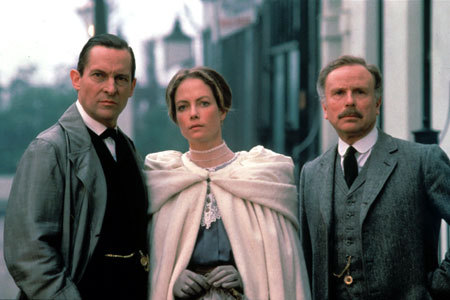
Jenny Seagrove (center) played Miss Mary Morstan in Granada Television's
1987 adaptation of "The Sign of Four, with Jeremy Brett as Sherlock Holmes (left)
and Edward Hardwicke as Dr. John Watson (right).  The adaptation omitted
the romantic subplot between Miss Morstan and Dr. Watson
(photo via bookishadventures.tumblr.com).
In “The Boscombe Valley Mystery,” when Watson responds to Holmes’s summons with hesitation, it is Mary who says: “Oh, Anstruther would do your work for you. You have been looking a little pale lately. I think that the change would do you good, and you are always so interested in Mr. Sherlock Holmes’s cases.”  To which Watson rightly responds: “I should be ungrateful if I were not, seeing what I gained through one of them.”  It is possible that Mary also, never forgot how much she owed to Sherlock Holmes—not just her husband, but her peace of mind in finally knowing what became of her father.  In “The Man with the Twisted Lip,” another story that opens on a scene of blissful domesticity, Mary makes no protest in sending out her husband to chase after Isa Whitney, at the Bar of Gold, in Upper Swandam Lane.  She could not possibly have known that he would meet Sherlock Holmes while there, but she knows her husband and the adventurous circumstances under which they first met.  Perhaps when Mary Watson told her husband he looked “a little pale lately,” what she really meant was that he had been looking “a little bored.”
Unfortunately, Mary was not to be a permanent fixture in Dr. Watson’s life.  When Sherlock Holmes returns from the Great Hiatus, the reader also learns of Mary Watson’s passing.  As Watson says in "The Empty House", “In some manner [Sherlock Holmes] had learned of my own sad bereavement, and his sympathy was shown in his manner rather than in his words.  ‘Work is the best antidote to sorrow, my dear Watson,’ said he.”  The cause of Mary’s death is not revealed, though some have posited that she died of tuberculosis, as the disease caused the death of Sir Arthur Conan Doyle’s first wife, Louisa.  Others have suggested a death in childbed, as it was not uncommon, and some authors, such as Duane Swierczynski in The Crimes of Dr. Watson, have suggested that Mary’s sudden absence from Watson’s life was a cover for some more sinister behavior.

Kelly Reilly (left) played Miss Mary Morstan, opposite Jude Law's Dr. John Watson
in the 2009 Guy Ritchie film "Sherlock Holmes."  She will reprise her role in
2011's "Sherlock Holmes: A Game of Shadows."
Whatever the cause, it is to be quite some time before Dr. Watson would remarry.  But he does take another wife and in “The Blanched Solider,” Sherlock Holmes tells the reader:  “The good Watson had at that time deserted me for a wife, the only selfish action which I can recall in our association.  I was alone.”  But this new Mrs. Watson is different.  The reader never learns her name, or how she and Watson met.  She certainly was not a client, or if she was, her case had been of little import or interest to the record.  She does not comment, in one way or another, on her husband’s relationship with Sherlock Holmes and his involvement in his cases.  And Sherlock Holmes does not arrive on her doorstep, seeking sanctuary.  While prior to her passing, Mary Watson was mentioned in multiple stories (outside of SIGN) this new wife is barely mentioned at all, only in the briefest and snidest of remarks.  This new wife is clearly no Mary Morstan.  Brad Keefauver puts forth a unique and interesting theory regarding the identity of this final Mrs. Watson, which is available for perusal in his article.
Mary Morstan was unique in that she was able to successfully balance all aspects of her life with Dr. John Watson—and by extension, her life with Sherlock Holmes.  The circumstances of their meeting allowed Mary to be uniquely in-tune with not only what Watson wanted out of life, but also what he needed.  She never shoved her husband headlong into danger, but occasionally she was certainly the gentle nudge that sent him out the door.
oOo
Check back here on Monday, August 29, for details on the latest blog contest and learn how you can win an assortment of Sherlock Holmes-related prizes.
“Better Holmes & Gardens” now has its own Facebook page.  Join by “Liking” the page here, and receive all the latest updates, news, and Sherlockian tidbits.

Friday, June 24, 2011

Some Thoughts on Character: Sir Henry Baskerville

“…the clock had just struck ten when Dr. Mortimer was shown up, followed by the young baronet.  The latter was a small, alert, dark-eyed man about thirty years of age, very sturdily built, with thick black eyebrows and a strong, pugnacious face.  He wore a ruddy-tinted tweed suit and had the weather-beaten appearance of one who has spent most of his time in the open air, and yet there was something in his steady eye and the quiet assurance of his bearing which indicated the gentleman” (HOUN).
Sir Arthur Conan Doyle resurrected Sherlock Holmes with The Hound of the Baskervilles, which is reason enough to make it a favorite canon story with many people.  Even if a person has read no other Sherlock Holmes story, he or she most likely read HOUN (or a selection from it) in a high school English class, during a book club, or at the behest of a particularly insistent relative.  Doyle himself termed the story “a real Creeper,” and as Christopher Redmond points out in the Sherlock Holmes Handbook (Second Edition), “…the dominant colors in this story are the black and white of night, the grey of uncertainty, and the green of the moor’s vegetation.  Somehow this grim environment has appealed to Sherlockians…” (24).  The spectral hound and his gruesome errand hold a universal appeal, which keeps readers returning to Dartmoor over and over, on the page and screen.
The plot of HOUN revolves around the young Sir Henry Baskerville, who has inherited his family’s estate and immense fortune, after the suspicious death of his uncle, Sir Charles.  Sir Henry returns to England from Canada, where he has been farming, and immediately finds himself embroiled in a complex and dangerous plot against his family legacy, and his own life.  The baronet has been played by a wide range of actors over the years, including Richard Greene, Christopher Lee, Nikita Mikhalkov, Kristoffer Tabori, and Jason London.  The production team behind “Sherlock” has announced a modern reinterpretation of HOUN in the second season of the show, and fans are eager to see how the role of Sir Henry will be filled in a 21st century capacity.  The character of Sir Henry Baskerville embodies all the characteristics necessary to propel the plot of the novel forward, and therefore stands on equal footing with Sherlock Holmes or Doctor Watson.  Sir Henry is not solving mysteries, but he is the foundation of one.  He moves the story even more so than the legendary hound that stalks him from across the moor.
To begin with, Sir Henry appears to be almost utterly fearless.  When he is finally completely informed of the situation that awaits him at Baskerville Hall, and the dangers that have been dogging him since he set foot in London, Sir Henry’s response is only to say: “There is no devil in hell, Mr. Holmes, and there is no man upon earth who can prevent me from going to the home of my own people, and you may take that to be my final answer.”  If Sir Henry had chosen that moment to refuse to return to Baskerville Hall—a not unreasonable notion in light of everything he has learned—then there simply would have been no mystery, and no story.  He could have liquidated the Baskerville real estate and claimed the financial assets while in London, or from other safer country.  Indeed, if Jack Stapleton had succeeded in his plot, the villain could have attempted to lay claim to the Baskerville fortune from the safety of Costa Rica—which begs the question of why Sir Henry could not have done the same, and why he returned to England at all.
Early on, the reader learns from Dr. Mortimer that Sir Henry had been farming in Canada, prior to his uncle’s death.  And while farming is not necessarily an occupation conducted in total isolation, it is rather strenuous and difficult; furthermore, he is separated from what little remains of his family, and from familiar country, by a vast ocean.  According to Redmond, “In Holmes’s time Canada was still, in British eyes at least, a colony; young Henry Baskerville went there to farm, but had no hesitation about returning to the motherland when his time came” (173).  Basil Rathbone’s 1939 version of HOUN starring Richard Greene as Sir Henry, makes a point of showing a newspaper clipping bearing news of the baronet’s return to England from Canada (the latter country’s name emphasized in a large, bold typeface) as if Sir Henry were a foreigner, returning from some exotic distant locale.  But in truth, he is merely a loyal soldier, returning to his home port for a new assignment.      
In a similar vein, the young Baskerville is also a herald of progress and change.  Upon surveying his new home, and lonely isolation of Dartmoor, he proclaims: "It's no wonder my uncle felt as if trouble were coming on him in such a place as this…It's enough to scare any man.  I'll have a row of electric lamps up here inside of six months, and you won't know it again, with a thousand-candlepower Swan and Edison right here in front of the hall door.”  Such an addition would offset the gloom of Dartmoor in both a literal and a more metaphorical sense.  Watson describes the moors and the country of Baskerville Hall as gloomy and barren, an isolated country:
We had left the fertile country behind and beneath us.  We looked back on it now, the slanting rays of a low sun turning the streams to threads of gold and glowing on the red earth new turned by the plough and the broad tangle of the woodlands.  The road in front of us grew bleaker and wilder over huge russet and olive slopes, sprinkled with giant boulders.  Now and then we passed a moorland cottage, walled and roofed with stone, with no creeper to break its harsh outline.  Suddenly we looked down into a cuplike depression, patched with stunted oaks and firs which had been twisted and bent by the fury of years of storm. Two high, narrow towers rose over the trees. The driver pointed with his whip.
’Baskerville Hall,’ said he.”
The arrival of Sir Henry and his electric lights demonstrates a rush towards modernity.  Baskerville Hall will no longer exist in a darkness and gloom; Dartmoor will abandon its technological isolation.  And Sir Henry will no longer feel as if he has “walked right into the thick of a dime novel.”
Finally, the mystery of HOUN hinges upon Sir Henry’s utter wholesomeness, and sense of traditional propriety.  As Redmond states, “In The Hound of the Baskervilles, much of the dramatic complexity comes from the relations between the sexes: the apparently wholesome attraction between Sir Henry Baskerville and Beryl Stapleton, the sadomasochistic relationship between Beryl and Jack Stapleton…” (64).  Sir Henry’s pursuit of Beryl Stapleton is remarkably proper and respectable, especially given the sinister motivations that dwell just below of the surface of their courtship. 
Surely if the baronet had known that Miss Stapleton was, in fact, Mrs. Stapleton, and that Jack Stapleton was not the young woman’s brother, but her husband, he would have been a bit less affectionate in his description of her: “I tell you, Watson, I’ve only known her these few weeks, but from the first I just felt that she was made for me, and she, too–she was happy when she was with me, and that I’ll swear.  There’s a light in a woman’s eyes that speaks louder than words.”  Indeed, if Sir Henry had been a bit less proper, had pressed his hand or taken advantage of his position a bit more forcefully, Beryl Stapleton may had felt inclined to reveal all (or at least crucial elements) of the machinations of her brother/husband that much sooner.  Sir Henry’s respectability and traditional values are ultimately what keeps the plot of HOUN moving.
I’ve spoken elsewhere about whether or not Sherlock Holmes exists in a vacuum, and whether or not his character creates enough momentum to propel a narrative forward on his own.  Sometimes the Great Detective creates enough force to drive other characters—Dr. Watson, Inspector Lestrade, the Irregulars—into action, which may or may not create the desired consequences.  Sir Henry Baskerville is different, however.  He is already a force in his own right when he enters the narrative of HOUN; he is already acting and being acted upon.  In many ways, Sherlock Holmes is caught up in the momentum of the youngest Baskerville, moved along by the violent current.
oOo
The new blog contest launches on Monday, June 27, so make sure to check back here for details on prizes, and how to win!
Sources:
• Redmond, Christopher.  Sherlock Holmes Handbook (Second Edition), Dundurn Press, September 2009.