Showing posts with label critical analysis. Show all posts

Tuesday, March 1, 2016

A Toast to the Woman: If You Can Believe It

[As presented as the February 2016 meeting of Watson's Tin Box in Ellicott City, Maryland.]

I’m probably one of the least likely of people to toast to the Woman. My feelings about Ms. Adler are well known, and well-documented, and there is no love lost between us. Frankly, I think she gets far too much credit.

For starters, she didn’t beat Sherlock Holmes. He knew exactly where that photograph was; she just managed to run away before he could confront her. And if that is the metric by which we are now determining winners – well, I was a much better athlete in high school than I originally believed. If we're being honest, she merely committed the literary equivalent of taking her ball and going home.

As it was, I was both pleased and excited when Elementary premiered on CBS in 2012, primarily because I initially heard that Irene Adler would not be appearing on the show. I was ecstatic to learn that supposedly her character had been brutally, horribly murdered off-screen. I was gleeful. I might not be a nice person.

Anyway, imagine my disappointment at the end of the first season when it was revealed that Irene Adler was alive, and that she would be played by Natalie Dormer. But there was a twist. Elementary’s Irene eventually revealed herself as a female Napoleon of Crime, Jamie Moriarty. For obvious reasons, they had my attention. I guess it doesn’t take much.

Elementary’s Jamie Moriarty was coolly calculating. She inspired both respect and fear. She was both shrewd and fiercely intelligent. She did not suffer fools lightly. 

All right. I'm listening. You have my attention.   

But most importantly, she actually, genuinely deceived Sherlock Holmes. For a time. Which is fine, because no one can get past Sherlock Holmes forever. Nor should they.

Here, finally, was the Irene Adler I had been promised. The one everyone else had seen, but I never had.

Please raise a glass with me and toast to the Woman – may we all find the incarnation of Irene Adler we need, if not the one we deserve.

oOo

"There is no Irene. There is only Moriarty, and Moriarty is never going to change." (Joan Watson)

Friday, January 1, 2016

My Favorite Sherlock Holmes Story: "The Adventure of the Six Napoleons" (SIXN)

[As presented at "A Saturday with Sherlock Holmes," in Baltimore, Md., on November 14, 2015.]

When Beth first honored me with the invitation to be here today, and I heard the theme for today’s presentations, I knew immediately and without hesitation that my favorite story in the Canon is “The Adventure of the Six Napoleons.” What I did not know immediately and without hesitation was why. And as I pondered the topic for many weeks (and months, if I’m being truly honest), I began to worry that maybe there wasn’t a why, that like the infamous motiveless crime I simply loved SIXN because. Because of its own merits. Because it was simply a great story. Because I said so. Because, end of sentence. Because, because, because. And then, to my own mind, I started to sound like a petulant child, unable or unwilling to complete the assignment given to her.

And this, for some reason, made me think of my mother. Who knows why?

Those who know me a little better know that my mother is the great reader of my life. She’s the reason that I love books and writing and words. And if there is anything my mother loves more than books and writing and words, it is Law & Order. Not the process, mind you – the television show. The original flavor too, not the Special Victims Unit persuasion or even the Criminal Intent version with its pseudo-Holmesian detective played by Vincent D’Onofrio (but that’s a topic for another day and another presentation). No, she loves the classic with Sam Waterston as Jack McCoy and its ever-cycling cast of district attorneys.

So, what does this have to do with Sherlock Holmes and his six busts of Napoleon, you may be asking (or not)? Because it occurred to me – as I contemplated SIXN and Jeremy Brett’s facial expressions and Basil Rathbone’s creature-features and everything else peripherally related to this tale – that the reason I loved this story is because it is exactly like an episode of Law & Order.


Told you I was going somewhere with this.

Now if you think about it (and I’m going to make you) – an episode of Law & Order typically opens with banal, unassuming scene meant to distract: some kids playing basketball in a park, two friends shopping for expensive clothing in a high-end boutique, a young couple spending the night in a fancy hotel. Eventually, all these people stumble upon something nefarious and gruesome (and usually dead). And SIXN has a similarly inauspicious beginning: the reader learns that Inspector Lestrade has taken to dropping in at Baker Street. To chat. And this particular evening is no different. They are talking about newspapers and the weather. Maybe even their macramé. There’s probably a fire going and brandy in snifters. It’s as charmingly a domestic scene if there ever was one. But not for long, because crime is about to drop from the sky, like a body falling right into the middle of the Baker Street sitting room (a plot device which may or may not have happened in an episode of Law & Order, I can’t be sure). Lestrade has a case. An interesting case – “This is certainly very novel,” says Sherlock Holmes.

Despite the case’s novelty, however, Holmes and Watson don’t pursue it right away. In fact after getting the initial details from Lestrade, Watson posits a theory which ultimately bears no fruit, and Holmes decides to wait to investigate the case until there are “fresh developments.” This brings us to our second element of a Law & Order episode: the redirection in the form of a second crime. In any given episode, upon being given their task, the detectives will set out on their investigation (this is, of course, the “law” portion of the title). However, invariably they find that this initial thread of investigation is nothing but a red herring, leading to a dead end. Or even worse (and better television), while they have been giving their energies to the first investigation, a second and related crime has been committed. There is another victim. And it’s this crime that will ultimately set the detectives on the right path towards solving the case.

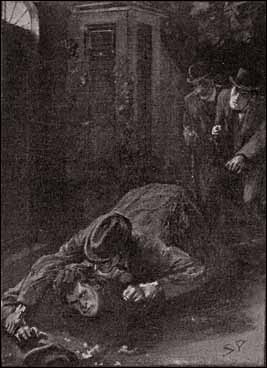
In the case of SIXN, the second crime is the body found on the doorstep of Mr. Horace Harker of the Central Press Syndicate. Aside from the dead body (a minor difference), the crime at the Harker residence seems much like the others before it – shattered busts of Napoleon and all. But now there’s a photograph in the dead man’s pocket and a broken streetlamp, both of which are indicative if not outright conclusive. From there, Holmes and Watson go to Harding Brothers, and then to Mr. Morse Hudson, of the Kennington Road. It’s Morse Hudson who provides a major breakthrough (interspersed with talk of Nihilists and anarchists and red republicans). He knows the man in the photograph: it’s Beppo, “a kind of Italian piece-work man,” he says. From there Holmes and Watson “make for Gelder & Co., of Stepney, the source and origin of the busts.” And then finally, based on the information they receive there, to Chiswick and the home of Mr. Josiah Brown. This is where Beppo is apprehended with the fifth bust of Napoleon and the active investigation draws to a close.

And...commercial break!

Now, a typical episode of Law & Order is usually split equally, with "law" bowing out of the way for "order" at about the 30 minute mark. We'll find that the structure of SIXN is definitely frontloaded with more law at the beginning and a briefer order experience at the end. If SIXN were truly an episode of Law & Order, then the “order” portion of the plot would probably only take up about 10-15 minutes of the episode. However, the reader finds that the impact of Sherlock Holmes's order more than makes up for its brevity. With Dr. Watson and Inspector Lestrade acting as something tantamount to a jury, Holmes’s revelatory theatrics are equal to any courtroom drama. With the reveal of the missing pearl in the sixth bust, one can easily imagine Waterston’s Jack McCoy unleashing the last damning piece of evidence against the accused, and all of the pieces of the case falling neatly into place. I mean, Watson and Lestrade even break out into applause for Sherlock Holmes, like they would for any actor on the stage. Holmes then proceeds to outline the details of the case, which go back over a year, and when he is done, it is obvious to the “jury” that Beppo is guilty. Holmes has proclaimed it so, with every leap and twirl and dramatic gesture. But more than that, Holmes has proven it so. And after all, what is order if not that?

Finally, every episode of Law & Order has a summary scene. More often than not, it’s very brief. Sam Waterston shares heated words with the prosecuting attorney on the steps of the courthouse. Or there’s a poignant conversation amongst all the attorneys over Chinese food in a darkened office. It’s a way to draw the episode to close quickly, and with wit and pathos. And this, let’s be honest, the concluding scene of SIXN has in spades.  
“Well,” said Lestrade, “I’ve seen you handle a good many cases, Mr. Holmes, but I don’t know that I ever knew a more workmanlike one than that. We’re not jealous of you at Scotland Yard. No, sir, we are very proud of you, and if you come down to-morrow, there’s not a man, from the oldest inspector to the youngest constable, who wouldn’t be glad to shake you by the hand.”
End of scene. Fade to black. Dun dun. And the Great Detective goes so far as to say, “Thank you! Thank you!,” as if he were at a curtain call, as if he were taking a bow.


As if you didn't know what I meant by "dun, dun".

Of course, it’s more accurate to say that the structure of SIXN paved the way for the episodic organization of Law & Order than the other way around. And I wish I could say with certainty, as Sherlock Holmes does in “The Empty House,” that “The parallel is exact.” Because it’s not exact, of course, but it is very near. It is very near enough to say that SIXN is my favorite Sherlock Holmes story because it reminds me of another dearly beloved thing. Of another dearly beloved person. Or perhaps just because. Because, because, because. 

Thursday, January 8, 2015

“My power to surprise you” (EMPT): On Hiatuses

“I moved my head to look at the cabinet behind me. When I turned again, Sherlock Holmes was standing smiling at me across my study table. I rose to my feet, stared at him for some seconds in utter amazement, and then it appears that I must have fainted for the first and the last time in my life. Certainly a gray mist swirled before my eyes, and when it cleared I found my collar-ends undone and the tingling after-taste of brandy upon my lips. Holmes was bending over my chair, his flask in his hand.” (EMPT)


It is sometimes more difficult to return, than to leave.

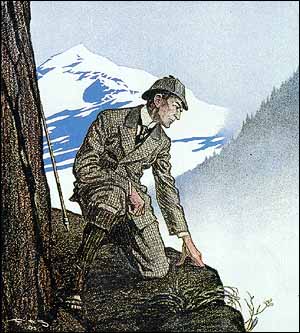
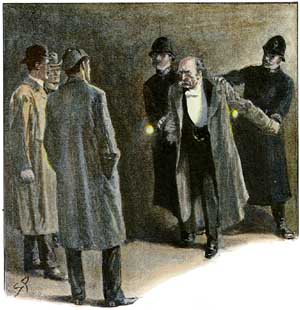
On May 4, 1891, Sherlock Holmes allowed the world to believe him dead. He abandoned everything and everyone, only permitting his brother to know the truth. Holmes didn’t leave a single clue that he still lived, not even the flimsiest scrap of hope for those who cared most about him – unless one made a habit of looking for subtext in newspaper articles about Norwegian explorers. (Don’t we all?) The Great Detective was silent for nearly three years.


It was a time during which the criminal population of London grew more confident: “It is best that I should not leave the country. Scotland Yard feels lonely without me, and it causes an unhealthy excitement among the criminal classes.” (LADY)

In which Inspector Lestrade managed somewhat passable achievements in police work: “Three undetected murders in one year won’t do, Lestrade. But you handled the Molesey Mystery with less than your usual – that’s to say, you handled it fairly well.” (EMPT)

In which Mrs. Hudson kept a strangely untouched room at 221 Baker Street: “…Mycroft had preserved my rooms and my papers exactly as they had always been. So it was, my dear Watson, that at two o’clock to-day I found myself in my old armchair in my own old room, and only wishing that I could have seen my old friend Watson in the other chair which he has so often adorned.” (EMPT)

And in which Dr. Watson returned to his medical practice, his personal bereavements, and a quiet, uneventful life: “As we drove away I stole a glance back, and I still seem to see that little group on the step – the two graceful, clinging figures, the half-opened door, the hall-light shining through stained glass, the barometer, and the bright stair-rods. It was soothing to catch even that passing glimpse of a tranquil English home in the midst of the wild, dark business which had absorbed us.” (SIGN)

It can be argued that Sherlock Holmes left under duress, certainly. He left in pursuit of what remained of Professor Moriarty’s criminal empire, dodging boulders heaved at his person by Colonel Sebastian Moran, and the safety of the public at the forefront of his mind. Neither was it three years of rest and relaxation. He may have found ways to occasionally amuse himself, but Sherlock Holmes was rarely at ease during this time, telling Watson:

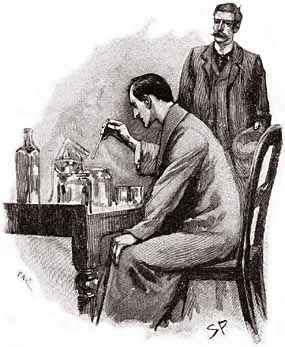
The course of events in London did not run so well as I had hoped, for the trial of the Moriarty gang left two of its most dangerous members, my own most vindictive enemies, at liberty. I travelled for two years in Tibet, therefore, and amused myself by visiting Lhassa, and spending some days with the head lama. You may have read of the remarkable explorations of a Norwegian named Sigerson, but I am sure that it never occurred to you that you were receiving news of your friend. I then passed through Persia, looked in at Mecca, and paid a short but interesting visit to the Khalifa at Khartoum the results of which I have communicated to the Foreign Office. Returning to France, I spent some months in a research into the coal-tar derivatives, which I conducted in a laboratory at Montpellier, in the south of France. Having concluded this to my satisfaction and learning that only one of my enemies was now left in London, I was about to return when my movements were hastened by the news of this very remarkable Park Lane Mystery, which not only appealed to me by its own merits, but which seemed to offer some most peculiar personal opportunities. (EMPT)

So, while it may not have been a consensual parting, the Great Detective left, nonetheless. And without a doubt there is a certain, sharped-edged cruelty to his departure, both for the people he left behind and for Sherlock Holmes himself. Leaving is difficult enough when you want to be found and contacted during your time away, but to disappear completely, without a trace? Well, that’s an extraordinary undertaking.

What’s even more extraordinary, however, is that Sherlock Holmes came back.

You may wonder, what’s so difficult about returning? Wouldn't that be the easiest part? Sherlock Holmes could just slip back into his old life, his old ways, his old work. Even his flat was kept just as he left it. And his friends and associates, once they got over the initial shock and sting of his deception, wouldn't they be grateful to have the Detective back? Wouldn't returning to his old life in London feel positively relaxing compared to the trials of the past three years?

But three years is a very long time, and things change. Mycroft Holmes may have done his best to keep his brother informed, but there was truly no way for the Detective to be certain of what awaited him in London. Perhaps Mrs. Hudson had grown tired of the perpetual silence in her home and the morbid memorial to a man she believed long dead – no matter what princely payments she was receiving for its upkeep? Perhaps Inspectors Lestrade and Gregson had learned to cooperate, and their combined forces meant the dawn of a new age of criminal investigation in London? Perhaps the criminal masses of London had grown tired of a city without Sherlock Holmes and had moved on to greener, more interesting pastures? Worst of all, perhaps Dr. Watson had grown accustomed to his new quiet life – with regular sleep, predictable meals, and no errant bullet holes piercing the walls of his sitting room?

None of these things, of course, proved to be true, but there was always the risk that his life was not as he left it. That there would be no well-worn rut to slip unobtrusively into. That returning to his life would be just as much of a fight as leaving it had been. Returning was just a risky as leaving, and Sherlock Holmes knew it, as he knew most things. But he also knew it was worth it. He knew – or perhaps only hoped – that there was still a place for him in London, and that the world still needed its only consulting detective.

My own hiatus has a name. Her name is Morrigan Maeve, and when she was born this past April, she weighed 7lbs, 5.5oz and was 20 inches long. She is an absolute joy and is completely worth everything. Unequivocally, everything. Like the Great Detective in Tibet, however, I have observed my Sherlockian life from a distance and hoped that there would still be a place for me when I returned. So now I’m back and “I trust that age doth not wither nor custom stale my infinite variety,” and that you all still have faith in “my power to surprise you.”

Now, there is work to do. Let’s get to it.


oOo

“Stand with me here upon the terrace…” (LAST)

For Trevor: You played the game for the game’s own sake. May it be 1895 wherever you are, my friend. 

Saturday, June 29, 2013

“The Meaning of This Extraordinary Performance” (COPP): Granada Television’s “The Man with the Twisted Lip”

“Jeremy Brett particularly enjoyed the next stage of the story, the construction of the divan and Holmes’ enormous consumption of tobacco as he thinks the problem through while Watson snatches an hour or two of sleep. We decided that Holmes had brought his mouse-colored dressing gown with him rather than borowing [sic] a blue one, thus adding our contribution to one of the minor mysteries of the Canon. Jeremy also enjoyed finding new aspects of Holmes and he relished the meditative stillness of this sequence, although inspiration does not strike until he washes his face at dawn.” (From A Study in Celluloid: A Producer’s Account of Jeremy Brett as Sherlock Holmes, by Michael Cox)

In Sir Arthur Conan Doyle’s original short story, “The Man with the Twisted Lip,” Mrs. Kate Whitney actually arrives at Dr. Watson’s home looking for, not the doctor himself, but his wife. “Folk who were in grief came to my wife like birds to a light-house,” he says. But in the 1986 Granada Television adaptation of the story, Dr. Watson is the lighthouse. This is, of course, because the marriage between Mary Morstan and Dr. Watson was written out of the Granada series. According to Jeremy Brett, “[Mary Morstan] would have got in the way. Watson was more in love with Holmes – in a pure sense – than he could have been with a woman. He wouldn’t want to give up the excitement, the danger. As for Holmes, if Watson had gone off and left him for a woman he wouldn’t know what to do. He’d be stoned out of his mind every night.” And so, in Granada’s version, Mrs. Kate Whitney arrives at Baker Street, hoping that Dr. Watson (played by Edward Hardwicke) might help her find her missing husband, Isa Whitney. But the hour is late, and Mrs. Whitney tells Mrs. Hudson that she is concerned that she will only be in the Doctor’s way. “He won’t mind, I’m sure,” says Mrs. Hudson. “He’s the kindest of men.”

The audience has already seen Mr. Isa Whitney in the opening sequence of the episode, walking distractedly past the beggar, Hugh Boone. Whitney attracts Boone’s attention momentarily, if only because he fails to give him any change before disappearing down a shadowy alleyway. “Yours is the Kingdom of Heaven, sir,” Boone mumbles after Whitney’s retreating figure. Whitney walks past a group of workmen, who lift a burlap sheet in the course of their labors, but when the sheet falls again, Whitney is gone – vanished completely. It is an effortless bit of cinematic magic, but nevertheless effective. Whitney has evaporated as completely as the smoke from an opium pipe, gone the audience knows not where, but the tone of the episode has been set. Existence and identity are insubstantial notions, and both ideas are at odds in this episode. A person can dissipate into nothing, with an ill-timed word or a thoughtless action. A person can vanish completely, but they can also vanish deliberately. “Mr. Holmes disappears without a trace at regular intervals,” Watson tells Kate Whitney, and such is the episode’s common thread. The audience finds characters that are tasked with the effort of identity and the burden of existence.

Dr. Watson eventually leaves Baker Street to retrieve our vanished man, leaving Mrs. Whitney to take tea with Mrs. Hudson. The two women muse philosophically as to whether “men ever really truly grow up, or if they remain little boys forever,” over a shot of Dr. Watson running to catch a cab and arriving in Upper Swandam Lane – a vile alley of disrepute if there ever was one, and brought to vivid life out of Sir Arthur Conan Doyle’s story. As the Doctor arrives, a well-dressed man is discussing trade with two women of ill-repute (who then turn their attentions to Watson), then a scream as a fight breaks out, and Watson narrowly avoids being struck down by a shattering bottle. Watson locates the vanished Whitney inside The Bar of Gold, the opium den, but he also finds Sherlock Holmes, “merge[ed] with the surroundings,” and artfully disguised as an opium addict – complete with grizzled wig and beard, false eyebrows, a prosthetic nose, and tattered clothing. It’s a masterful camouflage, and so the effect is rather singular, therefore, when Holmes removes the disguise once in a cab with Watson. Each piece of his false face is removed to reveal the refined, patrician features of Jeremy Brett underneath. He has already exchanged his ratty addict’s costume for his traditional black suit, all crisp lines and sharp angles, and the transformation is complete. Sherlock Holmes himself has shown the audience how simple it is to assume the persona of another person – and also how effortless it is to dispose of one.


Sherlock Holmes and Dr. Watson arrive at the Cedars, near Lee, in Kent, where Mrs. Neville St. Clair is waiting and eager to attest to her husband’s character. Of interest, in this adaptation Mrs. St. Clair is played by Eleanor David, who would take another Sherlockian turn in the 2004 film Sherlock Holmes and the Case of the Silk Stocking as Mary Pentney (with Jonathan Hyde, as George Pentney, who appears in Granada’s 1994 adaptation of “The Dying Detective”). She describes her dramatic ordeal in detail, including how she found her (also vanished) husband’s garments behind a curtain in the opium den. Neville St. Clair’s clothing has been discarded like a snakeskin, disposed of like so much trash, but Mrs. St. Clair fervently announces the name of her husband’s tailor – as if that were somehow an integral part of his identity and the mention of it will somehow summon him into being. Later on the episode, as Holmes recounts a discussion with Inspector Bradstreet, the audience sees those same clothes in Bradstreet’s office. In this instance, however, the clothes are laid out neatly, as if trying to replicate the man who should be occupying them. And at the end of the episode, when St. Clair emerges from his Bow Street cell in his gentleman’s persona, he arranges the remaining scraps of Hugh Boone in a similar, tidy fashion, perhaps in the hopes of bidding the beggar into his own separate, independent existence – so that he won’t have to destroy him completely by casting him into the fire.  

In the original short story, after a few hours of sleep at the St. Clair residence, Watson (and therefore, the reader) is awoken by Holmes’s shout of revelation, to find the Detective still smoking and in much the same contemplative position as he was before the Doctor drifted off. Holmes has solved the case, but the readers do not get to witness the actual epiphany. Granada’s adaptation remedies this omission by having the audience witness Sherlock Holmes while in the midst of his method. Immersed in the golden light of a slowly rising sun and subtle clouds of tobacco smoke, the Detective sits in a meditative state. The camera angle moves in gradually and narrows into a tight shot of Jeremy Brett’s face, his eyes opening slowly and his brow subtly arched. With his pipe in hand, perhaps we see a slight echo of Holmes as he appeared earlier – as the ragged opium addict in the Bar of Gold. And in this version, Watson sleeps through the moment of grand understanding, because it takes place elsewhere. In front of a mirror, Holmes washes his face only in waistcoat and shirtsleeves, and understanding slowly dawns, resulting in a boisterous clap instead of a verbal cue. As he wakes Watson in the next scene, Holmes is suddenly fully dressed – including overcoat and hat – his detective identity fully assumed and ready for battle.


At the end of the episode, Inspector Bradstreet makes Neville St. Clair promise that they will see no more of Hugh Boone. “I swear it by the most solemn oath that a man could take,” St. Clair replies. But the understated smirk and downturned expression on Holmes’s face suggest that the Detective doesn’t think much of St. Clair’s promises. Perhaps it is simply because the end of Hugh Boone doesn’t necessarily preclude St. Clair from taking up some other beggar persona, in another part of London. The man had a gift for disguise, after all. Or perhaps he understands that St. Clair and Boone are inexorably intertwined, and that untangling the two will be no mean feat. Because as the audience has already seen, Sherlock Holmes knows better than anyone how simple it is to assume an identity, dispose of one, and begin the whole process anew.

oOo
Sources:
"Better Holmes & Gardens” has its own Facebook page.  Join by “Liking” the page here, and receive all the latest updates, news, and Sherlockian tidbits.

Saturday, May 4, 2013

Some Thoughts on Setting: The Tranquil
English Home

“As we drove away I stole a glance back, and I still seem to see that little group on the step – the two graceful, clinging figures, the half-opened door, the hall-light shining through stained glass, the barometer, and the bright stair-rods. It was soothing to catch even that passing glimpse of a tranquil English home in the midst of the wild, dark business which had absorbed us.” (SIGN)

221B Baker Street was not a tranquil English home. Life with Sherlock Holmes was not tranquil. The world with Sherlock Holmes in it was not tranquil. An existence punctuated by indoor pistol practice, unpredictable and uncontrollable chemical experiments, and an assorted cast of unsavory characters arriving at irregular hours was not a tranquil one. But there were moments of tranquility. For instance, the conclusion of “The Adventure of the Blue Carbuncle,” in which the reader finds Sherlock Holmes and Dr. Watson enjoying a peaceful, seasonal meal together. The passage in The Sign of Four in which Holmes lulls a tense and exhausted Watson to sleep with his violin. Or even the opening lines of “The Adventure of the Six Napoleons,” in which the reader finds that Inspector Lestrade has acquired the habit of dropping in at Baker Street of an evening, just to chat. But, by and large, the Baker Street flat was a rambunctious residence.

But that doesn’t mean, necessarily, that all other canonical residences were tranquil ones, either. An address off of Baker Street did not guarantee a peaceful life. The eponymous residence of “The Copper Beeches,” for all its efforts at the appearance of normalcy, turned out to be – for Miss Violet Hunter especially – as dark and dangerous a residence as any alley of ill-repute in London. The Trevor residence in Donnithorpe, seen in “The ‘Gloria Scott’”, is certainly more than peaceful enough in the beginning. As Sherlock Holmes said, “…he would be a fastidious man who could not put in a pleasant month there,” but unfortunately the “old-fashioned, widespread, oak-beamed brick” dwelling quickly becomes the site of high drama, when the elder Trevor’s previous transgressions follow him home. And of course, in “The Adventure of the Abbey Grange,” no number of ivy-covered walls or pillared front facades can conceal the dark business that took place inside – the monstrous cruelty of Sir Eustace Brackenstall and his violent end.


Nevertheless, in “The Crooked Man,” Sherlock Holmes arrives at the home of Dr. and Mrs. Watson, seeking sanctuary. The Watsons have only been married a few months, and the hour is late – Watson informs the reader that his wife had already gone to bed – but there is no question that Sherlock Holmes would be welcome, that his hat can fill the vacant peg on the hatstand. So, if a tranquil English home doesn’t necessarily mean “anywhere outside of Baker Street,” then what was Dr. Watson longing after as he gazes back at the Forrester residence in The Sign of Four? Was it necessarily the tranquility? Was it the sense of stability? Was it the woman standing on the doorstep (you know, the one he would eventually marry)? Or was it something else, some more intangible quality, something that perhaps escaped even Watson’s implicit understanding?


It’s worth noting that, in the passage from SIGN, Watson is neither coming from nor returning to the flat at Baker Street. He is coming from Pondicherry Lodge – returning Miss Mary Morstan to the home where she currently resides as a governess – and their evening has been long and dark, punctuated by theft, murder, and the revelation of secrets horrible and long-harbored. After leaving Miss Morstan with the Forresters, Watson does not immediately return to Pondicherry Lodge, but instead embarks on an errand for Sherlock Holmes, and goes to Pinchin Lane. It is an unlovely place. As Watson says, “Pinchin Lane was a row of shabby, two-storied brick houses in the lower quarter of Lambeth. I had to knock for some time at No. 3 before I could make any impression.” He is then subjected to a variety of abuse at the hands of the resident, Mr. Sherman, before mentioning Sherlock Holmes and thus gaining entrance, and Sherman’s deference. The interior of No. 3 Pinchin Lane is no better than the exterior: “In the uncertain, shadowy light I could see dimly that there were glancing, glimmering eyes peeping down at us from every cranny and corner. Even the rafters above our heads were lined by solemn fowls, who lazily shifted their weight from one leg to the other as our voices disturbed their slumbers.”

So, what was Watson really seeing in that passage from SIGN, what were the particular items that drew his eye? The first thing he mentions is Miss Morstan and Mrs. Forrester on the doorstep – “the two graceful, clinging figures.” Mary Morstan didn’t just arrive at the place where she lived; she was welcomed home by Mrs. Forrester: “…it gave me joy to see how tenderly her arm stole round the other’s waist and how motherly was the voice in which she greeted her. She was clearly no mere paid dependant but an honoured friend.” And hasn’t Watson received similarly warm welcomes from Sherlock Holmes? In “The Naval Treaty,” the Doctor is informed, “You come at a crisis, Watson” and “I will be at your service in an instant... You will find tobacco in the Persian slipper.” In “The Adventure of the Empty House,” Holmes tells his friend: “So it was, my dear Watson, that at two o’clock to-day I found myself in my old armchair in my own old room, and only wishing that I could have seen my old friend Watson in the other chair which he has so often adorned.” It’s really very simple. What more can one want from a home than to just to know that you are welcome, and that all the comforts are at your disposal?  


And speaking of those comforts, that is the second thing that draws Watson’s eye in the passage from SIGN: “the half-opened door, the hall-light shining through stained glass, the barometer, and the bright stair-rods.” These items are all meant to be indicators of home – things that are comforting and familiar. So, how are these articles any different that the tobacco in the toe-end of a Persian slipper (or the cigars in the coal-scuttle, for that matter), correspondence eternally fixed under a jack-knife, or the bullet-marks in the wall. In “The Adventure of the Creeping Man,” Watson practically equates himself with these items: “As an institution I was like the violin, the shag tobacco, the old black pipe, the index books, and others perhaps less excusable.” If bullet-marks and jack-knifes are perhaps less graceful than “hall-light shining through stained glass,” does that make them any less effective as objects of comfort? They are still indicators of home, no matter what kind of home that might be.

Perhaps what Dr. Watson was longing for in that passage from SIGN was not necessarily a different type of home. Is it possible that he just wanted to go home – no matter where that home was, or what it might be? It had already been a long night, with the promise of it being even longer, and maybe all he wanted to do was feel welcomed, and surround himself with the items that comforted him (and most likely sleep, of all ridiculous notions). This is, after all, what Watson does for Holmes when the man arrives on his doorstep, on that long dark night in CROO. He welcomes him in, offers him a familiar creature comfort (in the form of his tobacco pouch), and shares his company with a man that knew his habits even better than himself. The tranquil English home might be, after all, not a necessarily a place, but a place of being.  

oOo

“Better Holmes & Gardens” has its own Facebook page.  Join by “Liking” the page here, and receive all the latest updates, news, and Sherlockian tidbits.

Saturday, March 30, 2013

“I should very much like to have a word with Mr. Holmes.” (3GAR): Some Thoughts on the Dichotomy of Sherlock Holmes

"It was 'The Adventures of Sherlock Holmes.' I opened the book with no realization that I stood, or rather sat, on the brink of my fate. I had no inkling, no premonition, that in another minute my life's work, such as it is, would be born... I finished 'The Adventures' that night... As I closed the book, I knew that I had read one of the greatest books ever written. And today I realize with amazement how true and tempered was my twelve-year-old critical sense. For in the mature smugness of my present literary judgment, I still feel unalterably that 'The Adventures' is one of the world's masterworks." (Frederic Dannay)

"The best literary work is that which leaves the reader better for having read it. Now nobody can possibly be the better – in the high sense in which I mean it – for reading Sherlock Holmes, although he may have passed a pleasant hour in doing so. It was not to my mind high work, and no detective work ever can be, apart from the fact that all work dealing with criminal matters is a cheap way of rousing the interest of the reader." (Sir Arthur Conan Doyle)

Sherlock Holmes ruined my life. But he also saved it. Because of Sherlock Holmes, I now know more about the world, the people in it, and myself. Previously a curious and avid student, Sherlock Holmes has made me compulsive about learning to an obsessive degree. I think differently, and more often, but to be fair, I’m usually thinking about a particular subject. And the things I know aren’t always something everyone would find particularly interesting, useful or necessary to everyday life. Some people would call it superfluous knowledge. These aren’t always scholarly or erudite facts, either. But some of them are. Nor has it always been a lofty or cerebral education. But some of it has been. And now as I stand at the precipice of 100 blog posts (well… sit, really, as Frederic Dannay was sitting… I’m sitting at my computer), I’m prepared to admit to the dichotomy. I’m here with hat in hand (not a deerstalker, rather more like a homburg, as we all know) and confess that the Great Detective is both the best and worst thing that ever happened to me.


I’m sure that some of Sherlock Holmes’s canonical clients would say much the same thing. While Holmes might have been able to solve whatever mystery they first approached him with, the explanation may have ultimately exposed something that they would rather the world have not known, something that they would never have willingly revealed to others, or simply something that they would rather have not realized about themselves. In “The ‘Gloria Scott’”, one of Holmes’s very first cases, Victor Trevor undoubtedly felt relief that Holmes was able to explain what happened to his father – the real identity of Hudson and the reason for the shadow he cast over the elder Trevor’s life – and the reason for his father’s fatal reaction to a seemingly innocuous letter. But ultimately Holmes’s explanation revealed uncomfortable facts about his father’s past – things that would be even more unsettling and disturbing now that Victor’s father was no longer alive to discuss them. There may been a solution for Victor Trevor, but there would never be any closure. Likewise Violet de Merville of “The Adventure of the Illustrious Client” probably felt no joy that her fiancé, the villainous Baron Gruner, was unquestionably revealed as an utter blackguard by Sherlock Holmes – but eventually there must have been relief at the disastrous future that she so narrowly avoided.  

And no one was more versed in the disparity of life and human nature than Sherlock Holmes. As he said to Dr. Watson: “I assure you that the most winning woman I ever knew was hanged for poisoning three little children for their insurance-money, and the most repellent man of my acquaintance is a philanthropist who has spent nearly a quarter of a million upon the London poor” (SIGN). But being aware of that disparity doesn’t mean he was always able to correctly assess it. In “The Yellow Face,” the Detective is quite convinced of his own theory: that Mrs. Munro’s first husband is the occupant of the mysterious cottage and he is an unscrupulous blackmailer. The climax of the story reveals both Sherlock Holmes’s failings, and that the occupant of the cottage is Mrs. Munro’s daughter from her first marriage. The Detective had assumed the worst, and Mr. Munro neatly assesses the situation in saying: “I am not a very good man, Effie, but I think that I am a better one than you have given me credit for being.”

The Detective himself is a study in contradictions. Who among Sherlockians doesn’t know that “…although in his methods of thought he was the neatest and most methodical of mankind, and although also he affected a certain quiet primness of dress, he was none the less in his personal habits one of the most untidy men that ever drove a fellow-lodger to distraction” (MUSG)? The actors who have portrayed Sherlock Holmes over the years have usually been rather adept at capturing both sides of the Detective’s personality. Most recently in his turn as the Great Detective, Benedict Cumberbatch sports immaculately tailored suits and coats (and, for some reason, shirts that that appear expensive, if a size too small) – but keeps severed heads and other assorted body parts in the refrigerator. And who can forget the incomparable Jeremy Brett crawling through an ever-growing sea of papers in the Baker Street sitting room – his hair sleeked back into a sharp widow’s peak, his cuffs and collars spotlessly white, his suit somehow inexplicably remaining wrinkle-free despite his exertions?


In addition, Holmes was ever inconsistent when it came to personal relationships. In “A Scandal in Bohemia,” Watson says, “Grit in a sensitive instrument, or a crack in one of his own high-power lenses, would not be more disturbing than a strong emotion in a nature such as his.” And in “The Five Orange Pips,” Holmes pronounces that he has no friends, except for Dr. Watson. All of this proves to be profoundly untrue. During 56 short stories and 4 novels, the reader learns of the Detective’s other friends, such as Victor Trevor (GLOR), a companion from Holmes’s university days. Even more significantly, over the course of the Canon, the Detective’s relationship with Inspector Lestrade evolves and eventually he comes to refer to the Scotland Yard inspector as “Friend Lestrade” (NOBL, CARD, EMPT, NORW, 3GAR). And of course, all readers remember how in “The Adventure of the Three Garridebs,” Watson sees all his “years of humble but single-minded service culminated” in a grand moment of revelation.


As such, I’ve found many Sherlockians to be the same – not inconsistent, but definitely contradictory. I include myself in that lot, of course. We pursue endlessly obscure topics, isolate ourselves during our researches, and hold fast to our theories when we believe ourselves to be right. We wait for our grand moment of revelation, a sign that all of our efforts have not been in vain. But in the end, we seek each other out. And such relationships are unique unto Sherlockiana, and often profound, because as C.S. Lewis said, “Friendship is born at that moment when one person says to another: What! You too? I thought I was the only one.”

I say that Sherlock Holmes is both the best and worst thing that ever happened to me, because he’s revealed the best and worst things about me. Surely my husband, who no longer remembers the color of our carpet, so covered in books it has become, would tell you that the Great Detective has revealed my slightly more compulsive and obsessive tendencies (and for the record, the carpet is grey… no, beige… taupe?). But I have also learned the most spectacular things, met some of the best and wisest people, and my life has been profoundly changed. I’m not the person I was before I met Sherlock Holmes, but I am the person I was meant to be. Such as I am.

oOo

“Better Holmes & Gardens” has its own Facebook page.  Join by “Liking” the page here, and receive all the latest updates, news, and Sherlockian tidbits.

Monday, January 21, 2013

Some Thoughts on Character: Colonel Sebastian Moran

Moran, Sebastian, Colonel. Unemployed. Formerly 1st Bangalore Pioneers. Born London, 1840. Son of Sir Augustus Moran, C. B., once British Minister to Persia. Educated Eton and Oxford. Served in Jowaki Campaign, Afghan Campaign, Charasiab (despatches), Sherpur, and Cabul. Author of Heavy Game of the Western Himalayas (1881); Three Months in the Jungle (1884). Address: Conduit Street. Clubs: The Anglo-Indian, the Tankerville, the Bagatelle Card Club… The second most dangerous man in London. ("The Adventure of the Empty House")

In the 2011 film, Sherlock Holmes: A Game of Shadows, Professor James Moriarty signs copies of The Dynamics of an Asteroid in Paris. His signature is an elegant scrawl from a fountain pen as he speaks in effortless French to those who have come to praise him. A man in an inconspicuous tweed suit slides into the empty seat next the Professor, a pair of opera tickets in his hands. There is a long pause as he waits for Moriarty to address him. Finally, the Professor turns, only slightly, to look at the man at his side: “My ticket?” The man nods, gesturing with the object in question.  “Unfortunately,” the Professor says, “you won’t be needing yours.” The man’s expression is largely unreadable as he looks back down at the tickets in his hands, but his sardonic tone is telling: “It’s a shame, Professor. I was looking forward to Don Giovanni.” The identity of the man in the unprepossessing suit isn’t officially revealed as Colonel Sebastian Moran until a bit later in the film, but there are enough clues in even that brief scene for the viewer to make the logical deduction on his or her own. For is that not how we always picture Colonel Moran – the slightly uncouth man on Moriarty’s right hand?


Paul Anderson as Colonel Sebastian Moran and
Jared Harris as Professor James Moriarty 
Colonel Sebastian Moran was first introduced to readers in “The Adventure of the Empty House,” but like many of the minor characters in the Canon, he has taken on a life of his own, appearing in numerous pastiches and television and film adaptations. In A Game of Shadows, mentioned above, he was played by Paul Anderson, and in the Granada television adaptation of EMPT, Patrick Allen. In the 1946 Basil Rathbone film, Terror by Night, Alan Mowbray took on the role of the Colonel (inexplicably masquerading as Major Duncan Bleek). In a recent episode of the new television series, Elementary (simply entitled, “M.”), actor Vinnie Jones takes a turn as Moran – a slightly more bloodthirsty, more unhinged version. And while the Colonel has not yet appeared in the BBC series, “Sherlock” (although who can say who was on the other end of those sinister red laser sights at the end of “The Great Game”?), don’t tell that to the legions of fans who have already imagined Mark Gatiss and Steven Moffat’s 21st century version of Professor Moriarty’s trusted assassin in full. Several pastiche writers have also imagined their own versions of Colonel Moran. Kim Newman’s Moran of The Hound of the D'Urbervilles is every bit as vulgar, crass, ruthless and merciless as so many have imagined (I fully recommend The Well-Read Sherlockian’s excellent review of the novel available here). In John Gardner’s novel, The Return of Moriarty, Moran’s appearance is pitifully, though logically and necessarily, brief – and raises a host of questions.


Jeremy Brett as Sherlock Holmes and Patrick Allen as Colonel Moran
But what do readers really know about Colonel Sebastian Moran? The above description – found in EMPT and taken from Sherlock Holmes’s own “index of biographies” – is concise and informative enough, providing details of birth and ancestry, education and military career, even his current address and preferred recreational spots, but the apparent glut of explicit knowledge ends there. Prior to EMPT (chronologically speaking), Moran is mentioned alongside Professor Moriarty in their brief cameo in The Valley of Fear: “[Moriarty’s] chief of the staff is Colonel Sebastian Moran, as aloof and guarded and inaccessible to the law as himself.” So readers can add those three remarkable descriptors (aloof, guarded, inaccessible) to what they already know about the man. To put Moran on the same level as Moriarty in terms of demeanor and position is quite a lofty compliment indeed. But it is also contrary to the man that readers know from EMPT. The Colonel found there is a man of barely contained rage, snarling, savage and “wonderfully like a tiger himself.” As Watson recounts, “The fury upon [Moran’s] face was terrible to look at.” This is a man impulsive and hotheaded enough to murder a man because he could expose the Colonel’s unethical card practices, but patient and methodical enough to be really clever about how he did it. There is the “man of iron nerve,” that Sherlock Holmes describes, a man ruthless enough to relentlessly pursue a man-eating tiger, but possessing of the necessary quietness of disposition to be successful.


At the end of EMPT, the Great Detective seems more than confident that the Colonel will no longer be a concern, but Moran doesn’t disappear from the Canon entirely. In “The Illustrious Client,” which according to William Baring-Gould’s chronology takes place in 1902, Holmes comments: “If your man is more dangerous than the late Professor Moriarty, or than the living Colonel Sebastian Moran, then he is indeed worth meeting.” And in “His Last Bow,” which according to the same chronology takes place in 1914: “The old sweet song… How often have I heard it in days gone by! It was a favourite ditty of the late lamented Professor Moriarty. Colonel Sebastian Moran has also been known to warble it.” This means that Moran was most definitely alive as of 1902, and most probably alive as of 1914 (Holmes refers to the Colonel in the present tense, but a life of international espionage is a busy one, so it might be worth arguing that Holmes’s information could be outdated). Surviving an incarceration of twenty years or more certainly shows a certain resilience of character, or perhaps just a mulish intractability.

At the end of A Game of Shadows, Moran covertly executes Professor Moriarty’s undercover assassin (discreetly, with a blowgun) and then walks out of the Swiss chateau, into the shadows, and away from Professor Moriarty, who is currently engaged in a cerebral battle out on the balcony with Sherlock Holmes. Dr. Watson runs towards his friend, while the Colonel just simply walks away, his intended direction unknown. It is a curious divergence, but not entirely unexpected. As Holmes himself points out in EMPT:

"There are some trees, Watson, which grow to a certain height, and then suddenly develop some unsightly eccentricity. You will see it often in humans. I have a theory that the individual represents in his development the whole procession of his ancestors, and that such a sudden turn to good or evil stands for some strong influence which came into the line of his pedigree. The person becomes, as it were, the epitome of the history of his own family... Whatever the cause, Colonel Moran began to go wrong."

The Great Detective refers to Colonel Moran as a shikari, which is a Persian word in two parts: the main “Shikar,” meaning “of hunting” and the suffix “i” denoting possession. And it would seem that Moran too was a character in two parts. He comprises a certain cold reservation that made him equal to sit beside Professor Moriarty, but also a contrary savagery that made him effective in his role. Like so many remarkable characters, it is the dichotomy that makes Moran interesting, makes him memorable. Sherlockians return to Colonel Sebastian Moran not simply because he sits beside Professor Moriarty, but because he stands on his own, and cuts his own path.

oOo

“Better Holmes & Gardens” now has its own Facebook page.  Join by “Liking” the page here, and receive all the latest updates, news, and Sherlockian tidbits.

Sunday, January 13, 2013

“At four yards, I could deceive you.” (DYIN): The Art and Necessity of Deception in the Stories of Sherlock Holmes

“The relations between us in those latter days were peculiar. He was a man of habits, narrow and concentrated habits, and I had become one of them. As an institution I was like the violin, the shag tobacco, the old black pipe, the index books, and others perhaps less excusable. When it was a case of active work and a comrade was needed upon whose nerve he could place some reliance, my role was obvious. But apart from this I had uses. I was a whetstone for his mind. I stimulated him. He liked to think aloud in my presence. His remarks could hardly be said to be made to me – many of them would have been as appropriately addressed to his bedstead – but none the less, having formed the habit, it had become in some way helpful that I should register and interject. If I irritated him by a certain methodical slowness in my mentality, that irritation served only to make his own flame-like intuitions and impressions flash up the more vividly and swiftly. Such was my humble role in our alliance.” (“The Creeping Man”)

Most of us, if we’re honest with ourselves, wouldn’t have been able to live with Sherlock Holmes for very long. I’m sure there would always be a stalwart few who would soldier on under any circumstance – convinced that the benefits of living with the Great Detective would far outweigh any “minor” annoyances. But I’m not one of them. When I was in college, I had a roommate that inexplicably began leaving the peanut butter in the refrigerator and the resulting animosity nearly ended our now decades-long friendship. (Sorry Claire, but have you ever tried to spread cold peanut butter? Have you?) So, if I’m clearly that sensitive about my sandwiches, can you imagine how I feel about my personal possessions, my living space, my life? The first time I arrived at Baker Street to find the sitting room filled with papers and noxious chemical fumes, 221B would suddenly be minus one tenant.

Clean. Up. NOW.
But Dr. John Watson was no such person. He seems to find certain behaviors charming when most other people would find them intolerable. He mentions the Detective’s numerous, dangerous chemical experiments off-handedly, merely describing them as “weird” (DYIN) and “malodorous” (SIGN), when others would have expressed more palpable concern. “My flatmate might kill me,” some might have said. Even Holmes’s indoor pistol practice doesn’t seem to bother the Doctor too much: “I have always held, too, that pistol practice should be distinctly an open-air pastime” (MUSG), he says flippantly, when for others this would have been serious cause for renegotiating the terms of the lease. “My flatmate is going to kill me,” would have certainly been a logical deduction. But Dr. Watson certainly seems to take most of Holmes’s eccentricities in stride.

But certainly some eccentricities are more serious than others. It is one thing, for example, to cleverly execute a disguise in the semblance of a wizened, old sailor (SIGN) or elderly woman (MAZA). Watson, after all, is always so amused when Holmes sheds a disguise to reveal himself beneath it. Amused, and often charmingly befuddled. As in The Sign of Four, when the cantankerous sailor in the Baker Street sitting room is replaced with the Detective, Watson says, “Holmes! […] You here! But where is the old man?” Is it a tribute to Sherlock Holmes’s skill in the art of disguise, or to Dr. Watson’s guilelessness that he cannot, at first, conceive that his friend might have played a lighthearted trick on him? On the other hand, Watson does get angry with Holmes, earlier in the same story, when he presents Holmes with a pocket watch and asks him to deduce what he can of the watch’s former owner. Holmes is successful, of course, in divining the existence of Watson’s unfortunate older brother. At first Watson is furious – convinced that Holmes already somehow knew about his sibling and is trying to play him for a fool – but once Holmes reveals precisely how he made his deductions, Watson is contrite: “It is as clear as daylight… I regret the injustice which I did you. I should have had more faith in your marvellous faculty.”

Holmes, quit waving that fake beard at me. I need to figure out where that old man went!
But neither of these ruses is quite on the same level as, say, a long and protracted ploy in which Watson is led to believe that Holmes is dying of a rare tropical illness. Even worse, Holmes does not want Watson to help treat him or even assist him beyond bringing Culverton Smith to Baker Street – a man who isn’t even a doctor (DYIN). A clever disguise can hardly be equated with leaving Watson to his own devices in Dartmoor, where he conducts a supposedly solitary investigation into the “ugly, dangerous business” and unknowingly cavorts with the most sinister of villains – all while Holmes watches on, but does not act, only revealing his presence when he finds Watson sitting in his den (HOUN). Oh, and of course, there was the time that Sherlock Holmes let Dr. Watson, and the world, believe he was dead. For three years. And then shows up on Watson’s doorstep – in disguise, yet again – making only a passing reference to the Doctor’s late wife, instead suggesting dinner and a quick skirmish with an assassin (EMPT). It’s enough to make the reader feel angry on Dr. Watson’s behalf, even if it seems he can’t quite manage the emotion on his own.
"I'm not dead! Let's have dinner."
And there’s the rub – Dr. Watson doesn’t really seem to be bothered by any of these things, from the most innocent disguises to the most devious, emotionally-charged deceptions. In The Hound of the Baskervilles, Watson is positively relieved that Holmes has arrived (“…a crushing weight of responsibility seemed in an instant to be lifted from my soul,” he says), rather than put-out that the Detective has apparently had him running through hoops while he watched. In “The Empty House,” Watson’s initial response to Holmes’s apparent resurrection is to faint, and when he comes back to himself, he announces, “My dear chap, I’m overjoyed to see you. Sit down, and tell me how you came alive out of that dreadful chasm” – as if it were no small thing for a previously dead friend to be alive and well and standing before him in his consulting room. Fans of the BBC’s “Sherlock,” can expect a different scene from the modern adaptation’s take on EMPT. According to series’ creator Mark Gatiss, "I always found it a little unlikely that Dr. Watson's only reaction was to faint for instance – as opposed to possibly a stream of terrible swear words." The only exception from the examples above is "The Dying Detective" – where the reader doesn’t get to experience Watson’s reaction to Holmes’s deception at all. The story ends with Holmes explaining his process, and one supposes it’s too much to imagine that Watson slugged the Detective once the story closed.

There’s a range of trickery and deception present in the Canon, but for the most part, Dr. Watson’s reactions to those instances don’t seem to vary. Rather than turning to a discussion about the reliability of Watson as a narrator (perhaps he did slug Holmes at the conclusion of DYIN, but if he left it out of the manuscript, how would the reader ever know?), is it equally as likely that Watson merely understood Holmes’s process even more than he would ever let himself realize? The deductive steps may have always been a mystery to him in varying degrees (such as his reaction to Holmes’s pocket watch analysis), but that didn’t mean he didn’t appreciate the result. Watson could have wasted valuable time and energy getting upset when Holmes let him run about Dartmoor to seemingly little end, or he could just skip right to being relieved that Holmes had arrived. What is the benefit in arguing whether or not Watson should have been angry about Holmes’s three-year deception, when the fact remains that he was, in fact, overjoyed to see his friend? Whenever Holmes managed to mislead Watson, whether it was a small trick of disguise or a large-scale deception, the Doctor was always able to move right to the necessity of it. And he was invaluable to the Detective’s process by always appreciating the art of it.

oOo

“Better Holmes & Gardens” now has its own Facebook page.  Join by “Liking” the page here, and receive all the latest updates, news, and Sherlockian tidbits.