Showing posts with label ILLU. Show all posts

Monday, January 21, 2013

Some Thoughts on Character: Colonel Sebastian Moran

Moran, Sebastian, Colonel. Unemployed. Formerly 1st Bangalore Pioneers. Born London, 1840. Son of Sir Augustus Moran, C. B., once British Minister to Persia. Educated Eton and Oxford. Served in Jowaki Campaign, Afghan Campaign, Charasiab (despatches), Sherpur, and Cabul. Author of Heavy Game of the Western Himalayas (1881); Three Months in the Jungle (1884). Address: Conduit Street. Clubs: The Anglo-Indian, the Tankerville, the Bagatelle Card Club… The second most dangerous man in London. ("The Adventure of the Empty House")

In the 2011 film, Sherlock Holmes: A Game of Shadows, Professor James Moriarty signs copies of The Dynamics of an Asteroid in Paris. His signature is an elegant scrawl from a fountain pen as he speaks in effortless French to those who have come to praise him. A man in an inconspicuous tweed suit slides into the empty seat next the Professor, a pair of opera tickets in his hands. There is a long pause as he waits for Moriarty to address him. Finally, the Professor turns, only slightly, to look at the man at his side: “My ticket?” The man nods, gesturing with the object in question.  “Unfortunately,” the Professor says, “you won’t be needing yours.” The man’s expression is largely unreadable as he looks back down at the tickets in his hands, but his sardonic tone is telling: “It’s a shame, Professor. I was looking forward to Don Giovanni.” The identity of the man in the unprepossessing suit isn’t officially revealed as Colonel Sebastian Moran until a bit later in the film, but there are enough clues in even that brief scene for the viewer to make the logical deduction on his or her own. For is that not how we always picture Colonel Moran – the slightly uncouth man on Moriarty’s right hand?


Paul Anderson as Colonel Sebastian Moran and
Jared Harris as Professor James Moriarty 
Colonel Sebastian Moran was first introduced to readers in “The Adventure of the Empty House,” but like many of the minor characters in the Canon, he has taken on a life of his own, appearing in numerous pastiches and television and film adaptations. In A Game of Shadows, mentioned above, he was played by Paul Anderson, and in the Granada television adaptation of EMPT, Patrick Allen. In the 1946 Basil Rathbone film, Terror by Night, Alan Mowbray took on the role of the Colonel (inexplicably masquerading as Major Duncan Bleek). In a recent episode of the new television series, Elementary (simply entitled, “M.”), actor Vinnie Jones takes a turn as Moran – a slightly more bloodthirsty, more unhinged version. And while the Colonel has not yet appeared in the BBC series, “Sherlock” (although who can say who was on the other end of those sinister red laser sights at the end of “The Great Game”?), don’t tell that to the legions of fans who have already imagined Mark Gatiss and Steven Moffat’s 21st century version of Professor Moriarty’s trusted assassin in full. Several pastiche writers have also imagined their own versions of Colonel Moran. Kim Newman’s Moran of The Hound of the D'Urbervilles is every bit as vulgar, crass, ruthless and merciless as so many have imagined (I fully recommend The Well-Read Sherlockian’s excellent review of the novel available here). In John Gardner’s novel, The Return of Moriarty, Moran’s appearance is pitifully, though logically and necessarily, brief – and raises a host of questions.


Jeremy Brett as Sherlock Holmes and Patrick Allen as Colonel Moran
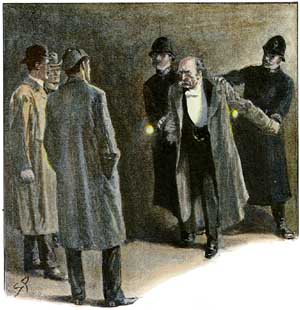
But what do readers really know about Colonel Sebastian Moran? The above description – found in EMPT and taken from Sherlock Holmes’s own “index of biographies” – is concise and informative enough, providing details of birth and ancestry, education and military career, even his current address and preferred recreational spots, but the apparent glut of explicit knowledge ends there. Prior to EMPT (chronologically speaking), Moran is mentioned alongside Professor Moriarty in their brief cameo in The Valley of Fear: “[Moriarty’s] chief of the staff is Colonel Sebastian Moran, as aloof and guarded and inaccessible to the law as himself.” So readers can add those three remarkable descriptors (aloof, guarded, inaccessible) to what they already know about the man. To put Moran on the same level as Moriarty in terms of demeanor and position is quite a lofty compliment indeed. But it is also contrary to the man that readers know from EMPT. The Colonel found there is a man of barely contained rage, snarling, savage and “wonderfully like a tiger himself.” As Watson recounts, “The fury upon [Moran’s] face was terrible to look at.” This is a man impulsive and hotheaded enough to murder a man because he could expose the Colonel’s unethical card practices, but patient and methodical enough to be really clever about how he did it. There is the “man of iron nerve,” that Sherlock Holmes describes, a man ruthless enough to relentlessly pursue a man-eating tiger, but possessing of the necessary quietness of disposition to be successful.


At the end of EMPT, the Great Detective seems more than confident that the Colonel will no longer be a concern, but Moran doesn’t disappear from the Canon entirely. In “The Illustrious Client,” which according to William Baring-Gould’s chronology takes place in 1902, Holmes comments: “If your man is more dangerous than the late Professor Moriarty, or than the living Colonel Sebastian Moran, then he is indeed worth meeting.” And in “His Last Bow,” which according to the same chronology takes place in 1914: “The old sweet song… How often have I heard it in days gone by! It was a favourite ditty of the late lamented Professor Moriarty. Colonel Sebastian Moran has also been known to warble it.” This means that Moran was most definitely alive as of 1902, and most probably alive as of 1914 (Holmes refers to the Colonel in the present tense, but a life of international espionage is a busy one, so it might be worth arguing that Holmes’s information could be outdated). Surviving an incarceration of twenty years or more certainly shows a certain resilience of character, or perhaps just a mulish intractability.

At the end of A Game of Shadows, Moran covertly executes Professor Moriarty’s undercover assassin (discreetly, with a blowgun) and then walks out of the Swiss chateau, into the shadows, and away from Professor Moriarty, who is currently engaged in a cerebral battle out on the balcony with Sherlock Holmes. Dr. Watson runs towards his friend, while the Colonel just simply walks away, his intended direction unknown. It is a curious divergence, but not entirely unexpected. As Holmes himself points out in EMPT:

"There are some trees, Watson, which grow to a certain height, and then suddenly develop some unsightly eccentricity. You will see it often in humans. I have a theory that the individual represents in his development the whole procession of his ancestors, and that such a sudden turn to good or evil stands for some strong influence which came into the line of his pedigree. The person becomes, as it were, the epitome of the history of his own family... Whatever the cause, Colonel Moran began to go wrong."

The Great Detective refers to Colonel Moran as a shikari, which is a Persian word in two parts: the main “Shikar,” meaning “of hunting” and the suffix “i” denoting possession. And it would seem that Moran too was a character in two parts. He comprises a certain cold reservation that made him equal to sit beside Professor Moriarty, but also a contrary savagery that made him effective in his role. Like so many remarkable characters, it is the dichotomy that makes Moran interesting, makes him memorable. Sherlockians return to Colonel Sebastian Moran not simply because he sits beside Professor Moriarty, but because he stands on his own, and cuts his own path.

oOo

“Better Holmes & Gardens” now has its own Facebook page.  Join by “Liking” the page here, and receive all the latest updates, news, and Sherlockian tidbits.

Sunday, June 10, 2012

“Mere random sketches of children” (DANC): Young Adults and Disseminating Knowledge in the Stories of Sherlock Holmes

[As presented at "A Scintillation of Scions V," in Laurel, Md., on June 9, 2012.]

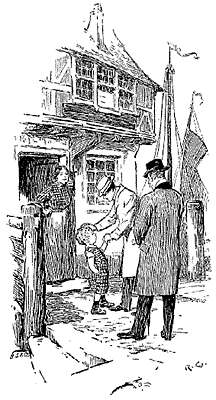
Of all the verbal cleverness in the Canon, of all the subtle linguistic quips and well-placed witticisms, I am especially fond of one particular use of the word strategically. “’Dear little chap!’ said Holmes strategically.” This application is from The Sign of Four in which the reader finds Sherlock Holmes seeking information about the steam launch Aurora and he presents the “dear little chap” with two shillings for seemingly nothing more than being “a rosy-cheeked young rascal.” The Detective uses young people – quite often small children – regularly in the course of his canonical investigations. Information gleaned from young people was frequently instrumental in providing the solution to more than one case, but Holmes was also known to use children as actual clues. In “The Copper Beeches,” for example, Holmes explains how he was able to infer the behavior of Mr. and Mrs. Rucastle by considering the behavior of the family’s youngest member: “I have frequently gained my first real insight into the character of parents by studying their children.” And as Edward Quayle said in his 1948 essay “Suffer the Little Children,” there are even canonical stories where children act as both clue and contributor: “In The Sussex Vampire a boy was the miscreant and a baby boy was exhibit A,” he says. And so the use of the word strategically found in The Sign of Four is just another example of Holmes’s often purposeful view of young people. 

But Sherlock Holmes uses the young people he encounters in the Canon not only to collect information from them, but to convey it to them. It is no great secret that Sherlock Holmes often seemed to casually pass along life lessons in the same way that he would pass along a box of matches or a pencil stub – that is to say frequently and easily. But it is to the young adults of the Canon – those characters who are nearly grown or merely believe themselves to be so; as opposed to the incorrigible and childish Irregulars who immediately leap to mind when one thinks of young people in the Canon – that Holmes imparts to, and therefore preserves with, his most valuable information: the lessons that were really the nucleus of some of his most remarkable cases. And in this narrow, specific distribution of information, the reader suddenly sees a Sherlock Holmes who has an eye towards his own future; a Detective who was, in fact, very concerned with ensuring his own posterity. Furthermore, the Canon is dotted with linguistic clues that highlight these passages. Each instance (or example) includes a single key word that indicates a descending relationship or succession, or implies a patriarchal or familial relationship (if only metaphorically, of course).

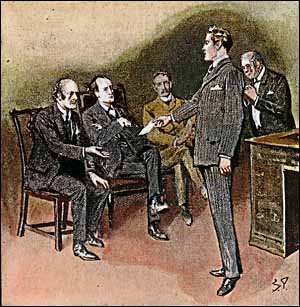
In “The Man with the Twisted Lip,” Holmes advises: “…it is better to learn wisdom late than never to learn it at all.” And the three students we find featured in the story of the same name (“The Three Students”) are no longer children, but they are still quite young in the way of most university or college students – convinced of their own experience and maturity, which only serves to emphasize how inexperienced and immature they really are. Indeed, Giles Gilchrist has managed to surreptitiously obtain an advance look at the exam, and in doing so has committed a youthful blunder, a rather common one, in fact – Gilchrist is not, for example, robbing a bank by tunneling beneath it while his employer copies an encyclopedia by hand. And his actions ultimately harm no one but himself. His decision is ill-advised and he is suitably remorseful. For his part Holmes reacts with a proportionate level of concern: “…it is human to err, and at least no one can accuse you of being a callous criminal…For once you have fallen low. Let us see, in the future, how high you can rise.” The word future speaks to what is fundamentally at stake in the story – both for Gilchrist and in terms of the lesson that Holmes imparts. The story concludes with Gilchrist revealing his decision to join the Rhodesian police and with that pronouncement, there is a glimpse of a future where he might apply the lesson he learned firsthand from Sherlock Holmes – a lesson about leniency and second chances. This is, of course, nearly the exact same lesson that Holmes imparts to James Ryder in “The Blue Carbuncle” – a man whose desperate concern for what his parents are going to say when they hear about this, harkens back to an uncomfortable moment in almost everyone’s formative years. Furthermore, Holmes’s ability to intuit Ryder’s eventual fate – should he have ended up in prison – demonstrates the same empathetic streak he showed to Gilchrist.

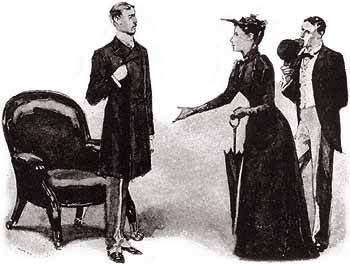
The manner in which Holmes speaks to Gilchrist could be described as “fatherly,” perhaps, although that specific description is never given explicitly in the text of “The Three Students.” In fact, the story, “The Noble Bachelor,” is the only one to feature this particularly telling descriptor – one suggestive of a patriarchal relationship. In relating to Dr. Watson how he found the secretly married Mr. and Mrs. Moulton, he says, “I ventured to give them some paternal advice and to point out to them that it would be better in every way that they should make their position a little clearer both to the general public and to Lord St. Simon in particular.” Hatty Doran is no longer quite a child either – in the strictest sense – but she is, by Lord St. Simon’s own description: “wild and free, unfettered by any sort of traditions”; he also uses the words, “impetuous” and “volcanic.” And so she is a young woman, childish if no longer a child, and like Gilchrist (and Ryder), she has made an impulsive decision that she would rather her father never learn of – as unlikely as that might be. And it is the word paternal that speaks to Holmes’s view of this young bride – who is also likely to soon be a young mother. Holmes has a view to a future full of little Moultons, with whom their mother can share the valuable lesson of a how a truth, no matter how painful, is better than a lifetime of uncertainties. And the fatherly advice that Holmes bestowed to her and her husband is not unlike that he which imparts in “The Yellow Face”: “Any truth is better than indefinite doubt.”


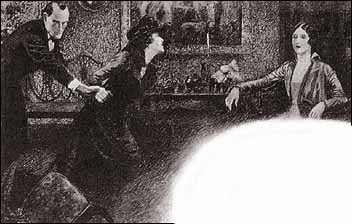
Finally, in “The Illustrious Client,” the reader finds Violet de Merville. Although no specifics about her age are given, she is referred to as “young” no less than five times throughout the course of the story. Violet has also found herself at a rather childish impasse – much like Gilchrist’s academic dishonesty or Mrs. Moulton’s clandestine union – but Violet is stubborn in the way of so many young women and men who find themselves newly in love and unreceptive to the words of parents, who know that their child’s new paramour is just no good – whether it is because he rides a motorcycle, was caught smoking under the bleachers, or has a documented history of murdering his wives. In any event, Holmes confesses to Watson, somewhat shockingly: “I thought of her for the moment as I would have thought of a daughter of my own.” The word daughter places emphasis on a family relationship and clearly indicates and stresses Violet’s gender. Holmes has given advice to young women before – and furthermore, he is used to having young women disregard that advice (having already dealt with another Violet – Miss Hunter – in 1890). He already knows that his next steps with Miss de Merville will have to be resolute, dramatic, and probably somewhat unpleasant. And so when Holmes says, “All my hot words could not bring one tinge of colour to those ivory cheeks or one gleam of emotion to those abstracted eyes” – it brings to mind his advice from “A Case of Identity”: “If I tell her she will not believe me. You may remember the old Persian saying, ‘There is danger for him who taketh the tiger cub, and danger also for whoso snatches a delusion from a woman.’ There is as much sense in Hafiz as in Horace, and as much knowledge of the world.”


As we know, Holmes was never pleased with Watson’s efforts to preserve his methods for posterity – often stating that his Boswell’s stories were too romantic or florid for his taste. So, Sherlock Holmes never saw his deductive methods put to paper in a way that was precisely to his liking – his oft-mentioned monographs only partially served this purpose and cannot be considered a complete compendium of Holmesian investigation. And for the purposes of the Canon, Holmes died unmarried and childless (my apologies to Mr. Baring-Gould), and he speaks of his own family in an absent, off-hand manner as if it were a footnote in one of those monographs. Perhaps Holmes chose young adults, rather than small children (of whom he was also famously fond) because young adults had the most potential for an immediate payout on his lessons. The canonical characters mentioned just now were all just on the cusp of a significant age-related milestone – a career, a marriage, children. These characters were all just old enough to really appreciate the enormity of Holmes’s lesson (if not the finer details of his methods), but also young enough for the lesson to still have a real impact. There was still time for the lesson to sink into their skin and linger there, rather than be brushed off as just one more lecture in a collection of a lifetime of experiences.

But ultimately what was at stake was the lesson, and as has hopefully been demonstrated, that lesson was shared, and Sherlock Holmes once again succeeded. Young people are mere random sketches of both children and adults – close to both roles without fully encompassing either. They are able to pick and choose details, disregarding irrelevancies, until their self-portrait is finally complete. Just as the lessons Holmes conveyed to them were mere random sketches of lessons he had outlined in previous stories – rough mirror images, cleverly concealing their significance, as well as their potential for so much more.

oOo

“Better Holmes & Gardens” now has its own Facebook page.  Join by “Liking” the page here, and receive all the latest updates, news, and Sherlockian tidbits.