Showing posts with label sherlock holmes on screen. Show all posts

Friday, March 25, 2016

“You evidently don’t know me” (FINA): The Many On-Screen Incarnations of Moriarty

I started thinking about this topic when everyone was a little preoccupied discussing other things. I found that I didn’t want to talk about those things, but I wanted to talk about Moriarty. Again. I’ve written about the character before, but now seems like a good time to revisit the conversation. Let’s talk about Professor Moriarty and Mr. Moriarty, James Moriarty and Jim Moriarty and No-First-Name-Given Moriarty, Moriarty in the 19th century and in the 21st, a Moriarty colluding with Nazis and one who wears a crown. Let’s talk about the author of The Dynamics of an Asteroid and a treatise on the binomial theorem. Let’s talk about the spider and his web, the virus in the hard drive. Let’s talk about the many faces of the Napoleon of Crime.

And there have been so many faces, and so many words written about a character that appears in comparatively little source material. Moriarty is only directly mentioned in two of the original stories: “The Final Problem,” and “The Valley of Fear,” and is mentioned reminiscently in five others: "The Empty House,”  “The Norwood Builder," "The Missing Three-Quarter," "The Illustrious Client," and "His Last Bow." When thinking in terms of words allotted in the Canon, Moriarty is a minor character – but a minor character in the way of Inspector Lestrade, Irene Adler (ick) or Mycroft Holmes. He looms large and casts a long shadow. That is to say, he is not minor at all.

The breadth and variety of on-screen Moriartys speak to the complexities of the character. No truly minor character would invite such panoply of interpretation. While many adaptations have characteristics that overlap – threads that are common throughout the web – each has a unique distinction that sets it apart.


Granada Television’s Sherlock Holmes: Professor Moriarty (Eric Porter)
Eric Porter was a Moriarty straight of the Canon if there ever was one. Such was the case with so many things in the Granada series, of course. In appearance, he was very nearly the epitome of Sir Arthur Conan Doyle’s description:

He is extremely tall and thin, his forehead domes out in a white curve, and his two eyes are deeply sunken in his head. He is clean-shaven, pale, and ascetic-looking, retaining something of the professor in his features. His shoulders are rounded from much study, and his face protrudes forward and is forever slowly oscillating from side to side in a curiously reptilian fashion. He peered at me with great curiosity in his puckered eyes.


Where Porter deviates from the original, of course, is in terms of screen time. According to Granada’s producer, Michael Cox: “…[Moriarty’s] one good scene and fight to the death gives him only four minutes and funeral.” To expand Porter’s role beyond that “four minutes and funeral,” Moriarty was included in the plot of Granada’s version of “The Red-headed League,” even though the Professor plays no role in the original story. At the end of the episode, it’s revealed that Professor Moriarty was the mastermind behind John Clay’s attempted bank robbery, and the Professor is obviously less than pleased to discover that he has been foiled by Sherlock Holmes. In addition, Granada’s version of “The Final Problem” included a subplot in which Moriarty has stolen the Mona Lisa, and is endeavoring to execute a complicated conspiracy of art forgery and extortion – only to be thwarted by Sherlock Holmes. Again. Footage featuring Porter from “The Final Problem” is also used in “The Empty House” (1986) and “The Devil’s Foot” (1988), which creates the reminiscent sense of the Professor that is present in the Canon.


The Rathbone-Bruce Films: Professor Moriarty (Lionel Atwill, Henry Daniell, George Zucco)
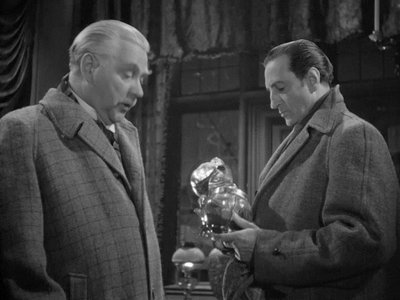
Over the course of their fourteen Sherlock Holmes films between 1939 and 1946, Basil Rathbone and Nigel Bruce would work with three different Moriartys – and the actors would all appear in other roles in the franchise. The first was George Zucco in the 1939 film, The Adventures of Sherlock Holmes. According to Alan Barnes, author of Sherlock Holmes on Screen, “The most measured of crazies, [George] Zucco’s Moriarty makes a significant impression, enjoying another standout scene in which he dares the bullied Dawes to let slip a razor while shaving him: ‘You’re a coward, Dawes. If you weren’t a coward you’d have cut my throat long ago…’” (21). Zucco would return to the franchise in the 1943 film, Sherlock Holmes in Washington, not as Moriarty, but as the less memorable villain, Heinrich Hinkel, a Nazi spy. He left his indelible mark on the character, however, in that many future Moriartys either returned to or borrowed from Zucco’s performance in some way.


Lionel Atwill first appeared in the Rathbone-Bruce films as Dr. James Mortimer in the 1939 version of The Hound of the Baskervilles. He would go on to play Professor Moriarty in Sherlock Holmes and the Secret Weapon (1942). According to Atwill in a 1933 interview with Motion Picture magazine, "See, one side of my face is gentle and kind, incapable of anything but love of my fellow man. The other side, the other profile, is cruel and predatory and evil, incapable of anything but the lusts and dark passions. It all depends on which side of my face is turned toward you—or the camera. It all depends on which side faces the moon at the ebb of the tide.” With such personal awareness, perhaps Atwill was the most equipped to capture the dual nature of Moriarty – the academic and the criminal, the genius and the madman.


Finally, Henry Daniell (who had previously appeared in the franchise in Sherlock Holmes and the Voice of Terror (1942) as Sir Alfred Lloyd, and Sherlock Holmes in Washington (1943) as William Easter), starred as Professor Moriarty in The Woman in Green (1945). Daniell’s take on the infamous Napoleon of Crime was Basil Rathbone’s favorite of the fourteen films. “There were other Moriartys,” Rathbone wrote in his autobiography In and Out of Character, “but none so delectably dangerous.” It is, of course, Daniell’s iconic scene in The Woman in Green, where Moriarty ominously ascends the staircase to meet Sherlock Holmes, which was borrowed for the 2012 episode of BBC’s Sherlock, “The Reichenbach Fall.”


Sherlock Holmes – A Game of Shadows: Professor James Moriarty (Jared Harris)
The Moriarty of the Guy Ritchie films began – appropriately enough – in shadow, never actually appearing on screen in the first film, Sherlock Holmes (2009). The Professor kept to dark corners, with only a glove or hat brim visible. Voiced by Ed Tolputt, the shadowy figure wasn’t even explicitly identified as Moriarty until the end of the movie.


However for the 2011 film, Sherlock Holmes: A Game of Shadows, Jared Harris was cast as Moriarty (ultimately going on to dub over Tolputt’s dialogue in the first film) and a new adaptation came into full form. Harris’s Moriarty is shades of George Zucco’s interpretation in terms of malevolence and single-minded ruthlessness. And he is, without question, Holmes’s equal in terms of intelligence. “Come now,” he says to Sherlock Holmes. “You really think you're the only one who can play this game?” Contrary to other interpretations, Harris’s Moriarty is set on a global domination that previous incarnations had not been – at least not to the scale seen in the film. World war – that’s his goal – and he’s not all that particular about how it comes to pass. As he says, “You see, hidden within the unconscious, there is an insatiable desire for conflict. So, you're not fighting me, so much as you are the human condition. All I want to do is own the bullets and the bandages.”

In his approach to the character of Professor Moriarty, Harris said: “I didn’t want to do the bad-guy monologue, and I didn’t want to say anything unless there was a really good reason for it...I think that [Moriarty] doesn’t have that morality chip that other people have. He just looks at things and says, ‘If I can do it and it can be done, then why not?’”


BBC’s Sherlock: Jim Moriarty (Andrew Scott)
The BBC’s recent Sherlock Christmas special, “The Abominable Bride,” inspired a lot of conversation, but it also inspired this post. I’ve always had an affinity for Andrew Scott’s interpretation of Moriarty, as it is fascinating to watch the subtle (and sometimes not-so-subtle) differences between an actor playing a James Moriarty and not a Jim Moriarty – which is what Andrew Scott is doing. Scott’s Moriarty is malevolent and villainous, which are features that should be considered fairly standard for the character. He’s also intelligent in the same way that a boiling pot is considered hot. He’s intelligent until something upsets the balance and tips him over into frenetic insanity. After all, he once famously proclaimed that he would turn a contact into shoes if they disappointed him. And therein is the difference between a James Moriarty and a Jim Moriarty, between a Professor Moriarty and a Mr. Moriarty.


Transplanting Andrew Scott’s Moriarty into the 19th century no more transforms him into Professor Moriarty than putting him a waistcoat. Nevertheless, there are still some similarities. After all, Scott’s Moriarty says to Holmes, “Shall we go over together? It has to be together, doesn't it? At the end it's always just you and me!” The bit of dialogue is somewhat reminiscent of George Zucco’s Moriarty, who once commented, “Always Holmes until the end.” It’s a sentiment that is perhaps the thesis statement for the pair’s entire relationship.


Elementary: Jamie Moriarty (Natalie Dormer)
Says Joan Watson, "There is no Irene. There is only Moriarty, and Moriarty is never going to change.” Jamie Moriarty began on CBS’s Elementary as Irene Adler, a former lover of Sherlock Holmes’s thought brutally murdered. She reappears – very much alive – in the first season episode, “Risk Management,” and Holmes believes that she has been Moriarty’s prisoner.


She was, of course, no such thing. Irene Adler was merely a cover for Jamie Moriarty – a criminal mastermind. Like other Moriartys before her, she is ruthless, coolly calculating, and possessed of a brilliant intellect. As she tells Sherlock Holmes, “My first instinct was to kill you. Quietly. Discreetly. But then, the more I learned about you, the more curious I became. Here, at last, seemed to be a mind that... that rivaled my own, something too complicated and too beautiful to destroy... at least without further analysis.”

However, as I’ve commented briefly elsewhere, what sets Dormer’s Moriarty apart is not her gender, but her triumphs. Jamie Moriarty succeeded where other Moriartys (and Adlers) had not – in actually, genuinely deceiving Sherlock Holmes. He is so thrown by her deception and the revelation of her true character that Watson is concerned that Holmes may relapse into his old drug habits.

Dormer had hinted at the dual nature of her character in a May 2013 interview: “The cool thing about Irene Adler is you don’t really know who she is or where she comes from… If you look into the novels or the incarnations of her — she’s a bit of a con woman, a bit of a wily one herself, so she has an accent, but you can’t quite place it, so I [thought], if I can do some kind of general American accent that is like, ‘What is that? Where is she from?’”


Moriarty has many faces – young and old, male and female, some a little more intelligent than others, some a little more unhinged than others. Nevertheless, if all roads lead to Baker Street, all incarnations still lead to Moriarty. For Sherlock Holmes, at the end it’s always Moriarty. Always Moriarty, until the end.


Sources:
  • Barnes, Alan. Sherlock Holmes on Screen: The Complete Film and TV History. London: Titan Books, 2011. Print.
  • Cox, Michael. A Study in Celluloid: A Producer’s Account of Jeremy Brett as Sherlock Holmes. Indianapolis: Gasogene Books, 2011. Print.
  • Gettell, Oliver. “‘Sherlock Holmes’: Jared Harris pulls Moriarty out of the shadows.” Los Angeles Times. Dec. 2011. n. pag. Web. 24 January 2013.
  • Lash, Jolie. “Natalie Dormer Talks Irene Adler ‘Elementary’ Guest Arc, Play Margaery in ‘Game of Thrones.” Access Hollywood, 16 May 2013. Web. 19 Feb. 2014.

Saturday, January 23, 2016

Sherlock Holmes on Screen: Mr. Holmes (2015)

The Distinguished Speaker Lecture during the most recent Baker Street Irregulars (BSI) Weekend in New York City featured Jeffrey Hatcher, the screenwriter for the 2015 film “Mr. Holmes.” Hatcher was erudite and funny, witty and insightful. On the other hand, I committed an egregious error – I forgot to bring my notebook. For those who know me well, this is akin to my walking into the Midtown Executive Club without trousers. The lapse in my memory caused by the flurry of new activity and unfamiliar surroundings, perhaps? Nevertheless, the lecture was one of the most enriching experiences of the weekend, and I managed to survive without notebook and pen. Somehow. I occasionally feel a little twitchy about it.

“Mr. Holmes,” which starred Sir Ian McKellen in the title role was based on the 2005 novel A Slight Trick of the Mind by Mitch Cullin. Featuring an elderly Sherlock Holmes beekeeping in Sussex Downs, the Detective struggles with the increasingly undeniable deterioration of his mental faculties. In a recent interview with “I Hear of Sherlock Everywhere,” Cullin said:

The novel was my way of dealing with my father's health issues as his sharp mind started to unravel. It's a literary novel, really, and a highly metaphorical yet personal one at that, touching on my own grappling with the definitive ending of my childhood.

It's also a book about lost father figures, and a tribute to the late John Bennett Shaw who had been another great benign father figure to me as a boy. I was saying goodbye to a lot of things and a lot of people with that book, and that was the function it served for me.

The 2015 film adaptation deals with many of the same themes. In the same way that Cullin’s novel was not a Sherlock Holmes novel, “Mr. Holmes” is not a Sherlock Holmes movie. It is a movie about Sherlock Holmes. Audiences looking for the explosive antics of the 2009 and 2011 Robert Downey, Jr. movies, or any of the modern adaptations, will be disappointed. There are no over-the-top murders disguised as satanic rituals. There are no complex criminal machinations or tightly wound villains. There is just an old man and his bees. His housekeeper and her young son. His memories, which fade in and out. And time, which keeps passing.  

In his lecture, Hatcher revealed that while Sir Ian had always been a top contender for the title role, he had not been the only candidate. Hatcher also gave the script to Ralph Fiennes, who declined the part upon reading it. He felt that the character would require “too much makeup,” which Hatcher had found ironic considering that Fiennes had no nose in his role has Lord Voldemort in the Harry Potter films. On the other hand, the film’s makeup team had conceded that it would a simple job to transform Sir Ian (in his mid-seventies at the time) into the 93-year-old Great Detective, but they would not be able to turn him into the 50-year-old Holmes featured in the flashback portions of Cullin’s original novel. The best the team could do was a 60-year-old man, and so Hatcher agreed to accommodate the change.

Sir Ian does dapper pretty darn well.

Indeed, much as changed for the Great Detective at the opening of “Mr. Holmes.” There is no more 221B Baker Street, and there is no Mrs. Hudson. Holmes now lives in a country cottage and is tended to by a middle-aged war widow named Mrs. Munro (played by Laura Linney) and enjoys an increasingly amicable relationship with her young son, Roger (played by Milo Parker). Mrs. Munro is both very much like Mrs. Hudson, and also nothing like her at all. Much like Mrs. Hudson, Mrs. Munro finds Holmes frustrating and uncooperative, but much of his behavior could be explained as a product of the man’s age. It would more surprising to find a 93-year-old without any eccentricities (unlike Mrs. Hudson who was hard-pressed to find reasonable explanations for her reasonably-aged tenant’s outrageous behavior). And unlike Mrs. Hudson, Mrs. Munro has less to gain from her relationship with Holmes, and as the audience soon learns – much, much more to lose.

More importantly, there is also no Watson. The best the audience gets is a glance at a distance from a window, and a shot of the Doctor’s back as he cares for Holmes when the Detective reflects on his memories. Watson’s loss is felt early in the film, when Holmes is in need of medical care and a village practitioner arrives to attend to him. Holmes is clearly familiar with the man, and even acquiesces to the man’s suggestions as to how to assess the Detective’s increasingly faulty memory. Familiarity is not closeness, however, and this loss is only enhanced when Holmes reveals later that Watson is long dead and worse yet – that the two had been estranged at the time of Watson’s death. They never said goodbye. Holmes has also suffered the losses of Mrs. Hudson and his brother, Mycroft. Their absences are painful and undeniable, and Holmes does his best to avoid them.

There is Roger, of course – Mrs. Munro’s young son. Roger’s father died in the Second World War and he has little memory of him. He can’t distinguish between the stories his mother told him and his actual memories – which is only one of many ways in which he relates to Holmes. He is fascinated by Holmes, and assists him whenever he can and whenever he is allowed. There is a childish charm in the way that he tries to emulate Holmes, and an understanding in the way that he can’t quite achieve it. For example, Roger mixes some of Holmes’s prickly ash extract into his porridge, proudly eating it in front of his mother – only to spit it out the moment he is out the door. Reminiscent, perhaps, of:  “It may be that you are not yourself luminous, but you are a conductor of light.” (HOUN)

“Mr. Holmes” is the self-indulgent character study that Sherlockians have always wanted, but never thought they would get. It is a truly intimate picture. An introspective look into the foibles and failings of the Great Detective is not something one expects to see on the big screen, much less with a major distribution. While not a Sherlock Holmes film in the traditional sense, “Mr. Holmes” was a gift to Sherlockians nonetheless. The film makes us think about the Master Detective, to spend time contemplating his most human characteristics. What makes him ordinary, and not extraordinary.

oOo


A Curious Collection of Dates: Through the Year with Sherlock Holmes, written by myself and Leah Guinn of The Well-Read Sherlockian is now available for purchase through Wessex Press. 


Sunday, June 21, 2015

“A Man of an Honourable Stock” (SHOS): Sir Christopher Lee

For those of you who have been following this blog for a long time (And have I thanked you for sticking with me? Thank you for sticking with me.), you know that I am not usually given to memorial tributes. This is primarily because I have always found it beyond my meager skills to encapsulate the whole of one person’s life – all its wonders and accomplishments – with just a few words. I have always worried that whatever I wrote would come across as, at best, inadequate, and, at worst, completely disingenuous.

However, on the morning of June 11 when I learned of Sir Christopher Lee’s death (Lee actually passed away earlier on June 7, with the knowledge only becoming public on June 11), I immediately went to share the news with my fellow “geek” colleague – a co-worker with whom I share some mutual interests and with whom I had commiserated over Leonard Nimoy’s death earlier this year. After a few moments of some subdued sadness, my co-worker admitted that, beyond the Lord of the Rings series, she knew little of Lee’s career. “Is that terrible?” she asked.

I didn’t answer at first. Of course, it wasn’t terrible. There’s nothing terrible about not having an investment in a particular actor’s filmography. However, I wanted to tell her about my Christopher Lee.

Christopher Lee with his friends Vincent Price and Peter Cushing

“A Man of Some Substance” (LION)

My Christopher Lee was Dracula. And in his embodiment of the iconic vampire, he was perhaps only second to one other actor. He was as synonymous with the role as Basil Rathbone with Sherlock Holmes, or Nigel Bruce with Dr. Watson. Although his Dracula films would sometimes take ridiculous turns (Dracula A.D. 1972, anyone?), the role would still cast a villainous pall over his career and indeed, my Christopher Lee was also the Mummy, Frankenstein’s monster, and Fu Manchu.

“A Man of Remarkable Appearance” (BLAC)

My Christopher Lee was even Count Dooku (or Darth Tyranus, if you are so inclined), unfortunately, in Star Wars: Attack of the Clones and Star Wars: The Revenge of the Sith. Typically an anathema to true Star Wars fans, the films are worth remembering, if only as a testament to Lee’s villainous character acting.

“A Man of Iron Nerve” (EMPT)

My Christopher Lee was also Francisco Scaramanga in the 1974 film, The Man with the Golden Gun, opposite Roger Moore’s sometimes ludicrous turn as James Bond. Lee was a relative of Bond creator Ian Fleming, and rather perfectly cast as the erudite assassin. Despite the fact that Fleming had originally wanted Lee for Dr. No, he was nonetheless able to channel all his leanness, elegance and his unique razor-sharp keenness to embody Scaramanga.

“A Grave and Taciturn Gentleman of Iron-gray Aspect” (BLAN)

My Christopher Lee was DEATH, voicing the late Sir Terry Pratchett’s (who also passed away earlier this year) characterization in several dramatizations, including The Color of Magic (2008). Tapping into the famous depth and timbre of his voice, his performance was equal turns unlimited cosmic power and affable approachability, just as Pratchett wrote him.

“A Man of Dreams” (GOLD)

And of course my Christopher Lee was Saruman the White in Peter Jackson’s Lord of the Rings series, a masterpiece of film. How could he not be? In addition to providing a vehicle for Lee’s unsurpassed ability to portray malevolence and subtle deviousness, it also gave rise to what might be one of my favorite Christopher Lee anecdotes. Peter Jackson was preparing to shoot a scene in which Saruman is stabbed in the back. Jackson provided Lee with a long, detailed explanation of how he wanted the scene to go. To which Lee replied, “Have you any idea what kind of noise happens when somebody’s stabbed in the back? Because I do.”

“A Man of Energy and Character” (MISS)

But perhaps, more than anything, my Christopher Lee was Sir Henry Baskerville in the 1959 Hammer Film adaptation of The Hound of the Baskervilles, starring opposite Lee's dear friend Peter Cushing as Sherlock Holmes. As the terrorized Sir Henry, Lee had to call upon no acting skills at all to show real fear:

Now there is one thing I’m really scared of…spiders. In particular these ghastly bird-eating spiders from South America, with big, huge hairy legs as thick as my fingers. I hate these things, and there was a sequence in the film in which one of spiders comes out of a boot. I refused to let them place it on my neck, but I did have it on one of my shoulders and I was in such a state that I virtually went green, and sweat poured off my face. Everybody said what a brilliant performance I gave. All I can say was that it wasn’t acting at all. I was nearly sick with nausea and fear.

And my Christopher Lee was Mycroft Holmes in the 1970 film The Private Life of Sherlock Holmes, starring opposite Robert Stephens as Sherlock Holmes and Colin Blakely as Dr. John Watson. Lee was perhaps one of the more sinister and uncanonically lean Mycrofts on record. Until Mark Gatiss’s Mycroft in the BBC’s Sherlock, that is. Gatiss has admitted to using Lee’s interpretation of the elder Holmes brother as the template for his own, calling him “cold” and “disdainful.”

And my Christopher Lee was Sherlock Holmes. First in the 1962 German film, Sherlock Holmes and the Deadly Necklace, in which Lee’s performance was inexplicably dubbed over. And then later in Sherlock Holmes and the Leading Lady (1991) and Sherlock Holmes and the Incident at Victoria Falls (1992), in which Lee plays a somewhat older, retired Great Detective. Of his performance as Sherlock Holmes, Lee said:

My portrayal of Holmes is, I think, one of the best things I’ve ever done because I tried to play him really as he was written – as a very intolerant, argumentative, difficult man – and I looked extraordinarily like him with the make-up on…Everyone who’s seen it said I was as like Holmes as any actor they’ve ever seen – both in appearance and interpretation.


“A Man of Deep Character, a Man with an Alert Mind, Grim, Ascetic, Self-Contained, Formidable” (MISS)

I wanted to say all these things. I wanted to share my experience of Christopher Lee and who my Christopher Lee was. But he also wasn’t my Christopher Lee, no matter how many times I say it. He wasn’t mine, because he belonged to everyone. He was everyone’s Christopher Lee. And he was also no one’s. For how can a person such as Christopher Lee belong to anyone but himself?

But I didn’t tell say any of those things, of course. Who could? Instead, I simply said, “I know Christopher Lee from a lot of things.”

Saturday, April 6, 2013

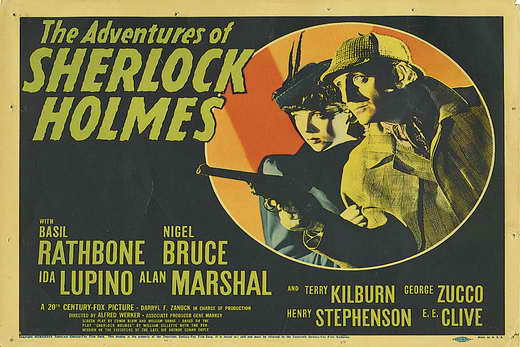
Sherlock Holmes on Screen: “The Adventures of Sherlock Holmes” (1939)

Professor Moriarty: “My whole success depends upon a peculiarity of Holmes’s brain, its perpetual restlessness, its constant struggle to escape boredom.

Bassick: “Holmes again?”

Professor Moriarty: “Always Holmes until the end.”

The man is a music hall singer – a vaudeville performer in a gaudy jacket, adorned with large stripes in an array of undoubtedly ostentatious colors. A straw boater with a large brim, adorned with a ribbon that coordinates with his jacket, is clutched between his gloved hands, and he uses it in a variety of theatrical flourishes during his performance. He sports a handlebar mustache – complete with extravagantly curled, upturned ends – and slickly-styled hair with a pronounced side-part and subtle fingerwave along the brow. He prances energetically about the stage at a garden party, clicking his heels and leaping at appropriate intervals, as he sings a rather nasally-pitched version of the popular British music hall song, “I Do Like to Be Beside the Seaside.” The singer trills and trumpets, and drums upon his boater when the moment calls for it. As a performer, he is utterly outlandish, wildly outrageous, and completely entertaining. He is also Sherlock Holmes – sporting one of his best disguises in his long career on film.

Photo Credit: www.basilrathbone.net
However, the song itself, “I Do Like to Be Beside the Seaside,” is an anachronism. Opening credits date the plot of the film as opening on May 9, 1894, but the song Sherlock Holmes so energetically performs was not written by John A. Glover-Kind until 1907, and was not popularized by the music hall performer Mark Sheridan until 1909. Likewise the 1939 film, The Adventures of Sherlock Holmes, starring Basil Rathbone as Sherlock Holmes and Nigel Bruce as Dr. John Watson, is filled with moments that, while not necessarily anachronistic, certainly seem out of place or inconsistent. The film opens with Professor Moriarty on trial for the murder of a man named “Lorait,” but he is ultimately acquitted, much to the courtroom’s dismay. Moments later, Sherlock Holmes races into the courtroom, proclaiming that he has found incontrovertible evidence of Moriarty’s guilt. He is trailed closely by a man who never speaks a word, and is never introduced. According to Alan Barnes of Sherlock Holmes on Screen, the man was supposedly chief astronomer Dr. Gates (played by Ivan Simpson), who was meant to provide the evidence about which Holmes was so adamant. However it appears that the explanation, along with many other contextual scenes, was cut from the picture (20). According to Barnes:

“The first of three possible endings has Holmes explaining how the vengeful Mateo believed that Ann’s father had been responsible for the death of his own, and had stolen the mine that had made the Brandons rich; meanwhile, Brandon family lawyer Jerrold’s shifty behaviour had been caused by his desire to shield Ann from the truth about her dead father. None of this crucial background information is conveyed in the finished piece” (21).

There are other contextual anomalies in The Adventures of Sherlock Holmes. Dr. Watson is inexplicably antagonistic toward the young page, Billy (Terry Kilburn – who, for some reason, receives top billing over George Zucco, the actor portraying Professor Moriarty), beginning by mocking the frilly, feminine apron that Mrs. Hudson has forced the boy to wear while doing chores. When Holmes good-naturedly points out the deficiencies in the boy’s housework (that Billy has swept the dust under the rug, rather than into the dustbin), the Doctor gives him an intimidating, unforgiving stare, while Billy stares back defensively. Watson is then positively hostile when Billy is able to provide a bit of opportune insight into a piece of evidence: “I’ve listened to seashells that made better sense.” The hostility isn’t solely confined to the Doctor, however. Sherlock Holmes behaves in an equally unfriendly fashion towards Watson, at one point calling him “an incorrigible bungler.” The Detective frequently interrupts his companion’s sentences, often providing his own piercing expression. At one point, Watson says, “You pushed me out of the room as if I were a child. What am I to make of this, Holmes?” And the audience may find themselves wondering the same thing. What are we to make of this?

 
But that doesn’t mean that the film is without its highlights. For every discordant note in the film, there is a harmonious one. The Adventures of Sherlock Holmes was the second of the fourteen Sherlock Holmes films made by the Rathbone-Bruce team. It was also the first film it which Rathbone and Bruce received top billing. For their first film, The Hound of the Baskervilles (also in 1939), Rathbone and Bruce were given second billing to their co-star, Richard Greene, who portrayed Sir Henry Baskerville. The Adventures of Sherlock Holmes was also the last film in the series made by 20th Century Fox, as afterwards the franchise would be acquired and produced by Universal Studios. It was also the last “period” film from the franchise; afterwards, a series of three Sherlock Holmes films set in World War II-era Britain, Europe, and the United States, were made, and followed nine contemporary films in non-wartime settings (sometimes embellished with gothic, not but strictly period, elements).

The Adventures of Sherlock Holmes features George Zucco in the role of Professor James Moriarty (the 1942 film, Sherlock Holmes and the Secret Weapon would feature Lionel Atwill in the role). Zucco’s Moriarty is sedately evil, with undercurrents of roiling menace. He is not a villain that chases after his victims; he waits for them to come to him – as they inevitably do. According to Alan Barnes, “The most measured of crazies, [George] Zucco’s Moriarty makes a significant impression, enjoying another standout scene in which he dares the bullied Dawes to let slip a razor while shaving him: ‘You’re a coward, Dawes. If you weren’t a coward you’d have cut my throat long ago…’” (21).

 
The film also contains an iconic scene. Watson arrives at Baker Street to find Sherlock Holmes in the sitting room, playing scales on his violin to a glass of trapped houseflies. He tells Watson that he is “observing the reaction of the common housefly on the chromatic scale,” and that once he is successful, homeowners will only need to play the correct note to rid the house of flies. The scene is replicated in the 2009 film Sherlock Holmes with Robert Downey, Jr., as Sherlock Holmes and Jude Law as Dr. Watson. Of course, Law’s Watson ultimately releases the carefully trapped flies as recompense for all the trouble his flatmate inflicts upon him. In another interesting contrast, George Zucco’s Moriarty is an avid horticulturist – even making murderous threats at his butler for failing to water one of his plants – while Guy Ritchie’s Professor Moriarty’s (played by Jared Harris in the 2011 film, Sherlock Holmes: A Game of Shadows) inattention to his box of flowers is a critical part of Moriarty’s downfall.

 
The Adventures of Sherlock Holmes was supposedly based on the play by William Gillette, although little – if anything – of the original plot was carried over for the film. Instead the audience is treated to a series of notable scenes, often irreverent, but not without purpose. After all, what could be more memorable than Dr. Watson laying in an empty street – playing at a dead body for Sherlock Holmes’s investigation – and snidely calling a well-meaning, if persistently inquiring stranger a “Stupid fellow”? Anachronisms, contextual problems, and incomplete plotlines aside – much of Sherlock Holmes’s film legacy is owed to the Rathbone-Bruce films, and to The Adventures of Sherlock Holmes in particular. The film’s moments are renowned, and transcend whatever small clumsiness may assert itself, leaping easily into the twenty-first century.  
 
oOo

Sources:


“Better Holmes & Gardens” has its own Facebook page.  Join by “Liking” the page here, and receive all the latest updates, news, and Sherlockian tidbits.

Tuesday, January 1, 2013

Sherlock Holmes on Screen: “The Crucifer of Blood” (1991)

“It would seem that [Paul] Giovanni had fun with the characters’ names, dragging them in from other Doyle stories. Major Ross borrows his name from the Colonel in ‘Silver Blaze’; Birdy Edwards, the butler at Pondicherry Lodge, appears in The Valley of Fear, Neville St Clair is really ‘The Man with the Twisted Lip’; and his daughter is named Irene which, especially because of her apparently amorous nature, has resonances with Irene Adler – ‘The Woman’.” (David Stuart Davies)

The Crucifer of Blood originated as a stage play by Paul Giovanni – opening on Broadway in 1978 and running for 236 performances. The original cast included Paxton Whitehead as Sherlock Holmes, Timothy Landfield as Dr. John Watson, and Glenn Close as Irene St. Claire. The play would also appear in London at the Theatre Royal Haymarket in in 1979, where it ran for 397 performances, with Keith Michell as Sherlock Holmes and Denis Lill as Dr. John Watson. Perhaps most famously, however, was the Los Angeles production, which premiered at the Ahmanson Theatre in 1980. The cast included Charlton Heston as Sherlock Holmes, and Jeremy Brett as Dr. John Watson. Though Brett would famously go on to play Sherlock Holmes for the Granada Television series (and become one of only a handful of actors who could boast having played both Sherlock Holmes and Dr. Watson), he said of playing Dr. Watson:


“In some ways Watson is stronger than Holmes. That comes through his kindness, I suppose. He sees Holmes' weaknesses and tries to protect him from them. Look how Watson rants at him about cocaine. Watson is always on the lookout in order to save his friend from pain, indignity or destruction… Watson is much more my kind of person. Watson is a warm, loving, sunny person who's very enthusiastic – and hurt and slightly upset when his friend is rude to people or him. This is much more like me.”

In 1991, The Crucifer of Blood was brought to the small screen with Charlton Heston again in the leading role as Sherlock Holmes, but this time featuring Richard Johnson as Dr. John Watson. Notably, the film also features Heston’s son, Fraser, in his first directing role. The film was first broadcast on the cable network TNT on November 4, 1991. With a plotline based largely upon The Sign of Four, the film opens with an extended sequence taking place during the Siege of Agra in 1857. The production’s stage origins are almost immediately apparent in the close, confined sets and painted backdrops. The sequence echoes the story that Jonathan Small tells in chapter twelve of SIGN (“The Strange Story of Jonathan Small”), even if it is not an exact parallel. Most notably, the characters of Major Sholto and Captain Morstan have been replaced instead by Major Alistair Ross and Captain Neville St. Claire (perhaps, as was mentioned earlier, in homage to some of Sir Arthur Conan Doyle’s other Sherlock Holmes stories). The scene is often laborious and frontloads the film, taking the viewer away from the very brief glimpse of Baker Street that they have had thus far – in which Dr. Watson narrates briefly in a black and white cutaway of Heston’s Sherlock Holmes playing the violin.


Thirty years later, Captain St. Clair’s daughter Irene (pronounced “Eye – reen – ee,” in this instance for those who are interested) arrives at 221B Baker Street, seeking the help of Holmes and Watson. Miss St. Clair is played by Susannah Harker, who would later appear in Granada Television’s 1994 adaptation of “The Dying Detective,” as Adelaide Savage, the wife of the unfortunate Victor Savage. Irene arrives just after Holmes has famously deduced the identity and characteristics of Dr. Watson’s unfortunate older brother by using the late man’s pocket watch, another scene famously lifted from SIGN, with Watson’s angry indignation intact. She has also missed Watson offering Holmes the newly arrived post, and Holmes telling him that, “[Watson] know[s] where it goes” – as if waiting for an audience response of “on the mantle, under the jackknife.” It is only one of many canonical allusions that come across as forced or stilted throughout the production. (The movie ends with a similarly wooden reference to the “Giant Rat of Sumatra” – and a sea captain collapsing theatrically on the hearthrug.)

Charlton Heston is not entirely unsuccessful in his portrayal of Sherlock Holmes. Undeniably tall, with an elegant bearing, he interacts well with Johnson’s Watson. He is aggressive and uncompromising when appropriate and apparently very motivated. He enjoys the hunt and relishes the thrill of the chase, with all its nuances and clever contrivances. But he isn’t well-spoken, often seeming to mumble, sounding as if he is perpetually speaking around the stem of a pipe, even when he’s not. As Sherlock Holmes Heston is often forgettable, a non-entity, allowing many scenes to be commandeered by co-stars, fading into the background, pipe between his lips and deerstalker on his head. According to David Stuart Davies, author of Starring Sherlock Holmes: A Century of the Master Detective on Screen, “The star’s best moment, oddly enough, comes not when he’s playing Holmes as Holmes, but when he plays Holmes in the guise of an ancient Chinese proprietor of a Soho opium den. Stereotypical though it is, it’s one of the best Holmes-in-disguise sequences ever committed to film” (156).


At the time of filming, Richard Johnson was 64-years-old (comparatively, Jeremy Brett, when he portrayed Dr. Watson in the 1980 stage play, was only 47-years-old). The somewhat advancing age of Johnson’s Watson rather changes some of the dynamics in the film. Nowhere else is this more obvious than when a drugged Irene both confuses Dr. Watson for her aging father, and then confesses to her “father” that she is falling in love with the Doctor. And then they kiss, passionately. It turns the stomach a little. Like the Sherlock Holmes and Dr. Watson of Murder by Decree – where the distinct age difference between Christopher Plummer’s Holmes and James Mason’s Watson generated a more paternal relationship between the two men than a fraternal one – the advancing ages of Heston’s Sherlock Holmes and Johnson’s Dr. Watson change many of the interactions in this film version of The Crucifer of Blood, not always for the better (or even indifferently). The romantic subplot of the story, so obviously meant to correspond with the courtship of Dr. Watson and Mary Morstan from SIGN, actually comes across as a bit unsettling, even creepy.

The Crucifer of Blood ends on a strange note – perhaps in keeping the tone of the film – with Irene transforming from mistreated ingénue to aggressive siren (complete with low-cut, red dress), Watson fainting dead away (presumably from the absurdity of it all), and Sherlock Holmes disgracefully begging for Watson to remain at Baker Street (once the Doctor regains consciousness and his indignation). A film adaptation allows a story to become available to a wider audience when it was once only accessible to a small one. However, there is something lost in adapting this particular play for the small screen. A presentation that was perhaps elegant and theatrical on stage becomes claustrophobic and outlandish on television. Without access to the original stage production, a Sherlock Holmes completionist could do worse than to add this particular film to their collection, with the awareness that the spirit of the production was willing, even if the flesh of it was weak.

oOo

Sources:

“Better Holmes & Gardens” now has its own Facebook page.  Join by “Liking” the page here, and receive all the latest updates, news, and Sherlockian tidbits.

Sunday, July 29, 2012

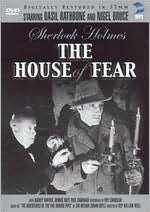
Sherlock Holmes on Screen: “The House of Fear” (1945)

“Viewed today however, one is inescapably reminded of a ‘reality TV’ format: seven diverse housemates are nominated one-by-one for permanent eviction until just one is left to scoop a prize of exactly £100,000. So if The House of Fear fails as both a Sherlock Holmes film and a properly satisfying murder-mystery, its premise is at least enduring.” (Alan Barnes, 92)

Occasionally, I think that Nigel Bruce gets a bad rap. Once in a great while, his performance as Dr. John Watson touches a soft place in my heart. I find myself susceptible to moments like his rendition of “Loch Lomond” in Pursuit to Algiers (and from the same film, his recounting of a recent adventure with Sherlock Holmes using a celery stalk as the Detective and a hunk of cheese as himself); or his utterly crestfallen expression in The Adventures of Sherlock Holmes when the Detective snappishly refers to his companion as “an incorrigible bungler” (though he is soothed by a gentle pat on the shoulder). For all his foolishness and sometimes blatant stupidity, there is warmth and openness in Bruce’s interpretation, with a certain guilelessness that goes a long way towards explaining how he has managed Holmes’s peculiarities for so long – perhaps it is simply because he sees no malice in the Detective’s actions, no animosity, and cannot bring himself to harbor any resentment or bitterness towards his friend.

But in the 1945 film, The House of Fear, such moments of softness and affectation are notably absent. Despite one rather astute and crucial observation, and one poignant moment between the two friends at the conclusion of the film (Holmes does seem rather touchingly grateful for his friend’s survival), Bruce’s Watson is at his vaudevillian worst. It’s hard to find any redemptive qualities in a scene in which Watson – unearthing a grave while Holmes stands about smoking a pipe – finds himself embroiled in an Abbott and Costello-style argument with an owl. Holmes’s comment of “Having a nice little chat, Watson?” is the only one of his many needle-like barbs throughout the film that is utterly deserved. According to Alan Barnes:

“Despite furnishing Holmes with the one last vital piece of evidence, Nigel Bruce’s Watson does not fare well, being a source of irritation to the detective (Holmes loudly informs the entire household that Watson snores ‘like a pig’) and the butt of a semi-jokey five minute sequence in which, guarding downstairs on his own, he flaps hither and thither while attempting to track down the source of a number of strange noises. (He shoots a suit of armour and a cat before asserting, ‘They’ve got me completely surrounded!’)” (94).
To be fair, Rathbone’s Holmes does not come across at his very best in this film either. As Barnes points out, the Detective makes a rather pointed, public and personal joke at the Doctor’s expense: “You snored like a pig!” Later, Watson is attacked in the sitting room while Holmes investigates upstairs. Watson screams rather ardently for his friend, to which Holmes responds by descending the stairs at a pace that could best be described as a “saunter,” or perhaps a leisurely stroll. There is no urgency in his manner, while Watson, for all appearances, has just escaped a brutal death. Holmes’s most animated moment comes only when his own life is in danger – as well as the Doctor’s – at the hands of a falling boulder.

However, Basil Rathbone might have been as much to blame as the film’s screenwriters for the Detective’s apathetic characterization in this film. According to David Stuart Davies: “It was becoming noticeable that Rathbone was beginning to tire of the role of Sherlock Holmes. After nine features and numerous radio broadcasts, the character was so familiar to him that he felt there was nothing fresh he could bring to the part. The reviewer in the New York Times called his performance in this movie ‘as pedestrian as a cop on patrol’” (59). There is a tiredness to Rathbone’s performance in this picture, as if he is trying to summon energy and enthusiasm for the role that he simply does not have. In response, Bruce’s Watson and Dennis Hoey’s Inspector Lestrade (inexplicably present in Scotland in his role as a police inspector, despite being rather clearly out of his jurisdiction) appear to move ever further into the role of caricature, seemingly becoming mere parodies of their roles. Lestrade, for example, loudly and brazenly takes credit for the capture of Professor Moriarty.
To its credit, The House of Fear has much going for it in the way of atmosphere – an eerie, gothic manor seated on top of a high cliff in Scotland, a morose and sinister housekeeper who acts as the harbinger of ill-tidings and death, and a strange men’s club shrouded in secrecy and strange ritual. Even the manners in which the “Good Comrades” are murdered demonstrate a distinct variety and creativity. They are gruesome and evocative, summoning an array of horrifying images with the simple phrase: “No man goes whole to his grave.” The House of Fear’s link to the Canon story “The Five Orange Pips” is tenuous at best – the only reference to the source material being the orange pips each Good Comrade receives prior to his death. But the film does manage to invoke the violence of the original story, the grim and sometimes coldhearted nature of humanity.

There are elements of The House of Fear that are reminiscent of the earlier Rathbone/Bruce picture, Sherlock Holmes Faces Death (1943). As Davies says, “…Sherlock Holmes Faces Death brings Holmes back to the world of creepy old houses, wild windy nights and mysterious unsolved murders. The mood is Victorian Gothic but the presence of the Second World War is still in evidence…” (50). Unfortunately, The House of Fear demonstrates little to none of the strength of its earlier counterpart. Perhaps, this is demonstrative of how much of a Sherlock Holmes film’s success is derived from the strength and vitality of the actor in the title role, and how much the film suffers if he finds himself indifferent.

oOo
“Better Holmes & Gardens” now has its own Facebook page. Join by “Liking” the page here, and receive all the latest updates, news, and Sherlockian tidbits.

Sources:
• Barnes, Alan. Sherlock Holmes on Screen. (September 2011).