Showing posts with label SIGN. Show all posts

Thursday, January 8, 2015

“My power to surprise you” (EMPT): On Hiatuses

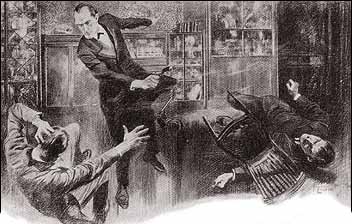
“I moved my head to look at the cabinet behind me. When I turned again, Sherlock Holmes was standing smiling at me across my study table. I rose to my feet, stared at him for some seconds in utter amazement, and then it appears that I must have fainted for the first and the last time in my life. Certainly a gray mist swirled before my eyes, and when it cleared I found my collar-ends undone and the tingling after-taste of brandy upon my lips. Holmes was bending over my chair, his flask in his hand.” (EMPT)
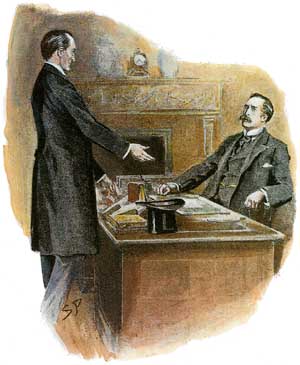

It is sometimes more difficult to return, than to leave.

On May 4, 1891, Sherlock Holmes allowed the world to believe him dead. He abandoned everything and everyone, only permitting his brother to know the truth. Holmes didn’t leave a single clue that he still lived, not even the flimsiest scrap of hope for those who cared most about him – unless one made a habit of looking for subtext in newspaper articles about Norwegian explorers. (Don’t we all?) The Great Detective was silent for nearly three years.
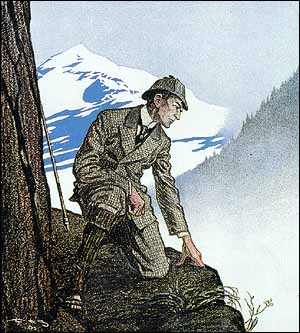

It was a time during which the criminal population of London grew more confident: “It is best that I should not leave the country. Scotland Yard feels lonely without me, and it causes an unhealthy excitement among the criminal classes.” (LADY)

In which Inspector Lestrade managed somewhat passable achievements in police work: “Three undetected murders in one year won’t do, Lestrade. But you handled the Molesey Mystery with less than your usual – that’s to say, you handled it fairly well.” (EMPT)

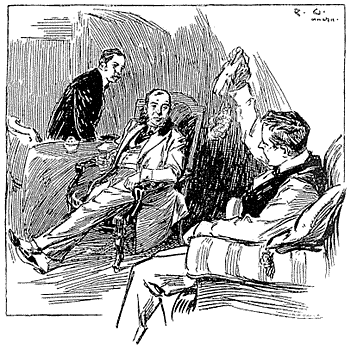
In which Mrs. Hudson kept a strangely untouched room at 221 Baker Street: “…Mycroft had preserved my rooms and my papers exactly as they had always been. So it was, my dear Watson, that at two o’clock to-day I found myself in my old armchair in my own old room, and only wishing that I could have seen my old friend Watson in the other chair which he has so often adorned.” (EMPT)

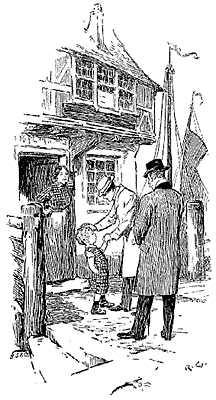
And in which Dr. Watson returned to his medical practice, his personal bereavements, and a quiet, uneventful life: “As we drove away I stole a glance back, and I still seem to see that little group on the step – the two graceful, clinging figures, the half-opened door, the hall-light shining through stained glass, the barometer, and the bright stair-rods. It was soothing to catch even that passing glimpse of a tranquil English home in the midst of the wild, dark business which had absorbed us.” (SIGN)

It can be argued that Sherlock Holmes left under duress, certainly. He left in pursuit of what remained of Professor Moriarty’s criminal empire, dodging boulders heaved at his person by Colonel Sebastian Moran, and the safety of the public at the forefront of his mind. Neither was it three years of rest and relaxation. He may have found ways to occasionally amuse himself, but Sherlock Holmes was rarely at ease during this time, telling Watson:

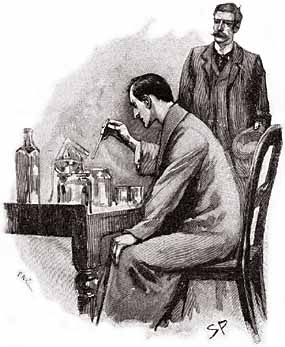
The course of events in London did not run so well as I had hoped, for the trial of the Moriarty gang left two of its most dangerous members, my own most vindictive enemies, at liberty. I travelled for two years in Tibet, therefore, and amused myself by visiting Lhassa, and spending some days with the head lama. You may have read of the remarkable explorations of a Norwegian named Sigerson, but I am sure that it never occurred to you that you were receiving news of your friend. I then passed through Persia, looked in at Mecca, and paid a short but interesting visit to the Khalifa at Khartoum the results of which I have communicated to the Foreign Office. Returning to France, I spent some months in a research into the coal-tar derivatives, which I conducted in a laboratory at Montpellier, in the south of France. Having concluded this to my satisfaction and learning that only one of my enemies was now left in London, I was about to return when my movements were hastened by the news of this very remarkable Park Lane Mystery, which not only appealed to me by its own merits, but which seemed to offer some most peculiar personal opportunities. (EMPT)

So, while it may not have been a consensual parting, the Great Detective left, nonetheless. And without a doubt there is a certain, sharped-edged cruelty to his departure, both for the people he left behind and for Sherlock Holmes himself. Leaving is difficult enough when you want to be found and contacted during your time away, but to disappear completely, without a trace? Well, that’s an extraordinary undertaking.

What’s even more extraordinary, however, is that Sherlock Holmes came back.

You may wonder, what’s so difficult about returning? Wouldn't that be the easiest part? Sherlock Holmes could just slip back into his old life, his old ways, his old work. Even his flat was kept just as he left it. And his friends and associates, once they got over the initial shock and sting of his deception, wouldn't they be grateful to have the Detective back? Wouldn't returning to his old life in London feel positively relaxing compared to the trials of the past three years?

But three years is a very long time, and things change. Mycroft Holmes may have done his best to keep his brother informed, but there was truly no way for the Detective to be certain of what awaited him in London. Perhaps Mrs. Hudson had grown tired of the perpetual silence in her home and the morbid memorial to a man she believed long dead – no matter what princely payments she was receiving for its upkeep? Perhaps Inspectors Lestrade and Gregson had learned to cooperate, and their combined forces meant the dawn of a new age of criminal investigation in London? Perhaps the criminal masses of London had grown tired of a city without Sherlock Holmes and had moved on to greener, more interesting pastures? Worst of all, perhaps Dr. Watson had grown accustomed to his new quiet life – with regular sleep, predictable meals, and no errant bullet holes piercing the walls of his sitting room?

None of these things, of course, proved to be true, but there was always the risk that his life was not as he left it. That there would be no well-worn rut to slip unobtrusively into. That returning to his life would be just as much of a fight as leaving it had been. Returning was just a risky as leaving, and Sherlock Holmes knew it, as he knew most things. But he also knew it was worth it. He knew – or perhaps only hoped – that there was still a place for him in London, and that the world still needed its only consulting detective.

My own hiatus has a name. Her name is Morrigan Maeve, and when she was born this past April, she weighed 7lbs, 5.5oz and was 20 inches long. She is an absolute joy and is completely worth everything. Unequivocally, everything. Like the Great Detective in Tibet, however, I have observed my Sherlockian life from a distance and hoped that there would still be a place for me when I returned. So now I’m back and “I trust that age doth not wither nor custom stale my infinite variety,” and that you all still have faith in “my power to surprise you.”

Now, there is work to do. Let’s get to it.


oOo

“Stand with me here upon the terrace…” (LAST)

For Trevor: You played the game for the game’s own sake. May it be 1895 wherever you are, my friend. 

Saturday, May 4, 2013

Some Thoughts on Setting: The Tranquil
English Home

“As we drove away I stole a glance back, and I still seem to see that little group on the step – the two graceful, clinging figures, the half-opened door, the hall-light shining through stained glass, the barometer, and the bright stair-rods. It was soothing to catch even that passing glimpse of a tranquil English home in the midst of the wild, dark business which had absorbed us.” (SIGN)

221B Baker Street was not a tranquil English home. Life with Sherlock Holmes was not tranquil. The world with Sherlock Holmes in it was not tranquil. An existence punctuated by indoor pistol practice, unpredictable and uncontrollable chemical experiments, and an assorted cast of unsavory characters arriving at irregular hours was not a tranquil one. But there were moments of tranquility. For instance, the conclusion of “The Adventure of the Blue Carbuncle,” in which the reader finds Sherlock Holmes and Dr. Watson enjoying a peaceful, seasonal meal together. The passage in The Sign of Four in which Holmes lulls a tense and exhausted Watson to sleep with his violin. Or even the opening lines of “The Adventure of the Six Napoleons,” in which the reader finds that Inspector Lestrade has acquired the habit of dropping in at Baker Street of an evening, just to chat. But, by and large, the Baker Street flat was a rambunctious residence.

But that doesn’t mean, necessarily, that all other canonical residences were tranquil ones, either. An address off of Baker Street did not guarantee a peaceful life. The eponymous residence of “The Copper Beeches,” for all its efforts at the appearance of normalcy, turned out to be – for Miss Violet Hunter especially – as dark and dangerous a residence as any alley of ill-repute in London. The Trevor residence in Donnithorpe, seen in “The ‘Gloria Scott’”, is certainly more than peaceful enough in the beginning. As Sherlock Holmes said, “…he would be a fastidious man who could not put in a pleasant month there,” but unfortunately the “old-fashioned, widespread, oak-beamed brick” dwelling quickly becomes the site of high drama, when the elder Trevor’s previous transgressions follow him home. And of course, in “The Adventure of the Abbey Grange,” no number of ivy-covered walls or pillared front facades can conceal the dark business that took place inside – the monstrous cruelty of Sir Eustace Brackenstall and his violent end.


Nevertheless, in “The Crooked Man,” Sherlock Holmes arrives at the home of Dr. and Mrs. Watson, seeking sanctuary. The Watsons have only been married a few months, and the hour is late – Watson informs the reader that his wife had already gone to bed – but there is no question that Sherlock Holmes would be welcome, that his hat can fill the vacant peg on the hatstand. So, if a tranquil English home doesn’t necessarily mean “anywhere outside of Baker Street,” then what was Dr. Watson longing after as he gazes back at the Forrester residence in The Sign of Four? Was it necessarily the tranquility? Was it the sense of stability? Was it the woman standing on the doorstep (you know, the one he would eventually marry)? Or was it something else, some more intangible quality, something that perhaps escaped even Watson’s implicit understanding?


It’s worth noting that, in the passage from SIGN, Watson is neither coming from nor returning to the flat at Baker Street. He is coming from Pondicherry Lodge – returning Miss Mary Morstan to the home where she currently resides as a governess – and their evening has been long and dark, punctuated by theft, murder, and the revelation of secrets horrible and long-harbored. After leaving Miss Morstan with the Forresters, Watson does not immediately return to Pondicherry Lodge, but instead embarks on an errand for Sherlock Holmes, and goes to Pinchin Lane. It is an unlovely place. As Watson says, “Pinchin Lane was a row of shabby, two-storied brick houses in the lower quarter of Lambeth. I had to knock for some time at No. 3 before I could make any impression.” He is then subjected to a variety of abuse at the hands of the resident, Mr. Sherman, before mentioning Sherlock Holmes and thus gaining entrance, and Sherman’s deference. The interior of No. 3 Pinchin Lane is no better than the exterior: “In the uncertain, shadowy light I could see dimly that there were glancing, glimmering eyes peeping down at us from every cranny and corner. Even the rafters above our heads were lined by solemn fowls, who lazily shifted their weight from one leg to the other as our voices disturbed their slumbers.”

So, what was Watson really seeing in that passage from SIGN, what were the particular items that drew his eye? The first thing he mentions is Miss Morstan and Mrs. Forrester on the doorstep – “the two graceful, clinging figures.” Mary Morstan didn’t just arrive at the place where she lived; she was welcomed home by Mrs. Forrester: “…it gave me joy to see how tenderly her arm stole round the other’s waist and how motherly was the voice in which she greeted her. She was clearly no mere paid dependant but an honoured friend.” And hasn’t Watson received similarly warm welcomes from Sherlock Holmes? In “The Naval Treaty,” the Doctor is informed, “You come at a crisis, Watson” and “I will be at your service in an instant... You will find tobacco in the Persian slipper.” In “The Adventure of the Empty House,” Holmes tells his friend: “So it was, my dear Watson, that at two o’clock to-day I found myself in my old armchair in my own old room, and only wishing that I could have seen my old friend Watson in the other chair which he has so often adorned.” It’s really very simple. What more can one want from a home than to just to know that you are welcome, and that all the comforts are at your disposal?  


And speaking of those comforts, that is the second thing that draws Watson’s eye in the passage from SIGN: “the half-opened door, the hall-light shining through stained glass, the barometer, and the bright stair-rods.” These items are all meant to be indicators of home – things that are comforting and familiar. So, how are these articles any different that the tobacco in the toe-end of a Persian slipper (or the cigars in the coal-scuttle, for that matter), correspondence eternally fixed under a jack-knife, or the bullet-marks in the wall. In “The Adventure of the Creeping Man,” Watson practically equates himself with these items: “As an institution I was like the violin, the shag tobacco, the old black pipe, the index books, and others perhaps less excusable.” If bullet-marks and jack-knifes are perhaps less graceful than “hall-light shining through stained glass,” does that make them any less effective as objects of comfort? They are still indicators of home, no matter what kind of home that might be.

Perhaps what Dr. Watson was longing for in that passage from SIGN was not necessarily a different type of home. Is it possible that he just wanted to go home – no matter where that home was, or what it might be? It had already been a long night, with the promise of it being even longer, and maybe all he wanted to do was feel welcomed, and surround himself with the items that comforted him (and most likely sleep, of all ridiculous notions). This is, after all, what Watson does for Holmes when the man arrives on his doorstep, on that long dark night in CROO. He welcomes him in, offers him a familiar creature comfort (in the form of his tobacco pouch), and shares his company with a man that knew his habits even better than himself. The tranquil English home might be, after all, not a necessarily a place, but a place of being.  

oOo

“Better Holmes & Gardens” has its own Facebook page.  Join by “Liking” the page here, and receive all the latest updates, news, and Sherlockian tidbits.

Saturday, March 30, 2013

“I should very much like to have a word with Mr. Holmes.” (3GAR): Some Thoughts on the Dichotomy of Sherlock Holmes

"It was 'The Adventures of Sherlock Holmes.' I opened the book with no realization that I stood, or rather sat, on the brink of my fate. I had no inkling, no premonition, that in another minute my life's work, such as it is, would be born... I finished 'The Adventures' that night... As I closed the book, I knew that I had read one of the greatest books ever written. And today I realize with amazement how true and tempered was my twelve-year-old critical sense. For in the mature smugness of my present literary judgment, I still feel unalterably that 'The Adventures' is one of the world's masterworks." (Frederic Dannay)

"The best literary work is that which leaves the reader better for having read it. Now nobody can possibly be the better – in the high sense in which I mean it – for reading Sherlock Holmes, although he may have passed a pleasant hour in doing so. It was not to my mind high work, and no detective work ever can be, apart from the fact that all work dealing with criminal matters is a cheap way of rousing the interest of the reader." (Sir Arthur Conan Doyle)

Sherlock Holmes ruined my life. But he also saved it. Because of Sherlock Holmes, I now know more about the world, the people in it, and myself. Previously a curious and avid student, Sherlock Holmes has made me compulsive about learning to an obsessive degree. I think differently, and more often, but to be fair, I’m usually thinking about a particular subject. And the things I know aren’t always something everyone would find particularly interesting, useful or necessary to everyday life. Some people would call it superfluous knowledge. These aren’t always scholarly or erudite facts, either. But some of them are. Nor has it always been a lofty or cerebral education. But some of it has been. And now as I stand at the precipice of 100 blog posts (well… sit, really, as Frederic Dannay was sitting… I’m sitting at my computer), I’m prepared to admit to the dichotomy. I’m here with hat in hand (not a deerstalker, rather more like a homburg, as we all know) and confess that the Great Detective is both the best and worst thing that ever happened to me.


I’m sure that some of Sherlock Holmes’s canonical clients would say much the same thing. While Holmes might have been able to solve whatever mystery they first approached him with, the explanation may have ultimately exposed something that they would rather the world have not known, something that they would never have willingly revealed to others, or simply something that they would rather have not realized about themselves. In “The ‘Gloria Scott’”, one of Holmes’s very first cases, Victor Trevor undoubtedly felt relief that Holmes was able to explain what happened to his father – the real identity of Hudson and the reason for the shadow he cast over the elder Trevor’s life – and the reason for his father’s fatal reaction to a seemingly innocuous letter. But ultimately Holmes’s explanation revealed uncomfortable facts about his father’s past – things that would be even more unsettling and disturbing now that Victor’s father was no longer alive to discuss them. There may been a solution for Victor Trevor, but there would never be any closure. Likewise Violet de Merville of “The Adventure of the Illustrious Client” probably felt no joy that her fiancĂ©, the villainous Baron Gruner, was unquestionably revealed as an utter blackguard by Sherlock Holmes – but eventually there must have been relief at the disastrous future that she so narrowly avoided.  

And no one was more versed in the disparity of life and human nature than Sherlock Holmes. As he said to Dr. Watson: “I assure you that the most winning woman I ever knew was hanged for poisoning three little children for their insurance-money, and the most repellent man of my acquaintance is a philanthropist who has spent nearly a quarter of a million upon the London poor” (SIGN). But being aware of that disparity doesn’t mean he was always able to correctly assess it. In “The Yellow Face,” the Detective is quite convinced of his own theory: that Mrs. Munro’s first husband is the occupant of the mysterious cottage and he is an unscrupulous blackmailer. The climax of the story reveals both Sherlock Holmes’s failings, and that the occupant of the cottage is Mrs. Munro’s daughter from her first marriage. The Detective had assumed the worst, and Mr. Munro neatly assesses the situation in saying: “I am not a very good man, Effie, but I think that I am a better one than you have given me credit for being.”

The Detective himself is a study in contradictions. Who among Sherlockians doesn’t know that “…although in his methods of thought he was the neatest and most methodical of mankind, and although also he affected a certain quiet primness of dress, he was none the less in his personal habits one of the most untidy men that ever drove a fellow-lodger to distraction” (MUSG)? The actors who have portrayed Sherlock Holmes over the years have usually been rather adept at capturing both sides of the Detective’s personality. Most recently in his turn as the Great Detective, Benedict Cumberbatch sports immaculately tailored suits and coats (and, for some reason, shirts that that appear expensive, if a size too small) – but keeps severed heads and other assorted body parts in the refrigerator. And who can forget the incomparable Jeremy Brett crawling through an ever-growing sea of papers in the Baker Street sitting room – his hair sleeked back into a sharp widow’s peak, his cuffs and collars spotlessly white, his suit somehow inexplicably remaining wrinkle-free despite his exertions?


In addition, Holmes was ever inconsistent when it came to personal relationships. In “A Scandal in Bohemia,” Watson says, “Grit in a sensitive instrument, or a crack in one of his own high-power lenses, would not be more disturbing than a strong emotion in a nature such as his.” And in “The Five Orange Pips,” Holmes pronounces that he has no friends, except for Dr. Watson. All of this proves to be profoundly untrue. During 56 short stories and 4 novels, the reader learns of the Detective’s other friends, such as Victor Trevor (GLOR), a companion from Holmes’s university days. Even more significantly, over the course of the Canon, the Detective’s relationship with Inspector Lestrade evolves and eventually he comes to refer to the Scotland Yard inspector as “Friend Lestrade” (NOBL, CARD, EMPT, NORW, 3GAR). And of course, all readers remember how in “The Adventure of the Three Garridebs,” Watson sees all his “years of humble but single-minded service culminated” in a grand moment of revelation.


As such, I’ve found many Sherlockians to be the same – not inconsistent, but definitely contradictory. I include myself in that lot, of course. We pursue endlessly obscure topics, isolate ourselves during our researches, and hold fast to our theories when we believe ourselves to be right. We wait for our grand moment of revelation, a sign that all of our efforts have not been in vain. But in the end, we seek each other out. And such relationships are unique unto Sherlockiana, and often profound, because as C.S. Lewis said, “Friendship is born at that moment when one person says to another: What! You too? I thought I was the only one.”

I say that Sherlock Holmes is both the best and worst thing that ever happened to me, because he’s revealed the best and worst things about me. Surely my husband, who no longer remembers the color of our carpet, so covered in books it has become, would tell you that the Great Detective has revealed my slightly more compulsive and obsessive tendencies (and for the record, the carpet is grey… no, beige… taupe?). But I have also learned the most spectacular things, met some of the best and wisest people, and my life has been profoundly changed. I’m not the person I was before I met Sherlock Holmes, but I am the person I was meant to be. Such as I am.

oOo

“Better Holmes & Gardens” has its own Facebook page.  Join by “Liking” the page here, and receive all the latest updates, news, and Sherlockian tidbits.

Sunday, January 13, 2013

“At four yards, I could deceive you.” (DYIN): The Art and Necessity of Deception in the Stories of Sherlock Holmes

“The relations between us in those latter days were peculiar. He was a man of habits, narrow and concentrated habits, and I had become one of them. As an institution I was like the violin, the shag tobacco, the old black pipe, the index books, and others perhaps less excusable. When it was a case of active work and a comrade was needed upon whose nerve he could place some reliance, my role was obvious. But apart from this I had uses. I was a whetstone for his mind. I stimulated him. He liked to think aloud in my presence. His remarks could hardly be said to be made to me – many of them would have been as appropriately addressed to his bedstead – but none the less, having formed the habit, it had become in some way helpful that I should register and interject. If I irritated him by a certain methodical slowness in my mentality, that irritation served only to make his own flame-like intuitions and impressions flash up the more vividly and swiftly. Such was my humble role in our alliance.” (“The Creeping Man”)

Most of us, if we’re honest with ourselves, wouldn’t have been able to live with Sherlock Holmes for very long. I’m sure there would always be a stalwart few who would soldier on under any circumstance – convinced that the benefits of living with the Great Detective would far outweigh any “minor” annoyances. But I’m not one of them. When I was in college, I had a roommate that inexplicably began leaving the peanut butter in the refrigerator and the resulting animosity nearly ended our now decades-long friendship. (Sorry Claire, but have you ever tried to spread cold peanut butter? Have you?) So, if I’m clearly that sensitive about my sandwiches, can you imagine how I feel about my personal possessions, my living space, my life? The first time I arrived at Baker Street to find the sitting room filled with papers and noxious chemical fumes, 221B would suddenly be minus one tenant.

Clean. Up. NOW.
But Dr. John Watson was no such person. He seems to find certain behaviors charming when most other people would find them intolerable. He mentions the Detective’s numerous, dangerous chemical experiments off-handedly, merely describing them as “weird” (DYIN) and “malodorous” (SIGN), when others would have expressed more palpable concern. “My flatmate might kill me,” some might have said. Even Holmes’s indoor pistol practice doesn’t seem to bother the Doctor too much: “I have always held, too, that pistol practice should be distinctly an open-air pastime” (MUSG), he says flippantly, when for others this would have been serious cause for renegotiating the terms of the lease. “My flatmate is going to kill me,” would have certainly been a logical deduction. But Dr. Watson certainly seems to take most of Holmes’s eccentricities in stride.

But certainly some eccentricities are more serious than others. It is one thing, for example, to cleverly execute a disguise in the semblance of a wizened, old sailor (SIGN) or elderly woman (MAZA). Watson, after all, is always so amused when Holmes sheds a disguise to reveal himself beneath it. Amused, and often charmingly befuddled. As in The Sign of Four, when the cantankerous sailor in the Baker Street sitting room is replaced with the Detective, Watson says, “Holmes! […] You here! But where is the old man?” Is it a tribute to Sherlock Holmes’s skill in the art of disguise, or to Dr. Watson’s guilelessness that he cannot, at first, conceive that his friend might have played a lighthearted trick on him? On the other hand, Watson does get angry with Holmes, earlier in the same story, when he presents Holmes with a pocket watch and asks him to deduce what he can of the watch’s former owner. Holmes is successful, of course, in divining the existence of Watson’s unfortunate older brother. At first Watson is furious – convinced that Holmes already somehow knew about his sibling and is trying to play him for a fool – but once Holmes reveals precisely how he made his deductions, Watson is contrite: “It is as clear as daylight… I regret the injustice which I did you. I should have had more faith in your marvellous faculty.”

Holmes, quit waving that fake beard at me. I need to figure out where that old man went!
But neither of these ruses is quite on the same level as, say, a long and protracted ploy in which Watson is led to believe that Holmes is dying of a rare tropical illness. Even worse, Holmes does not want Watson to help treat him or even assist him beyond bringing Culverton Smith to Baker Street – a man who isn’t even a doctor (DYIN). A clever disguise can hardly be equated with leaving Watson to his own devices in Dartmoor, where he conducts a supposedly solitary investigation into the “ugly, dangerous business” and unknowingly cavorts with the most sinister of villains – all while Holmes watches on, but does not act, only revealing his presence when he finds Watson sitting in his den (HOUN). Oh, and of course, there was the time that Sherlock Holmes let Dr. Watson, and the world, believe he was dead. For three years. And then shows up on Watson’s doorstep – in disguise, yet again – making only a passing reference to the Doctor’s late wife, instead suggesting dinner and a quick skirmish with an assassin (EMPT). It’s enough to make the reader feel angry on Dr. Watson’s behalf, even if it seems he can’t quite manage the emotion on his own.
"I'm not dead! Let's have dinner."
And there’s the rub – Dr. Watson doesn’t really seem to be bothered by any of these things, from the most innocent disguises to the most devious, emotionally-charged deceptions. In The Hound of the Baskervilles, Watson is positively relieved that Holmes has arrived (“…a crushing weight of responsibility seemed in an instant to be lifted from my soul,” he says), rather than put-out that the Detective has apparently had him running through hoops while he watched. In “The Empty House,” Watson’s initial response to Holmes’s apparent resurrection is to faint, and when he comes back to himself, he announces, “My dear chap, I’m overjoyed to see you. Sit down, and tell me how you came alive out of that dreadful chasm” – as if it were no small thing for a previously dead friend to be alive and well and standing before him in his consulting room. Fans of the BBC’s “Sherlock,” can expect a different scene from the modern adaptation’s take on EMPT. According to series’ creator Mark Gatiss, "I always found it a little unlikely that Dr. Watson's only reaction was to faint for instance – as opposed to possibly a stream of terrible swear words." The only exception from the examples above is "The Dying Detective" – where the reader doesn’t get to experience Watson’s reaction to Holmes’s deception at all. The story ends with Holmes explaining his process, and one supposes it’s too much to imagine that Watson slugged the Detective once the story closed.

There’s a range of trickery and deception present in the Canon, but for the most part, Dr. Watson’s reactions to those instances don’t seem to vary. Rather than turning to a discussion about the reliability of Watson as a narrator (perhaps he did slug Holmes at the conclusion of DYIN, but if he left it out of the manuscript, how would the reader ever know?), is it equally as likely that Watson merely understood Holmes’s process even more than he would ever let himself realize? The deductive steps may have always been a mystery to him in varying degrees (such as his reaction to Holmes’s pocket watch analysis), but that didn’t mean he didn’t appreciate the result. Watson could have wasted valuable time and energy getting upset when Holmes let him run about Dartmoor to seemingly little end, or he could just skip right to being relieved that Holmes had arrived. What is the benefit in arguing whether or not Watson should have been angry about Holmes’s three-year deception, when the fact remains that he was, in fact, overjoyed to see his friend? Whenever Holmes managed to mislead Watson, whether it was a small trick of disguise or a large-scale deception, the Doctor was always able to move right to the necessity of it. And he was invaluable to the Detective’s process by always appreciating the art of it.

oOo

“Better Holmes & Gardens” now has its own Facebook page.  Join by “Liking” the page here, and receive all the latest updates, news, and Sherlockian tidbits.

Sunday, June 10, 2012

“Mere random sketches of children” (DANC): Young Adults and Disseminating Knowledge in the Stories of Sherlock Holmes

[As presented at "A Scintillation of Scions V," in Laurel, Md., on June 9, 2012.]

Of all the verbal cleverness in the Canon, of all the subtle linguistic quips and well-placed witticisms, I am especially fond of one particular use of the word strategically. “’Dear little chap!’ said Holmes strategically.” This application is from The Sign of Four in which the reader finds Sherlock Holmes seeking information about the steam launch Aurora and he presents the “dear little chap” with two shillings for seemingly nothing more than being “a rosy-cheeked young rascal.” The Detective uses young people – quite often small children – regularly in the course of his canonical investigations. Information gleaned from young people was frequently instrumental in providing the solution to more than one case, but Holmes was also known to use children as actual clues. In “The Copper Beeches,” for example, Holmes explains how he was able to infer the behavior of Mr. and Mrs. Rucastle by considering the behavior of the family’s youngest member: “I have frequently gained my first real insight into the character of parents by studying their children.” And as Edward Quayle said in his 1948 essay “Suffer the Little Children,” there are even canonical stories where children act as both clue and contributor: “In The Sussex Vampire a boy was the miscreant and a baby boy was exhibit A,” he says. And so the use of the word strategically found in The Sign of Four is just another example of Holmes’s often purposeful view of young people. 

But Sherlock Holmes uses the young people he encounters in the Canon not only to collect information from them, but to convey it to them. It is no great secret that Sherlock Holmes often seemed to casually pass along life lessons in the same way that he would pass along a box of matches or a pencil stub – that is to say frequently and easily. But it is to the young adults of the Canon – those characters who are nearly grown or merely believe themselves to be so; as opposed to the incorrigible and childish Irregulars who immediately leap to mind when one thinks of young people in the Canon – that Holmes imparts to, and therefore preserves with, his most valuable information: the lessons that were really the nucleus of some of his most remarkable cases. And in this narrow, specific distribution of information, the reader suddenly sees a Sherlock Holmes who has an eye towards his own future; a Detective who was, in fact, very concerned with ensuring his own posterity. Furthermore, the Canon is dotted with linguistic clues that highlight these passages. Each instance (or example) includes a single key word that indicates a descending relationship or succession, or implies a patriarchal or familial relationship (if only metaphorically, of course).

In “The Man with the Twisted Lip,” Holmes advises: “…it is better to learn wisdom late than never to learn it at all.” And the three students we find featured in the story of the same name (“The Three Students”) are no longer children, but they are still quite young in the way of most university or college students – convinced of their own experience and maturity, which only serves to emphasize how inexperienced and immature they really are. Indeed, Giles Gilchrist has managed to surreptitiously obtain an advance look at the exam, and in doing so has committed a youthful blunder, a rather common one, in fact – Gilchrist is not, for example, robbing a bank by tunneling beneath it while his employer copies an encyclopedia by hand. And his actions ultimately harm no one but himself. His decision is ill-advised and he is suitably remorseful. For his part Holmes reacts with a proportionate level of concern: “…it is human to err, and at least no one can accuse you of being a callous criminal…For once you have fallen low. Let us see, in the future, how high you can rise.” The word future speaks to what is fundamentally at stake in the story – both for Gilchrist and in terms of the lesson that Holmes imparts. The story concludes with Gilchrist revealing his decision to join the Rhodesian police and with that pronouncement, there is a glimpse of a future where he might apply the lesson he learned firsthand from Sherlock Holmes – a lesson about leniency and second chances. This is, of course, nearly the exact same lesson that Holmes imparts to James Ryder in “The Blue Carbuncle” – a man whose desperate concern for what his parents are going to say when they hear about this, harkens back to an uncomfortable moment in almost everyone’s formative years. Furthermore, Holmes’s ability to intuit Ryder’s eventual fate – should he have ended up in prison – demonstrates the same empathetic streak he showed to Gilchrist.

The manner in which Holmes speaks to Gilchrist could be described as “fatherly,” perhaps, although that specific description is never given explicitly in the text of “The Three Students.” In fact, the story, “The Noble Bachelor,” is the only one to feature this particularly telling descriptor – one suggestive of a patriarchal relationship. In relating to Dr. Watson how he found the secretly married Mr. and Mrs. Moulton, he says, “I ventured to give them some paternal advice and to point out to them that it would be better in every way that they should make their position a little clearer both to the general public and to Lord St. Simon in particular.” Hatty Doran is no longer quite a child either – in the strictest sense – but she is, by Lord St. Simon’s own description: “wild and free, unfettered by any sort of traditions”; he also uses the words, “impetuous” and “volcanic.” And so she is a young woman, childish if no longer a child, and like Gilchrist (and Ryder), she has made an impulsive decision that she would rather her father never learn of – as unlikely as that might be. And it is the word paternal that speaks to Holmes’s view of this young bride – who is also likely to soon be a young mother. Holmes has a view to a future full of little Moultons, with whom their mother can share the valuable lesson of a how a truth, no matter how painful, is better than a lifetime of uncertainties. And the fatherly advice that Holmes bestowed to her and her husband is not unlike that he which imparts in “The Yellow Face”: “Any truth is better than indefinite doubt.”


Finally, in “The Illustrious Client,” the reader finds Violet de Merville. Although no specifics about her age are given, she is referred to as “young” no less than five times throughout the course of the story. Violet has also found herself at a rather childish impasse – much like Gilchrist’s academic dishonesty or Mrs. Moulton’s clandestine union – but Violet is stubborn in the way of so many young women and men who find themselves newly in love and unreceptive to the words of parents, who know that their child’s new paramour is just no good – whether it is because he rides a motorcycle, was caught smoking under the bleachers, or has a documented history of murdering his wives. In any event, Holmes confesses to Watson, somewhat shockingly: “I thought of her for the moment as I would have thought of a daughter of my own.” The word daughter places emphasis on a family relationship and clearly indicates and stresses Violet’s gender. Holmes has given advice to young women before – and furthermore, he is used to having young women disregard that advice (having already dealt with another Violet – Miss Hunter – in 1890). He already knows that his next steps with Miss de Merville will have to be resolute, dramatic, and probably somewhat unpleasant. And so when Holmes says, “All my hot words could not bring one tinge of colour to those ivory cheeks or one gleam of emotion to those abstracted eyes” – it brings to mind his advice from “A Case of Identity”: “If I tell her she will not believe me. You may remember the old Persian saying, ‘There is danger for him who taketh the tiger cub, and danger also for whoso snatches a delusion from a woman.’ There is as much sense in Hafiz as in Horace, and as much knowledge of the world.”


As we know, Holmes was never pleased with Watson’s efforts to preserve his methods for posterity – often stating that his Boswell’s stories were too romantic or florid for his taste. So, Sherlock Holmes never saw his deductive methods put to paper in a way that was precisely to his liking – his oft-mentioned monographs only partially served this purpose and cannot be considered a complete compendium of Holmesian investigation. And for the purposes of the Canon, Holmes died unmarried and childless (my apologies to Mr. Baring-Gould), and he speaks of his own family in an absent, off-hand manner as if it were a footnote in one of those monographs. Perhaps Holmes chose young adults, rather than small children (of whom he was also famously fond) because young adults had the most potential for an immediate payout on his lessons. The canonical characters mentioned just now were all just on the cusp of a significant age-related milestone – a career, a marriage, children. These characters were all just old enough to really appreciate the enormity of Holmes’s lesson (if not the finer details of his methods), but also young enough for the lesson to still have a real impact. There was still time for the lesson to sink into their skin and linger there, rather than be brushed off as just one more lecture in a collection of a lifetime of experiences.

But ultimately what was at stake was the lesson, and as has hopefully been demonstrated, that lesson was shared, and Sherlock Holmes once again succeeded. Young people are mere random sketches of both children and adults – close to both roles without fully encompassing either. They are able to pick and choose details, disregarding irrelevancies, until their self-portrait is finally complete. Just as the lessons Holmes conveyed to them were mere random sketches of lessons he had outlined in previous stories – rough mirror images, cleverly concealing their significance, as well as their potential for so much more.

oOo

“Better Holmes & Gardens” now has its own Facebook page.  Join by “Liking” the page here, and receive all the latest updates, news, and Sherlockian tidbits.

Sunday, March 11, 2012

“Such as children’s toys are kept in” (MUSG): Assorted Sherlock Holmes Trappings and its Role

“And now, Doctor, we’ve done our work, so it’s time we had some play. A sandwich and a cup of coffee, and then off to violin-land, where all is sweetness and delicacy and harmony, and there are no red-headed clients to vex us with their conundrums.” (“The Red-Headed League”)

There’s little else in this world that can motivate my husband and I to clean like an unexpected visitor. It’s not that we’re untidy people per se – it’s just that we have no children, no nearby relatives, and nobody that we feel the need to impress except ourselves. All right, and maybe we’re lazy. But we can summon energy to organize and dust when properly motivated, and recently, when our oldest friends called to let us know they were in the area and stopping by for a visit – my husband’s two-year-old goddaughter in tow – well, consider us properly motivated. And this is how I found myself knee-deep in my Sherlock Holmes collection – dusting, reorganizing, tucking things away, and just generally trying to make it all look as uninteresting as possible from a toddler’s perspective.
This actually proved a more difficult task than I had imagined. There are books, of course. So very many books. Books on shelves and books in boxes; books neatly catalogued and organized, and books in towering stacks leaning up against walls. Books that I’ve read, books that I mean to read, and books that I plan to read again – if I should ever wake up to find there is another day in the week or an additional five hours in the day. There are also movies – on VHS, DVD and Blu-Ray. There might even be a few on laser disc tucked away somewhere, which I no longer have a way of viewing. There are comic books, and video games, and even a rather lovely magnifying glass for which I can neither figure out a practical daily use nor a practical way of displaying it. There’s a pewter figurine of Sherlock Holmes in an inverness cape and deerstalker hat, which the owner is supposed to paint by hand, but I lack the necessary skillset. There is even a glass bottle of green M&M candies that my husband had personalized with the Sherlock Holmes silhouette for my birthday. I tried to place the more tantalizingly colorful, breakable, and edible items up on high shelves.
But I also found several items that did not fall in any of those categories, strictly speaking. There is the Sherlock Holmes action figure, which I acquired from the online purveyor of a variety of oddities, Archie McPhee, but can also be purchased elsewhere. I use the term “action figure” relatively loosely here. Though the figure is also clad in a plastic inverness cape and deerstalker hat (the hat is removable, the cape is not), he neither moves nor is he particularly pose-able. There are, however, a removable pipe and magnifying glass that come included with the package, which I have kept obsessively sealed. Similarly, there is the set of Sherlock Holmes paper dolls, which remain likewise untouched on their shelf. The set features 60 interchangeable heads of actors who have portrayed Sherlock Holmes and Dr. Watson over the years (including the Will Ferrell/Sacha Baron Cohen venture that never quite came to fruition), as well as 10 different costumes and 4 other companions in addition to Dr. Watson (Professor Moriarty, Inspector Lestrade, Mrs. Hudson and Irene Adler). I even own two copies of the “221B Baker Street: The Master Detective Game.” One copy is still wrapped tightly in its original plastic packaging; the other copy I was convinced to open, and I have actually played, when I can find a willing companion.
But somewhere, between the matchbooks adorned with the famous Sherlockian silhouette and the Sherlock Holmes bookplates that I will never paste into books and the vintage metal bookmark in the shape of the Great Detective that’s really a little too tarnished to be considered a collectible anymore – I suddenly found myself wondering: “Why do I own this stuff, precisely?”
That’s not to say that I’m not glad that I do – own these things, that is. The first time I ever walked into the dealers’ room at my very first Sherlockian event, I think I must have had some sort of fit. I don’t remember much personally but to hear it told I just started pitching money at people in exchange for whatever I could find. My collection is not unique. It is not even particularly large in the grand scheme of Sherlockian collecting. And collections are a universal theme of most hobbies – see the “Doctor Who” fan with his own TARDIS in his living room, the “Trekkie” who built his own tricorder, or the “Star Wars” aficionado with her own wearable Stormtrooper armor. Many people seem to come equipped with that internal “collector’s alarm” that responds to one particular type of item, and when it goes off, causes the bearer lose all perspective – financial or otherwise.
Collecting makes the whole endeavor seem more tangible – gives the whole exercise substance. It’s certainly not that we’re looking for validation – no one is looking for or even requires permission – and it’s not as if owning a plastic replica of a Calabash pipe and a 1000-piece jigsaw puzzle that reveals the plot to “The Speckled Band” when assembled will provide that validation anyway. But there are only 56 short stories and 4 novels in the original Sherlock Holmes canon, as penned by Sir Arthur Conan Doyle. Collecting helps to expand the universe – extend it beyond its original boundaries. Owning these items is a reminder that there are no limitations – not really. Every book, movie, soundtrack album, and replica deerstalker only serves to contribute to the vastness of the enterprise.
The challenge, of course, will always be finding the space and the time. But as Sherlock Holmes once said, "Now, Watson…we have half an hour to ourselves. Let us make good use of it.” (The Sign of Four)
oOo
“Better Holmes & Gardens” now has its own Facebook page.  Join by “Liking” the page here, and receive all the latest updates, news, and Sherlockian tidbits.

Friday, September 30, 2011

Sherlock Holmes on Screen: “The Sherlock Holmes Animated Collection” (1983)

[Pacific Arts; Peter O’Toole, Earle Cross]
“Perhaps these pedestrian cartoon films featuring the dreary voiced Peter O’Toole should be re-titled The Somnambulist Adventures of Sleepy Holmes.” (“Sherlock Holmes—The Detective Magazine”)
A favorite Sherlock Holmes film, like any beloved thing, should feel comfortable, yet familiar.  For many Sherlockians, their favorite on-screen Holmes and Watson is soothing, consoling on even the worst of days.  Moreover, an animated feature, as has been discussed in a previous post, can provide an additional sense of whimsy and childlike nostalgia that can also be cheering.  But the line between “soothing” and “sleepy” is a fine one and quite easy to cross.  Unfortunately, I only discovered this notion after my husband found me dozing, sprawled across our sofa, with the remote hanging limply from my hand.  The film that was scrolling, unseen, on our television screen was a volume from the 1983 “Sherlock Holmes Animated Collection,” and my husband was, frankly, appalled at the sight.
He had never seen me fall asleep during a Sherlock Holmes film before, and he was more unsettled than I thought was honestly necessarily.  “I don’t understand,” he said, staring at me pointedly.  “Explain this to me again.  You told me they were good movies.  You told me you liked them.  That they were ‘fantastically faithful.’”  Still half-asleep and grumpy, I lifted an eyebrow, while wondering why he seemed to be taking my little nap as a personal offense to our marriage.  “They are good movies,” I snapped.  “It’s just that there is something about Peter O’Toole’s voice.  It’s so… lethargic.”  In fact, to call Peter O’Toole’s performance as the Great Detective “sluggish,” would not be inaccurate.  According David Stuart Davies, author of Starring Sherlock Holmes: A Century of the Master Detective on Screen:
“The most surprising aspect of these tame and somewhat insipid cartoons is the performance of the star: even when the drawn image moves and gestures in a dramatic fashion, O’Toole’s rather somnambulistic tones do not vary their pitch or rhythm.  It has been suggested that the actor recorded the dialogue for all four films in one day; whatever the reason, Peter O’Toole failed to impress as the voice of the Great Detective” (119).   
“The Sherlock Holmes Animated Collection” is comprised of four remarkably detailed adaptations of A Study in Scarlet, The Sign of Four, The Hound of the Baskervilles (inexplicably retitled in the collection as “The Baskerville Curse”), and The Valley of Fear.  The animated format lends itself especially well to the long flashback sequences that appear in every novel, with the exception of HOUN.  The audience is taken to Salt Lake City in STUD, to India in SIGN, and to Chicago and Vermissa Valley in VALL.  Although these flashbacks are often remarked upon as unnecessary or even strange plot deviations in the original text, they are a part of the stories as Sir Arthur Conan Doyle presented them, and so it is refreshing to see a collection of films in which those aspects are fully represented.  In addition, the mere inclusion of an interpretation of VALL is noteworthy in and of itself, as VALL often appears to be the least adapted of all the Sherlock Holmes novels.  Previously, the last notable adaptation was Arthur Wontner’s “The Triumph of Sherlock Holmes” in 1935.
However, the animated series does include some strange and off-putting omissions.   The adaptation of STUD does not include that ever elusive “introduction scene,” which so many adaptations of the novel seem to avoid, and personally, I had been quite hopeful to find in the collection.  Holmes and Watson begin the film firmly ensconced in their partnership and their Baker Street residence, with Holmes complaining drearily about the dullness of crime and shooting bullet holes in the walls.  This is particularly frustrating as an animated film appears to be an ideal venue to show Holmes’s and Watson’s first meeting, even if only in the form of a flashback.  Animators do not have to worry about the age of their actors, and whether or not they can play both young men and their older counterparts.  Live action Sherlock Holmes films offer some logistical challenges in the way of casting, and accurate representation of age.  But it would have been no difficulty to animate Holmes as a young chemist, shaking Dr. Watson’s hand and saying, “How are you?  You have been in Afghanistan I perceive” (even if it was in Peter O’Toole's sonorous tones).

Sleepy kitty, happy kitty, little ball of fur...someone has been listening
to Peter O'Toole's lethargic purr.

Other strange omissions from the collection include the absence of the romantic subplot between Dr. Watson and Mary Morstan in SIGN.  The Dr. Watson voiced by Earle Cross is certainly no young man, but neither is he a doddering elderly gentleman, whose designs on a woman half his age could be perceived as inappropriate.  Watson ends the film thinking wistfully upon Mary Morstan's memory, but there are no definitive conclusions as to their future.  “The Sherlock Holmes Animated Collection” is an ideal series of films for Sherlockians who look for comprehensive adaptations of the Sherlock Holmes canon, interpretations that pay attention to details that would please only devoted enthusiasts.  However, these are not films for completists, for admirers who seek a version of STUD that features Holmes and Watson’s first meeting, or what The Ritual called the “Sherlockian Holy Grail”—a definitive version of HOUN.  And it is certainly not the place to find a Sherlock Holmes who burns with an inner fire, and “the fierce energy of his own keen nature” (SCAN).
oOo

“Better Holmes & Gardens” now has its own Facebook page.  Join by “Liking” the page here, and receive all the latest updates, news, and Sherlockian tidbits.

Congratulations to Katie Magnusson, who is the winner of the "Sherlock Holmes on Screen" contest! She will receive copies of the canon on audiobook, as read by the incomparable Edward Hardwicke. Thank you to everyone who entered!

Friday, September 9, 2011

“I had neither kith nor kin in England” (STUD): The Family Relationship in the Sherlock Holmes Canon (Part One)

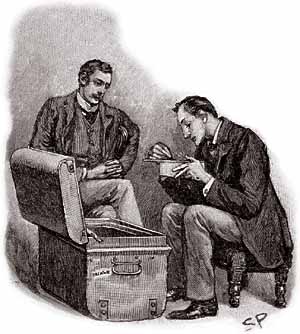
“The date of the watch is nearly fifty years back, and the initials are as old as the watch: so it was made for the last generation.  Jewellery usually descends to the eldest son, and he is most likely to have the same name as the father.  Your father has, if I remember right, been dead many years.  It has, therefore, been in the hands of your eldest brother…He was a man of untidy habits–very untidy and careless.  He was left with good prospects, but he threw away his chances, lived for some time in poverty with occasional short intervals of prosperity, and finally, taking to drink, he died.  That is all I can gather.” (“The Sign of Four,” Chapter One)
The Sherlock Holmes stories are filled with lonely, unmoored people.  People without family, or with only distant relations.  People who seem to neither need any close relationships, or are unable to maintain them.  Dr. Watson, after all, introduces himself to the reader in A Study in Scarlet as man without any family or close relations, and that is why upon returning from the Afghan War he “was therefore as free as air.”  But for a man who claimed to be “free,” and all the lighthearted imaginings that may invoke, he is quick to throw in his lot with a complete stranger, a man who admits from the outset that he is not the best of companions: “Let me see–what are my other shortcomings?  I get in the dumps at times, and don’t open my mouth for days on end.  You must not think I am sulky when I do that.  Just let me alone, and I’ll soon be right.  What have you to confess now?  It’s just as well for two fellows to know the worst of one another before they begin to live together” (STUD).
Sherlock Holmes analyzes Dr. Watson's elder brother's watch in The Sign of Four.
The reader learns in the above passage from The Sign of Four that Watson’s father and older brother have both died, and there is no mention of any other relations.  While it is true that Watson tells his reader in STUD that he “had neither kith nor kin in England [emphasis mine],” and therefore opens the door to speculation that he had relations in other nations, he never mentions them, and they never visit.  And whether the reader believes that the good Doctor was married once, twice, or six times as Brad Keefauver maintains (see the recent posting about Miss Mary Morstan), the sad fact is that none of the many Mrs. Watsons was a permanent, or even a long-term fixture in the Doctor’s life.  There is also no mention of any “little Watsons,” and as Dr. Watson was quick to return to his rooms at Baker Street in between his marriages, there is some evidence that Watson remained childless.  Baker Street, and his life with Sherlock Holmes, remained one of the few constant fixtures in his life; however often he found himself untethered from its moorings.

Sherlock looks like he's afraid Mycroft is about to tell an embarrassing family story. 
Mycroft looks like he's wondering where his dinner is. (bookishadventures.tumblr.com)
Sherlock Holmes’s isolation is legendary, of course.  Even bringing up the subject seems to confirm Christopher Morley’s admonishment to Sherlockian writers: “Never has so much been written by so many for so few."  Holmes is reticent, and close-fisted with his personal details.  And nowhere in the canon is this better exemplified than in “The Greek Interpreter.”  As Watson says:
“During my long and intimate acquaintance with Mr. Sherlock Holmes I had never heard him refer to his relations, and hardly ever to his own early life.  This reticence upon his part had increased the somewhat inhuman effect which he produced upon me, until sometimes I found myself regarding him as an isolated phenomenon, a brain without a heart, as deficient in human sympathy as he was preeminent in intelligence.  His aversion to women and his disinclination to form new friendships were both typical of his unemotional character, but not more so than his complete suppression of every reference to his own people.  I had come to believe that he was an orphan with no relatives living; but one day, to my very great surprise, he began to talk to me about his brother.”

If the traditional chronology is to be believed, then the events of GREE took place in 1888, and Holmes and Watson had been sharing their rooms at Baker Street for over seven years.  Seven years without a word about a close relation, a brother, living in the same city!  It beggars belief.  Indeed, Gavin Brend of My Dear Holmes: Studies in Sherlock, posits the theory that the events of GREE took place within the first few years of Holmes and Watson’s acquaintance (58-62), which seems more likely if still a curious oversight.  Furthermore, if William Baring-Gould is to be believed, Holmes was quiet on the subject of more than just one older brother!  The famous Sherlockian scholar put forth the theories that there was a third, older Holmes brother, Sherrinford; that his parents were named Siger (the inspiration for Holmes’s alias during the “Great Hiatus”) and Violet; and that Sherlock Holmes was the father Rex Stout's detective character Nero Wolfe (the result of an affair with Irene Adler in Montenegro).  Despite the fact that Holmes’s family relationships are apparently more prodigious than Watson’s, they are no more substantial.  More is made of Mycroft’s character—and the Holmes brothers’ relationship—in pastiches or on screen, than ever was truly made of it in the canon; in fact, Mycroft only appears in just two of the original stories: “The Greek Interpreter,” and “The Bruce-Partington Plans,” and is just briefly mentioned in “The Final Problem,” and “The Empty House.” 
And finally, what of Mrs. Hudson, the famous matriarchal figure of Baker Street?  She is a “Mrs.,” but no “Mr.” Hudson ever appears (although fans of BBC’s “Sherlock” know what might have happened to her missing spouse).  Neither do there appear to be any Hudson children.  Her tenants are often troublesome, and she seems to go through agonies to care for them: cooking, cleaning, sending telegrams, shepherding clients (at all hours of the day and night), tending to bullet holes in her walls.  Oh, and not to forget: the task of preserving the flat while one of her residents was presumably dead for three years.  Watson does say that Holmes’s “… [rent] payments were princely.  I have no doubt that the house might have been purchased at the price which Holmes paid for his rooms during the years that I was with him” (DYIN), but it still seems quite a lot for one landlady to tolerate, “princely” rent payments or no.
In fact, according to Christopher Redmond, author of the Sherlock Holmes Handbook (2nd Edition), Mrs. Hudson’s unusual devotion to her tenants—particularly Holmes—is worth noting.  “Certainly the kind of devotion seen in ‘The Empty House,’ in which she repeatedly crawls to Holmes’s wax bust ‘on my knees’ and in danger of her life to adjust its position, suggests something more than the usual relationship between tenant and landlady” (54).  In the pastiche, The Further Adventures of Sherlock Holmes: War of the Worlds, Manly Wade Wellman and Wade Wellman theorize that Mrs. Hudson’s devotion to Sherlock Holmes stems from another source entirely, as well as find a neat solution for the “three Hudsons” that appear in the canon: Blackmailer Hudson of “The Gloria Scott,” Morse Hudson of “The Six Napoleons,” and Mrs. Hudson of Baker Street, of course.
Mycroft and Sherlock Holmes in 2010.  Not pictured, their longsuffering mother.
So, Sherlock Holmes, Dr. Watson, and Mrs. Hudson form a neat little family unit at Baker Street, for all that it is flexible and changeable, for all its strangeness and peculiarity.  Dr. Watson needed somewhere to return to—after the war, after his marriages.  Sherlock Holmes needed to be allowed to remain in the middle distance—to create his legendary separation and isolation.  And Mrs. Hudson needed a place to tend to—and perhaps even residents that needed tending.  They work rather neatly together as a unit, perhaps better than most.
oOo
There’s a new blog contest open!  Share your thoughts about the Master Detective on screen, and you can win the original canon on audiobook, read by the incomparable Edward Hardwicke.  Contest is open until 11:59p.m., on Saturday, September 24.  Details here.
“Better Holmes & Gardens” now has its own Facebook page.  Join by “Liking” the page here, and receive all the latest updates, news, and Sherlockian tidbits.