Showing posts with label inspector lestrade. Show all posts

Sunday, July 29, 2012

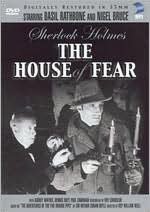
Sherlock Holmes on Screen: “The House of Fear” (1945)

“Viewed today however, one is inescapably reminded of a ‘reality TV’ format: seven diverse housemates are nominated one-by-one for permanent eviction until just one is left to scoop a prize of exactly £100,000. So if The House of Fear fails as both a Sherlock Holmes film and a properly satisfying murder-mystery, its premise is at least enduring.” (Alan Barnes, 92)

Occasionally, I think that Nigel Bruce gets a bad rap. Once in a great while, his performance as Dr. John Watson touches a soft place in my heart. I find myself susceptible to moments like his rendition of “Loch Lomond” in Pursuit to Algiers (and from the same film, his recounting of a recent adventure with Sherlock Holmes using a celery stalk as the Detective and a hunk of cheese as himself); or his utterly crestfallen expression in The Adventures of Sherlock Holmes when the Detective snappishly refers to his companion as “an incorrigible bungler” (though he is soothed by a gentle pat on the shoulder). For all his foolishness and sometimes blatant stupidity, there is warmth and openness in Bruce’s interpretation, with a certain guilelessness that goes a long way towards explaining how he has managed Holmes’s peculiarities for so long – perhaps it is simply because he sees no malice in the Detective’s actions, no animosity, and cannot bring himself to harbor any resentment or bitterness towards his friend.

But in the 1945 film, The House of Fear, such moments of softness and affectation are notably absent. Despite one rather astute and crucial observation, and one poignant moment between the two friends at the conclusion of the film (Holmes does seem rather touchingly grateful for his friend’s survival), Bruce’s Watson is at his vaudevillian worst. It’s hard to find any redemptive qualities in a scene in which Watson – unearthing a grave while Holmes stands about smoking a pipe – finds himself embroiled in an Abbott and Costello-style argument with an owl. Holmes’s comment of “Having a nice little chat, Watson?” is the only one of his many needle-like barbs throughout the film that is utterly deserved. According to Alan Barnes:

“Despite furnishing Holmes with the one last vital piece of evidence, Nigel Bruce’s Watson does not fare well, being a source of irritation to the detective (Holmes loudly informs the entire household that Watson snores ‘like a pig’) and the butt of a semi-jokey five minute sequence in which, guarding downstairs on his own, he flaps hither and thither while attempting to track down the source of a number of strange noises. (He shoots a suit of armour and a cat before asserting, ‘They’ve got me completely surrounded!’)” (94).
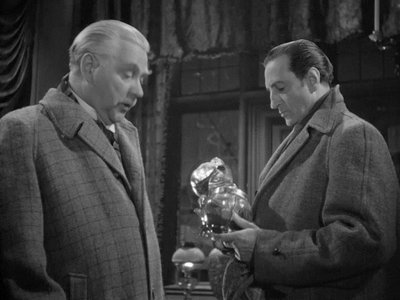
To be fair, Rathbone’s Holmes does not come across at his very best in this film either. As Barnes points out, the Detective makes a rather pointed, public and personal joke at the Doctor’s expense: “You snored like a pig!” Later, Watson is attacked in the sitting room while Holmes investigates upstairs. Watson screams rather ardently for his friend, to which Holmes responds by descending the stairs at a pace that could best be described as a “saunter,” or perhaps a leisurely stroll. There is no urgency in his manner, while Watson, for all appearances, has just escaped a brutal death. Holmes’s most animated moment comes only when his own life is in danger – as well as the Doctor’s – at the hands of a falling boulder.

However, Basil Rathbone might have been as much to blame as the film’s screenwriters for the Detective’s apathetic characterization in this film. According to David Stuart Davies: “It was becoming noticeable that Rathbone was beginning to tire of the role of Sherlock Holmes. After nine features and numerous radio broadcasts, the character was so familiar to him that he felt there was nothing fresh he could bring to the part. The reviewer in the New York Times called his performance in this movie ‘as pedestrian as a cop on patrol’” (59). There is a tiredness to Rathbone’s performance in this picture, as if he is trying to summon energy and enthusiasm for the role that he simply does not have. In response, Bruce’s Watson and Dennis Hoey’s Inspector Lestrade (inexplicably present in Scotland in his role as a police inspector, despite being rather clearly out of his jurisdiction) appear to move ever further into the role of caricature, seemingly becoming mere parodies of their roles. Lestrade, for example, loudly and brazenly takes credit for the capture of Professor Moriarty.
To its credit, The House of Fear has much going for it in the way of atmosphere – an eerie, gothic manor seated on top of a high cliff in Scotland, a morose and sinister housekeeper who acts as the harbinger of ill-tidings and death, and a strange men’s club shrouded in secrecy and strange ritual. Even the manners in which the “Good Comrades” are murdered demonstrate a distinct variety and creativity. They are gruesome and evocative, summoning an array of horrifying images with the simple phrase: “No man goes whole to his grave.” The House of Fear’s link to the Canon story “The Five Orange Pips” is tenuous at best – the only reference to the source material being the orange pips each Good Comrade receives prior to his death. But the film does manage to invoke the violence of the original story, the grim and sometimes coldhearted nature of humanity.

There are elements of The House of Fear that are reminiscent of the earlier Rathbone/Bruce picture, Sherlock Holmes Faces Death (1943). As Davies says, “…Sherlock Holmes Faces Death brings Holmes back to the world of creepy old houses, wild windy nights and mysterious unsolved murders. The mood is Victorian Gothic but the presence of the Second World War is still in evidence…” (50). Unfortunately, The House of Fear demonstrates little to none of the strength of its earlier counterpart. Perhaps, this is demonstrative of how much of a Sherlock Holmes film’s success is derived from the strength and vitality of the actor in the title role, and how much the film suffers if he finds himself indifferent.

oOo
“Better Holmes & Gardens” now has its own Facebook page. Join by “Liking” the page here, and receive all the latest updates, news, and Sherlockian tidbits.

Sources:
• Barnes, Alan. Sherlock Holmes on Screen. (September 2011).

Friday, March 4, 2011

Some Thoughts on Character: “The Best of the Professionals” (HOUN)

Detective Inspector Lestrade stands in the doorway of 221B Baker Street, shrugging on his jacket as John Watson watches.  Doctor Watson asks the DI for any insight into the behavior of his new, eccentric flatmate, Sherlock Holmes.  He’s hoping that Lestrade will advise him on how to handle the man’s many apparent foibles; perhaps he’s hoping that Lestrade will tell him that, despite all appearances to the contrary, John Watson has not decided to share a flat with a man who runs after serial killers, like a child runs after an ice cream truck. 
Unfortunately, Lestrade does not give the Doctor any hope, but he does pause, on his way out the door, to explain why he puts up with Holmes’s manic behavior:  “Because I’m desperate, that’s why.  Because Sherlock Holmes is a great man, and I think one day—if we're very, very lucky—he might even be a good one.”  The scene is from the 2010 BBC adaptation, “Sherlock,” but it’s not so difficult to imagine any of the incarnations of Inspector G. Lestrade muttering this sentiment.
With little time and little effort, any reader could summarize Lestrade’s characteristics, as should probably be the case with any supporting character in an extended series.  According to H. Paul Jeffers in his book, Bloody Business: An Anecdotal History of Scotland Yard:
“He is the most famous detective ever to walk the corridors of Scotland Yard, yet he existed only in the fertile imagination of a writer.  He was Inspector Lestrade.  We do not know his first name, only his initial: G.  Although he appears thirteen times in the immortal adventures of Sherlock Holmes, nothing is known of the life outside the Yard of the detective whom Dr. Watson described unflatteringly as sallow, rat-faced, and dark-eyed and whom Holmes saw as quick and energetic but wholly conventional, lacking in imagination, and normally out of his depth—the best of a bad lot who had reached the top in the CID by bulldog tenacity (95).”
Sidney Paget
Lestrade has the honor of appearing in the first Sherlock Holmes story, A Study in Scarlet, along with Inspector Tobias Gregson, but beyond that it’s easy to think of his character as merely a method of conveyance—someone has to get the details of the case into Holmes’s hands, why not a member of the police force?  In fact, Lestrade—as with any member of Scotland Yard that appear in the canon—seems almost painfully one-dimensional.  We don’t even know his first name (Gregory? Geoffrey? George? Gerald? Gabriel?), and sometimes it seems that most of the debate over Lestrade centers on the pronunciation of his last name (Long ‘A” sound? Short ‘A’ sound?). 
In Dictionary of the Theatre: Terms, Concepts, and Analysis, Patrice Pavis says that the role of a character is to give off “the illusion of being a human person.”  This is particularly applicable in the case of Inspector Lestrade, because he gives off the illusion of being Sherlock Holmes, and therefore makes the Great Detective himself seem even more real.  Just as Mycroft Holmes makes his younger sibling seem more god-like, Inspector Lestrade makes Sherlock Holmes seem a little more human, his skills and abilities a little more attainable.  Lestrade makes clear the cracks in Holmes’s deductive armor, the places where he is most vulnerable.   
Sherlock Holmes describes Lestrade in “The Cardboard Box” as being, “…absolutely devoid of reason, he is as tenacious as a bulldog when he once understands what he has to do.”  Holmes says this as if it were a characteristic unique to Lestrade, as if it were something charming about the man that made him a little more palatable than the rest of Scotland Yard.  Well, to be totally frank, Mr. Holmes?  You can be “as tenacious as a bulldog” yourself, when you want to be.  When Holmes gets his claws into a case, he has been known to, amongst other things: masquerade as a priest (SCAN), pretend he was dying (DYIN), camp out on a moor for several days without anyone's knowledge (HOUN), and poison himself (DEVI).  Lestrade’s tenacity is, in fact, rather subdued when compared to Holmes’s exploits; making everything the Detective does seem more extreme and wonderful in contrast.
In addition, using a secondary character in this manner makes the on-screen portrayals all the more important, and all the more valid as interpretations.  By using him so sparingly, Sir Arthur Conan Doyle left holes in Lestrade’s character.  Actors can fill in the gaps and smooth out the edges, and the manner in which they interpret the Inspector is ultimately reflected back on Holmes in some way.
Colin Jeavons
Eddie Marsan
http://www.allmoviephoto.com/
Rupert Graves

Colin Jeavons plays a slightly bumbling (though in no way stupid) and awkward Lestrade to Jeremy Brett’s elegant and masterful Sherlock Holmes…who becomes patient and affectionately amused as he watches Lestrade peek inside his case files when he thinks no one is looking.  Eddie Marsan plays a biting and irritated Lestrade to Robert Downey Jr.’s frenetic and feverish Great Detective…whose genius appears even more inspired and enlightened when the police inspector agrees to go along with his insane plan.  And Rupert Graves, who started this entry, plays a Lestrade who seems equal parts weary and put-upon, like the proud parent of a difficult prodigy...and Benedict Cumberbatch’s Holmes suddenly seems younger and more inexperienced, but with a new well of vast, untapped potential.  
Over the past couple of weeks, I've realized a few things as I've been writing; one of which is that it is easy to believe that Sherlock Holmes stands on his own two feet as a character—based on his own merits and abilities—but he really does not.  Sherlock Holmes is influenced and formed by those who surround him in the stories, as much as he influences them.  His character is determined by those in his circle, and that makes him extremely variable.  In "The Secret of Sherlock Holmes," by Jeremy Paul, Holmes says:
“If it wasn’t for Watson, I would have been dead within two years.  A man needs a companion, he cannot sit alone… With his silent reproaches, his hurt looks, Watson controlled my [cocaine] addition.  And our walks, our conversations… the sheer breadth and enthusiasm of his mind on any manner of subjects kept me sane when the black fits were upon me.  There was never a better friend.  And I treated him abominably.”
Dr. Watson makes Holmes accessible, capable of friendship and empathy when we had previously thought him incapable of either.  His brother makes him simultaneously human and god-like.  And, perhaps, if Sherlock Holmes is ever considered a "good" man, and not just a "great" one, it will be because of Inspector Lestrade.  Because he rounds off the edges of Holmes when necessary, he fills in his gaps, and introduces the Great Detective to himself.
oOo
I’m giving stuff away!  So make sure you take a minute to enter my contest.  It’s open to all and entries are accepted until 11:59p.m. EST on March 26.