Showing posts with label jack sparks. Show all posts

Thursday, August 4, 2011

BOOK REVIEW: “The Six Messiahs”

Mark Frost; Publisher: Avon (July 2005)
[Warning: The following review most likely contains spoilers for The List of Seven despite my best efforts to the contrary.  My review of The List of Seven can be found here.]
“Do you know what you find, down here”—[Jack Sparks] stabbed a fist sharply into his gut—“when every article of civility, every habit, cherished memory, every manufactured shred of this puppet we assume ourselves to be is stripped off us like the skin of an animal?”
Doyle swallowed hard.  “Tell me.”
“Nothing…A void.  No sight, no sound, no thought; not a ripple of the faintest echo.  That’s the secret at the base of the stairs that no one is supposed to find.  They warn you when we’re young: Don’t look down there, children; stay here by the fire and we’ll tell you the lies our parents beat into us about the greater glory of man.  Because they know coming face-to-face with that emptiness would obliterate every trace of who you thought you were like a beetle crushed under a jackboot” (236).
If you have read, or are even tangentially familiar with the plot of The List of Seven by Mark Frost, then you were probably able to follow that story to its logical conclusion, and imagine where the novel’s climax would find Jack Sparks.  You now know what happened to Frost’s dynamic and debonair secret agent for the British crown—and his malevolent archenemy and brother, Alexander Sparks.  That said, if you have been able to follow me thus far, then you can probably also imagine where Mark Frost’s sequel, The Six Messiahs, finds Jack Sparks.  But if you think that Sparks is the same character that you left behind in The List of Seven, then you would be wrong, because Jack Sparks is very much changed.  He is not the same man.
Set in 1894, The Six Messiahs takes place ten years after the conclusion of the first novel’s narrative.  Jack Sparks has been lost, along with his wicked brother Alexander, in their clash at the Reichenbach Falls.  And Arthur Conan Doyle is now a successful man, having made his name as a writer of stories, which feature a character modeled largely on his late friend.  However, as the novel opens, Doyle has just dispatched Sherlock Holmes in “The Final Problem,” in a manner eerily similar to that of Sparks’s fate.  In addition, Doyle is about to embark on a lengthy book tour of the United States, with his brother Innes along as his secretary.  But when a rare book dealer on board their ship is murdered, and an elderly priest reveals himself to be Jack Sparks in disguise, Doyle momentarily believes: “This is, indeed, like the old days” (EMPT).  But he is very wrong, as is almost immediately revealed.
Because as was said before, Jack Sparks is not the same flamboyant, energetic, “James Bond-esque” figure that graced the pages of The List of Seven.  Sparks is a greatly changed man.  He is angry, distant, and withdrawn; prone to dark moods before his plunge over the waterfall—his temper is now positively black.  And he is snappish, even with his old friend.  When Doyle suggests to Sparks that he would have been happy, all those long years, just to know that Jack was still alive, Sparks assures Doyle that he is not alive: “Not in the way you suppose when you say it.  Not in the way you assume” (122).  And if Mark Frost’s Doyle does indeed model Sherlock Holmes after Jack Sparks, then this angry, even violent, “post-hiatus” Sparks is perfectly in keeping with the Sherlock Holmes with which most readers are familiar, even if they do not realize it.
It is often commented that the Great Detective is very different when he reappears in the stories Doyle wrote after his long time away from his most famous character.  For instance, the Sherlock Holmes of “Charles Augustus Milverton” is not the same Sherlock Holmes as in “A Case of Identity.”  Sherlock Holmes is much changed when he reappears after his three years of being presumed dead.  As Graham Moore points out in The Sherlockian, “After the Great Hiatus, when Holmes returned in those later stories, he was just different.  Meaner.  Colder.  He starts manipulating witnesses for information.  Lying to people.  Committing crimes himself if he thinks it will serve his cause…He becomes a real bastard” (163-4).  And Jack Sparks is most certainly quite a bastard after he reappears in Doyle’s life.  Whatever happened to him during his long time away has left him scarred, both physically and emotionally, and sometimes the reader—and Arthur Conan Doyle—worries that the old Sparks has, indeed, been lost entirely.
And again, as in The List of Seven, Frost’s Doyle is a fully-formed character, standing on his own merits and abilities, and does not play a bumbling “Watson-esque” foil to Sparks’s Sherlock Holmes.  In The List of Seven, Doyle behaves really more as a detective than a doctor, and that has not changed in this novel.  Doyle is more than capable of deducing the smallest details of those around him—and he often does—and receives the same astonished reactions that could be taken directly from one of his own stories.  When he evaluates a fellow passenger—accurately inferring all of the man’s major characteristics, from his religion to his country of origin to his recent travels—even Doyle’s own brother seems pleasantly baffled (53).  Frost has rendered an Arthur Conan Doyle that the reader wants to follow around for 450 pages, a Doyle who is a man of action and decision, and who does not sit idly by and wait for Jack Sparks to tell him what to do.
Several characters from The List of Seven make appearances in this sequel, if only briefly.  Featured largely is the beautiful and enigmatic Eileen Temple, Doyle’s former love interest.  She is now part of a traveling theater group with the slightly ominous name the “Penultimate Players,” which is run by the moronic Bendigo Rymer.  Her path will cross again with Doyle and Sparks in a rather cataclysmic fashion, though their stories run parallel for most of the novel.  There is also a brief appearance by Larry, whose rough edges and uncouth manners seem to have softened and mellowed with the passing years.  Larry is the remaining member of the set of twins who worked for Jack Sparks in The List of Seven, and seemed to foreshadow Sherlock Holmes’s own Irregulars.
And speaking of the Irregulars—the Baker Street Irregulars (BSI), that is—an apparent very early incarnation of that famous Sherlockian society tries to introduce itself to Arthur Conan Doyle once the author arrives in New York City.  For his part, Doyle has very little patience for the group’s fanaticism—and his impatience is only due in part to the ongoing criminal investigation.  “…Doyle had never heard of [the Baker Street Irregulars], which according to [Doyle’s tour manager] had sprouted out of Sherlock mania like a wild toadstool” (117).  Unfortunately, Doyle’s first encounter with the adoration of Sherlock Holmes’s fans is awkwardly and poorly (if humorously) received.  Although Doyle is polite, the early BSI members are left to themselves in the hotel lobby.
With The Six Messiahs, Mark Frost presents his readers with another remarkable and unique Doyle-as-Sherlock-Holmes pastiche.  His novel features characters that are brightly original in their own right, and yet faintly familiar echoes of the ones we already know and love.  The reader knows that Doyle will ultimately return to writing stories featuring the character-who-was-Jack-Sparks, but Frost’s novel keeps the reader turning the pages—guessing and hoping all the while—and waiting to discover how and in what form Jack Sparks will eventually return (in every sense of the word)—not just the why and where of it.
oOo
More information about The Six Messiahs, and other works by Mark Frost is available on the author’s website.  You can also follow him on Twitter.

Friday, March 25, 2011

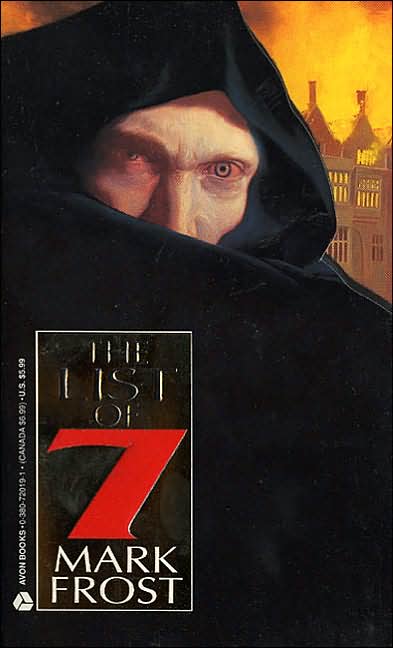
BOOK REVIEW: "The List of Seven"

Mark Frost; Publisher: Avon (September 1, 1993)
“The prospect that I’ve met my match in the exercise of observational deduction brings my competitive tendencies racing to the fore.”
“How will I know these are legitimate inferences and not facts you’ve gathered by some covert means [said Doyle]?”
“You won’t,” said Sparks, flashing his grin again.  “You were born in Edinburgh, Catholic parents of Irish descent and modest means.  You fished and hunted extensively in youth.  You were educated in Jesuit parochial schools.  Your lifelong passions have been literature and medicine.  You attended medical school at the University of Edinburgh, where you studied under an inspirational professor who encouraged you to develop your powers of observation and deduction beyond the scope of their diagnostic application.  Despite your medical training, you have never relinquished your dream of one day making your living exclusively as a man of letters.  Despite your indoctrination into the Church of Rome, you renounced your family’s faith after attending séances and encountering experiences to difficult to reconcile with an adherence to any religious dogma.  You now consider yourself a confirmed, albeit open-minded, agnostic.  You are very handy with a revolver…” (94).
There is an interesting subgenre of Sherlockian pastiches that features not Sherlock Holmes, but his creator, Sir Arthur Conan Doyle, as the detective.  These books usually cast Doyle as a Watson figure alongside Dr. Joseph Bell (Doyle’s real-life mentor) or a comparable character’s Sherlock Holmes, with varying degrees of success.  One such book, David Pirie’s The Patient's Eyes: The Dark Beginnings of Sherlock Holmes, has been largely well received, while Howard Engel’s Mr. Doyle & Dr. Bell: A Victorian Mystery, has not.  Frankly, I only recommend the latter if you feel up to stomaching a lukewarm mystery and 212 pages of Sherlockian puns.
You cannot, however, read The List of Seven by Mark Frost without knowing immediately that it is a different breed of Sherlockian novel; this is not entirely surprising, considering that Frost was also one of the scriptwriters for Twin Peaksan entirely different breed of television show.  Frost’s screenwriting talents are apparent in the book’s narration.  There is a unique cinematographic quality in the way Frost sets a scene and the way he narrates a conflict.  His settings are vivid, his dialogue is crisp and fluid, and his characters are alive.  
Frost presents another pastiche where Doyle is solving crime, but this one is different. Doyle is not playing a carbon copy of his famous doctor, and Dr. Bell is nowhere in sight.  Doyle plays opposite Jack Sparks, a charming, athletic, ascetic Special Agent for the Crown, who on first glance seems to be the obvious template for the character-who-will-be-Sherlock-Holmes, but it’s not that simple.  Jack Sparks is no Sherlock Holmes, and Doyle is no Dr. Watson. Although every character in Frost’s novel seems to prefigure some character to come (you may occasionally find yourself muttering, “I see what you did there, Mr. Frost!”), you would do yourself a disservice by trying to force them into predetermined molds.  You would miss the qualities that make each character unique and enjoyable in his own right.
Doyle meets Jack Sparks for the first time on Christmas Day,1884.  His presence has been requested at a séance “as a man of God and science” (3).  Outside the building, before the séance, Doyle quickly and efficiently sizes up the situation and each of its participants (in “Sherlockian” fashion), and we get our first glimpse of the man that Frost imagines Doyle to be.  Inside the building, during the séance, events take a horrible, tragic turn, and Sparks bursts onto the page for the first time (although he initially introduces himself as Armond Sacker).  His manner is less reminiscent of Sherlock Holmes than it is of Robin Hood and Zorro, with some James Bond thrown in for good measure—turning over tables, crashing through doors, and leaping onto moving carriages.
Sparks is more special agent than detective, and Doyle is more detective than doctor, but the one thing that they have in common is that they are matched mentally, able to deduce: “[b]y a man’s finger-nails, by his coat-sleeve, by his boots, by his trouser-knees, by the callosities of his forefinger and thumb, by his expression, by his shirt-cuffs—by each of these things a man’s calling is plainly revealed.” (STUD).  And they need all their abilities, because the mystery in which they have found themselves mired is more than a bit complex…it is equal parts supernatural adventure, political conspiracy, and historical thriller, with a little bit of family drama thrown in for extra spice.  And you never once find yourself wondering if Sherlock Holmes could have done it better.
There are similarities here to the characters and tales that Arthur Conan Doyle will eventually pen, and there is no use denying it.  There are Larry and Barry, the identical twins, once criminals, but now fiercely loyal to Sparks and his work.  There’s a bit of the Irregulars in their rough, streetwise ways.  And there is also Eileen Temple, a beautiful actress with the Manchester Players—that’s certainly the shadow of Irene Adler behind her.  Sparks even has his own version of The Index (which he refers to as "The Brain"), that contains index cards with biographical information on every known criminal (but is written in an obscure code of Sparks’s own devising).
And as for Jack Sparks himself, he plays the violin, smokes a pipe, and uses a magnifying glass.  He lives on Montague Street in a townhouse full of strange things (including a large “Baskervillian” hound named Zeus).  He uses cocaine.  And the entire plot of the novel hinges on Sparks’s archenemy, his brother, the malevolent Alexander Sparks (fans of the 2010 BBC adaptation are chuckling knowingly here), who is every bit as terrifying, vicious, manipulative, and scheming as Professor Moriarty, if not more so.  But none of these things suddenly turns Jack Sparks into Sherlock Holmes.   
Sparks tells Doyle, “I made a sweet, simple fool out of myself,” (156) as he describes his brother’s earliest machinations.  Sparks tells a long story, full of details about his childhood and family, his history and choices.  It is melancholy and heartbreaking.  Sparks is describing himself as a young boy, understandably unable to see through his much older brother’s designs, and it’s difficult to ever imagine Sherlock Holmes in the same position—describing himself as “a sweet, simple fool,” no matter what his age or the circumstances.  But that’s also the crux of the matter—Sherlock Holmes would never speak about himself.  Details about Holmes’s early life are few and far between, and seem practically wrenched from Holmes’s unwilling hands by Dr. Watson (GLOR, MUSG).  After 401 pages of The List of Seven, you walk away feeling as if you know Jack Sparks, at least a little bit.  On the other hand, after 56 short stories and four novels, you wonder if you can ever know Sherlock Holmes at all.  That’s the dividing line; that’s what prevents Jack Sparks from ever being Sherlock Holmes.  But that is a good thing, too, because he becomes his own character, rich and nuanced, and not a cardboard parody of another. 
Frost has written a sequel to The List of Seven, The Six Messiahs, which manages to be one of those rare books that is both a continuation of the original story and an entirely new tale in its own right.  Learn more about these works and the author at Frost’s website.
oOo
You have one more day to enter my contest!  Entries are accepted until 11:59 p.m. EST on March 26.  At that time, a random winner will be chosen.
Many thanks to Laura for her wonderful edits to this week’s blog post.  My usual editor is off gallivanting in the Vegas desert, and Laura very kindly volunteered to help me this week.  And she did a fantastic job (especially with a terrible comma-abuser like me)!