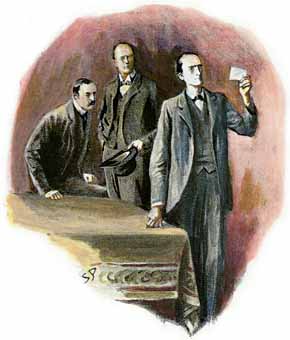
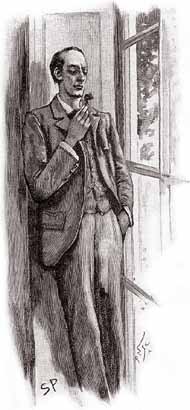
“There is nothing in which deduction is so necessary as in religion,” said he, leaning with his back against the shutters. “It can be built up as an exact science by the reasoner. Our highest assurance of the goodness of Providence seems to me to rest in the flowers. All other things, our powers, our desires, our food, are all really necessary for our existence in the first instance. But this rose is an extra. Its smell and its colour are an embellishment of life, not a condition of it. It is only goodness which gives extras, and so I say again that we have much to hope from the flowers.”
A few months ago, a friend of mine read “The Naval Treaty,” for the first time, in response to one of my earlier blog posts. When she reached the famous “soliloquy on flowers,” she set the book down and leaned in towards me, conspiratorially. “Was this,” she asked, “One of those moments when Holmes was…well...you know…” Her question trailed off for a moment, but then her voice dropped to a whisper. “Was this one of those times when Holmes was…on drugs?”
“Oh, for goodness sake…no,” I replied, quite defensively. As if the Great Detective’s honor were in question, and for some reason it was my job to defend it. And I wasn’t even sure if my answer to her question was correct, not in the fullest sense. How could I be? Watson certainly did not record every single one of Holmes’s actions, and even then, who can say what the Detective got up to when the Doctor’s back was turned. So, it was entirely possible that Holmes was on drugs (as my friend had so furtively put it) when he spoke on the goodness of flowers. But I understood what she was really asking, what she could perceive even from reading this single tale: Sherlock Holmes is acting a little strange here, isn’t he?
Monday of this week, September 12, marked the sixteenth anniversary of the passing of Jeremy Brett, who played Sherlock Holmes in the Granada Television series from 1984-1994. The series was famous for the manner in which it remained faithful to Sir Arthur Conan Doyle’s original stories, and exhaustively captured the minutest details in setting, costume, and performance. Granada’s interpretation of NAVA manages to be both nuanced and theatrical, and thus successfully captures the scope of the original story. Brett’s performance manages to mitigate some of the strangeness of Holmes’s dialogue, and as a result, the passage becomes a part of Holmes’s character, rather than a deviation from it. As Dr. Watson says in NAVA, in regards to Holmes’s speech: “It was a new phase of his character to me, for I had never before seen him show any keen interest in natural objects.” Likewise, David Burke’s Dr. Watson seems perplexed, and perhaps a little embarrassed by his friend’s behavior, but his expression is mostly gently accepting. His face reads more, “Oh, he’s off again,” and less, “What is he on about?”
“Fidelity to Doyle was always at the forefront of [Producer Michael] Cox’s and Brett’s minds. At the start of the project, both men agreed to use the Sidney Paget drawings as ‘their image’, and in the early shows at least one shot was set up to mirror a Paget illustration. ‘The Naval Treaty’, which contains the famous rose speech—‘What a lovely thing a rose is’—is a case in point. The passage and the Paget drawing present Holmes as a dreamer and philosopher, and Brett reproduces the pose very effectively” (124).
 |
| This is a moss rose, apparently. I learned something today. |
Unfortunately, canonical fidelity can only go so far in a story where most of the action occurs off-page, and is related secondhand to Dr. Watson and Percy Phelps, on the next morning, by Sherlock Holmes. Upon spying Holmes’s injured hand, Watson says: “That bandage tells of adventures…Won’t you tell us what has happened?” The reader has no reason to believe that Holmes tells anything but the complete truth, but it is one thing to hear an account of how Holmes netted the villainous Joseph Harrison, and returned the missing treaty, and quite another to see the story acted out widely, vividly, and in full dramatic fashion.
Granada’s version of NAVA shows the audience firsthand, all that the original text relates indirectly, or perhaps only vaguely implies. There is Holmes communing kindly with the horses in the stable, and then a shot of the Detective buried in a pile of hay as he waits for Harrison to make his move (it is quite uncomfortable, and there is a light-hearted moment as he tries to surreptitiously scratch his nose). There is also the very peaceful scene of Holmes resting contentedly under a tree, his light-colored jacket (off-setting Holmes’s normally black, or otherwise dark-colored clothing) over his shoulders. The sun is setting, and the landscape is bathed in a golden light, and the viewer perhaps gets a brief, rare glimpse of the Detective as he prepares for confrontation.
 |
| Photo Credit: bookishadventures.tumblr.com |
That confrontation is also filmed dramatically, with the actions played out mostly in shadow on the wall of the room. There is a bright red splash of blood as Harrison attacks Holmes, and the glint of steel as Holmes draws a blade from inside his cane. The audience does not see the Detective strike at Harrison, or hold the blade against his neck, but the large, expressive shadows show the actions slowly, languorously; the conflict more of a choreographed dance than a ferocious battle. The slight lilt in his voice as he says to Harrison: "Now...run," aptly shows how amusing Sherlock Holmes finds the whole thing to be. NAVA is an early episode in the Granada series, and shows some evidence that the production team was not always quite sure how they wanted to capture Sherlock Holmes and his adventures. The slightly theatrical fight scene is one moment. Additionally, it is unclear at the beginning of the episode as to whether or not Watson is in residence at Baker Street. This is also the only episode that makes reference to “Billy the Page.”
When Holmes unexpectedly parts company Dr. Watson and Percy Phelps, as the trio was supposed to be leaving Woking for London, Phelps says of Holmes: “He really is the most inscrutable fellow, Watson.” And NAVA certainly demonstrates some of Sherlock Holmes’s more inscrutable moments. But the Granada adaptation of this tale goes a long way towards translating some of that inscrutability for the reader, and like Watson, allowing them to see “a new phase of his character.”
oOo
Less than one week remaining! Share your thoughts about the Master Detective on screen, and you can win the original canon on audiobook, read by the incomparable Edward Hardwicke. Contest is open until 11:59p.m., on Saturday, September 24. Details here.
“Better Holmes & Gardens” now has its own Facebook page. Join by “Liking” the page here, and receive all the latest updates, news, and Sherlockian tidbits.