Friday, April 15, 2011

Sherlock Holmes Miscellany: Some Frequently Asked Questions

"I should very much like to ask you one or two plain questions to which I beg that you will give a plain answer” (TWIS).
Most people have a hobby, I think, and that usually provokes a certain amount of curiosity from those closest to them.  My husband, for instance, has been studying military history all of his life, and so there is always a little discussion regarding accuracy and continuity whenever The Guns of Navarone is on Turner Classic Movies.  My little sister is very interested in all genres of heavy metal music (I didn’t even know there was more than one genre until she told me), about which I try to ask thoughtful questions, while simultaneously covering my ears, as very angry men scream at me from her stereo.  I have friends who run, friends who bike, friends who knit, friends who collect tiny spoons from around the world, friends who love Oz, and friends who spend most of their time in Wonderland.  I always try to ask thoughtful questions of varying specificity, if only to show that I care about these things simply because they do.  And they do the same for me.
My sister's music
sometimes feels like this.
So, what types of questions do you get asked if your hobby is a literary nineteenth century detective, his doctor companion, and all things related to their world?  I’ve found that the questions range from the mostly general (Which story should I read first?) to the oddly specific (Did Sherlock Holmes ever investigate a case in my hometown?) to more loaded than they were probably imagining (Was Sherlock Holmes real?).  Occasionally, the questions can irritate, like the proverbial pea under the mattress (What’s the deal with that stupid hat and silly pipe?), but I’ve found that the really good questions, the truly thoughtful ones, tend to inspire.  They get me thinking, they start me on new research, and most importantly, they’re questions I want to share.  I’ve listed a (very) few of my favorites below, and I hope you’ll supply your own for discussion in future installments.       
·         Who lives in 221A Baker Street?
Oh, poor Mrs. Hudson.  After all she does for the tenants of Baker Street—cooking, cleaning, laundry, making tea, delivering telegrams and other correspondence, ushering and comforting clients (mindless of the time of day or night)— people seem to forget that she needed somewhere to sleep as much as her residents.  She was certainly more than a landlady (noting that the term “housekeeper” seems to sit ill with Mrs. Hudson’s 21st century counterpart, though she appears to conduct many of the same tasks as her 19th century forebear).  In fact, according to Christopher Redmond, author of the Sherlock Holmes Handbook (2nd Edition), Mrs. Hudson’s unusual devotion to her tenants—particularly Holmes—is worth noting.  “Certainly the kind of devotion seen in ‘The Empty House,’ in which she repeatedly crawls to Holmes’s wax bust ‘on my knees’ and in danger of her life to adjust its position, suggests something more than the usual relationship between tenant and landlady” (54). 
Rosalie Williams played Mrs. Hudson,
Holmes and Watson's landlady and housekeeper
in the Granada Television series.
In all likelihood, as the owner of the residence, Mrs. Hudson would have retained the usage of the ground floor as her personal apartments, while Holmes and Watson would have taken up residence on the top two levels (Day 8).  Thus, Mrs. Hudson is the most likely resident of “221A” Baker Street, though her apartments probably never bore that official designation.  Also of note, in her book Talking About Detective Fiction, P.D. James posits the existence of a “221C” Baker Street, though I think this unlikely (37).  Primarily because a neighbor in such close proximity to Holmes and Watson would have been mentioned eventually in the canon, and also because I’ve had some monstrously bad neighbors in my life, but one who shot through our adjoining walls would be beyond most human endurance.
·    Why isn’t Sherlock Holmes a police officer, or otherwise working full-time for Scotland Yard?
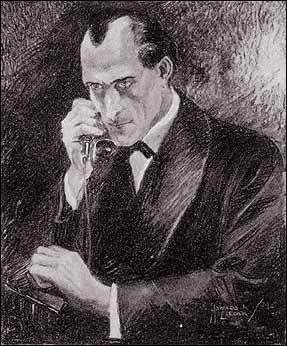
“I am not retained by the police force to supply their deficiencies,” Sherlock Holmes says in “The Blue Carbuncle”—a statement which goes quite a ways toward explaining his feelings about the “official” police force.  But it is more than just a matter of ego or a condescending disregard for the abilities of the Yarders that surround him.  If it were simply a matter of feeling above the rest of the detective force, surely Sherlock Holmes could have risen to the top of the company, with little effort, and made an easy career for himself.  At the very least, he would not have been the first man to be a “big fish in a small pond,” as it were.  But a position within Scotland Yard wasn’t the only potential job at issue.  With a brother like Mycroft, who is described in “The Bruce-Partington Plans” as occasionally being the whole of the British government, it would probably be a matter of small consequence for Sherlock Holmes to find himself in government service, in intelligence or similar activity.  Indeed, he does spend a brief period prior to the First World War masquerading as the spy “Altamont,” whom we meet in “His Last Bow.”  But he never takes an official, permanent position, and Watson tells us that Holmes even turned down knighthood (3GAR).  Holmes didn’t seem to want to be tied to any master, only himself.
Sherlock Holmes as
the spy "Altamont"
Holmes tells Watson in The Sign of Four, “The work itself, the pleasure of finding a field for my particular powers, is my highest reward.”  Being a consulting detective was Holmes’s career, but it was not his job.  There are many people who I am sure can appreciate the difference.  Holmes made money by using his “particular powers,” but he never sought to become rich through his work.  He even told Neil Gibson, a wealthy American client, “My professional charges are upon a fixed scale…I do not vary them, save when I remit them altogether” (THOR).  (Whether or not he was eventually a wealthy man, despite his indifference, is another matter.)  A task loses a certain amount of enjoyment when it becomes something you have to do, and not something you want to do, no matter how talented or successful you may be in your position.  Joining the police force or taking a government position would have made detection a job, and Holmes was clearly loathe to lose his ability to do what made him unique, and to find pleasure in the task, no matter how difficult.
·     Why on earth would any parent named his child, “Sherlock”?
Well, with an older brother named “Mycroft” and, if William Baring-Gould is to be believed, another older brother named “Sherrinford,” I’m occasionally of the opinion that the Holmes parents were probably possessed of an appalling sense of humor.  The name “Sherlock” means “with cropped hair,” or more popularly, “fair haired,” which is a particularly ironic descriptor as the Great Detective is typically depicted as having dark, usually black, hair.  Renowned Sherlock Holmes scholar William Baring-Gould, in his biography, Sherlock Holmes of Baker Street, actually gave the Great Detective the full name of “William Sherlock Scott Holmes,” in addition to a number of other intriguing biographical items regarding Holmes’s early life.  The addition of an extended full name for Holmes is curious.  Going as “Sherlock” despite having a first name of “William,” indicates a preference, on some level, for the name “Sherlock.”  But throughout the canon, the only person who calls Holmes by that name is his brother.  Even his closest friend of nearly fifty years never refers to him as anything except “Holmes,” which seems to indicate that he somehow finds the name “Sherlock” repellant.  Pulling on either thread, it seems, creates a whole new row of loose ends.
Even the cringe-inducing 2010 “mockbuster” entitled simply, “Sherlock Holmes,” makes light of this subject.  At the end of the film, Watson (played by Gareth David-Lloyd) asks Holmes (played by Ben Syder) why the villain kept referring to Holmes as “Robert.”  Holmes reveals that his full name is “Robert Sherlock Holmes,” and that he goes by Sherlock because, “Whoever heard of a detective named Robert?”
~~~
As I said earlier, I’ve listened to a lot of questions about Sherlock Holmes, and these are only a very few of my favorites.  Some make me smile, most make me think, and there are many I couldn’t even begin to answer.  “Only a fool knows everything.  A wise man knows how little he knows,” as the saying goes.  Feel free to share the questions you have been asked or may have asked yourself, either in the comments or via e-mail at betterholmesandgardens[at]gmail[dot]com, for discussion in future installments.
oOo
Less than two weeks until the new blog contest!  Brush up on your Sherlock Holmes trivia, and check back here on April 25 for details on how to enter and win.
Other sources used in the post include: Sherlock Holmes: In His Own Words and in the Words of Those Who Knew Him, by Barry Day (Taylor Trade Publishing, July 2003).

Wednesday, April 13, 2011

Currently on Twitter...

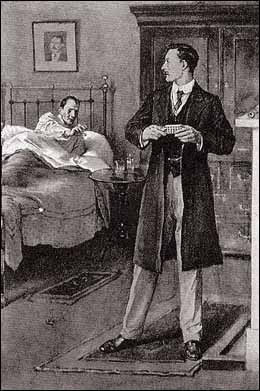
As part of an ongoing project on my Twitter feed, I'm delivering stories from the Sherlock Holmes canon in tiny installments of 140 characters or less.  On Monday, I finished-up "The Adventure of the Dying Detective," and I hope everyone enjoyed the story of Culverton Smith and his diabolical little box.

The current story is "The Adventure of the Three Garridebs" and when the tale is done, maybe you'll let me know if you agree with Watson that "it was worth a wound," as his famous statement goes.

Check out my Twitter feed for a daily installment, though I am usually inspired to post more than once a day.  And don't forget that you can read through the original canon stories online.

oOo

In less than two weeks, I'll be launching a new blog contest, complete with new, excellent prizes.  So brush up on your Sherlock Holmes trivia, and check back here on April 25 for details.

Friday, April 8, 2011

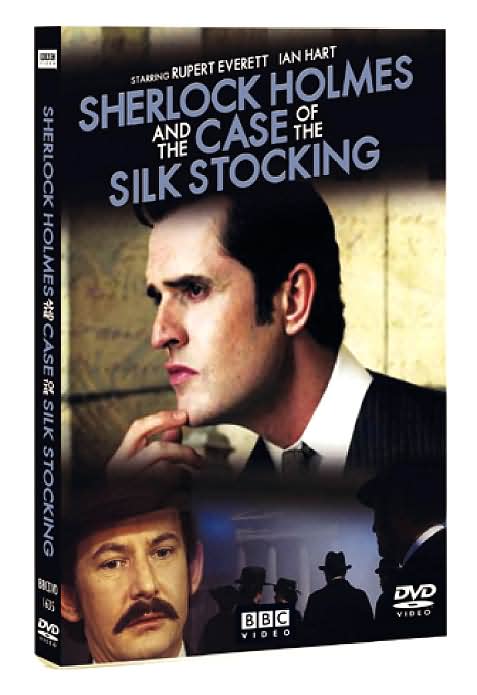
Sherlock Holmes on Screen: "The Hound of the Baskervilles" (2002), and "Sherlock Holmes and the Case of the Silk Stocking" (2004)

In recent months, if anyone mentions “Sherlock Holmes” and “BBC” in the same sentence, thoughts immediately turn to Benedict Cumberbatch, Martin Freeman, pink suitcases, and blind bankers.  But in 2002, the BBC launched the first of two new Sherlock Holmes made-for-television films, beginning with an adaptation of The Hound of the Baskervilles, and two years later, an original mystery called Sherlock Holmes and the Case of the Silk Stocking.  Both scripts were written by Allan Cubitt.   
Ian Hart, who is perhaps most recognizable from his roles as Professor Quirrell from Harry Potter and the Sorcerer's Stone and, appropriately, as Sir Arthur Conan Doyle from Finding Neverland, appears in both films as Dr. John Watson.  The role of Sherlock Holmes is filled by Richard Roxburgh in 2002, and Rupert Everett, in 2004.
These two films successfully conjure up the images of the young men that Holmes and Watson undoubtedly were at the onset of their partnership, unlike the old men as whom they are so often portrayed.  Hart’s Watson is much more the iron-willed, former solider that most Sherlockians prefer to see, and both films make excellent use of setting and atmosphere.  Therefore, the problems with both films hinge on the erratic and unpredictable interactions between Hart’s Watson and his accompanying Holmes; and also on Holmes’s likewise unpredictable and erratic drug use.
·         The Hound of the Baskervilles (2002); Starring Richard Roxburgh and Ian Hart
Perhaps more than any other canon story, the dramatic tension in HOUN is dependent on setting and the 2002 adaptation excels immediately in this respect as it was filmed on the Isle of Man, in order to replicate the moody and atmospheric setting of Dartmoor.  According to Jack Tranter, who was BBC Controller of Drama in 2002, “…[in 1901, when the film is set] London is welcoming in a new age of electric light and internal combustion engines while the moorland of Dartmoor is like the wild west—bleak, inhospitable, and lawless” (Davies 188).    
Yet despite the film’s relatively close adherence to the plot of Doyle’s original novel, the film lacks something that is not directly related to the narrative.  In effect, Roxburgh and Hart lack chemistry, and as a result, the film lacks the warm friendship between Holmes and Watson that is so often crucial to the success of Sherlock Holmes stories.  According to David Stuart Davies, author of Starring Sherlock Holmes: A Century of the Master Detective on Screen, “This [lack of chemistry] is due perhaps to the way their relationship is presented in the script.  It is laced with cynicism, mistrust, and constant bickering.  Watson’s last words to Holmes in the movie are, ‘No, I don’t trust you’” (189).  In portraying Dr. Watson, Hart is humorless and ill-tempered, and there is little about his attitude that explains why he would have put up with Sherlock Holmes and his antics for so many years.  Hart’s Watson may have been long-suffering at one point, but at the time of this version of HOUN, he is a kettle about to boil over.
Richard Roxburgh’s Great Detective is similarly unpleasant, described in The Observer as “insipid and unlikeable.”  His performance is often cold and confusing, an impression not helped by Holmes’s random drug use throughout the film.  For example, he slams a door in Watson’s face before dosing himself (just after Dr. Mortimer’s initial visit), and later, injects himself with cocaine in the train station bathroom, just before the film’s climax. As Davies correctly points out, “This is in direct contradiction of Doyle’s use of the detective’s drug habit, which manifested itself only when he was bored and there was no mystery on hand to occupy his mind.  While on a case, he needed no further stimulation” (188-9). 
Indeed, if the writers were going to incorporate Holmes’s canonical drug use into the film, they couldn’t have chosen two more unlikely moments.  In Eliminate the Impossible: An Examination of the World of Sherlock Holmes on Page and Screen, Alistair Duncan posits that these scenes were an attempt to keep Sherlock Holmes more in line with 21st century perceptions (that Holmes's drug use was casual, and not calculated), rather than the way the Detective actually was (15).  The battle between modern perception and canonical reality would carry-over into the BBC’s next Sherlock Holmes film, in 2004.
·         Sherlock Holmes and the Case of the Silk Stocking (2004); Starring Rupert Everett and Ian Hart
The London of this 2004 Sherlock Holmes film seems to be permanently enshrouded in fog.  Whenever any character steps outside, they are enveloped in a thick peasouper that distorts all faces and scenery.  However, rather than summoning the spirit of the Sherlock Holmes’s London, which appears to be the intended purpose, it comes across as a mere parody—the London that uninformed viewers expect, rather than what is true.  The same goes for Dr. Watson’s American fiancĂ© “Mrs. Vandeleur,” played by Helen McCrory (recently seen as Narcissa Malfoy in the latest Harry Potter films).  She speaks with a non-regional American accent, and has a rather obnoxious habit of referring to the Great Detective as “Sherlock”; she freely discusses sexual deviancies over tea (under the auspices of her career as a psychoanalyst), and has committed the ultimate crime of convincing Watson to dress down for dinner.  Perhaps the fog is a metaphor for the mystery in which Holmes is embroiled (Davies 192); and perhaps Mrs. Vandeleur is a stab at “English stuffiness or American informality” (Duncan 231).  But the overall impression is more heavy-handed: London is drab and grey; Americans are boorish and unrefined.   
Hart’s portrayal of Dr. Watson remains disagreeable and angry, and Everett, as the new Sherlock Holmes, often seems morally dubious—even slipping into a young woman’s bedroom as she sleeps when he needs her assistance.  To his credit, “Physically, [Everett] has a look and manner of [Jeremy] Brett about him: he is tall, dark, handsome, with saturnine features and a prominent nose, but producer Elinor Day was of the opinion that he was more like [Basil] Rathbone” (Davies 192).  Holmes and Watson seem to spend very little time on screen together, and when they do, a significant portion of their time is spent arguing, sniping, or largely ignoring each other.
Also at issue here, as in Roxburgh’s 2002 performance, is Sherlock Holmes’s drug use.  The film opens with Holmes smoking in an opium den, a lascar at his elbow.  We later learn that he had been absent from Baker Street nearly three days.  Opium is not at all Holmes’s drug of choice, and in the canon only uses it one time as a part of a disguise: “I suppose, Watson…that you imagine that I have added opium-smoking to cocaine injections, and all the other little weaknesses on which you have favoured me with your medical views” (TWIS).  Again, in this film we also see Holmes’s injecting himself with cocaine in the middle of a case, presumably when he would have the least need of it.
Making an appearance as George Pentney is Jonathan Hyde, who previously starred in the 1994 version of “The Dying Detective,” as Culverton Smith.  In addition, Eleanor David, who plays Mary Pentney, was featured in the 1986 version of “The Man with the Twisted Lip,” as Mrs. St. Clair.
~~~
Ultimately, it takes more than a canonically accurate mystery, or even a compellingly original one, to make a successful Sherlock Holmes film.  Dr. Watson isn’t likeable if all he does is bitterly follow Holmes around; he must, at least, do it with enthusiasm, not resentment.  And the ability to be successful as Sherlock Holmes means more than being possessed of height, dark hair, and aquiline features (though it certainly doesn’t hurt, in my opinion).  It’s about elements that sit outside the boundaries of plot structure.
It's certainly improbable, though not impossible, that a Sherlock Holmes film will ever be made that adheres to every single canonical detail that Sherlockians would love to see.  But there is a measure of foundation that is required to keep such a film upright, if you will.  The manner in which Holmes’s mind works (and the way he uses drugs to augment it) is part of that foundation.  And the relationship between Holmes and Watson is undoubtedly the other part.   
oOo
For more on this subject, see Alistair Duncan’s article on “Screen Chemistry & Canonical Fidelity.”

Friday, April 1, 2011

Some Thoughts on Setting: St. Bartholomew’s Hospital

“St. Bartholomew’s Hospital Medical College, known popularly as ‘Barts’ or ‘Bart’s,’ was founded in 1123 by—legend has it—Rahere, a jester at Henry I’s court.  Having taken ill in Rome, Rahere prayed on the banks of Tiber, on the island of St. Bartholomew, that he might recover in time to die on his native soil.  St. Bartholomew appeared to him a vision, commanding him to return to London and build a church and a hospital in his name.  By 1896, the hospital had grown to 678 beds, treating some 6,500 in-patients and 16,000 out-patients annually.”
—From “A Study in Scarlet,” page 16, in “The New Annotated Sherlock Holmes,” edited by Leslie Klinger
All great heroes have an origin story.  They cannot exist in a vacuum; their journeys must have a starting point.  And Sherlock Holmes and John Watson are no exception.  Most readers know the story of Holmes and Watson’s first meeting, which Sir Arthur Conan Doyle presents to us in A Study in Scarlet.  And more recently, some talented writers have been revisiting and rewriting that source material, in the form of the comic book: “Sherlock Holmes: Year One,” which re-imagines Watson as a twenty-something police surgeon (sans mustache, but still an ex-soldier), who meets a likewise youthful Sherlock Holmes for the first time at (naturally) a crime scene.  This adaptation includes some new, intriguing back-story for the Great Detective, and Holmes and Watson’s youthfulness lends new color and spirit to their adventures.
But Holmes and Watson didn’t meet at a crime scene.  They met at St. Bartholomew’s Hospital Medical College on January 1, 1881.  The story is as a familiar as an old coat: Dr. Watson, newly returned from Afghanistan, injured and ill, finds himself living beyond his means in a London hotel; he meets “young Stamford,” an old acquaintance, at the Criterion Bar, where the Doctor tells him about his need for affordable lodgings; Stamford, surprisingly, has met another fellow that very day in need of a roommate, and he takes Dr. Watson to the chemical laboratories at St. Bart’s to meet him.  And the rest, as they say, is history.
But St. Bart’s is an important location, perhaps one of the most important in the canon—outside of 221B Baker Street.  By having the two men meet at the hospital, Sir Arthur Conan Doyle says quite a bit, intentionally or not.  He certainly could have shoehorned them into a meeting at a restaurant, a park, or even one of their current lodgings; but instead, we have “young Stamford,” who leads Watson to Holmes, like Virgil leading Dante to Beatrice.  By having Holmes and Watson meet for the first time at St. Bart’s, we not only get a glimpse of the men that they will become, but also the men that they might have been, and, most importantly, the men they already are.
Stamford has no idea what Sherlock Holmes does in the chemical labs, or even what his course of study might be, but he takes Dr. Watson to see this odd fellow anyway.  According to the Doctor:
“This was a lofty chamber, lined and littered with countless bottles. Broad, low tables were scattered about, which bristled with retorts, test-tubes, and little Bunsen lamps, with their blue flickering flames. There was only one student in the room, who was bending over a distant table absorbed in his work” (STUD).
Alone, and bent over his work—these are our first impressions of Sherlock Holmes, and the ones that will color our interpretations of him eternally.  Impressions that are further enforced by his first spoken words: “I’ve found it! I’ve found it!”  In this instance, he is speaking of his hemoglobin test, but we see many variations on this moment throughout the canon—the moment of realization and discovery unique unto Sherlock Holmes—which he marks in various ways, ranging from unsettling laughter to dramatic disclosures.  From his first appearance, before his first word, the reader knows Sherlock Holmes to be a man driven by the pursuit of knowledge, and consumed by his work.  Although Watson seems to believe that Holmes is addressing Stamford as he describes his new discovery, there is the underlying implication that, at the moment, Holmes would have told anyone and anything about his breakthrough—a Bunsen burner, the cleaning lady, a particularly nice chair.  The solitary chemist of St. Bart’s is clearly in search of an audience.
Seeing Sherlock Holmes in the setting of St. Bart’s is also a reminder of the man he might have been.  Stamford describes him as “a first-class chemist,” and Holmes’s hemoglobin discovery seems to verify this assertion.  [Note: Of course, a Sherlock Holmes story is nothing without debate and disagreement.  See, for instance, Remsen Ten Eyck Schenk’s article “Baker Street Fables,” in which he argues that Holmes’s discovery must have been invalid, or it would still have been used today.]  It is not so difficult to imagine Sherlock Holmes as a chemist—the profession would have certainly provided him with enough pretty little problems and complex scientific puzzles to keep his brain occupied for the rest of his days.  But it would have been sedentary, solitary work.  What need does a chemist have of an audience, or of a chase?  So Sherlock Holmes is no mere chemist then, which he already knows when Stamford and his companion walk through the door.
Additionally, by meeting at St. Bart’s, the reader is reminded that Watson is, first and foremost, a doctor.  St. Bart’s is his alma mater.  Watson remained a doctor all of his life, although his practice was frequently neglected for long intervals while he ran after London’s only consulting detective.  A meeting at St. Bart’s reminds us of the ordinary life he could have chosen, with normal hours and a peaceful, quiet house—no strange violin concertos in the middle of the night, no unannounced visits from sinister guests.  As he says in The Sign of Four, “…a tranquil English home in the midst of the wild, dark business which had absorbed us;” a peaceful home would be a natural, reasonable desire for a man who had been ill, a man who be so long away from familiar country.  But then Sherlock Holmes says to him, “You have been in Afghanistan, I perceive,” and suddenly St. Bart’s fades away into the background, to the place it should be relegated, in the past. 
Because St. Bart’s is Dr. Watson’s past, not his present or his future.  He hasn’t been a student in a very long time, and he’ll always be a doctor, but more recently he has been a soldier.  War is what he currently knows, and perhaps that is why London is so alien to him, why he is so antagonistic in his description of the city: “…London, that great cesspool into which all the loungers and idlers of the Empire are irresistibly drained” (STUD).
The Doctor is so intensely angry at London; it’s as if it has disappointed him in some way or offended him personally.  “Most people blunder around this city and all they see are streets and shops and cars.  But when you walk with Sherlock Holmes, you see the battlefield,” a recent incarnation of Mycroft Holmes says about his younger brother.  Before Watson met Sherlock Holmes, he had lost the battlefield.  But he gets it back.  Dr. Watson actually makes a very neat little journey in those few paragraphs: he is lead by an old acquaintance to a place from his past, to meet a man who reminds him of who is presently, but is also offering him an extraordinary future.
In 2010, the BBC adaptation “Sherlock” re-imagined the first meeting between Holmes and Watson in a 21st century setting.  Holmes and Watson still meet at St. Bart’s, in the labs; Watson still weary from the battlefield, and Holmes bent over a beaker with a pipette in his hand.  Stamford is still the corner—a smirking, knowing guide—perhaps wondering if he’s done the Doctor a terrible disservice.  There is far more electronic buzzing and digital beeping than there would have been in 1881.  Holmes asks for the use of a mobile phone, and then says to the Doctor, “Afghanistan or Iraq?”  But he’s still able to read Watson from the way he carries himself, the color of his skin, and the state of his possessions (a smartphone, rather than a pocket watch).  Holmes is still mind-bogglingly observant and Watson is still unerringly loyal and long-suffering (now there are body parts in the refrigerator and not cigars in the coal-scuttle).  They are still Sherlock Holmes and Dr. John Watson.  And their story still began in the shadow of St. Bart’s.
oOo
Thank you to everyone who entered the recent blog contest, and for sharing your reasons why you read Sherlock Holmes.  Congratulations to Jenny Teo, who was the winner of the “Better Holmes & Gardens Prize Package,” which included a copy of The Chronicles of Sherlock Holmes, by Paul D. Gilbert, and a copy of the soundtrack to Granada Television’s “Sherlock Holmes” series, starring Jeremy Brett, David Burke, and Edward Hardwicke, with music by Patrick Gowers.
Check back here on April 25 for a new contest and prizes.

Friday, March 25, 2011

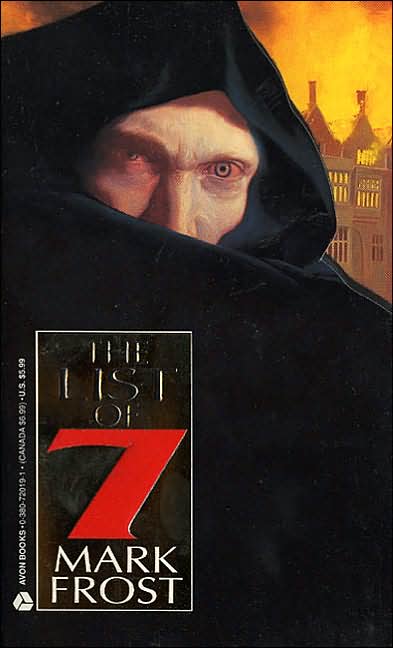
BOOK REVIEW: "The List of Seven"

Mark Frost; Publisher: Avon (September 1, 1993)
“The prospect that I’ve met my match in the exercise of observational deduction brings my competitive tendencies racing to the fore.”
“How will I know these are legitimate inferences and not facts you’ve gathered by some covert means [said Doyle]?”
“You won’t,” said Sparks, flashing his grin again.  “You were born in Edinburgh, Catholic parents of Irish descent and modest means.  You fished and hunted extensively in youth.  You were educated in Jesuit parochial schools.  Your lifelong passions have been literature and medicine.  You attended medical school at the University of Edinburgh, where you studied under an inspirational professor who encouraged you to develop your powers of observation and deduction beyond the scope of their diagnostic application.  Despite your medical training, you have never relinquished your dream of one day making your living exclusively as a man of letters.  Despite your indoctrination into the Church of Rome, you renounced your family’s faith after attending sĂ©ances and encountering experiences to difficult to reconcile with an adherence to any religious dogma.  You now consider yourself a confirmed, albeit open-minded, agnostic.  You are very handy with a revolver…” (94).
There is an interesting subgenre of Sherlockian pastiches that features not Sherlock Holmes, but his creator, Sir Arthur Conan Doyle, as the detective.  These books usually cast Doyle as a Watson figure alongside Dr. Joseph Bell (Doyle’s real-life mentor) or a comparable character’s Sherlock Holmes, with varying degrees of success.  One such book, David Pirie’s The Patient's Eyes: The Dark Beginnings of Sherlock Holmes, has been largely well received, while Howard Engel’s Mr. Doyle & Dr. Bell: A Victorian Mystery, has not.  Frankly, I only recommend the latter if you feel up to stomaching a lukewarm mystery and 212 pages of Sherlockian puns.
You cannot, however, read The List of Seven by Mark Frost without knowing immediately that it is a different breed of Sherlockian novel; this is not entirely surprising, considering that Frost was also one of the scriptwriters for Twin Peaksan entirely different breed of television show.  Frost’s screenwriting talents are apparent in the book’s narration.  There is a unique cinematographic quality in the way Frost sets a scene and the way he narrates a conflict.  His settings are vivid, his dialogue is crisp and fluid, and his characters are alive.  
Frost presents another pastiche where Doyle is solving crime, but this one is different. Doyle is not playing a carbon copy of his famous doctor, and Dr. Bell is nowhere in sight.  Doyle plays opposite Jack Sparks, a charming, athletic, ascetic Special Agent for the Crown, who on first glance seems to be the obvious template for the character-who-will-be-Sherlock-Holmes, but it’s not that simple.  Jack Sparks is no Sherlock Holmes, and Doyle is no Dr. Watson. Although every character in Frost’s novel seems to prefigure some character to come (you may occasionally find yourself muttering, “I see what you did there, Mr. Frost!”), you would do yourself a disservice by trying to force them into predetermined molds.  You would miss the qualities that make each character unique and enjoyable in his own right.
Doyle meets Jack Sparks for the first time on Christmas Day,1884.  His presence has been requested at a sĂ©ance “as a man of God and science” (3).  Outside the building, before the sĂ©ance, Doyle quickly and efficiently sizes up the situation and each of its participants (in “Sherlockian” fashion), and we get our first glimpse of the man that Frost imagines Doyle to be.  Inside the building, during the sĂ©ance, events take a horrible, tragic turn, and Sparks bursts onto the page for the first time (although he initially introduces himself as Armond Sacker).  His manner is less reminiscent of Sherlock Holmes than it is of Robin Hood and Zorro, with some James Bond thrown in for good measure—turning over tables, crashing through doors, and leaping onto moving carriages.
Sparks is more special agent than detective, and Doyle is more detective than doctor, but the one thing that they have in common is that they are matched mentally, able to deduce: “[b]y a man’s finger-nails, by his coat-sleeve, by his boots, by his trouser-knees, by the callosities of his forefinger and thumb, by his expression, by his shirt-cuffs—by each of these things a man’s calling is plainly revealed.” (STUD).  And they need all their abilities, because the mystery in which they have found themselves mired is more than a bit complex…it is equal parts supernatural adventure, political conspiracy, and historical thriller, with a little bit of family drama thrown in for extra spice.  And you never once find yourself wondering if Sherlock Holmes could have done it better.
There are similarities here to the characters and tales that Arthur Conan Doyle will eventually pen, and there is no use denying it.  There are Larry and Barry, the identical twins, once criminals, but now fiercely loyal to Sparks and his work.  There’s a bit of the Irregulars in their rough, streetwise ways.  And there is also Eileen Temple, a beautiful actress with the Manchester Players—that’s certainly the shadow of Irene Adler behind her.  Sparks even has his own version of The Index (which he refers to as "The Brain"), that contains index cards with biographical information on every known criminal (but is written in an obscure code of Sparks’s own devising).
And as for Jack Sparks himself, he plays the violin, smokes a pipe, and uses a magnifying glass.  He lives on Montague Street in a townhouse full of strange things (including a large “Baskervillian” hound named Zeus).  He uses cocaine.  And the entire plot of the novel hinges on Sparks’s archenemy, his brother, the malevolent Alexander Sparks (fans of the 2010 BBC adaptation are chuckling knowingly here), who is every bit as terrifying, vicious, manipulative, and scheming as Professor Moriarty, if not more so.  But none of these things suddenly turns Jack Sparks into Sherlock Holmes.   
Sparks tells Doyle, “I made a sweet, simple fool out of myself,” (156) as he describes his brother’s earliest machinations.  Sparks tells a long story, full of details about his childhood and family, his history and choices.  It is melancholy and heartbreaking.  Sparks is describing himself as a young boy, understandably unable to see through his much older brother’s designs, and it’s difficult to ever imagine Sherlock Holmes in the same position—describing himself as “a sweet, simple fool,” no matter what his age or the circumstances.  But that’s also the crux of the matter—Sherlock Holmes would never speak about himself.  Details about Holmes’s early life are few and far between, and seem practically wrenched from Holmes’s unwilling hands by Dr. Watson (GLOR, MUSG).  After 401 pages of The List of Seven, you walk away feeling as if you know Jack Sparks, at least a little bit.  On the other hand, after 56 short stories and four novels, you wonder if you can ever know Sherlock Holmes at all.  That’s the dividing line; that’s what prevents Jack Sparks from ever being Sherlock Holmes.  But that is a good thing, too, because he becomes his own character, rich and nuanced, and not a cardboard parody of another. 
Frost has written a sequel to The List of Seven, The Six Messiahs, which manages to be one of those rare books that is both a continuation of the original story and an entirely new tale in its own right.  Learn more about these works and the author at Frost’s website.
oOo
You have one more day to enter my contest!  Entries are accepted until 11:59 p.m. EST on March 26.  At that time, a random winner will be chosen.
Many thanks to Laura for her wonderful edits to this week’s blog post.  My usual editor is off gallivanting in the Vegas desert, and Laura very kindly volunteered to help me this week.  And she did a fantastic job (especially with a terrible comma-abuser like me)!

Friday, March 18, 2011

“The Meaning of This Extraordinary Performance” (COPP): Granada Television’s “The Devil’s Foot”

“To me, the Sherlock Holmes stories are about a great friendship.  Without Watson, Holmes might well have burnt out on cocaine long ago.  I hope the series shows how important friendship is” (Jeremy Brett).
Have you been paying attention?  I mean, specifically, to this blog?  I hope so, for a lot of reasons, but more relevantly, if you have been paying attention, you’ve probably figured out who my favorite Sherlock Holmes is.  A lot of talented, brilliant actors have taken on the mantle of the Great Detective over the years, so I try to remain unbiased when it comes to this blog.  Having a favorite does not make me blind to all others, of course.  However, as I looked back over my last few posts, I saw that my preference had managed to worm its way in anyway, subtly and stealthily, much to my chagrin.  Whoops.
Anyway, since my secret is out, “The Adventure of the Devil’s Foot” is a wonderfully atmospheric story in its original form, and Granada Television is, of course, famous for their nearly compulsively faithful adaptations of the Sherlock Holmes canon.  Cornwall is deliciously gothic and sinister as a setting, but it is one thing to read: “The glamour and mystery of the place, with its sinister atmosphere of forgotten nations, appealed to the imagination of my friend, and he spent much of his time in long walks and solitary meditations upon the moor,” and quite another to see Sherlock Holmes walking pensively and alone amongst the dismal landscape, sitting perched high atop ancient ruins, as his thoughts turn inward—looking pale, diminished, and one stiff breeze away from total collapse.
But if I wanted to speak solely on the subject of atmosphere and setting, I would be writing on DEVI, the original text, and not the television adaptation.  I think that the 1988 version of DEVI is worth discussing on its own merits, based upon the inclusion of three new plot points into the story: Sherlock Holmes’s (literal) abandonment of his cocaine habit on the beaches of Cornwall, the inclusion of Holmes’s nightmarish vision under the influence of Radix pedis diaboli, and, finally, the subsequent aftermath of the vision in which Holmes calls out to Dr. Watson by his first name.  These three additions change the whole tenor of the episode, and can be influential in interpreting the original tale, if you like.
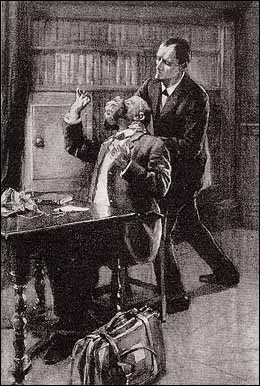
Beginning, of course, at the beginning: after what only seems like a few minutes after their arrival in Cornwall (but who can say, really, in television time), Watson enters the cottage to find Holmes at a table injecting himself with cocaine.  The Doctor says nothing, but his expression speaks volumes, and an exceedingly tense moment passes between the two men, before Watson leaves to tend to their luggage.  Not long after, during a scene in which Watson narrates his companion’s activities during the early days of their holiday, we see Holmes standing alone the beach, taking a deep breath before removing a vial of cocaine for his coat pocket.  He empties the vial onto the sand, and then buries the syringe (and modern medical professionals everywhere cringe…someone could step on that). 
Interestingly, Holmes doesn’t appear to inform Watson of his decisions or his actions, as later in the episode, as Holmes sits recoiling from the pain of withdrawal, Watson seems concerned for his friend, but mostly confused—as if he does not know what to make of this new, odd behavior.  Furthermore, after the spasm passes, Holmes smiles benignly: “Cheer up, Watson.  Sea air, sunshine, patience!” and then, “All will be revealed!”  On the surface, he’s speaking of the case, of course, but his attitude is reminiscent of one presenting a well-thought-out gift to a loved one, and Holmes will absolutely not let the surprise be spoiled until it’s ready.  It’s typical of Sherlock Holmes to attempt something potentially life-threatening or dangerous on his own because he wants to, or because he can, but in this instance he seems to act because he must.
Moving on (and more on the subject of Holmes and his danger-for-danger’s-sake habit): in the original text of DEVI, because of the limited perspective of the narrator, the reader is only given access to Watson’s thoughts as the poison smoke of the devil’s foot root overtakes them.  It is an ugly picture:
“A thick, black cloud swirled before my eyes, and my mind told me that in this cloud, unseen as yet, but about to spring out upon my appalled senses, lurked all that was vaguely horrible, all that was monstrous and inconceivably wicked in the universe. Vague shapes swirled and swam amid the dark cloud-bank, each a menace and a warning of something coming, the advent of some unspeakable dweller upon the threshold, whose very shadow would blast my soul.”
But in this televised version, we see Holmes’s vision, and it is nightmarish, gruesome.  There is endless running, across endless fields, and the ghost of a child in a mirror.  There is blood, and churning water, and ghastly, religious-themed images.  And behind it all, is the specter of Professor Moriarty saying, “You must stand clear, Mr. Holmes, or be trodden under foot” (FINA).  So, we walk away from this scene knowing that Holmes is a haunted man, not immune to fear, as we may have thought (or want to believe, your choice).  The original text leaves the reader blind to what happens to Holmes during the ordeal (though Watson describes his friend as looking “drawn with horror”), and even though Holmes says, “It was an unjustifiable experiment even for one’s self, and doubly so for a friend,” there is no way to know for certain what he went through.  Fear being a relative thing, of course.  A televised version, and this particular one, lends depth to the ordeal, and the viewer sees another instance where, perhaps, Holmes acted because he must, and not because he wanted to—because Holmes’s personal sense of amusement might be twisted, but there are limits.
Finally, Holmes awakes from his vision, screaming, insensible, on the ground outside the cottage, with Watson shaking him and calling his name.  After what seems like a full minute of hysterics, Holmes finally comes to his senses enough to call out to his friend…by his first name.  “John!” he screams.  It is a startling moment, one that Jeremy Brett commented on:
“Well, Holmes is semiconscious at the time, right?  It really was the one time that he could call him John.  I think in extremis he might have said ‘John.’ It gives another slant to it.  I slipped in ‘John’ just to show that, underneath it all, there was just something more than what they say, that Holmes is all mind and no heart.”
It goes back, I think, to who Sherlock Holmes becomes when his layers are stripped away.  There are many interpretations, and they’re all subjective, of course—since this is something we never really see in the canon (just as he never refers to Watson by his first name).  But in a moment of semi-conscious horror, there are going to be very few layers, very little armor.  And there again, we see the things that Holmes must do, and not what he can, or wants to do.
Sometimes readers get caught up in seeing Sherlock Holmes as a man that is driven by proving himself, and demonstrating what he can do to everyone around him; that his every action had a pointed, defensive edge to it, an almost passive-aggressive streak, in which he is determined to show himself capable, and worthy.  Televised adaptations, and particularly clever ones like the 1988 version of “The Devil’s Foot,” serve as excellent reminders that despite what Holmes may have believed or thought of himself, he was still human, with compulsions that prevented him from being entirely separated from the human experience.  He was still one of us, if he only walked amongst us briefly.
oOo
One more week to enter my blog contest!  It’s so easy to enter, and the prizes are very cool—a little light reading, a little music.  Sounds like my perfect Sunday afternoon.

Monday, March 14, 2011

Currently on Twitter...

Recently on my Twitter feed, I finished parceling out "The Adventure of the Six Napoleons," in 140 character installments.  A story story becomes awfully long that way, I won't lie, but it turned out to be a surprisingly fun project.  So I'm doing it again.

Currently, I am "tweeting" "The Adventure of the Dying Detective" for those of you interested in seeing Sherlock Holmes during what might be one of his most devious moments.

Check out my Twitter feed for a daily installment, though I can sometimes be inspired to post more than once a day.  And don't forget that you can read through the original canon stories online

oOo

Less than two weeks left to enter my contest.  There's some excellent reading material, and a little bit of music up for grabs (all related to Sherlock Holmes, of course).